
Pharmacoepidemiology is defined as the study of the

- Slides: 54
Pharmacoepidemiology is defined as the study of the use and the effects of drugs in large groups of people. It can be viewed as an epidemiological discipline with particular focus on drugs. JAMASOFT 2017 1
The scandinavians pioneered the developement of methods to study drug utilisation. JAMASOFT 2017 2
More than 100, 000 pharmaceutical packages are licensed in European countries and tons of medicines are daily used with a yearly expenditure wider than 100 billion euro. JAMASOFT 2017 3
This very large amount of medicines is a challenge to public health for several reasons: JAMASOFT 2017 4
Medicines can positively influence public health by their intended therapeutic effect. Medicines can adversely affect public health because of medicine related problems; medicines related problems are an important cause of mortality and most of them can be prevented. There is an important economic burden of medicines on healthcare systems. Medicines are able, via the wastewater, to pollute the environment, including drinking water. Several medicines have endocrine-disrupters or carcinogenic properties. There are wide discrepancies between European countries in licensed medicines and in their price, utilisation and expenditure. JAMASOFT 2017 5
Because of these challenges of medicines on public health there is a need JAMASOFT 2017 6
to increase awareness and spread knowledge on the impact of medicine utilisation on public health to promote European harmonised data collection about licensed medicines, their prices, utilisation and expenditure, to develop indicators for monitoring price, utilisation and expenditure of medicines at a European level to promote benchmarking exercise on utilisation of medicines at national and regional level to assess the outcome of medicine utilisation, linking pharmacoepidemiological data to morbidity-mortality data to develop a public health-oriented European database JAMASOFT 2017 of the licensed medicines with relevant information 7 about their best use
For all these purposes it is essential to have an internationally valid classification system of medicines and a measurement system of their utilisation. JAMASOFT 2017 8
Since 1981, the WHO Regional Office for Europe has recommended the ATC (Anatomical Therapeutic Chemical) classification system and the DDD (Defined Daily Dose) as the standard for medicine classification and drug utilisation studies, respectively. JAMASOFT 2017 9
Since 1996 the ATC/DDD methodology has been adopted and proposed by the WHO Headquarters for global use. JAMASOFT 2017 10
Minimal Data Set for National Register of Medicinal Products with Validated ATC Codes and DDD Values JAMASOFT 2017 11
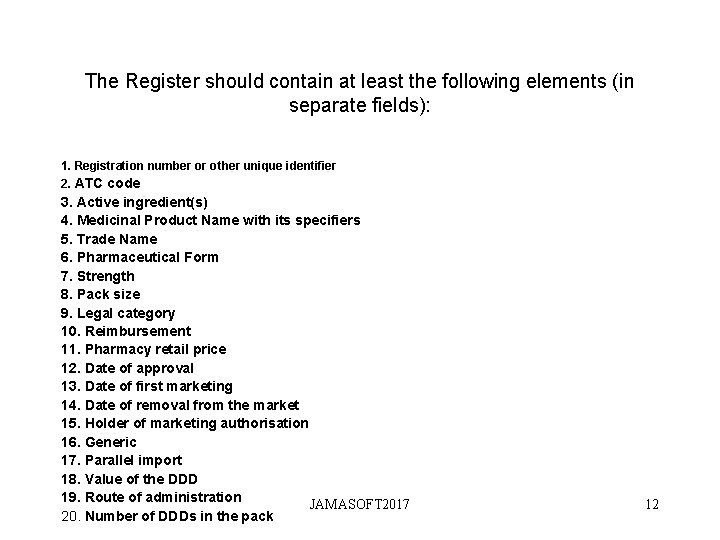
The Register should contain at least the following elements (in separate fields): 1. Registration number or other unique identifier 2. ATC code 3. Active ingredient(s) 4. Medicinal Product Name with its specifiers 5. Trade Name 6. Pharmaceutical Form 7. Strength 8. Pack size 9. Legal category 10. Reimbursement 11. Pharmacy retail price 12. Date of approval 13. Date of first marketing 14. Date of removal from the market 15. Holder of marketing authorisation 16. Generic 17. Parallel import 18. Value of the DDD 19. Route of administration JAMASOFT 2017 20. Number of DDDs in the pack 12
Registration (Marketing authorisation) number or other unique identifier JAMASOFT 2017 13
Allowed format: letter, number or alphanumeric code [text]. Length: >6 Definition. The registration number can be defined as a code representing the market authorisation act within a given marketing authorisation territory. No definition of registration number is given in the rules governing medicinal products for human use in the European Union. A code must be used once and it cannot be repeated in the file. If a pack is withdrawn from the market the number cannot be used for a new licensed product. It can be an advantage when more national registers use the same number [i. e. the Nordic number] for the same package. JAMASOFT 2017 14
ATC code Allowed format: alphanumeric code [text]. Length: max 7 characters Definition. See separate description in paragraph 6 - ATC and DDD linkage process. Examples: C 09 AA 01; C 03 AA 01; B 01 AC 06 JAMASOFT 2017 15
Active ingredient 1 • • Allowed format: text Definition. Ingredient that alone or in combination with one or more other ingredients is considered to fulfil the intended activity of a medicinal product. Nomenclature. International non-proprietary names (INN) should be used. If INN names are not assigned, USAN (United States Adopted Name) or BAN (British Approved Name) names should be used. If the product contains more than one active ingredient it is recommended that the description stops to the first three ingredients. In this case the names of the active ingredients should be given in the same order of the “ATC INDEX with DDD” JAMASOFT 2017 16
Active ingredient 2 For a second active ingredient in the case the medicinal products contains more than one active ingredient JAMASOFT 2017 17
Active ingredient 3 For a third active ingredient in the case the medicinal products contains more than one active ingredient JAMASOFT 2017 18
Further active ingredients Allowed format: yes/no If the package contains more than the three active ingredients given in the fields above, this should be indicated in this field, without further description of these additional active ingredients JAMASOFT 2017 19
Medicinal Product Name with its specifiers Allowed format: Text Definition. Medicinal Product Name Specifiers are the additional elements added to the medicinal product name in order to distinguish medicinal products with the same medicinal product name. The additional elements can be based on: • the galenic properties (enteric coated, slow release, CR) • a strength related property (by means of an imprecise term (Forte, Mitis) or by means of an indication related to the amount of active ingredient (Transderm Nitro 5, Humelin 60/40) • an intended user group (paediatric, geriatric) • the ingredients, mainly the reference active ingredient (Rubella live vaccine) • the physical nature of the product • the route of administration (Oral gel; Oral Tablets; Intravenous solution) • the pack size (28 tablets; These elements should be treated as an integral part of the medicinal product name for identification purposes. Directive 92/27 EEC indicates specifiers to add to the medicinal product name e. g. strength and pharmaceutical form Examples: Capoten tablet 50 mg 28 -tab pack JAMASOFT 2017 20 Lasix injectable solution 10 mg/m. L ampoule 2 m. L Canesten cream 1% tube 50 g
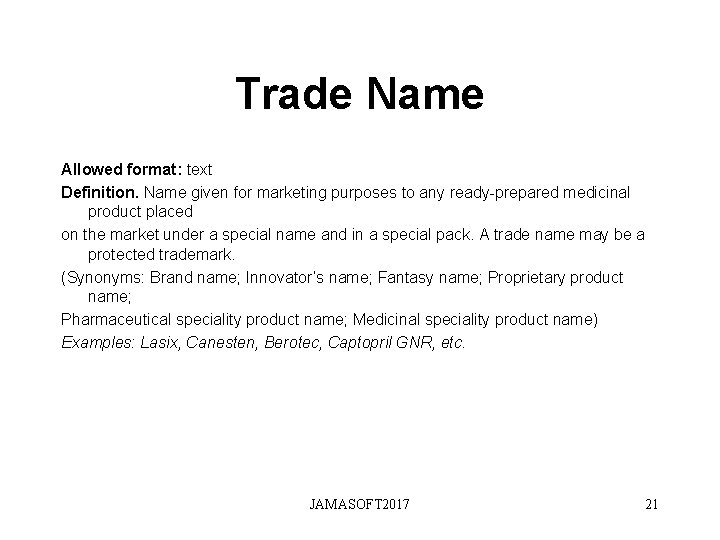
Trade Name Allowed format: text Definition. Name given for marketing purposes to any ready-prepared medicinal product placed on the market under a special name and in a special pack. A trade name may be a protected trademark. (Synonyms: Brand name; Innovator’s name; Fantasy name; Proprietary product name; Pharmaceutical speciality product name; Medicinal speciality product name) Examples: Lasix, Canesten, Berotec, Captopril GNR, etc. JAMASOFT 2017 21
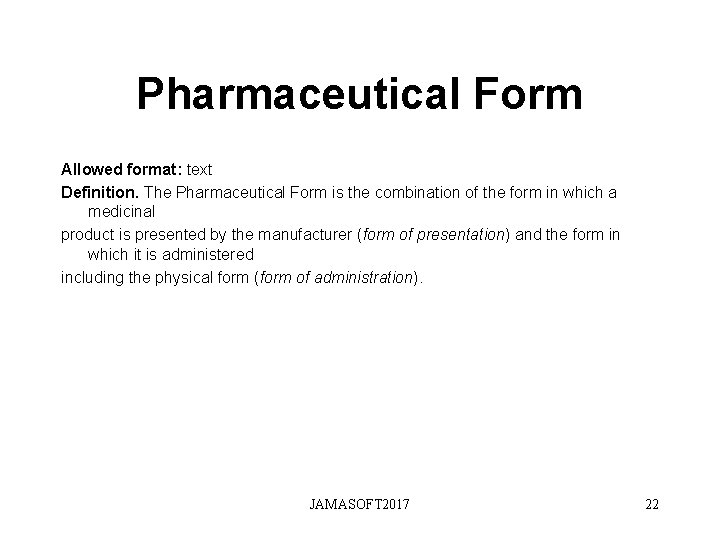
Pharmaceutical Form Allowed format: text Definition. The Pharmaceutical Form is the combination of the form in which a medicinal product is presented by the manufacturer (form of presentation) and the form in which it is administered including the physical form (form of administration). JAMASOFT 2017 22
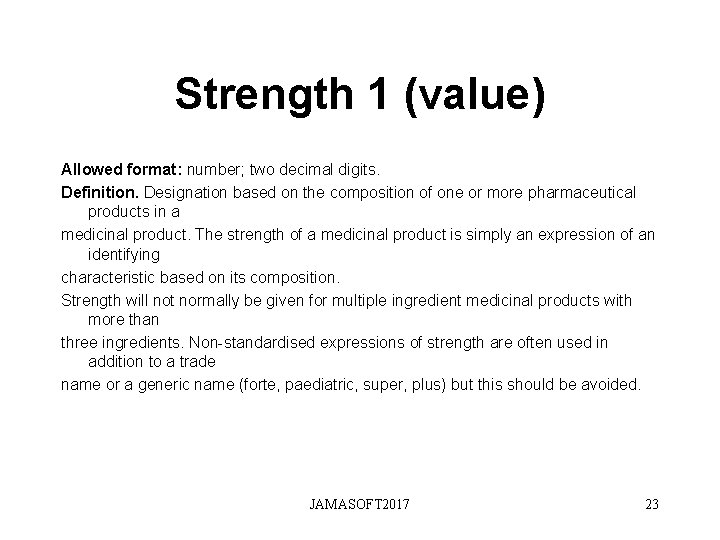
Strength 1 (value) Allowed format: number; two decimal digits. Definition. Designation based on the composition of one or more pharmaceutical products in a medicinal product. The strength of a medicinal product is simply an expression of an identifying characteristic based on its composition. Strength will not normally be given for multiple ingredient medicinal products with more than three ingredients. Non-standardised expressions of strength are often used in addition to a trade name or a generic name (forte, paediatric, super, plus) but this should be avoided. JAMASOFT 2017 23
The ATC and DDD methodology is now a widely accepted consensus on how to categorise drugs and compare sales of drugs of different potency. JAMASOFT 2017 24
The background of pharmacoepidemiology is the increasing understanding that the information gathered in pre-marketing studies does not adequately describe the true health impact of a drug There are two reasons: JAMASOFT 2017 25
First pre-marketing trials are usually conducted in highly selected populations free of concurrent ailments or drug use, and who very poorly represent the drug users after marketing. JAMASOFT 2017 26
Secondly most drugs have important side effects that are not known at the time of marketing, either because they are too rare to be noticed in the small premarketing trials, or they are confused with unrelated, randomly occurring adverse events. JAMASOFT 2017 27
Scandinavians pioneered the development of models to study drug use in populations, mainly through the work of the Drug Utilization Research Group (DURG) under the auspices of WHO. Two inventions were crucial for this accomplishment: JAMASOFT 2017 28
The first is a hierarchical system to classify drugs, the Anatomical-Therapeutic. Chemical (ATC) code. JAMASOFT 2017 29
The other important development for the study of drug use in populations is the defined daily dose (DDD). JAMASOFT 2017 30
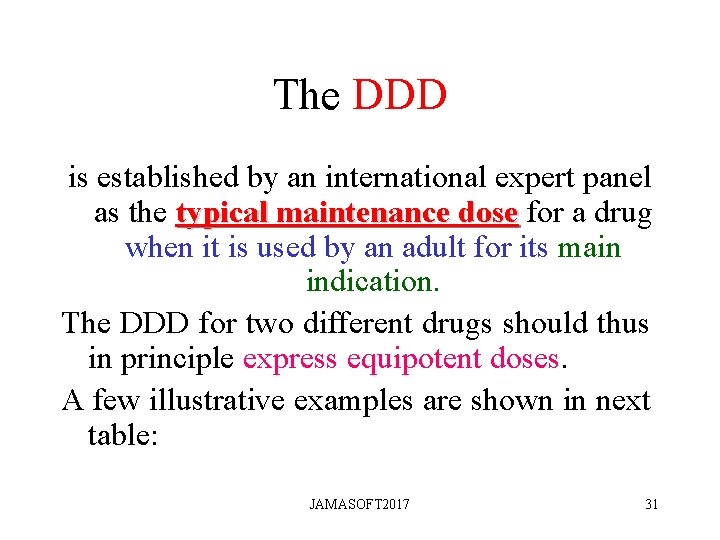
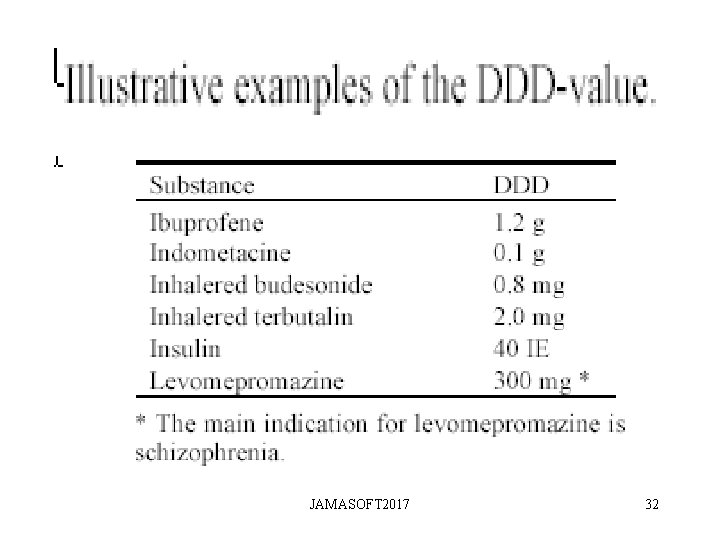
The DDD is established by an international expert panel as the typical maintenance dose for a drug when it is used by an adult for its main indication. The DDD for two different drugs should thus in principle express equipotent doses. A few illustrative examples are shown in next table: JAMASOFT 2017 31
JAMASOFT 2017 32
The DDD should not be interpreted as a dose recommendation, but rather as a technical unit of measurement that allows us to collapse data on drugs with differing potency. JAMASOFT 2017 33
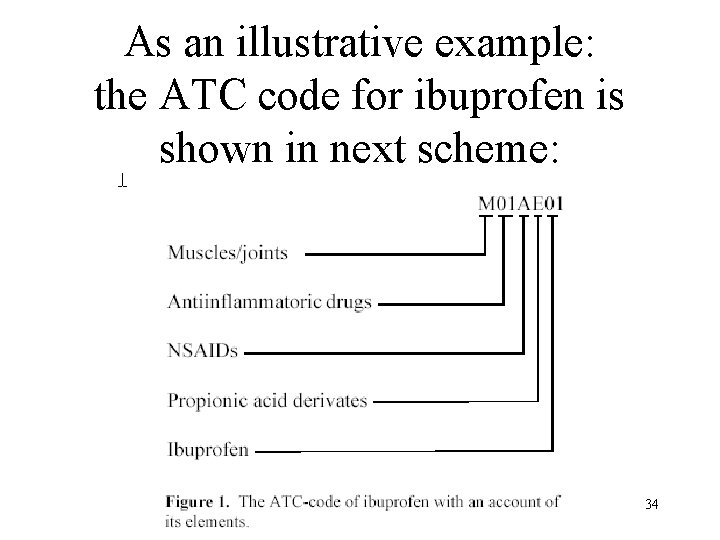
As an illustrative example: the ATC code for ibuprofen is shown in next scheme: JAMASOFT 2017 34
ATC code has 5 levels and 7 digits. The first level, the M, indicates that the drug belongs to the class of drugs with action on the muskulosceletal system. The next level, indicated by 01, specifies it further as belonging to the group of antiinflammatory drugs, the next level A as an NSAID (non-steroidal anti-inflammatory drugs) etc. JAMASOFT 2017 35
This classification provides a consensus about how to collapse drugs with similar properties. By referring to, e. g. , NSAIDs as any drug with an ATC-code of M 01 A in the first four digits, a researcher can avoid endless explanations of what particular drugs are the focus of a study of NSAID use. JAMASOFT 2017 36
The ATC - System is not the only possible way to classify drugs, but it provides a well-elaborated, well -accepted, reasonable consensus. JAMASOFT 2017 37
One recent example of the latter: is the propensity of SSRIs (Selective serotonin reuptake inhibitors (SSRIs) are antidepressants) to cause ulcer bleeding. These limitations warrant the continuous postmarketing surveillance of drug dispersion in society and of drug effects, the two core elements in the definition of pharmacoepidemiology. JAMASOFT 2017 38
Both, the ATC system and the DDDs are reviewed once annually by the WHO Collaborating Centre for Drug Statistics Methodology in Oslo, to adjust for new developments in the clinical use of the drugs. JAMASOFT 2017 39
DRUGS AS CAUSES OF DISEASE As in most other disciplines of epidemiology, we deal with multiple causes of disease. It is almost an axiom that there are no disease entities where drug exposure is both a necessary and sufficient cause. There may be observed that a patient developed some unexpected adverse event after starting a drug, but he can never conclude with certainty that the drug caused the event. JAMASOFT 2017 40
This possibility of confusing adverse drug reactions with other adverse events entails two categories of problems: 1. a delay in the recognition of true adverse drug reactions, 2. or perceiving something as adverse drug reactions when in fact it is not. JAMASOFT 2017 41
There are many examples of the former. E. g. , aspirin was marketed in 1898. Gastroduodenal lesion ascribed to aspirin was not described before 1939. Not before the early 1970 s, more than 70 years after marketing, could it be viewed as well documented that these lesions exist. Phenacetin was marketed in late 1890 s, but its liability to cause renal failure was not reported before 1955. JAMASOFT 2017 42
The other category of problems, perceiving something as adverse drug reactions when in fact it is not, is seen when old doctrines, e. g. , the depressiogenic effect of betablockers, is subjected to formal testing and found to be not substantiated. JAMASOFT 2017 43
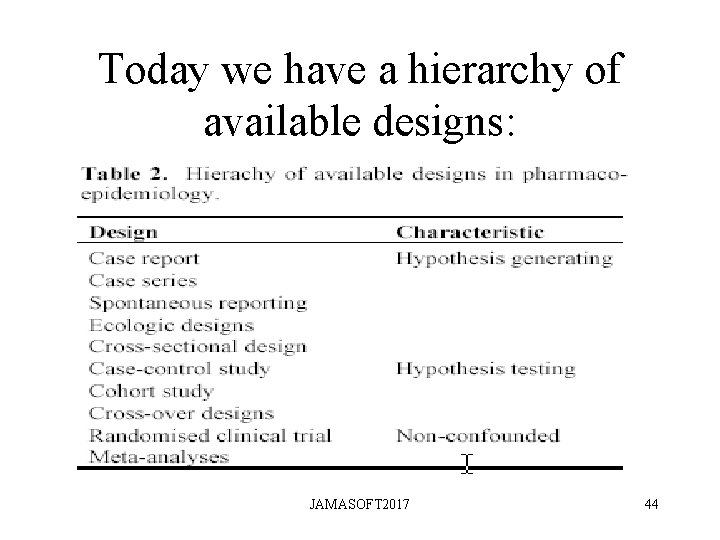
Today we have a hierarchy of available designs: JAMASOFT 2017 44
PHARMACOEPIDEMIOLOGIC DATABASES One of the main methodological developments in pharmacoepidemiology has been the emergence of large databases with more or less complete capture of individual drug use and clinical outcomes for large populations. JAMASOFT 2017 45
PHARMACOEPIDEMIOLOGIC DATABASE It makes it possible to gather detailed systematic information on large groups of drug users and to link it to information concerning suspected adverse outcomes in individual users JAMASOFT 2017 46
The advantages of using pharmacoepidemiologic databases are: 1. Data are free of recall or interviewer bias. A statistical sampling or testing error caused by systematically favoring some outcomes over others. ) 2. Data are already recorded when the controversy arises. 3. Costs are usually low. JAMASOFT 2017 47
The most important limitations of pharmacepidemiologic databases are: 1. They are not suitable for the study of drug effects where the timing of drug intake is critical, i. e. , short-term hyperacute effects. 2. It may be uncertain whether the patient has actually ingested the drug. 3. Cases where the endpoint is poorly described by the coding system. 4. They do not cover medication bought over the counter. JAMASOFT 2017 48
CONCLUSIONS Pharmacoepidemiology is the study of the use of and the effects of drugs in large groups of people. There are worldwide a number of databases with comprehensive registration of drug use and outcomes for entire populations. JAMASOFT 2017 49
CONCLUSIONS • Pharmacoepidemiology allows to make comparisons between countries and regions (drug utilisation studies). JAMASOFT 2017 50
CONCLUSIONS Another important aspect of pharmacoepidemiology is the safety of drugs and the study of adverse reactions to drug treatment. JAMASOFT 2017 51
Pharmacoepidemiology • conducted before marketing approval can improve safety monitoring by organising data resources. • conducted after marketing approval of a drug can supplement information from premarketing studies. JAMASOFT 2017 52
In pharmacoepidemiology during the last decade, more and more interest has focused on patient-reported outcomes such as health-related quality od life. At the same time pharmacoepidemiology is increasingly being regarded as an important tool in pharmacoeconomics. JAMASOFT 2017 53
Thanks for your attention. JAMASOFT 2017 54