
Pharmaceutical Waste Management Presented by Nathan Funk MHA
Pharmaceutical Waste Management Presented by: Nathan Funk, MHA, BS Environmental Health & Safety Officer Wake. Med Health & Hospitals 3000 New Bern Avenue Raleigh, NC 27610 (919) 350 -8375 Office Wake. Med. org
Objectives What is Hazardous Waste What is Pharmaceutical Waste Disposal Options Regulatory Enforcement Pharmaceutical Waste Collection Models Hazardous Waste Generator Status Proposed Management Standards for Hazardous Waste Pharmaceuticals Rule • Other Program Decisions • Training • Additional Hazardous Waste Streams • •
Resource Conservation & Recovery Act (RCRA) • Enacted in 1976, enforced by the EPA • Federal regulation of the disposal of solid wastes • Defines “hazardous waste” • Encourages the minimization of waste generation
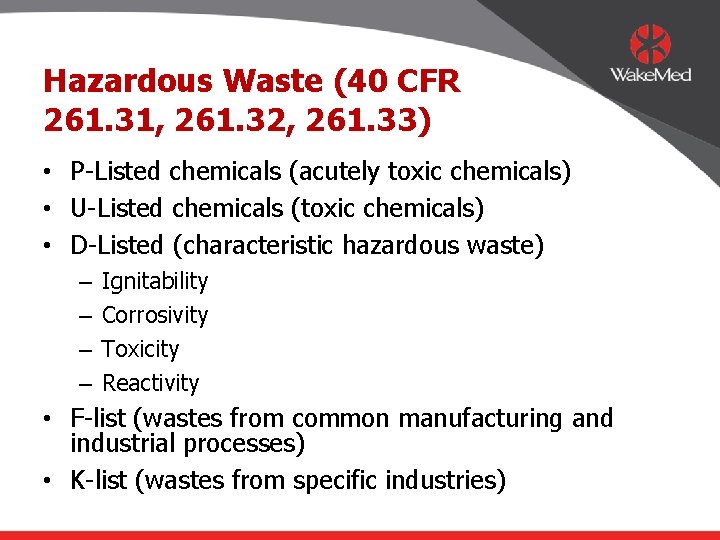
Hazardous Waste (40 CFR 261. 31, 261. 32, 261. 33) • P-Listed chemicals (acutely toxic chemicals) • U-Listed chemicals (toxic chemicals) • D-Listed (characteristic hazardous waste) – – Ignitability Corrosivity Toxicity Reactivity • F-list (wastes from common manufacturing and industrial processes) • K-list (wastes from specific industries)
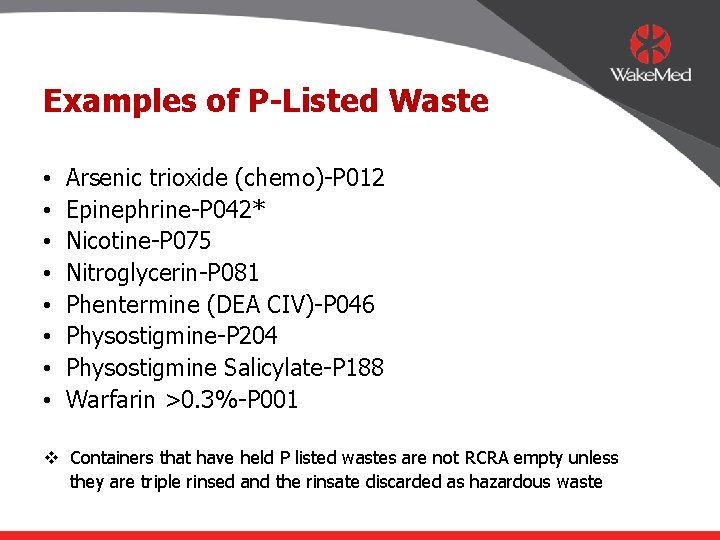
Examples of P-Listed Waste • • Arsenic trioxide (chemo)-P 012 Epinephrine-P 042* Nicotine-P 075 Nitroglycerin-P 081 Phentermine (DEA CIV)-P 046 Physostigmine-P 204 Physostigmine Salicylate-P 188 Warfarin >0. 3%-P 001 v Containers that have held P listed wastes are not RCRA empty unless they are triple rinsed and the rinsate discarded as hazardous waste
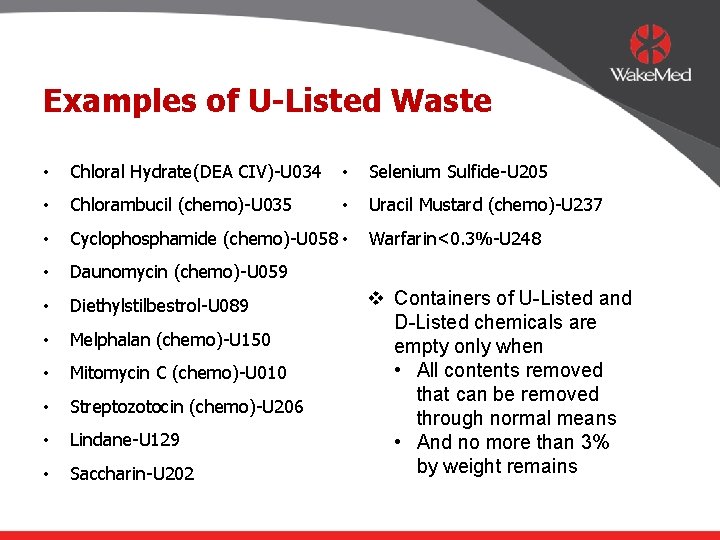
Examples of U-Listed Waste • Chloral Hydrate(DEA CIV)-U 034 • Selenium Sulfide-U 205 • Chlorambucil (chemo)-U 035 • Uracil Mustard (chemo)-U 237 • Cyclophosphamide (chemo)-U 058 • • Daunomycin (chemo)-U 059 • Diethylstilbestrol-U 089 • Melphalan (chemo)-U 150 • Mitomycin C (chemo)-U 010 • Streptozotocin (chemo)-U 206 • Lindane-U 129 • Saccharin-U 202 Warfarin<0. 3%-U 248 v Containers of U-Listed and D-Listed chemicals are empty only when • All contents removed that can be removed through normal means • And no more than 3% by weight remains
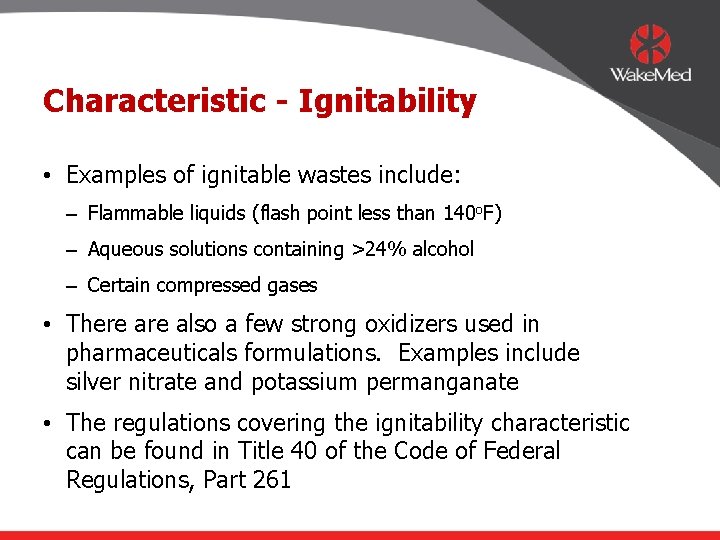
Characteristic - Ignitability • Examples of ignitable wastes include: – Flammable liquids (flash point less than 140 o. F) – Aqueous solutions containing >24% alcohol – Certain compressed gases • There also a few strong oxidizers used in pharmaceuticals formulations. Examples include silver nitrate and potassium permanganate • The regulations covering the ignitability characteristic can be found in Title 40 of the Code of Federal Regulations, Part 261
Characteristic - Corrosivity • This RCRA category refers to acids (p. H less than 2) and bases (p. H greater than 12. 5) that are capable of corroding metal containers, such as storage tanks, drums, and barrels • Examples: Primarily compounding chemicals – Glacial Acetic Acid – Sodium Hydroxide • The regulations covering the corrosivity characteristic can be found in Title 40 of the Code of Federal Regulations, Part 261, Section 22
Characteristic - Toxicity • Toxic wastes are harmful or fatal when ingested or absorbed • Approximately 40 chemicals which meet specific leaching concentrations • The regulations covering the toxicity characteristic can be found in Title 40 of the Code of Federal Regulations, Part 261, Section 24 • • • Arsenic Barium Cadmium Chloroform Chromium Lindane • m-Cresol • Mercury (thimerosal) • Phenylmercuric acetate • Selenium • Silver
Characteristic - Reactivity • Reactive wastes are unstable under "normal" conditions • They can cause explosions, toxic fumes, gases, or vapors when heated, compressed, or mixed with water • Examples include – lithium-sulfur batteries – explosives • The regulations covering the reactivity characteristic can be found in Title 40 of the Code of Federal Regulations, Part 261, Section 23
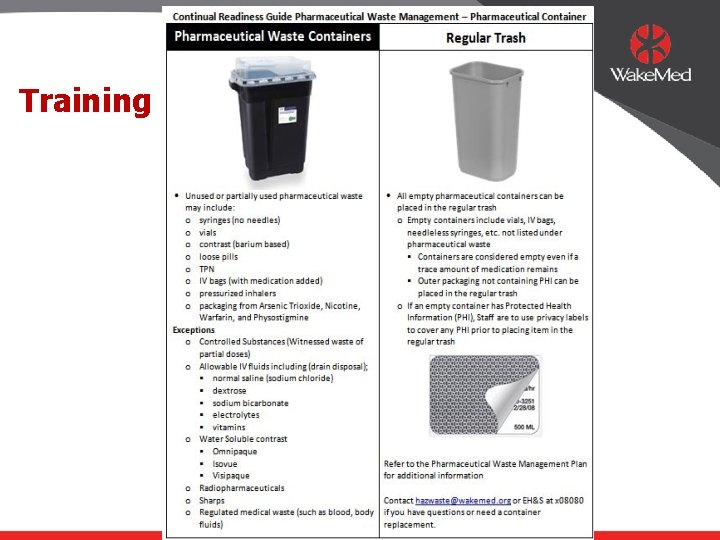
What Is Pharmaceutical Waste? • Any Partially Used or Unused Medication Including: - Syringes - Vials, Bottles - IV Bags and Tubing With Medicine Additives - Loose Pills, Tablets, Capsules - Aerosol Inhalers - Creams, Ointments, Shampoos - Patient Prep-Alcohol and Iodine • Empty Vials/Containers That Held P-Listed Drugs - Nicotine, Warfarin, etc.
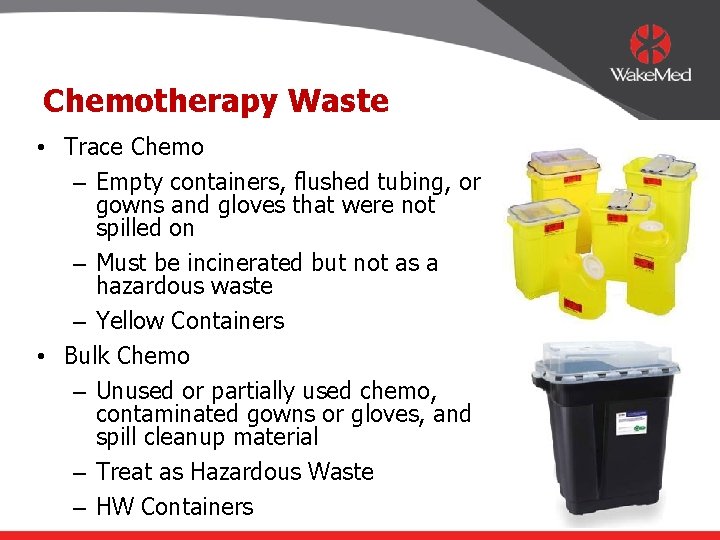
Chemotherapy Waste • Trace Chemo – Empty containers, flushed tubing, or gowns and gloves that were not spilled on – Must be incinerated but not as a hazardous waste – Yellow Containers • Bulk Chemo – Unused or partially used chemo, contaminated gowns or gloves, and spill cleanup material – Treat as Hazardous Waste – HW Containers
Why Manage Pharmaceutical Waste? • Federal Regulations – Resource Conservation & Recovery Act (RCRA) – Comprehensive Environmental Response, Compensation & Liability Act (CERCLA – a. k. a. “Superfund”) • State Regulations (NC) – Mirror Federal Rules & Regulations – Recent Increased Enforcement
Why Manage Pharmaceutical Waste? • U. S. Geological Survey – Measured concentrations of 95 Organic Wastewater Contaminants in water samples from 139 streams in 30 states • Organic Wastewater Contaminants were found in 80% of the streams sampled – Pharmaceuticals and Other Chemicals Common in Landfill Waste • Study of 19 landfills across the United States found 129 of 202 pharmaceutical (prescription and nonprescription), household, and industrial chemicals in untreated leachate samples (prior to treatment and environmental release)
Waste Disposal Options • Municipal Solid Waste Landfill – May be permitted to accept non-hazardous drug waste • Regulated Medical Waste (RMW) Vendor – Infectious waste, sharps – Can accept TRACE chemotherapy waste – May be permitted to accept non-hazardous drug waste • Hazardous Waste Incinerator – Permitted to handle RCRA hazardous waste – Most are NOT permitted to handle RMW – Can accept bulk chemotherapy waste
Regulatory Enforcement: The Joint Commission • Adding healthcare engineers to survey teams • Beginning to ask questions about waste disposal • JC surveyors trained on pharmaceutical waste issues on January 3 rd, 2005
Regulatory Enforcement: The Joint Commission • EC. 01. 01 – EP 5 The hospital has a written plan for managing the following: Hazardous materials and waste. • EC. 02. 01 The hospital manages risks related to hazardous materials and waste. – EP 1 The organization creates and maintains an inventory that identifies hazardous materials and waste used, stored, or generated using criteria consistent with applicable law and regulation (for example, the Environmental Protection Agency [EPA] and the Occupational Safety and Health Administration [OSHA]).
NC Department of Environmental Quality • NC DEQ – Division of Waste Management, Hazardous Waste Program – Protect public health and the environment by assuring that solid and hazardous wastes and underground storage tanks are managed properly, and that existing contamination is cleaned up
US Environmental Protection Agency Enforcement • Maximum penalty can be $37 K per day per instance – Instance is individual incorrect disposal per container per unit per facility • Facility’s monetary benefit for noncompliance is factored into the penalty
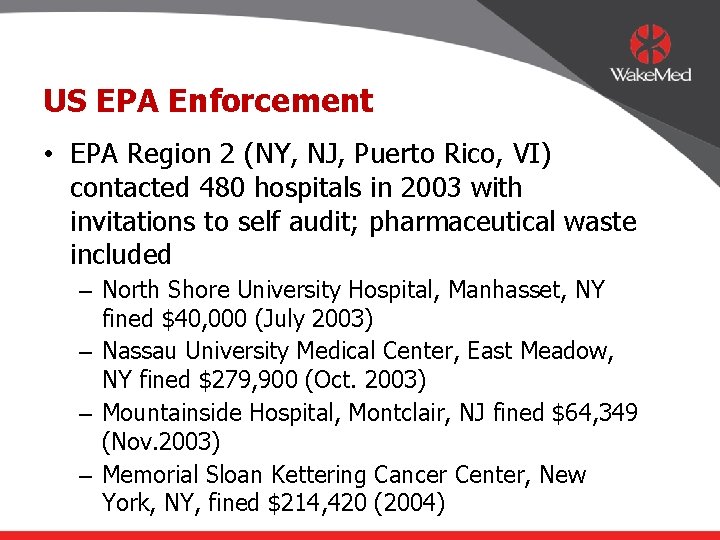
US EPA Enforcement • EPA Region 2 (NY, NJ, Puerto Rico, VI) contacted 480 hospitals in 2003 with invitations to self audit; pharmaceutical waste included – North Shore University Hospital, Manhasset, NY fined $40, 000 (July 2003) – Nassau University Medical Center, East Meadow, NY fined $279, 900 (Oct. 2003) – Mountainside Hospital, Montclair, NJ fined $64, 349 (Nov. 2003) – Memorial Sloan Kettering Cancer Center, New York, NY, fined $214, 420 (2004)
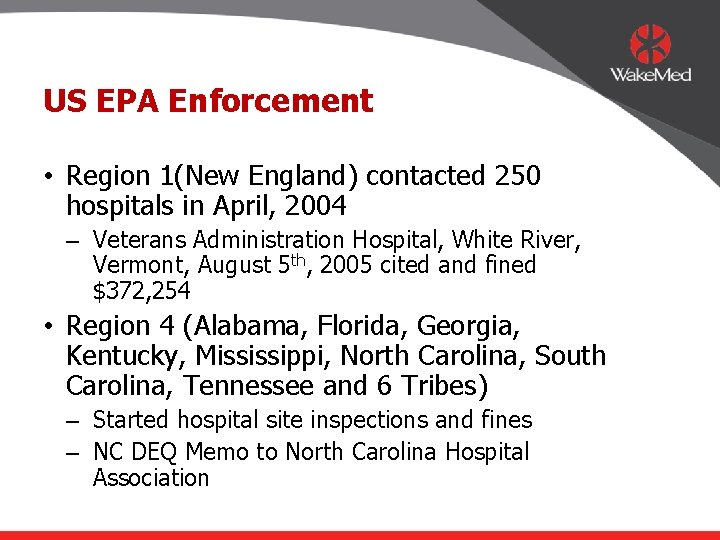
US EPA Enforcement • Region 1(New England) contacted 250 hospitals in April, 2004 – Veterans Administration Hospital, White River, Vermont, August 5 th, 2005 cited and fined $372, 254 • Region 4 (Alabama, Florida, Georgia, Kentucky, Mississippi, North Carolina, South Carolina, Tennessee and 6 Tribes) – Started hospital site inspections and fines – NC DEQ Memo to North Carolina Hospital Association
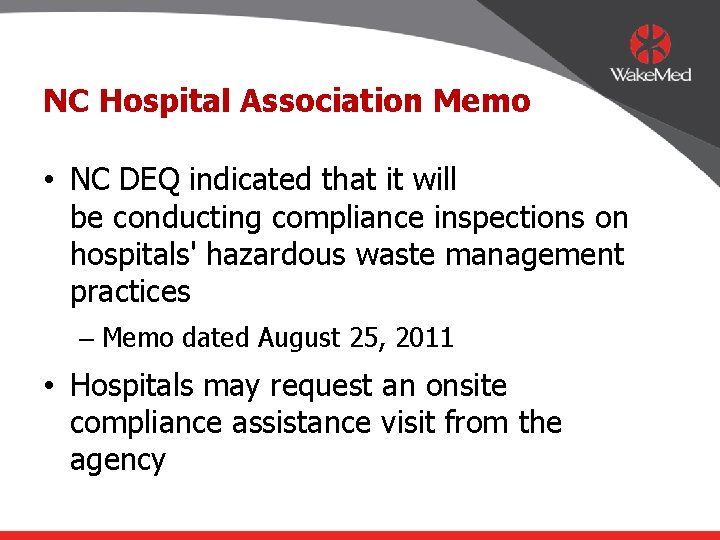
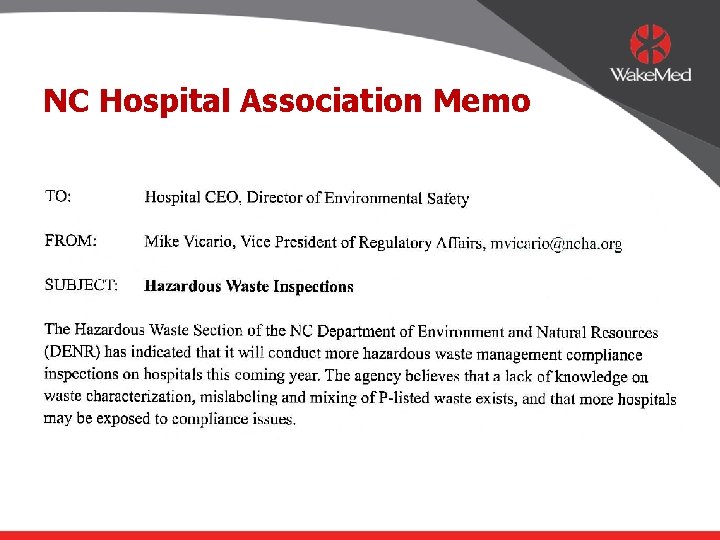
NC Hospital Association Memo • NC DEQ indicated that it will be conducting compliance inspections on hospitals' hazardous waste management practices – Memo dated August 25, 2011 • Hospitals may request an onsite compliance assistance visit from the agency
NC Hospital Association Memo
Compliance Assistance Visits • Conducted by NC DEQ inspectors • Document any potential or actual violation • No formal Notice of Violations are issued – Unless determined to be immediately hazardous to health or the environment
Pharmaceutical Waste Management Program
Action Plan • Engage stakeholders to provide project feedback • Identify department to provide program oversight • Research vendors • Meet with vendors to evaluate pharmaceutical waste project • Conduct facility assessments with vendors to develop a budgetary estimate • Begin review of staff training documents, presentations, and policies for revision or development • Begin looking at supply sourcing • Set target dates for staff training • Establish central waste accumulation areas • Finalize staff training documents, presentations, etc. • Finalize contingency plans, waste minimization plans, other regulatory items • Finalize date for hospital-wide program rollout • Conduct pharmaceutical waste train-the-trainer sessions system-wide • Hospital-wide program rollout
Pharmaceutical Waste Collection Models Proposed Options: • Collect only EPA regulated pharmaceutical waste (Model 1) • Collect all pharmaceutical waste, segregate regulated and non-regulated (Model 2) • Collect all pharmaceutical waste, no segregation (Model 3) Ø Also need to consider Ø Who will manage program Ø On-site labor support Ø Supplies
Model 1 Overview Collect only EPA regulated pharmaceutical waste Pros: - Lowest disposal cost (~10 -15% of formulary is EPA regulated) - Potential for lower generator classification - One additional container Cons: - Complex training - Additional time burden for staff - Increased liability due to potential for mistakes
Model 1 Impacts • Have pharmaceutical formulary characterized to determine what is EPA regulated – Must be kept up-to-date – New pharmaceuticals reviewed – Service Cost • Develop an identification system for regulated pharmaceuticals – Additional printers, custom labels, identify pharmaceuticals within the Pharmacy system including at point of distribution • Only Haz. Waste need to be collected – Increased opportunity for disposal error that could lead to a violation
Model 2 Overview Collect all pharmaceutical waste, segregate regulated and non-regulated Pros: - Accurate record of regulated waste volume - Reduced waste costs - Potential for lower generator classification Cons: - Complex training - Additional time burden for staff - Increased liability due to potential for mistakes - Increased space requirements
Model 2 Impacts • Have pharmaceutical formulary characterized to determine what is EPA regulated – Must be kept up-to-date – New pharmaceuticals reviewed – Service Cost • Develop an identification system for regulated pharmaceuticals – Additional printers, custom labels, identify pharmaceuticals within the Pharmacy system including at point of distribution • Waste need to be segregated – Increased opportunity for disposal error that could lead to a violation
Model 3 Overview Collect all pharmaceutical waste, no segregation Pros: - Decreased opportunity for non-compliance - Simplified training - Minimal time commitment for staff - One additional container Cons: - Higher cost than Model 1 & 2 - Increased hazardous waste volume - Potential for higher generator classification
Model 3 Impacts • Do not need a pharmaceutical formulary characterization • Do not need to develop an identification system for regulated pharmaceuticals • Only need to train staff on disposal procedure • May require higher waste generator status
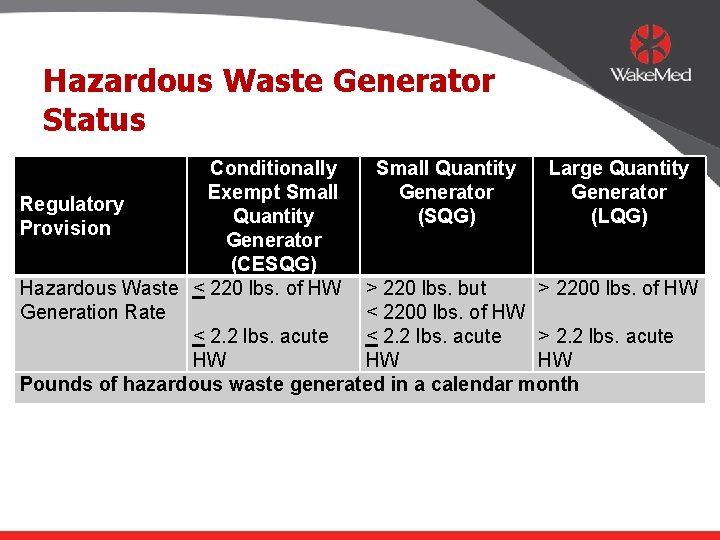
Hazardous Waste Generator Status Conditionally Small Quantity Large Quantity Exempt Small Generator Regulatory Quantity (SQG) (LQG) Provision Generator (CESQG) Hazardous Waste < 220 lbs. of HW > 220 lbs. but > 2200 lbs. of HW Generation Rate < 2200 lbs. of HW < 2. 2 lbs. acute > 2. 2 lbs. acute HW HW HW Pounds of hazardous waste generated in a calendar month
Management Standards for Hazardous Waste Pharmaceuticals; Proposed Rule • Removes Pharmaceutical Waste totals from counting towards generator status – Including acute hazardous waste (P-Listed) – Still required to count other waste streams towards total • Bans sewer disposal of hazardous waste pharmaceuticals – In line with most current requirements – Recommends to limit amount of non-hazardous pharmaceuticals that are placed in the sewer
Management Standards for Hazardous Waste Pharmaceuticals; Proposed Rule • Unit dose packaging, dispensing bottles, and vials no longer treated as hazardous waste if empty • A healthcare facility will not have to comply with the satellite accumulation area regulations, which are a poor fit for healthcare facilities • The facility will not need to specify hazardous waste codes on manifests • The facility will be able to accumulate hazardous waste pharmaceuticals on site without a RCRA permit for 365 days • The facility will have basic training requirements
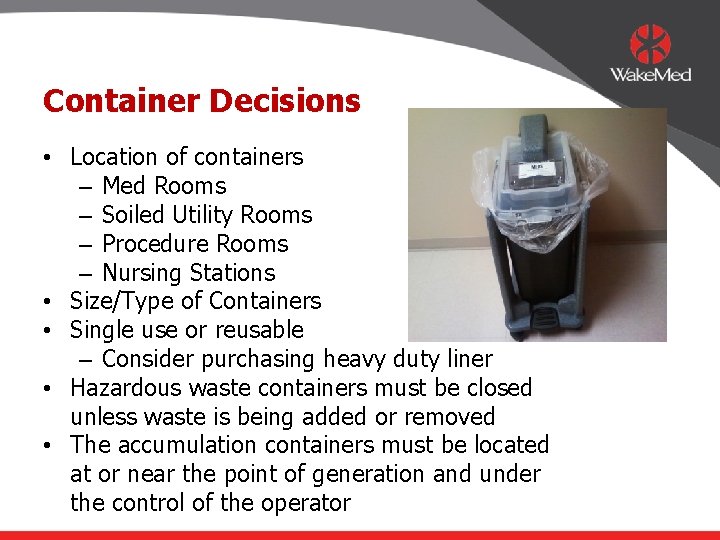
Container Decisions • Location of containers – Med Rooms – Soiled Utility Rooms – Procedure Rooms – Nursing Stations • Size/Type of Containers • Single use or reusable – Consider purchasing heavy duty liner • Hazardous waste containers must be closed unless waste is being added or removed • The accumulation containers must be located at or near the point of generation and under the control of the operator
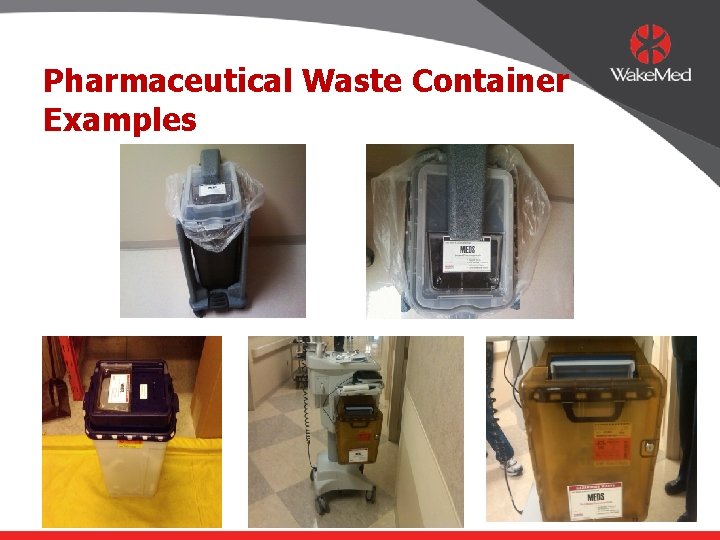
Pharmaceutical Waste Container Examples
Other Supplies • Department of Transportation rated shipping container – 55 gallon DOT rated Co-Pack – Fibrous Tape • Absorbent – Vermiculite • Trolleys
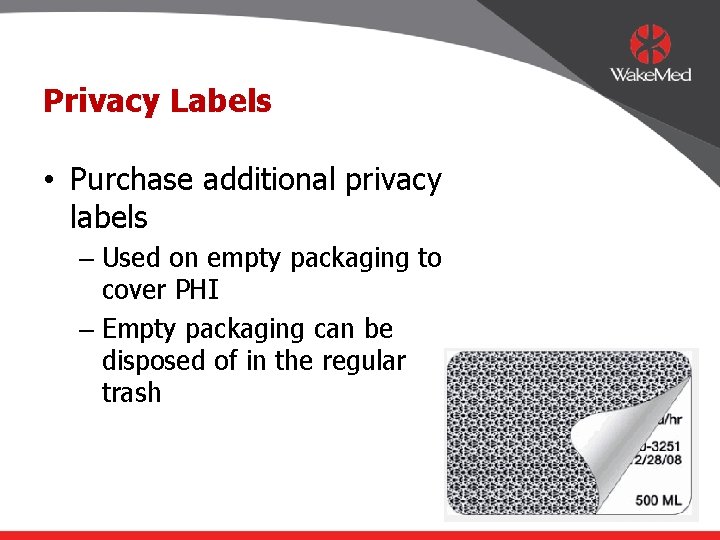
Privacy Labels • Purchase additional privacy labels – Used on empty packaging to cover PHI – Empty packaging can be disposed of in the regular trash
Training Requirements • Department of Transportation (DOT) Hazardous Materials Training – required for all employees who prepare hazardous materials for shipment, sign manifests, etc. (8 hours every 3 years) • OSHA Emergency Response Training (HAZWOPER) – required for all employees who have the potential to respond or initiate response to hazardous material spills, level of training and classroom time dependent on employee responsibilities (minimum 8 hours/year) • EPA Hazardous Waste Generator Training (RCRA) – required for all employees who handle hazardous waste containers outside of satellite accumulation areas or who have responsibilities related to managing central waste storage areas (generally 8 hours/year)
Training • Meet with leadership from key departments – Nursing – Pharmacy – Imaging – Surgical Services – Medical Staff
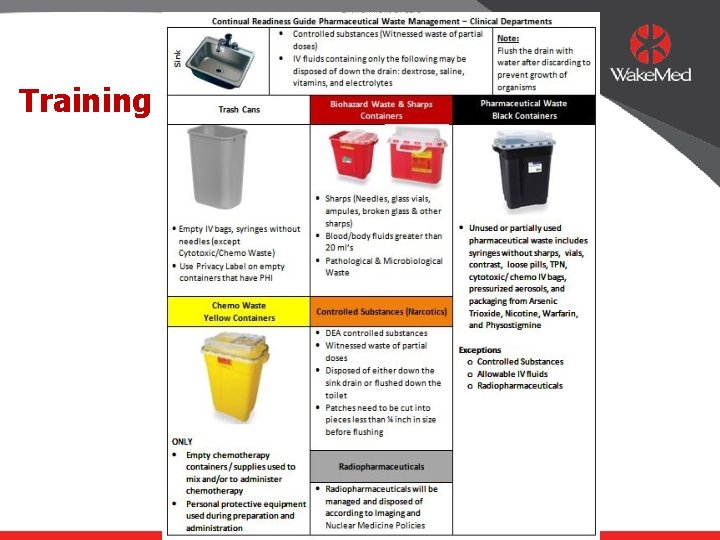
Training
Training
Training
Training
Training
Program Support • How can staff contact responsible department for questions or concerns? – Consider a generic email address – hazwaste@wakemed. org • What happens on nights, weekends, or holidays
Additional Waste Streams • Universal Waste – Batteries • Need to collect for disposal/recycling all batteries except alkaline – Bulbs • Fluorescent, Compact Fluorescent, Metal Halide, Halogen, etc. – Mercury Containing Equipment • Thermometers, Blood Pressure Cuffs, Switches • E-Waste – Computers, TVs, DVD, VHS, etc.
Additional Waste Streams • Aerosol Cans – Maintenance Operations, Food & Nutrition, Environmental Services, etc. • Pathology – Alcohols, Non-Path Vials, Analyzer Waste, Specimens in Formalin • Used Oil
Additional Resources EPA BMP Guidance Practice Greenhealth Proposed Pharmaceutical Waste Rule Proposed Rule FAQs
Questions? Nathan Funk nfunk@wakemed. org
- Slides: 53