
Pharmaceutical technology Ointment Ointments are semisolid preparations intended

- Slides: 16
Pharmaceutical technology Ointment
Ointments are semisolid preparations intended for external application to the skin or mucous membranes. Ointments may be medicated or non medicated, non medicated ointments are used for the physical effects that they provide as protestants , emollients or lubricants
Ointment Bases Ointment bases may be used for their physical effects or as vehicles in the preparation of medicated ointments. Ointment bases are classified into four general groups: 1. Hydrocarbon bases (oleaginous bases) 2. Absorption bases 3. Water-removable bases 4. Water-soluble bases
Hydrocarbon. Bases Hydrocarbon bases are also termed oleaginous bases, on application to the skin they have an emollient effect, protect against the escape of moisture , effective as occlusive dressing and can remain on the skin for prolonged periods of time without drying out and because of their immiscibility with water are difficult to wash off. Water and aqueous preparations may be incorporated in to them but only in small amounts and with some difficulty. Petrolatum , white petrolatum , white ointment and yellow ointment are examples of hydrocarbon ointment bases
Absorption Bases Absorption bases are of two types: 1. Those that permit the in corporation of aqueous solutions resulting in the formation of w/o emulsions e. g. Hydrophilic petrolatum. 2. Those that are w/o emulsions(emulsion bases)permit the incorporation of additional quantities of aqueous solutions. e. g. Lanolin These bases may be used as emollients although they don’t provide the degree of occlusion afforded by the hydrocarbon bases. Absorption bases are note easily removed from the skin, since the external phase of the emulsion is oleaginous.
Water-removable. Bases Water-removable bases are o/w emulsions resembling creams in appearance and because the external phase of the emulsion is aqueous , they are easily washed from the skin and are often called ‘waterwashable bases’. They may be diluted with water or aqueous solutions. Hydrophilic ointment USP , is an example of this type of base.
Water-soluble. Bases Water soluble bases don’t contain oleaginous components, they are completely water-washable and often referred to as ‘greaseless ’. Since they soften greatly with the addition of water, large amounts of aqueous solutions are not effectively incorporated into these bases Polyethylene glycol ointment, NF is an example of water-soluble base.
Selection of appropriate base The selection of the base to be used in the formula of an ointment depends on a number of factors: 1. Desired release rate of the drug substance from the ointment. base. 2. Desirability of occlusion of moisture from the skin. 3. Stability of the drug in the ointment base. 4. Effect of the drug on the consistency of the ointment base. 5. The desire for a base that is easily removed by washing with water. 6. Characteristics of the skin surface to which it is applied.
Preparation of ointments Ointments are prepared by two general methods: 1. Incorporation 2. Fusion The method used depends primarily on the nature of the ingredients.
Incorporation When preparing an ointment by speculation, If the components of an ointment are reactive with the metal of the spatula hard rubber spatula may be used. The ointment base is placed on one side and the powdered components previously reduced to fine powders on the other side. A small portion of the powder is mixed with a portion of the base until uniform mixture is obtained. The process is continued until all portions of the powder and the base are combined and thoroughly and uniformly blended.
Fusion By the fusion method, all or some of the components of an ointment are combined by being melted together and cooled with constant stirring until congealed. Components not melted are added to the congealing mixture as it is being cooled and stirred. Naturally, heat labile substances and any volatile components are added Last when the temperature of the mixture is low enough not to caused composition or volatilization of the components. Substances may be added to the congealing mixture as solutions or as insoluble powders levigated with a portion of the base
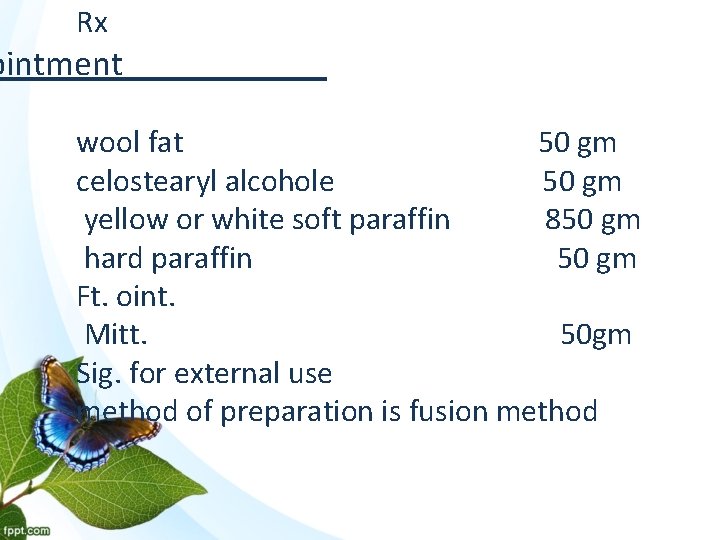
Rx ointment wool fat 50 gm celostearyl alcohole 50 gm yellow or white soft paraffin 850 gm hard paraffin 50 gm Ft. oint. Mitt. 50 gm Sig. for external use method of preparation is fusion method
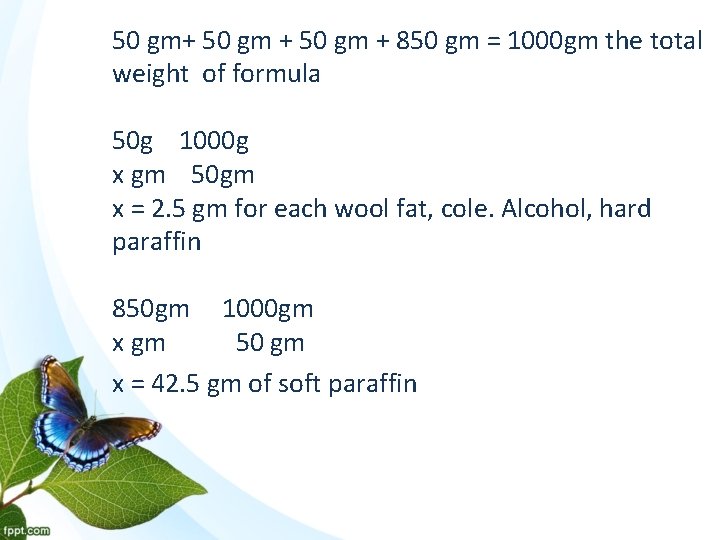
50 gm+ 50 gm + 850 gm = 1000 gm the total weight of formula 50 g 1000 g x gm 50 gm x = 2. 5 gm for each wool fat, cole. Alcohol, hard paraffin 850 gm 1000 gm x gm 50 gm x = 42. 5 gm of soft paraffin
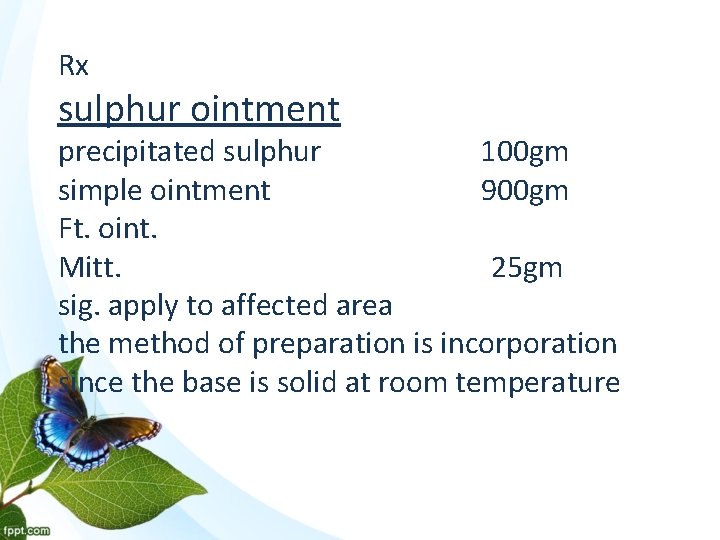
Rx sulphur ointment precipitated sulphur 100 gm simple ointment 900 gm Ft. oint. Mitt. 25 gm sig. apply to affected area the method of preparation is incorporation since the base is solid at room temperature
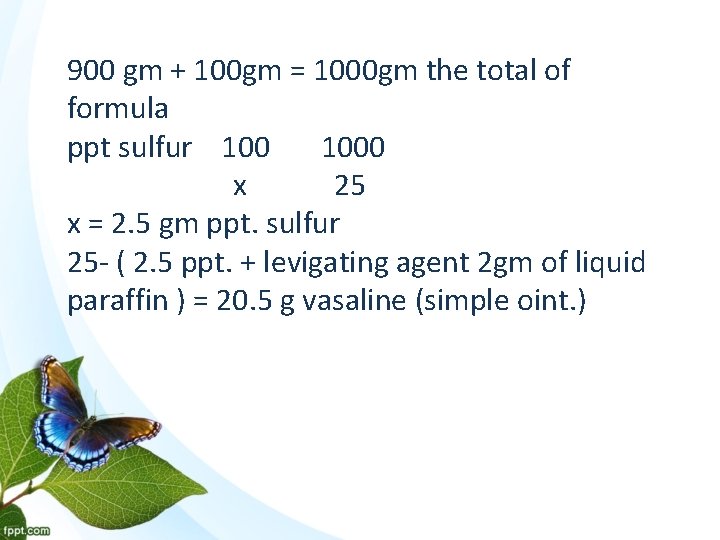
900 gm + 100 gm = 1000 gm the total of formula ppt sulfur 1000 x 25 x = 2. 5 gm ppt. sulfur 25 - ( 2. 5 ppt. + levigating agent 2 gm of liquid paraffin ) = 20. 5 g vasaline (simple oint. )