
PHARMACEUTICAL INGREDIENTS Murat Kizaibek Acidifying agent Definition Used
PHARMACEUTICAL INGREDIENTS Murat Kizaibek
• Acidifying agent • Definition: Used in liquid preparations to provide acidic medium for product stability • Examples: Citric acid Acetic acid Fumaric acid Hydrochloric acid Nitric acid
• Alkalinizing agent • Definition: Used in liquid preparations to provide alkaline medium for product stability
• Examples: Ammonia solution Ammonium carbonate Diethanol amine Monoethanol amine Potassium hydroxide Sodium bicarbonate Sodium borate Sodium carbonate Sodium hydroxide Trolamine

• Adsorbent • Definition: An agent capable of holding other molecules onto its surface by physical or chemical (chemisorption) means • Examples: Powdered cellulose Activated charcoal
• Aerosol propellant • Definition: Agent responsible for developing the pressure within an aerosol container and expelling the product when the valve is opened • Examples: Carbon dioxide; Dichlorodifluoromethane; Dichlorotetrafluoroethane; Trichloromonofluoromethane.
• Air displacement • Definition: Agent employed to displace air in a hermetically sealed container to enhance product stability. • Examples: Nitrogen Carbon dioxide
• Antifungal preservative • Definition: Used in liquid and semisolid preparations to prevent growth of fungi. Effectiveness of parabens is usually enhanced by use in combination. Example: Butylparaben Ethylparaben Methylparaben Benzoic acid Propylparaben Sodium benzoate; Sodium propionate
• Antimicrobial preservative • Definition: Used in liquid and semisolid preparations to prevent growth of microorganisms • Examples: Benzalkonium chloride
• Antioxidant • Definition: Used to prevent deterioration of preparations by oxidation • Examples: Ascorbic acid; Ascorbyl palmitate; Butylated hydroxyanisole; Butylated hydroxytoluene; Hypophosphorous acid; Monothioglycerol; Propyl gallate; Sodium ascorbate; Sodium bisulfite; Sodium formaldehyde; Sulfoxylate; Sodium metabisulfite

• Buffering agent • Definition: Used to resist change in p. H upon dilution or addition of acid or alkali • Examples: Potassium metaphosphate; Potassium phosphate; monobasic; Sodium acetate; Sodium citrate, anhydrous and dihydrate
• Chelating agent • Definition: Substance that forms stable watersoluble complexes (chelates) with metals; used in some liquid pharmaceuticals as stabilizers to complex heavy metals that might promote instability. In such use, they are also called sequestering agents • Examples: EDTA
• Clarifying agent • Definition: Used as a filtering aid for its adsorbent qualities • Examples: Bentonite
• Colorant • Definition: Used to impart color to liquid and solid (e. g. , tablets and capsules) preparations • Examples: • FD&C Red No. 3 FD&C Red No. 20 FD&C Yellow No. 6 FD&C Blue No. 2 D&C Green No. 5 D&C Orange No. 5 D&C Red No. 8 Caramel Ferric oxide, red
• Emulsifying agent • Definition: Used to promote and maintain dispersion of finely subdivided particles of liquid in a vehicle in which it is immiscible. End product may be a liquid emulsion or semisolid emulsion(e. g. , a cream) • Examples: Acacia Cetomacrogol Cetyl alcohol Glyceryl monostearate Span 80 Polyoxyethylene 50 stearate
• Encapsulating agent • Definition: Used to form thin shells to enclose a drug for ease of administration • Examples: Gelatin
• Flavorant • Definition: Used to impart a pleasant flavor and often odor to a preparation. In addition to the natural flavorants listed, many synthetic ones are used. • Examples: Anise oil Cinnamon oil Cocoa Menthol Orange oil Peppermint oil Vanillin
• Humectant • Definition: Used to prevent drying of preparations, particularly ointments and creams • Examples: Glycerin Propylene glycol Sorbitol
• Levigating agent • Definition: Liquid used as an intervening agent to reduce the particle size of a powder by grinding, usually in a mortar • Examples: Mineral oil Glycerin Propylene glycol
• Ointment base • Definition: Semi solid vehicle for medicated ointments • Examples: Lanolin Hydrophilic ointment Polyethylene glycol ointment Petrolatum Hydrophilic petrolatum
• Plasticizer • Definition: Component of film coating solutions to make film more pliable, enhance spread of coat over tablets, beads, and granules • Examples: Diethyl phthalate Glycerin
• Solvent • Definition: Used to dissolve another substance in preparation of a solution; may be aqueous or not (e. g. , oleaginous). Cosolvents, such as water and alcohol (hydroalcoholic) and water and glycerin, may be used when needed. Sterile solvents are used in certain preparations (e. g. , injections) • Examples: Alcohol; Corn oil; Cotton seed oil; Glycerin; Isopropyl alcohol; Mineral oil; Oleic acid; Peanut oil; Purified water; Water for injection; Sterile water for irrigation
• Stiffening agent • Definition: Used to increase thickness or hardness of a preparation, usually an ointment • Examples: Cetyl alcohol Cetyl esters wax Microcrystalline wax Paraffin Stearyl alcohol White wax Yellow wax
• Suppository base • Definition: Vehicle for suppositories • Examples: Cocoa butter Polyethylene glycols (mixtures) PEG 3350
• Surfactant (surface active agent) • Definition: Substances that absorb to surfaces or interfaces to reduce surface or interfacial tension. May be used as wetting agents, detergents, or emulsifying agents • Examples: Spans Tweens
• Suspending agent • Definition: Viscosity-increasing agent used to reduce sedimentation rate of particles in a vehicle in which they are not soluble; suspension may be formulated for oral, parenteral, ophthalmic, topical, or other route • Examples: Agar Bentonite Carbomer (e. g. , Carbopol) Carboxymethylcellulose sodium Hydroxyethyl cellulose Hydroxypropyl methylcellulose Kaolin Methylcellulose Tragacanth
• Sweetening agent • Definition: Used to impart sweetness to a preparation • Examples: Aspartame Dextrose Glycerin Mannitol Saccharin sodium Sorbitol Sucrose
• Tablet antiadherents • Definition: Prevent tablet ingredients from sticking to punches and dies during production • Examples: Magnesium stearate
• Tablet binders • Definition: Substances used to cause adhesion of powder particles in tablet granulations • Examples: Acacia Alginic acid Carboxymethyl cellulose sodium Compressible sugar (e. g. , Nu-Tab) Ethylcellulose Gelatin Liquid glucose Methylcellulose Povidone Pregelatinized starch
• Tablet and capsule diluent • Definition: Inert filler to create desired bulk, flow properties, and compression characteristics of tablets and capsules • Examples: Dibasic calcium phosphate Kaolin Lactose Mannitol Microcrystalline cellulose Powdered cellulose Precipitated calcium carbonate Sorbitol Starch
• Tablet coating agent • Definition: Used to coat a tablet to protect against decomposition by atmospheric oxygen or humidity, to provide a desired release pattern, to mask taste or odor, or for aesthetic purposes. Coating may be sugar, film, or thick covering around a tablet. Sugar-coated tablets generally start to break up in the stomach. Film forms a thin cover around a formed tablet or bead. Unless it is enteric, film dissolves in the stomach. Enteric coating passes through the stomach to break up in the intestines. Some water-insoluble coatings (e. g. , ethylcellulose) are used to slow the release of drug in the gastrointestinal tract.
• • Sugar coating Example: Liquid glucose, Sucrose Film coating Example Hydroxyethyl cellulose Hydroxypropyl methylcellulose Methylcellulose (e. g. , Methocel) Ethylcellulose (e. g. , Ethocel) • Enteric coating • Example Cellulose acetate phthalate Shellac (35% in alcohol, pharmaceutical glaze)
• Tablet direct compression excipient • Definition: Used in direct compression tablet formulations • Examples: Dibasic calcium phosphate (e. g. , Ditab)
• Tablet disintegrant • Definition: Used in solid forms to promote disruption of the mass into smaller particles more readily dispersed or dissolved • Examples: Alginic acid Polacrilin potassium (e. g. , Amberlite) Sodium alginate Sodium starch glycolate Starch
• Tablet glidant • Definition: Used in tablet and capsule formulations to improve flow properties of the powder mixture. • Examples: Colloidal silica Corn starch Talc
• Tablet lubricant • Definition: Used in tablet formulations to reduce friction during tablet compression • Examples: Calcium stearate Magnesium stearate Mineral oil Stearic acid Zinc stearate
• Tablet or capsule opaquant • Definition: Used to render a coating opaque. May be used alone or with a colorant • Examples: Titanium dioxide
• Tablet polishing agent • Definition: Used to impart an attractive sheen to coated tablets • Examples: Carnauba wax White wax
• Tonicity agent • Definition: Used to render solution similar in osmotic-dextrose characteristics to physiologic fluids, e. g. , in ophthalmic, parenteral, and irrigation fluids • Examples: Sodium chloride
• Vehicle • Definition: Carrying agent used in formulating a variety of liquids for oral and parenteral administration. Generally, oral liquids are aqueous (e. g. , syrups) or hydroalcoholic (e. g. , elixirs). Solutions for intravenous use are aqueous, whereas intramuscular injections may be aqueous or oleaginous.
• Flavored, sweetened • Examples: Acacia syrup Aromatic elixir Cherry syrup Cocoa syrup Orange syrup Syrup
• Oleaginous • Examples: Corn oil Mineral oil Peanut oil Sesame oil
• Sterile • Examples: Bacteriostatic sodium chloride injection
• Viscosity-increasing agent • Definition: Used to render preparations more resistant to flow. Used in suspensions to deter sedimentation, in ophthalmic solutions to enhance contact time (e. g. , methylcellulose), to thicken topical creams, etc. • Examples: Alginic acid Bentonite Carbomer Carboxymethylcellulose Sodium Methylcellulose Povidone Sodium alginate Tragacanth
Optimization of ingredients and process
• • Simplex method Lagrangian Response surface methodology Factorial design Central composite design Orthogonal design Uniform design
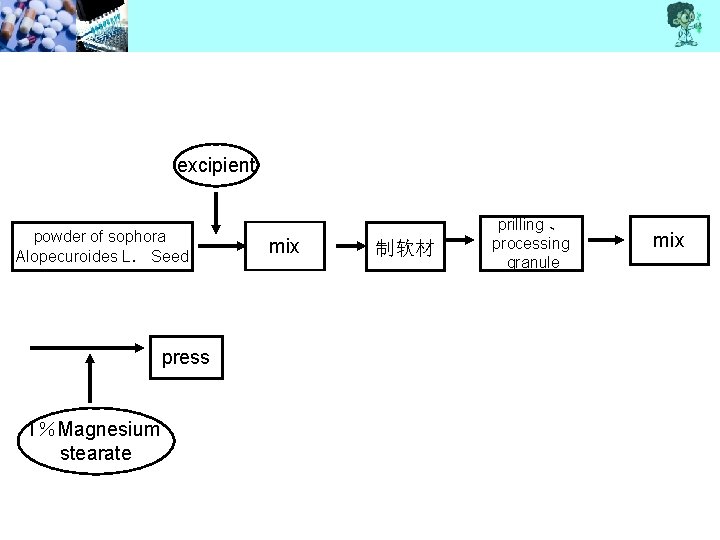
excipient powder of sophora AIopecuroides L. Seed press 1%Magnesium stearate mix 制软材 prilling 、 processing granule mix
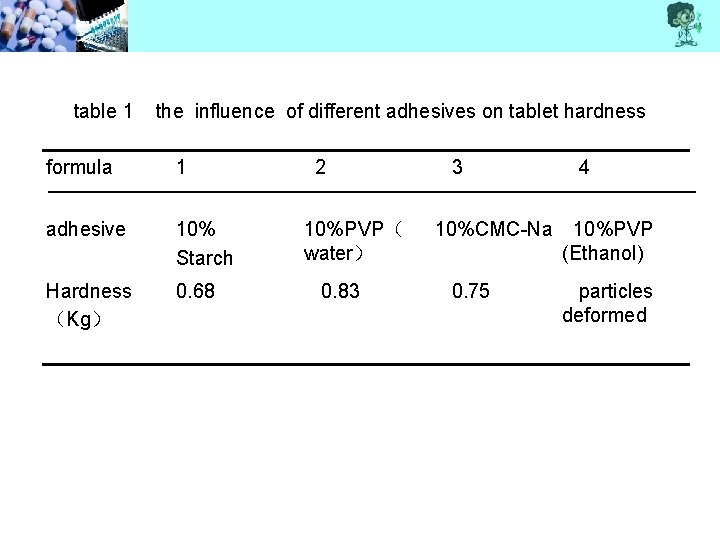
table 1 the influence of different adhesives on tablet hardness formula 1 adhesive 10% Starch Hardness (Kg) 0. 68 2 10%PVP( water) 0. 83 3 10%CMC-Na 0. 75 4 10%PVP (Ethanol) particles deformed
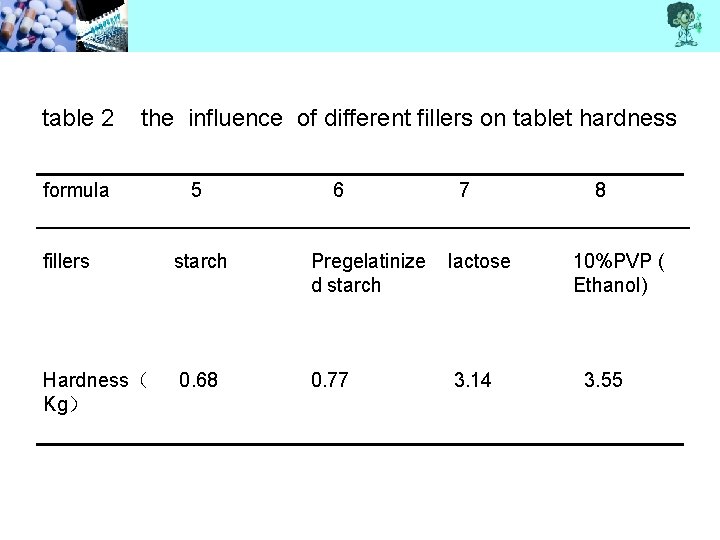
table 2 the influence of different fillers on tablet hardness formula 5 6 7 fillers starch Pregelatinize d starch lactose Hardness( Kg) 0. 68 0. 77 3. 14 8 10%PVP ( Ethanol) 3. 55
![table 3 factor level Factor level A [The amount of Microcrstalline 80 cellulose(g)] 120](http://slidetodoc.com/presentation_image_h2/fe19e000f09273e0bf187d167ae42c8d/image-51.jpg "table 3 factor level Factor level A [The amount of Microcrstalline 80 cellulose(g)] 120")
table 3 factor level Factor level A [The amount of Microcrstalline 80 cellulose(g)] 120 160 A [Concentration of PVP solution(%,g/ml)] 15 20 10
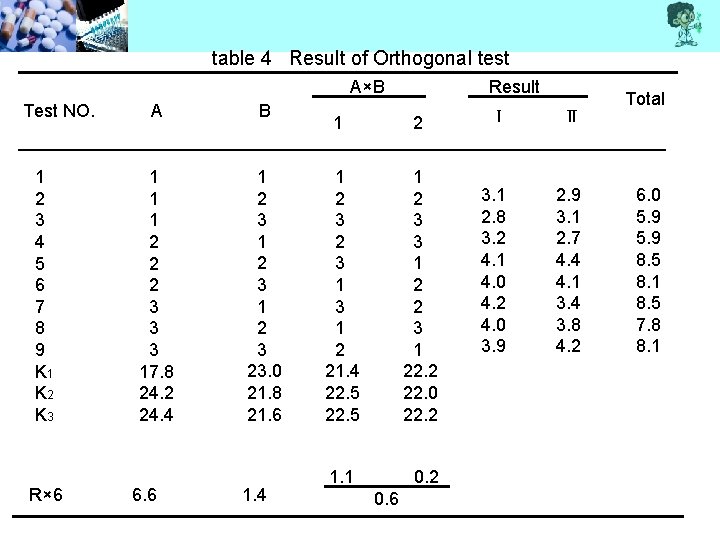
table 4 Result of Orthogonal test A×B Test NO. 1 2 3 4 5 6 7 8 9 K 1 K 2 K 3 R× 6 A B 1 1 1 2 2 2 3 3 3 17. 8 24. 2 24. 4 1 2 3 23. 0 21. 8 21. 6 6. 6 1. 4 Result 1 2 3 2 3 1 2 21. 4 22. 5 1 2 3 3 1 2 2 3 1 22. 2 22. 0 22. 2 1. 1 0. 2 0. 6 Ⅰ Ⅱ 3. 1 2. 8 3. 2 4. 1 4. 0 4. 2 4. 0 3. 9 2. 9 3. 1 2. 7 4. 4 4. 1 3. 4 3. 8 4. 2 Total 6. 0 5. 9 8. 5 8. 1 8. 5 7. 8 8. 1
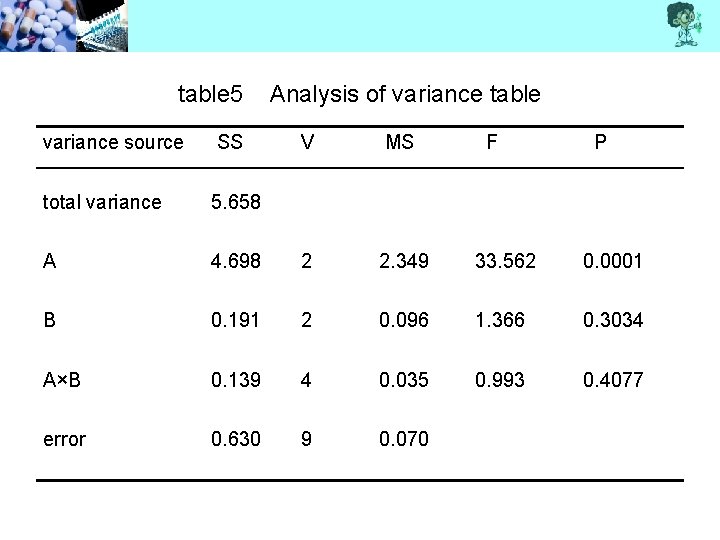
table 5 variance source SS total variance 5. 658 A Analysis of variance table V MS F P 4. 698 2 2. 349 33. 562 0. 0001 B 0. 191 2 0. 096 1. 366 0. 3034 A×B 0. 139 4 0. 035 0. 993 0. 4077 error 0. 630 9 0. 070
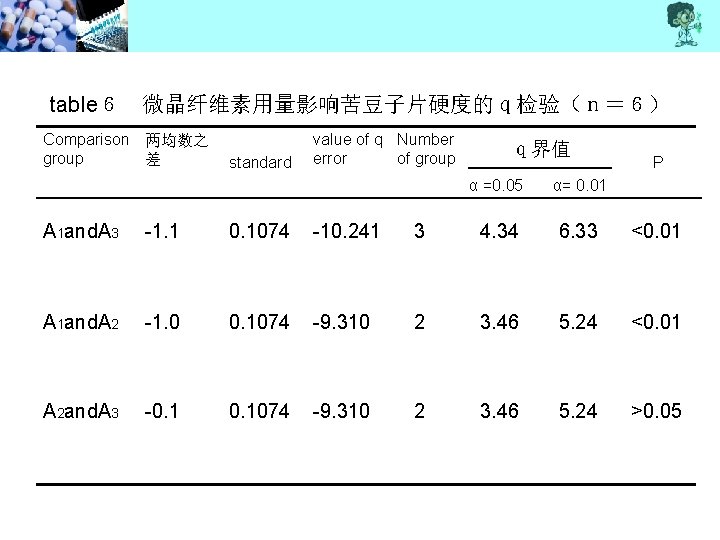
table6 微晶纤维素用量影响苦豆子片硬度的q检验(n=6) Comparison 两均数之 group 差 standard value of q Number error of group q界值 α =0. 05 α= 0. 01 P A 1 and. A 3 -1. 1 0. 1074 -10. 241 3 4. 34 6. 33 <0. 01 A 1 and. A 2 -1. 0 0. 1074 -9. 310 2 3. 46 5. 24 <0. 01 A 2 and. A 3 -0. 1074 -9. 310 2 3. 46 5. 24 >0. 05
- Slides: 54