
Pharmaceutical Diversion Recent Trends and Updates Mark Rubbins
Pharmaceutical Diversion Recent Trends and Updates Mark Rubbins, Diversion Group Supervisor Drug Enforcement Administration New England Field Division
Abuse Facts n n In 2014, 27 million Americans aged 12 or older were current (past month) users of illicit drugs 1 in 10 Americans 6. 5 million used prescription-type psychotherapeutic drugs (any pain relievers, tranquilizers, stimulants or sedatives) for nonmedical purposes in a one-month period (2011 data – 6. 1 million) 4. 3 non-medical users of pain killers Non medical use of prescription type drugs is second only to marijuana SOURCE: 2014 National Survey on Drug Use and Health (NSDUH) published September 2014 by the Dept of HHS/ Substance Abuse and Mental Health Services Administration (SAMHSA) 2
Abuse Facts n n n The rate of non-medical use of prescription-type drugs among young adults (age 18 -25) decreased to 5. 0 % from a range of 5. 5 -5. 9% from 2002 -2013. From 2002 to 2013, there was a significant increase among older adults (50 to 54) in the rate of illicit drug use (3. 4 to 7. 9%) – baby boomers aging – they like their drugs! Of the 4. 8 million older adults who had used illicit drugs in the past year, 2. 1 million were non-medical use of prescription-type drugs. 3
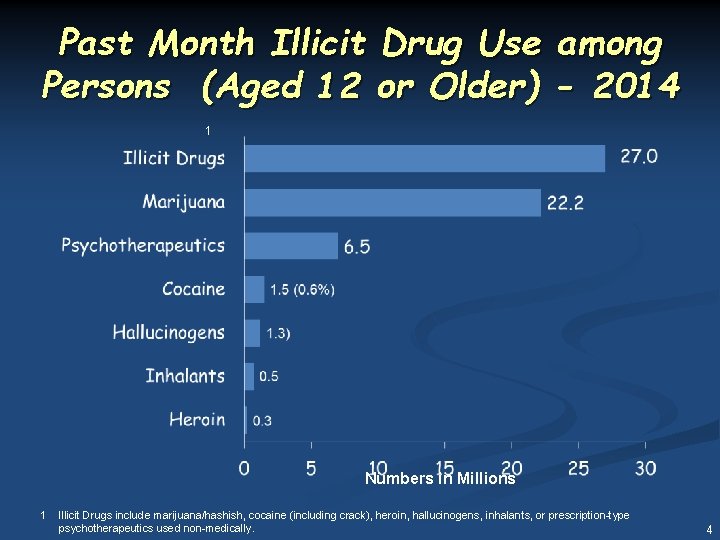
Past Month Illicit Drug Use among Persons (Aged 12 or Older) - 2014 1 Numbers in Millions 1 Illicit Drugs include marijuana/hashish, cocaine (including crack), heroin, hallucinogens, inhalants, or prescription-type psychotherapeutics used non-medically. 4
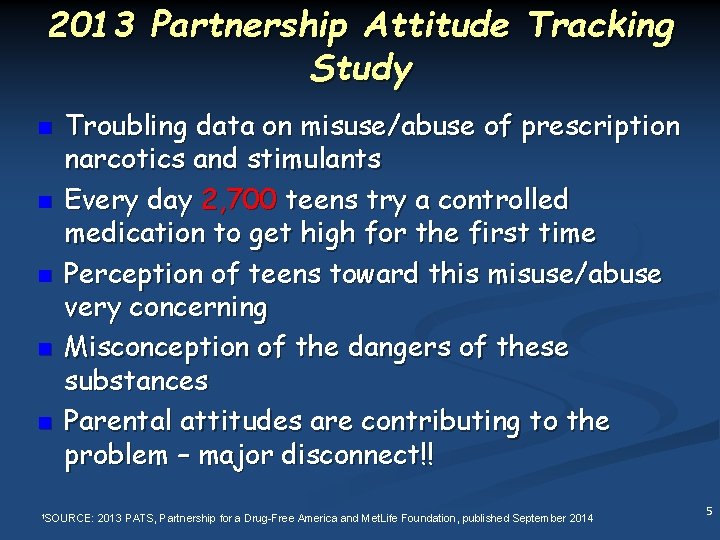
2013 Partnership Attitude Tracking Study n n n Troubling data on misuse/abuse of prescription narcotics and stimulants Every day 2, 700 teens try a controlled medication to get high for the first time Perception of teens toward this misuse/abuse very concerning Misconception of the dangers of these substances Parental attitudes are contributing to the problem – major disconnect!! 1 SOURCE: 2013 PATS, Partnership for a Drug-Free America and Met. Life Foundation, published September 2014 5
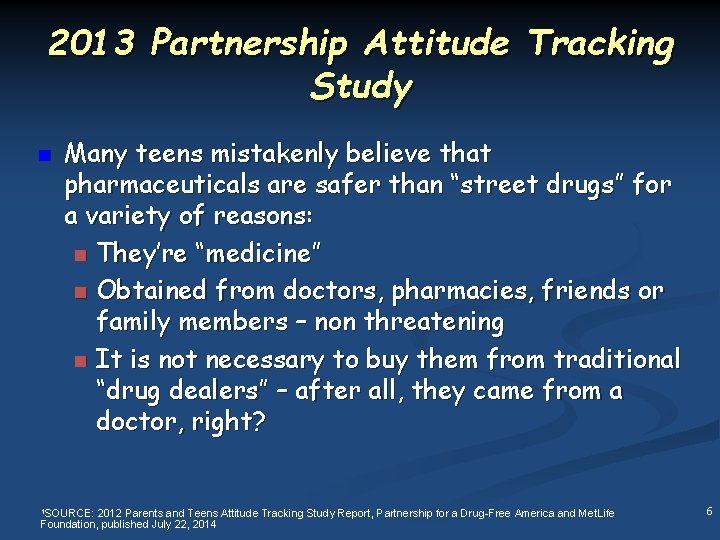
2013 Partnership Attitude Tracking Study n Many teens mistakenly believe that pharmaceuticals are safer than “street drugs” for a variety of reasons: n They’re “medicine” n Obtained from doctors, pharmacies, friends or family members – non threatening n It is not necessary to buy them from traditional “drug dealers” – after all, they came from a doctor, right? 1 SOURCE: 2012 Parents and Teens Attitude Tracking Study Report, Partnership for a Drug-Free America and Met. Life Foundation, published July 22, 2014 6
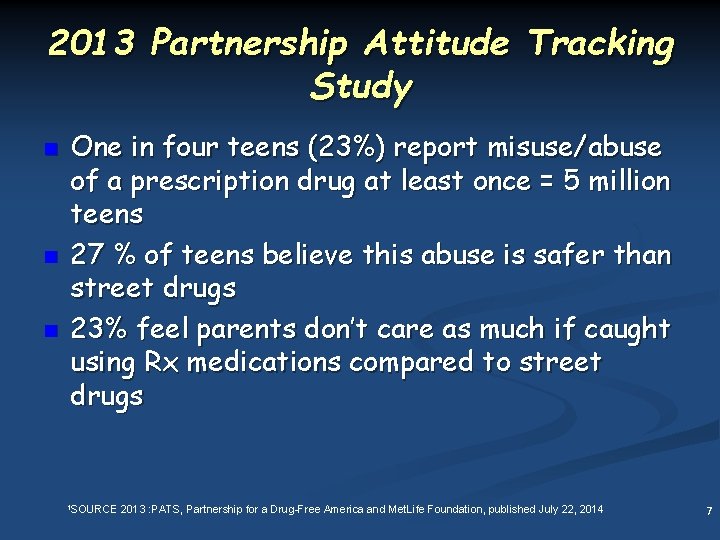
2013 Partnership Attitude Tracking Study n n n One in four teens (23%) report misuse/abuse of a prescription drug at least once = 5 million teens 27 % of teens believe this abuse is safer than street drugs 23% feel parents don’t care as much if caught using Rx medications compared to street drugs 1 SOURCE 2013 : PATS, Partnership for a Drug-Free America and Met. Life Foundation, published July 22, 2014 7
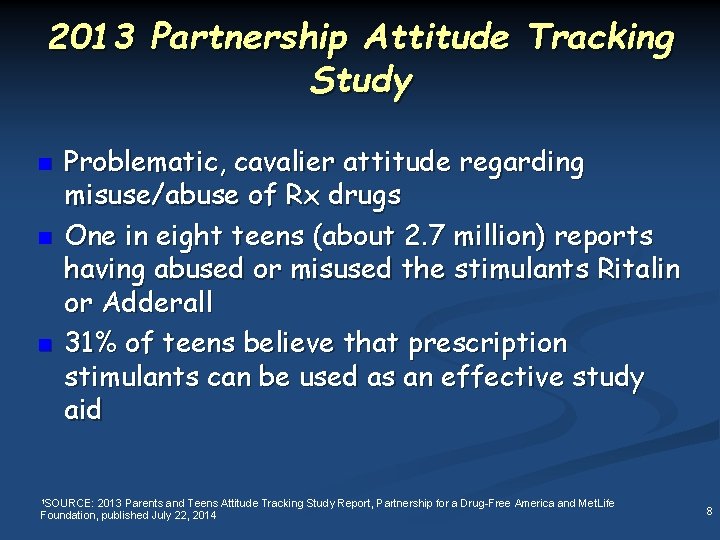
2013 Partnership Attitude Tracking Study n n n Problematic, cavalier attitude regarding misuse/abuse of Rx drugs One in eight teens (about 2. 7 million) reports having abused or misused the stimulants Ritalin or Adderall 31% of teens believe that prescription stimulants can be used as an effective study aid 1 SOURCE: 2013 Parents and Teens Attitude Tracking Study Report, Partnership for a Drug-Free America and Met. Life Foundation, published July 22, 2014 8
2013 Partnership Attitude Tracking Study n n Parents attitude toward this issue even worse… 21% of parents feel ADHD drugs can improve academic performance, even if child does not have ADHD 16% feel a child abusing Rx drugs much safer than abusing illicit drugs 13 % feel its ok if their teen were to take Rx drugs without a prescription…WHAT!!! 1 SOURCE: 2013 Parents and Teens Attitude Tracking Study Report, Partnership for a Drug-Free America and Met. Life Foundation, published July 22, 2014 9
2013 Partnership Attitude Tracking Study n n n 73% of teens say its easy to access Rx drugs from their parents medicine cabinet 38% of teens who have misused Rx drugs obtained them from parents medicine cabinet 23% said parents would not care as much if they were caught abusing Rx meds as compared to illicit drugs 1 SOURCE: 2013 Parents and Teens Attitude Tracking Study Report, Partnership for a Drug-Free America and Met. Life Foundation, published July 22, 2014 10
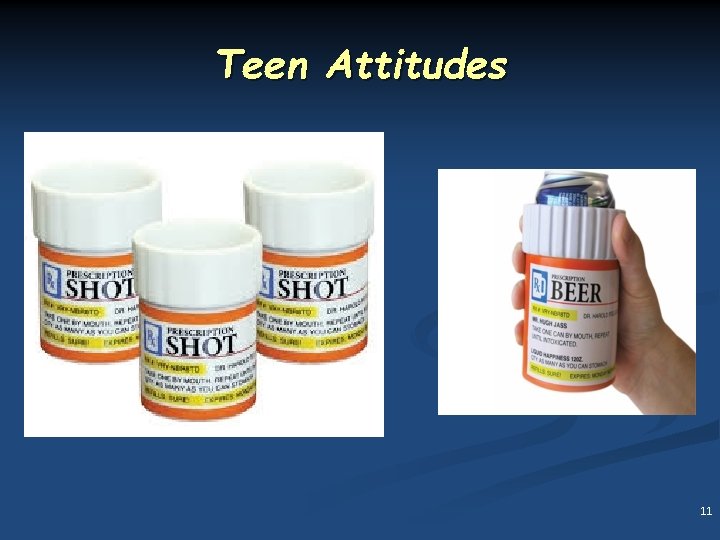
Teen Attitudes 11
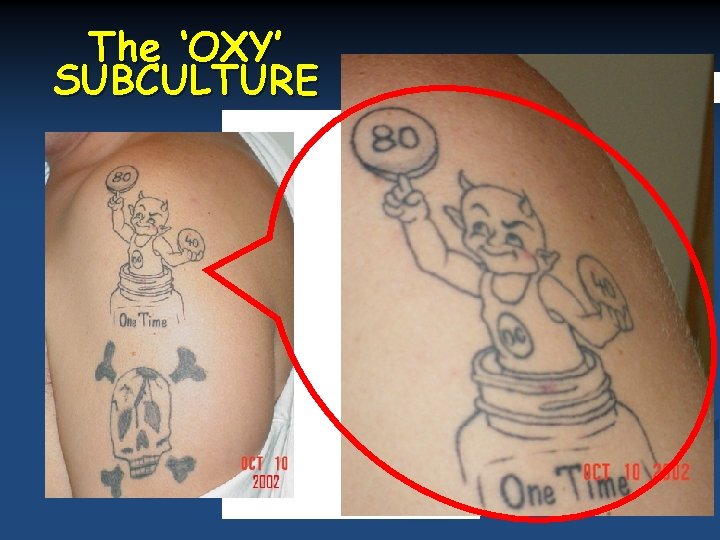
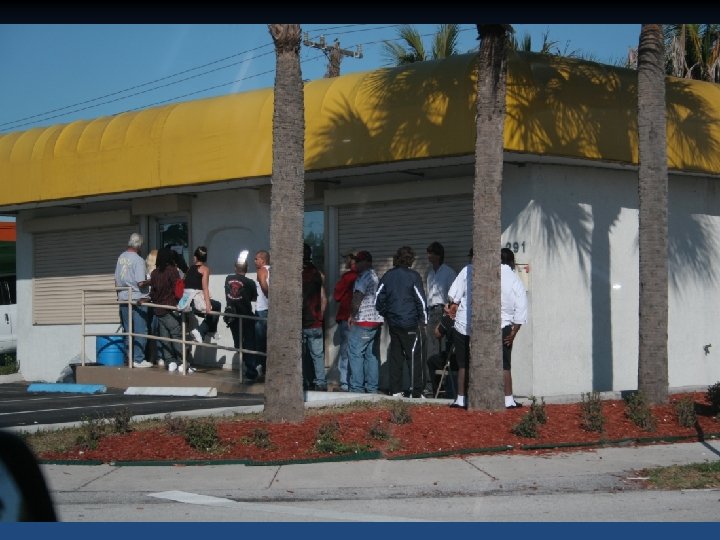
The ‘OXY’ SUBCULTURE
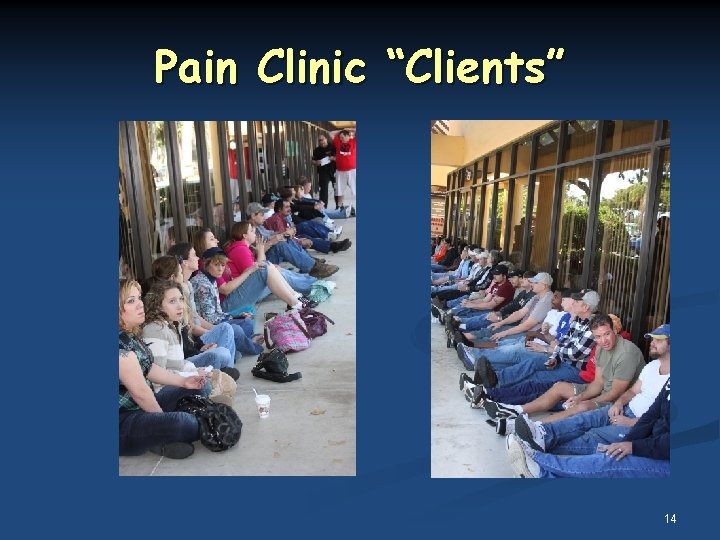
Pain Clinic “Clients” 14
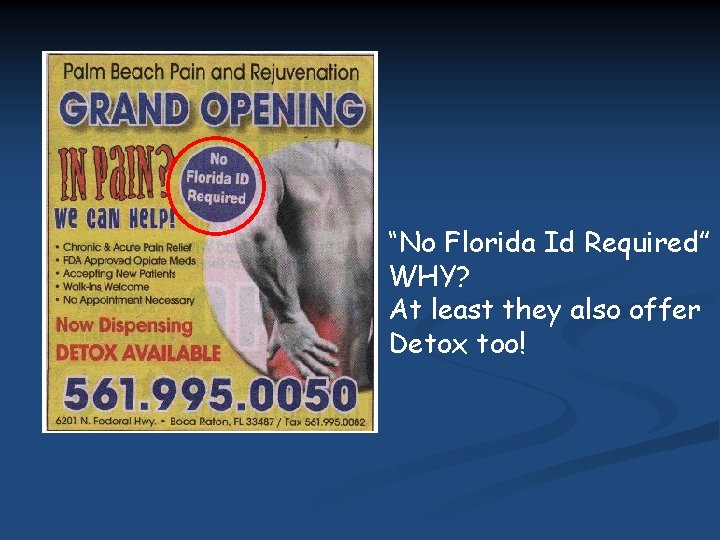
“No Florida Id Required” WHY? At least they also offer Detox too!

DRUG ENFORCEMENT ADMINISTRATION | DIVERSION CONTROL PROGRAM 17
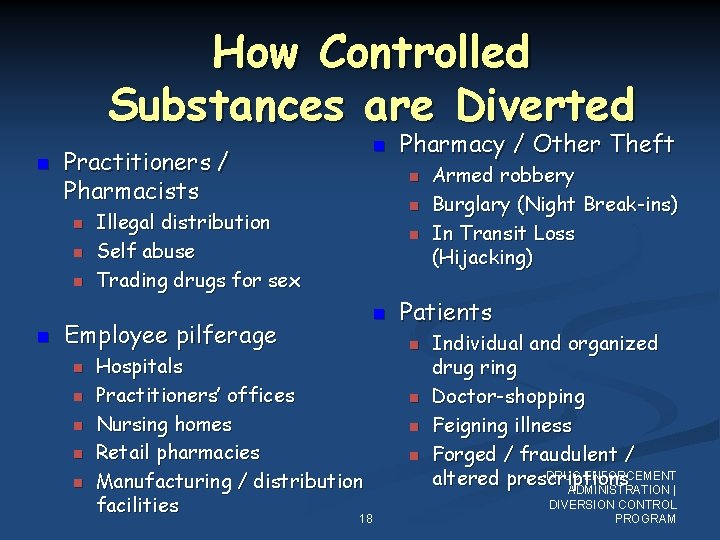
How Controlled Substances are Diverted n Practitioners / Pharmacists n n n n Illegal distribution Self abuse Trading drugs for sex n n Employee pilferage n n n Pharmacy / Other Theft Hospitals Practitioners’ offices Nursing homes Retail pharmacies Manufacturing / distribution facilities 18 Armed robbery Burglary (Night Break-ins) In Transit Loss (Hijacking) Patients n n Individual and organized drug ring Doctor-shopping Feigning illness Forged / fraudulent / DRUG ENFORCEMENT altered prescriptions ADMINISTRATION | DIVERSION CONTROL PROGRAM
Registration • On-line application much faster than paper application – one week to get registration certificate vs. four-to-six weeks for paper • On-line application is approved same day it comes to Registration Unit in Boston if all certifications are included and valid • Applicant must have a valid MA Medical License and a valid MA Controlled Substance license before applying for a DEA Registration
Registration • Renewals: Practitioner is sent a renewal reminder letter 60 days prior to expiration. Letter goes to registered address – if changed address and did not update or notify, may not receive letter. • Two more letters are sent before the registration is no longer valid on its expiration date. • Practitioner is no longer authorized to order, administer, dispense or store controlled substances. • 30 days after the expiration date, the registration is officially retired, and cannot be reactivated.
Electronic Prescriptions for Controlled Substances (EPCS) 21
EPCS n Interim Final Rule Published March 31, 2010 Provides practitioners with the option of writing Rxs electronically. n Permits pharmacies to receive, dispense and archive these Rxs. n 2 factor authentication for practitioners n n Something you know (password) n Something you have (hard token) n Something you are (biometric) 22
EPCS n Third Party Reviews of Prescriber or Pharmacy Applications n Before any application may be used for electronic prescriptions for controlled substances, it must be reviewed, tested and determined by a third party to meet all of the requirements of 21 C. F. R. § Part 1311. 23
EPCS n There are two alternative processes for review and certification of EPCS applications under the Interim Final Rule: 24
EPCS n (1) A third-party audit conducted by a person qualified to conduct a Sys. Trust, Web. Trust or SAS 70 audit or a Certified Information System Auditor as stated in 21 CFR 1311. 300(b), which comports with the requirements of paragraphs (c) and (d) of 21 CFR 1300. 300, or 25
EPCS n n (2) A certification by a certifying organization whose certification process has been approved by DEA as stated in 21 CFR 1311. 300(e), which certification verifies that the application meets all of the requirements of 21 CFR Part 1311. Review of processing integrity is required under either type of review. 26
EPCS n n Venders must have their systems certified by a third-party entity that it complies with the regulations. Practitioners and pharmacies should request a copy of the certificate. DEA Investigators should ask to see the certificate. Currently six companies approved – listed on our website. 27
EPCS n Fax vs. Electronic Prescription True electronic Rxs are transmitted as electronic data files to the pharmacy, whose application securely import the data file into its database – utilizing 2 factor authentication n A system the allows the prescriber to “sign” his/her name does not conform to EPCS regulations (hand held device, tablet) n A facsimile with a written signature is not an electronic Rxs. n 28
EPCS n n Final Rule is being drafted More info on the DEA Website www. DEAdiversion. gov 29
Disposal of Controlled Substances
Secure and Responsible Drug Disposal Act of 2010 n n n Public Law 111 -273 Enacted on October 12, 2010 This Act amended the Controlled Substances Act to provide for disposal of controlled substances by certain persons. Ultimate Users n Long Term Care Facilities n Survivor of decedent n 31
Disposal of Controlled Substances n n n Final Rule Published September 9, 2014 in the Federal Register Patients now have expanded options to safely and responsibly dispose of unused/unwanted medications – through collection receptacles and mail-back packages Establishes “Authorized collectors”
Disposal of Controlled Substances n n n DEA –registered retail pharmacies, hospitals/clinics with an on-site pharmacy, narcotic treatment programs, manufacturers, distributors, and reverse distributors may become “authorized collectors” May apply to modify their registrations to reflect this status May also conduct mail-back programs
Disposal of Controlled Substances n n Must be registered to handle schedule ll CDS – all collected substances treated as schedule ll Standard of destruction – “non-retrievable” “cannot be transformed to a physical or chemical condition or state as a controlled substance or CS analogue. ”
Disposal of Controlled Substances n Authorized retail pharmacies and hospital/clinics with an on-site pharmacy may also place receptacles at LTCF’s
Disposal of Controlled Substances n n Authorizes Police Departments to continue and expand current disposal programs Gives other entities access to becoming “collectors” (Manufactureres, Distributors, Reverse Distributors, Pharmacies)
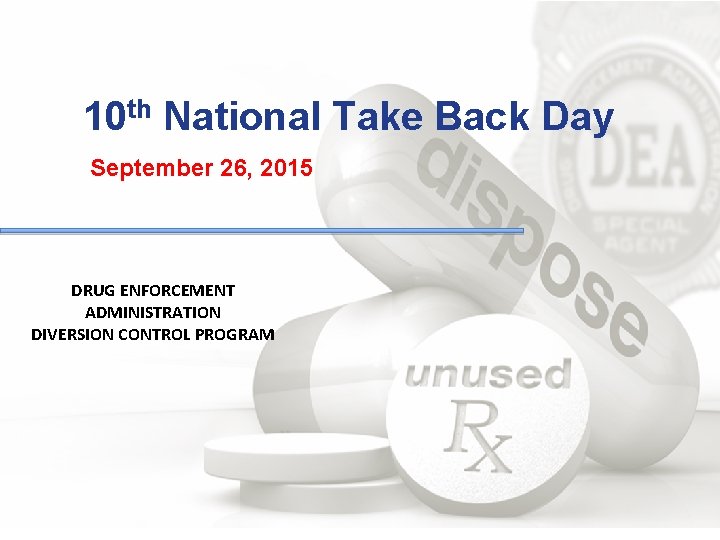
10 th National Take Back Day September 26, 2015 DRUG ENFORCEMENT ADMINISTRATION DIVERSION CONTROL PROGRAM
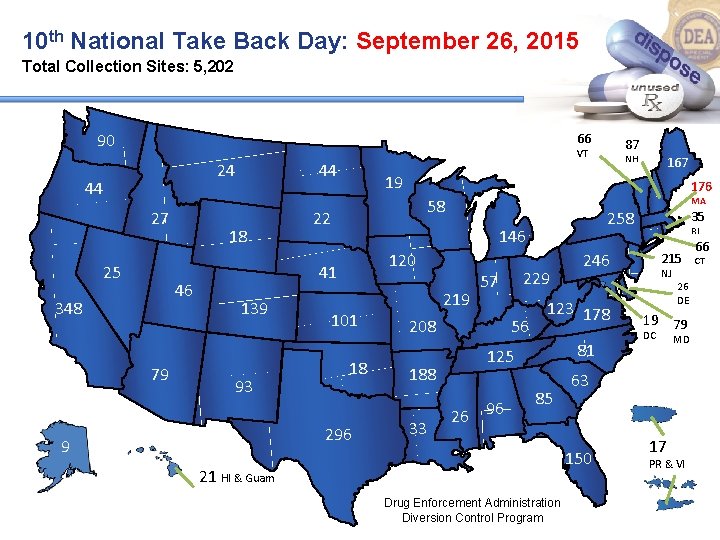
10 th National Take Back Day: September 26, 2015 Total Collection Sites: 5, 202 90 66 24 44 27 25 46 348 79 44 18 93 167 176 MA 58 22 258 146 120 101 18 296 9 NH 19 41 139 87 VT 219 208 188 33 229 57 56 26 96 81 85 Drug Enforcement Administration Diversion Control Program 215 NJ 26 DE 19 79 DC MD 63 150 21 HI & Guam RI 246 123 178 125 35 17 PR & VI 66 CT
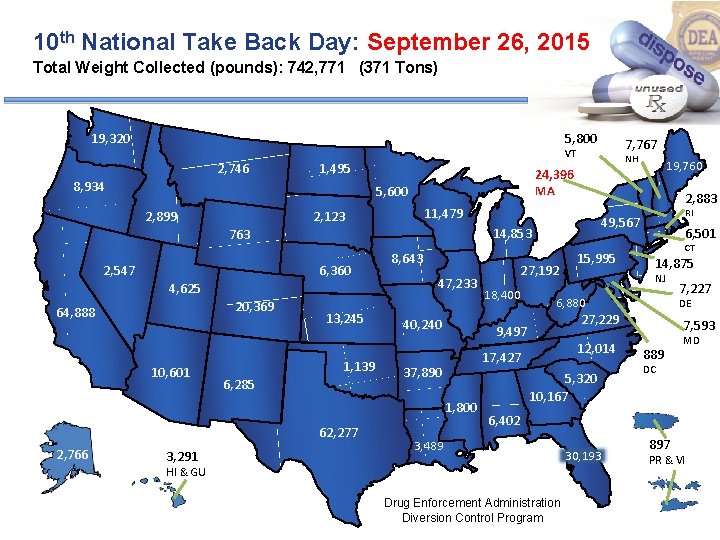
10 th National Take Back Day: September 26, 2015 Total Weight Collected (pounds): 742, 771 (371 Tons) 19, 320 5, 800 2, 746 1, 495 8, 934 20, 369 10, 601 13, 245 1, 139 6, 285 8, 643 47, 233 40, 240 2, 766 3, 291 CT 14, 875 NJ 12, 014 5, 320 10, 167 7, 227 DE 27, 229 17, 427 37, 890 15, 995 6, 501 6, 880 9, 497 1, 800 62, 277 27, 192 18, 400 RI 49, 567 14, 853 4, 625 64, 888 2, 883 11, 479 763 6, 360 19, 760 MA 2, 123 2, 547 NH 24, 396 5, 600 2, 899 7, 767 VT 7, 593 889 MD DC 6, 402 3, 489 HI & GU Drug Enforcement Administration Diversion Control Program 30, 193 897 PR & VI
Questions? ?
Thank You!
- Slides: 41