
Phantom Limb Phenomena Hand movement observation by individuals
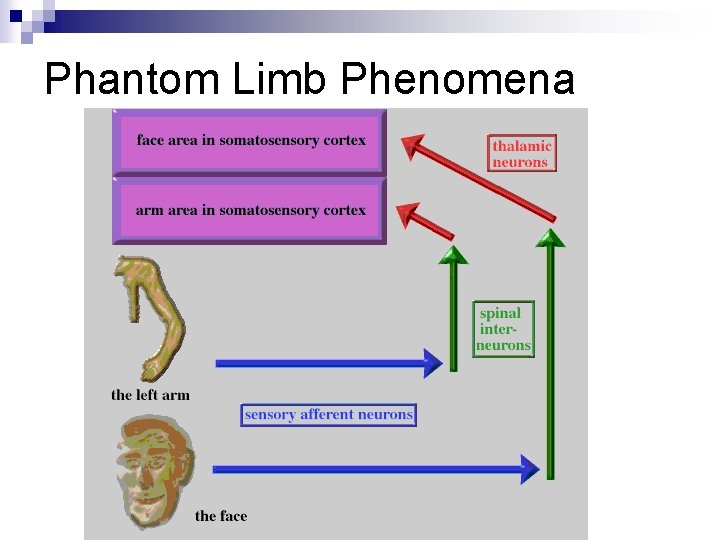
Phantom Limb Phenomena
Hand movement observation by individuals born without hands: phantom limb experience constrains visual limb perception. Funk M, Shiffrar M, Brugger P. We investigated the visual experiences of two persons born without arms, one with and the other without phantom sensations. Normally-limbed observers perceived rate-dependent paths of apparent human movement. The individual with phantom experiences showed the same perceptual pattern as control participants, the other did not. Neural systems matching action observation, action execution and motor imagery are likely contribute to the definition of body schema in profound ways.
Summary n Both genetic factors and activity dependent factors play a role in developing the brain architecture and circuitry. ¨ There are critical developmental periods where nurture is essential, but there is also a great ability for the adult brain to regenerate. n n Next lecture: What computational models satisfy some of the biological constraints. Question: What is the relevance of neural development and learning in language and thought?
Connectionist Models: Basics Jerome Feldman CS 182/Cog. Sci 110/Ling 109 Spring 2007
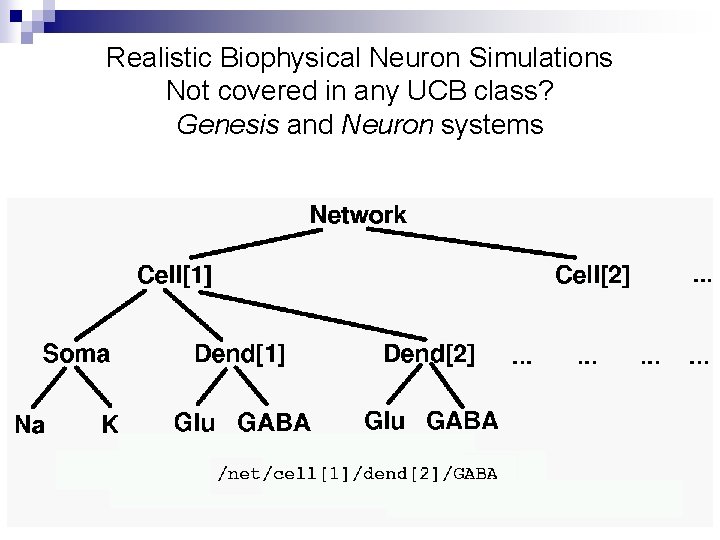
Realistic Biophysical Neuron Simulations Not covered in any UCB class? Genesis and Neuron systems
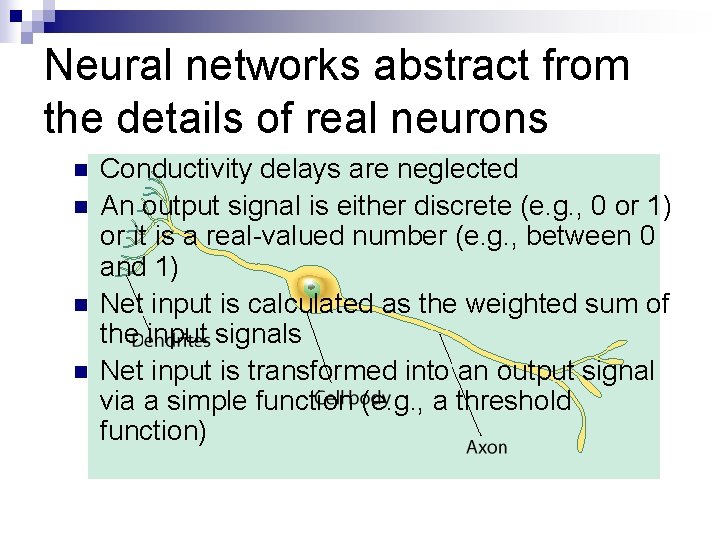
Neural networks abstract from the details of real neurons n n Conductivity delays are neglected An output signal is either discrete (e. g. , 0 or 1) or it is a real-valued number (e. g. , between 0 and 1) Net input is calculated as the weighted sum of the input signals Net input is transformed into an output signal via a simple function (e. g. , a threshold function)
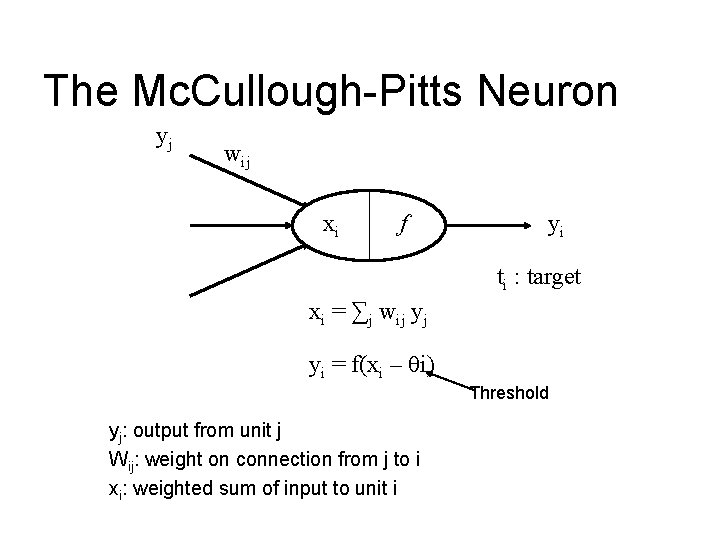
The Mc. Cullough-Pitts Neuron yj wij xi f yi ti : target xi = ∑j wij yj yi = f(xi – qi) Threshold yj: output from unit j Wij: weight on connection from j to i xi: weighted sum of input to unit i
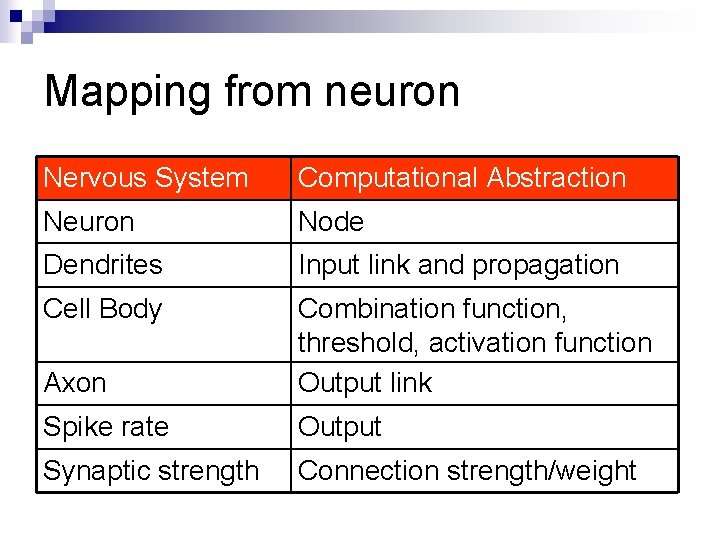
Mapping from neuron Nervous System Computational Abstraction Neuron Node Dendrites Input link and propagation Cell Body Axon Combination function, threshold, activation function Output link Spike rate Output Synaptic strength Connection strength/weight
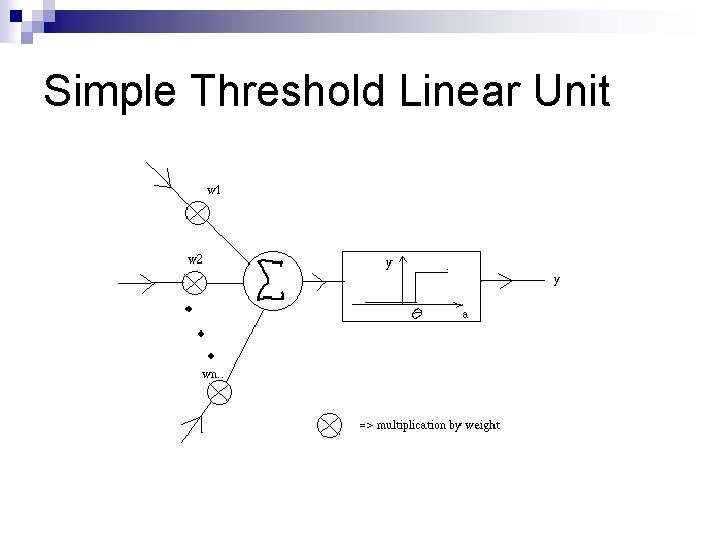
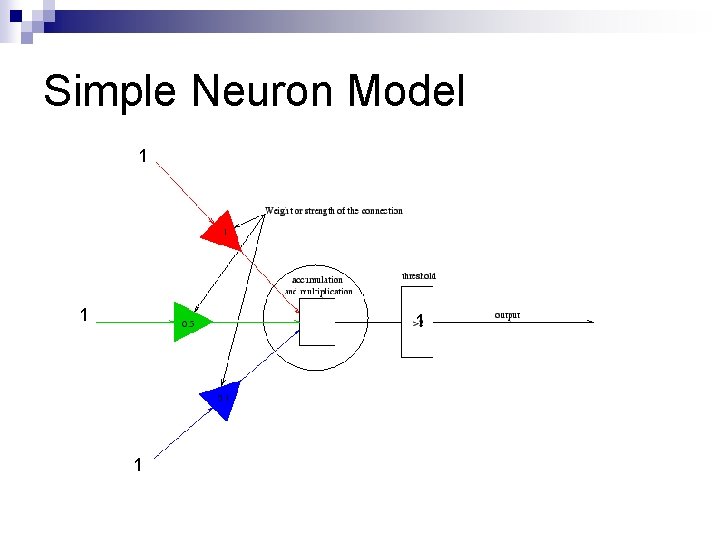
Simple Threshold Linear Unit
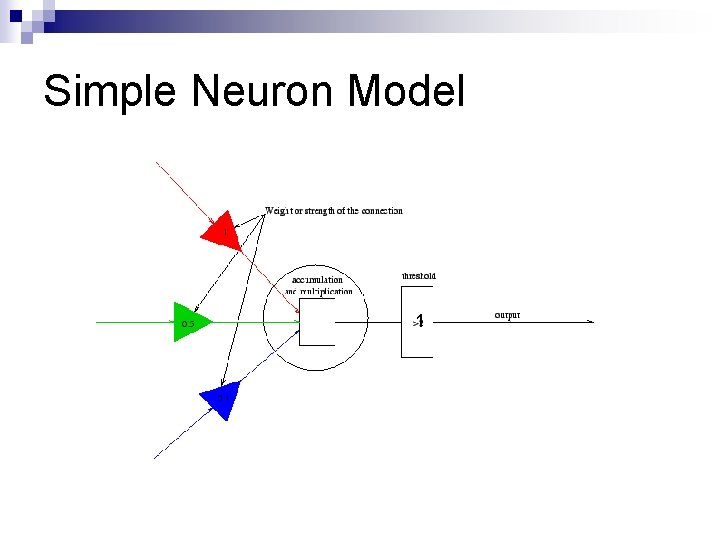
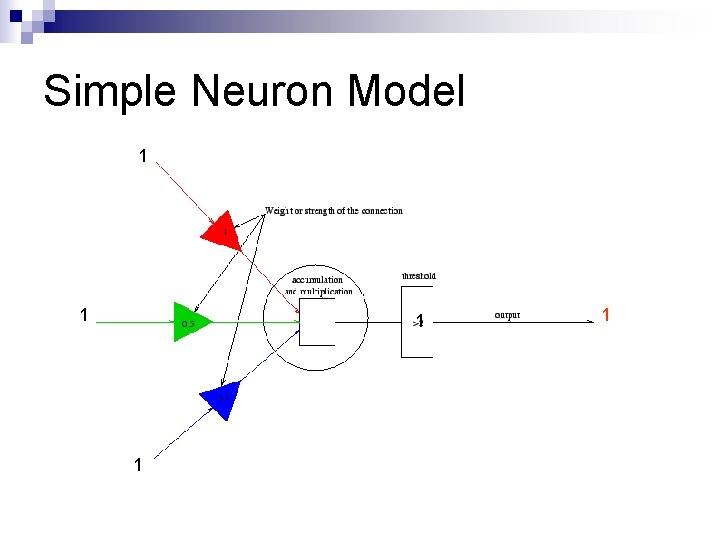
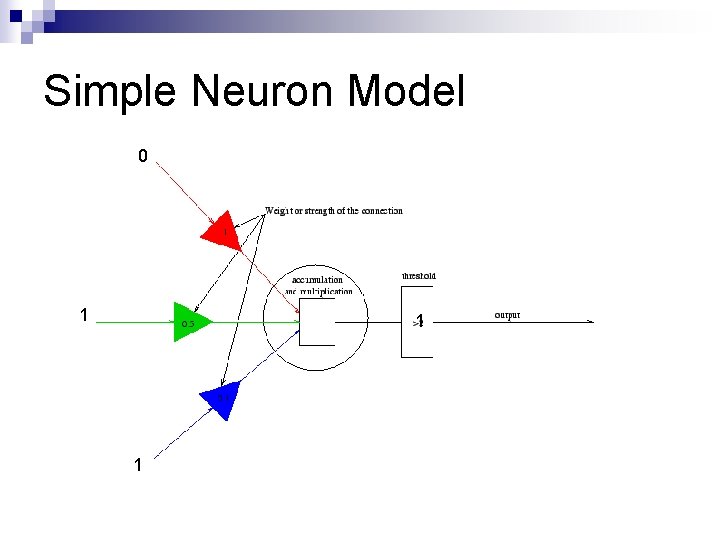
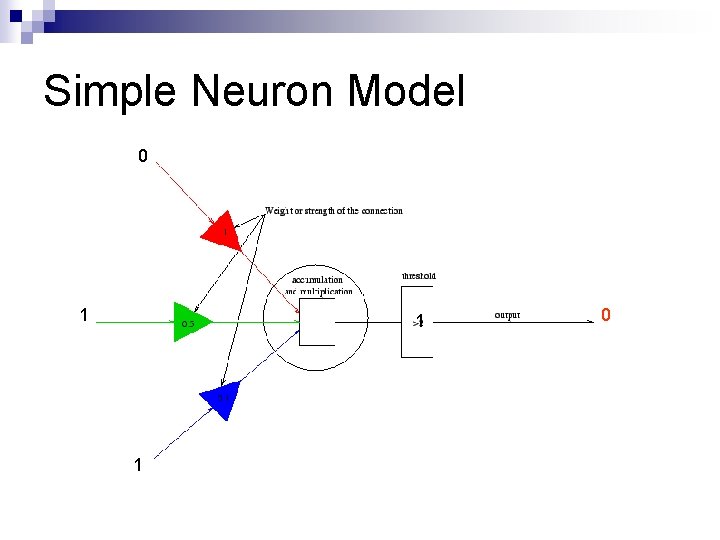
Simple Neuron Model 1
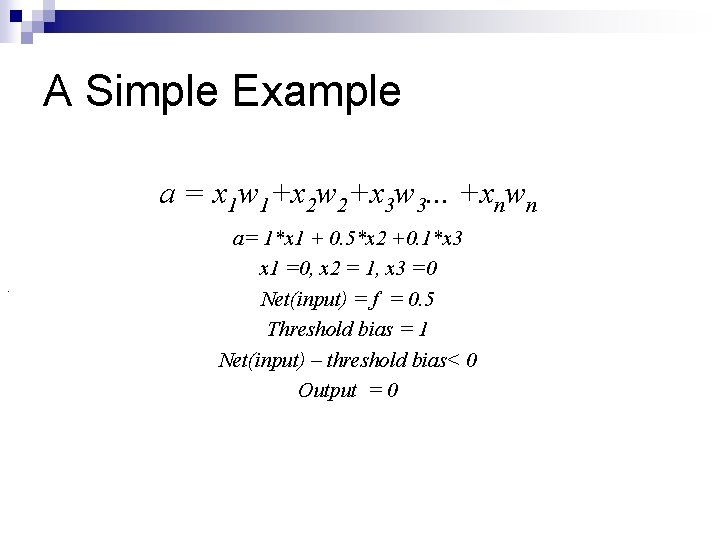
A Simple Example a = x 1 w 1+x 2 w 2+x 3 w 3. . . +xnwn. a= 1*x 1 + 0. 5*x 2 +0. 1*x 3 x 1 =0, x 2 = 1, x 3 =0 Net(input) = f = 0. 5 Threshold bias = 1 Net(input) – threshold bias< 0 Output = 0
Simple Neuron Model 1 1
Simple Neuron Model 1 1 1
Simple Neuron Model 0 1 1 1
Simple Neuron Model 0 1 1 1 0
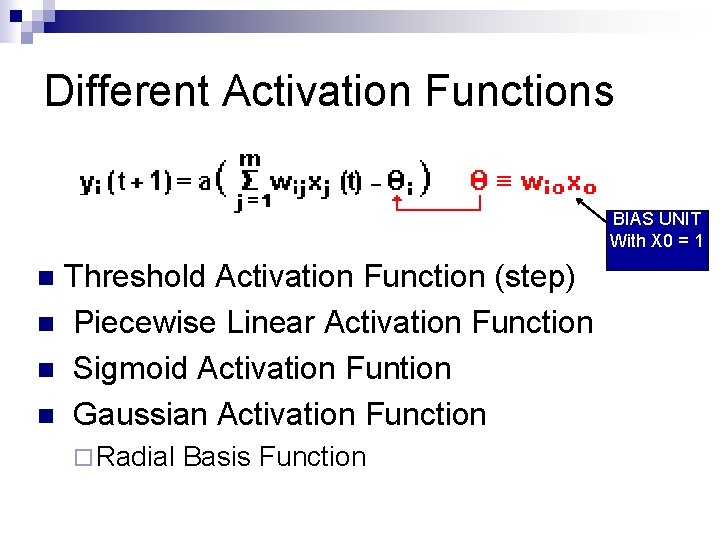
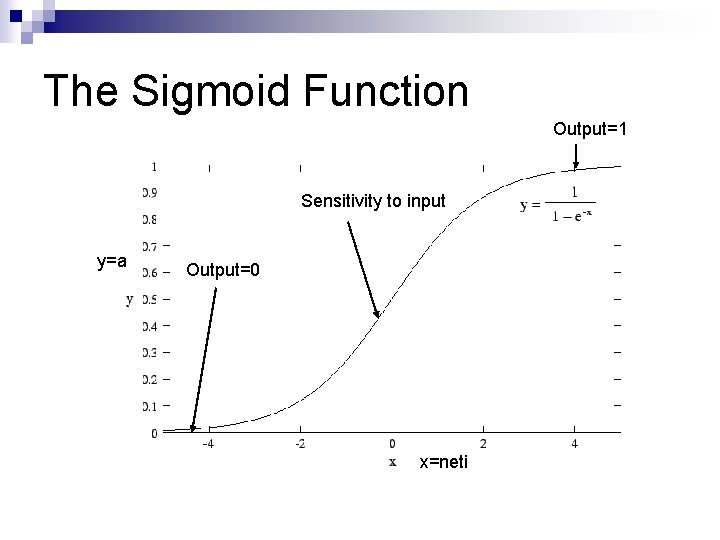
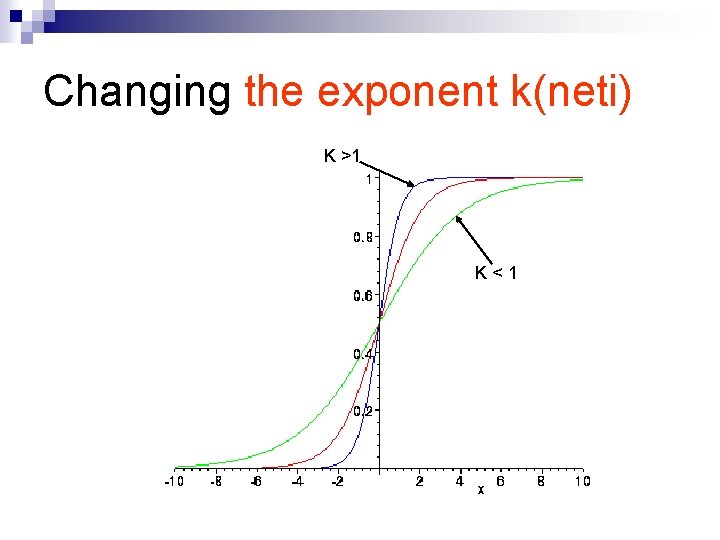
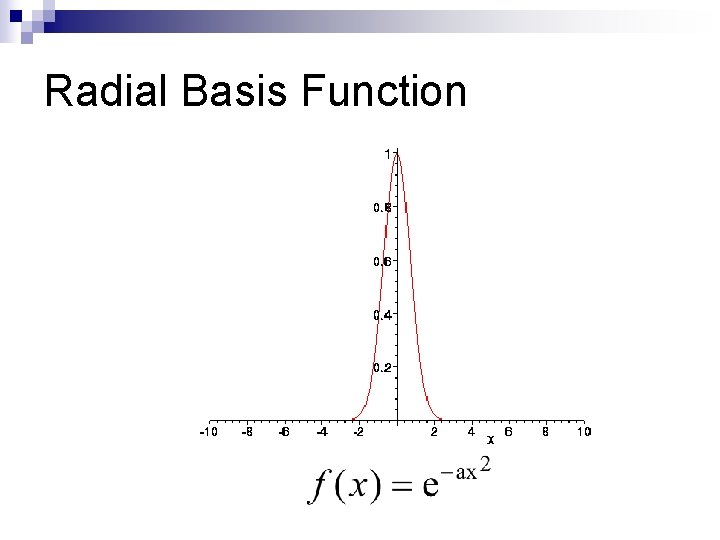
Different Activation Functions BIAS UNIT With X 0 = 1 Threshold Activation Function (step) n Piecewise Linear Activation Function n Sigmoid Activation Funtion n Gaussian Activation Function n ¨ Radial Basis Function
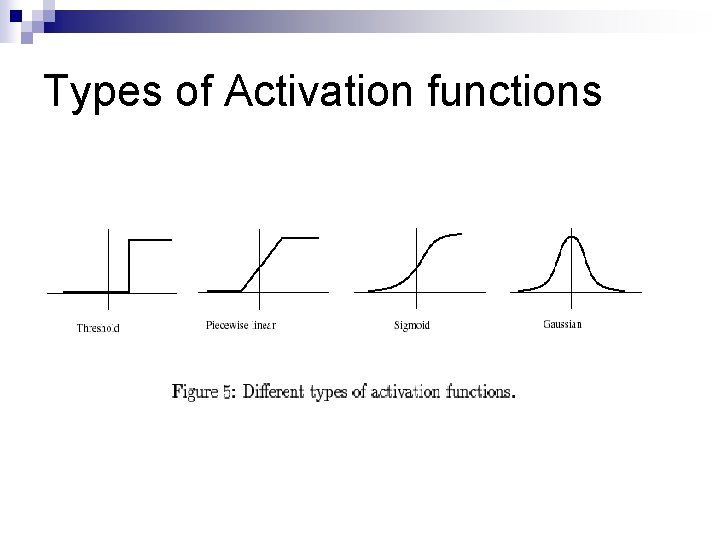
Types of Activation functions
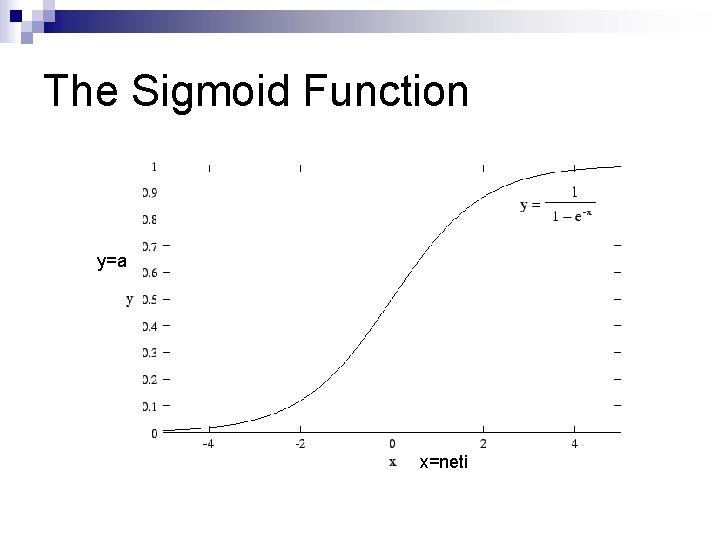
The Sigmoid Function y=a x=neti
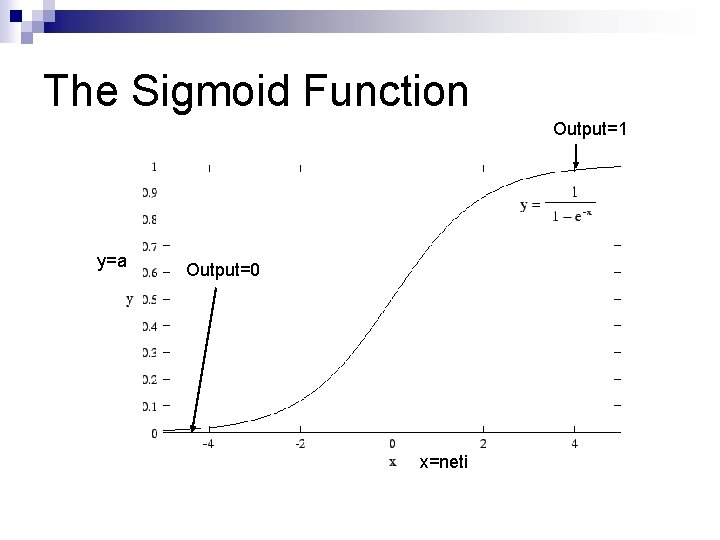
The Sigmoid Function Output=1 y=a Output=0 x=neti
The Sigmoid Function Output=1 Sensitivity to input y=a Output=0 x=neti
Changing the exponent k(neti) K >1 K < 1
Radial Basis Function
Stochastic units n Replace the binary threshold units by binary stochastic units that make biased random decisions. ¨ The “temperature” controls the amount of noise temperature
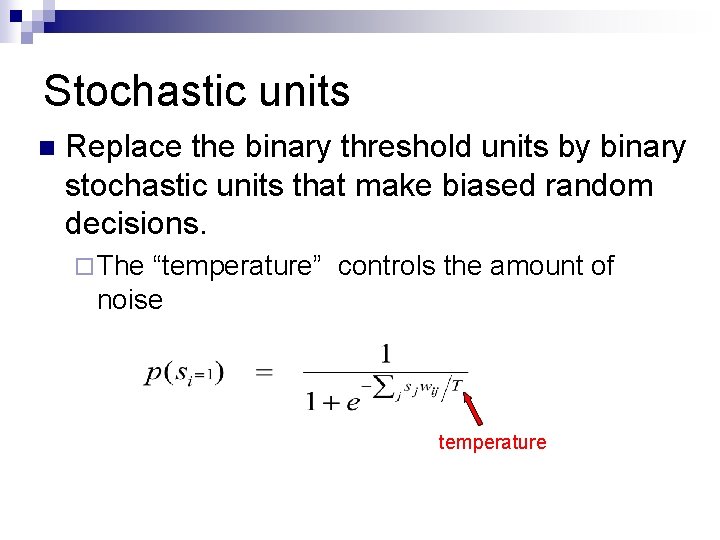
Types of Neuron parameters n n The form of the input function - e. g. linear, sigma-pi (multiplicative), cubic. The activation-output relation - linear, hardlimiter, or sigmoidal. The nature of the signals used to communicate between nodes - analog or boolean. The dynamics of the node - deterministic or stochastic.
Computing various functions n Mc. Collough-Pitts Neurons can compute logical functions. ¨ AND, NOT, OR
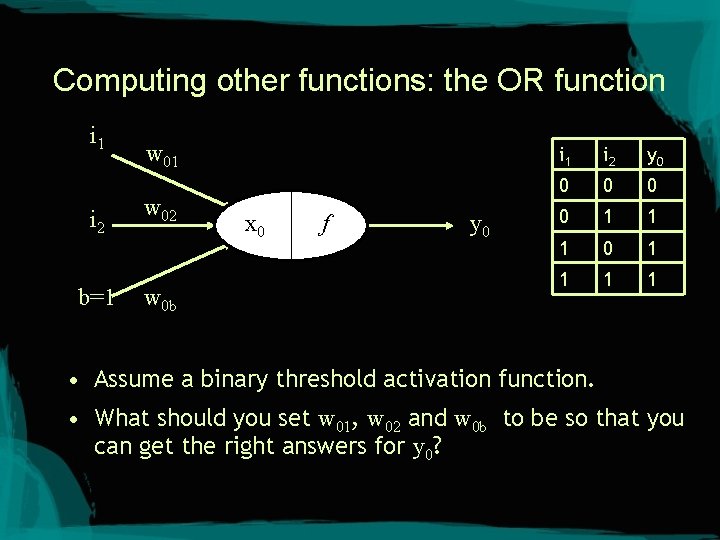
Computing other functions: the OR function i 1 i 2 b=1 w 02 w 0 b x 0 f y 0 i 1 i 2 y 0 0 0 1 1 1 1 • Assume a binary threshold activation function. • What should you set w 01, w 02 and w 0 b to be so that you can get the right answers for y 0?
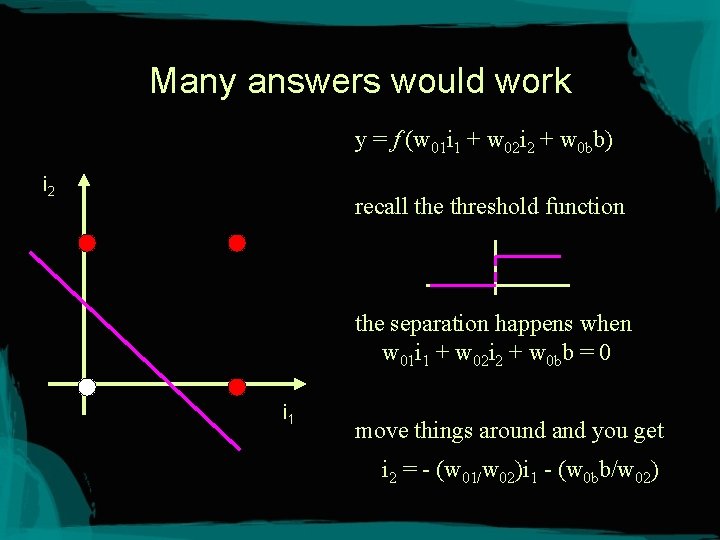
Many answers would work y = f (w 01 i 1 + w 02 i 2 + w 0 bb) i 2 recall the threshold function the separation happens when w 01 i 1 + w 02 i 2 + w 0 bb = 0 i 1 move things around and you get i 2 = - (w 01/w 02)i 1 - (w 0 bb/w 02)
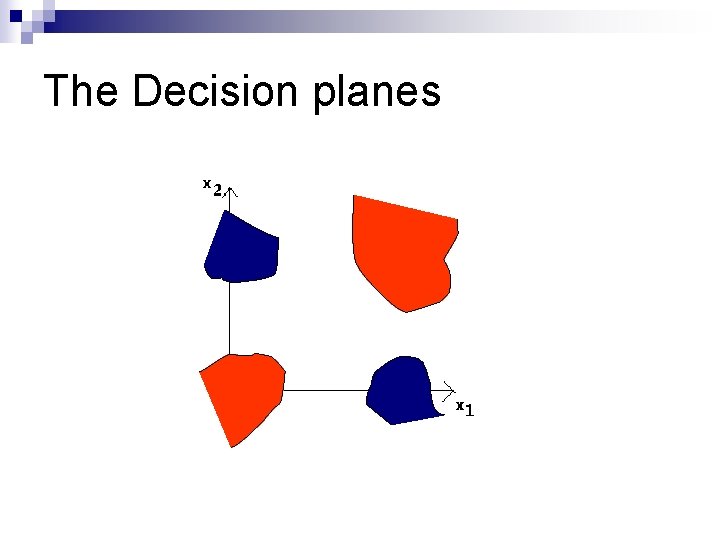
Decision Hyperplane n n The two classes are therefore separated by the `decision' line which is defined by putting the activation equal to the threshold. It turns out that it is possible to generalise this result to TLUs with n inputs. In 3 -D the two classes are separated by a decision-plane. In n-D this becomes a decision-hyperplane.
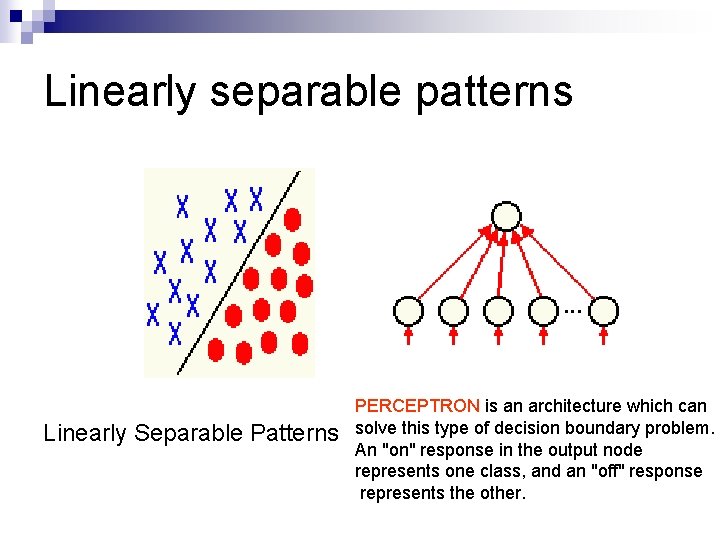
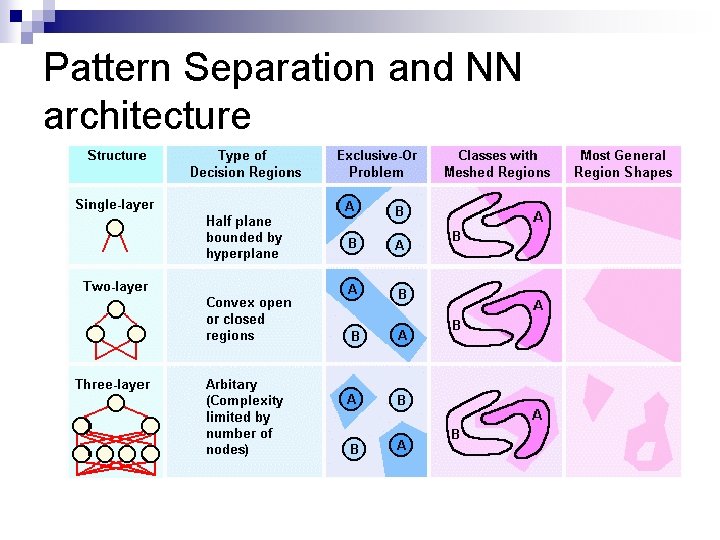
Linearly separable patterns Linearly Separable Patterns PERCEPTRON is an architecture which can solve this type of decision boundary problem. An "on" response in the output node represents one class, and an "off" response represents the other.
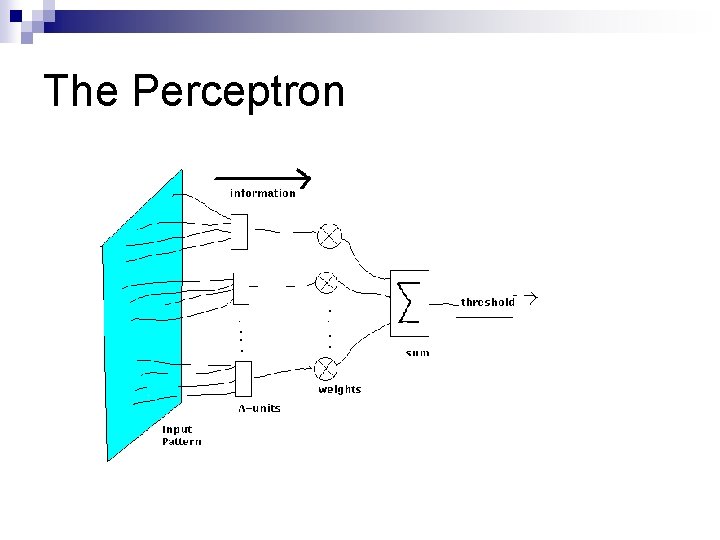
The Perceptron
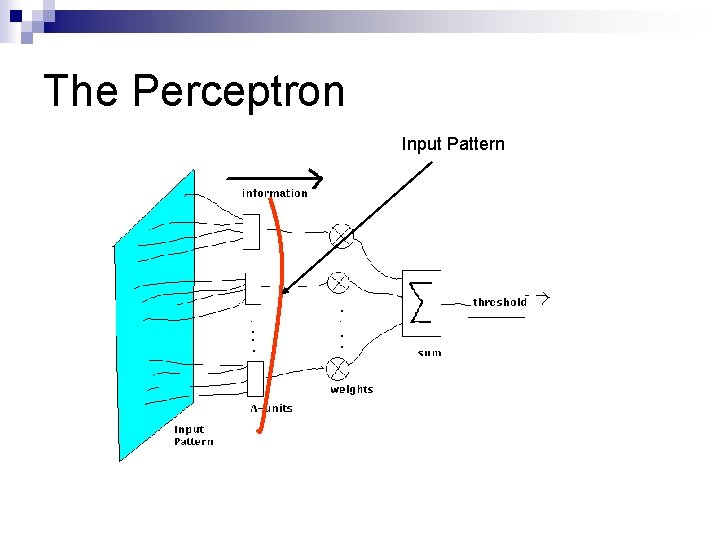
The Perceptron Input Pattern
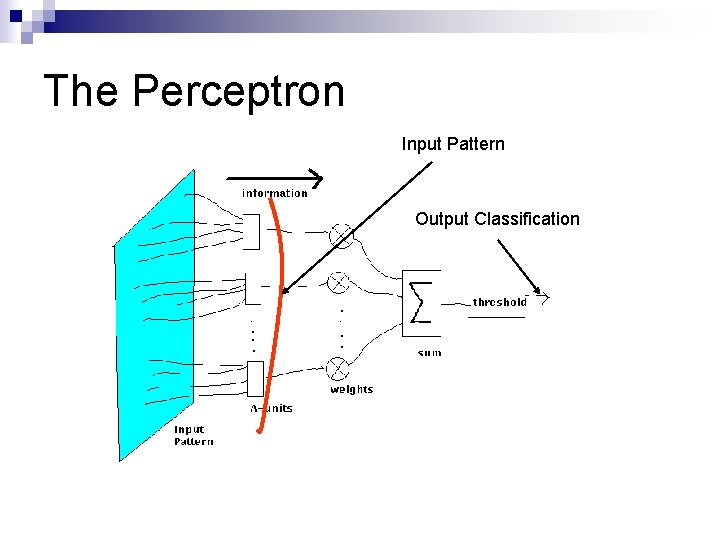
The Perceptron Input Pattern Output Classification
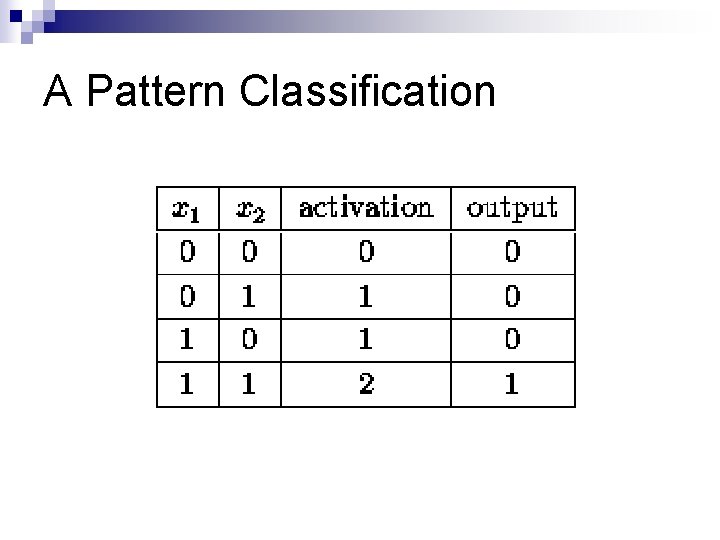
A Pattern Classification
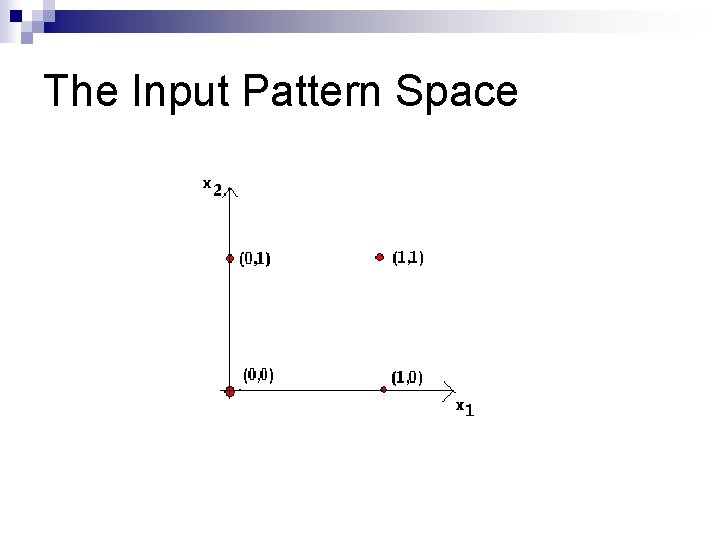
Pattern Space § The space in which the inputs reside is referred to as the pattern space. Each pattern determines a point in the space by using its component values as spacecoordinates. In general, for n-inputs, the pattern space will be n-dimensional. § Clearly, for n. D, the pattern space cannot be drawn or represented in physical space. This is not a problem: we shall return to the idea of using higher dimensional spaces later. However, the geometric insight obtained in 2 -D will carry over (when expressed algebraically) into n. D.
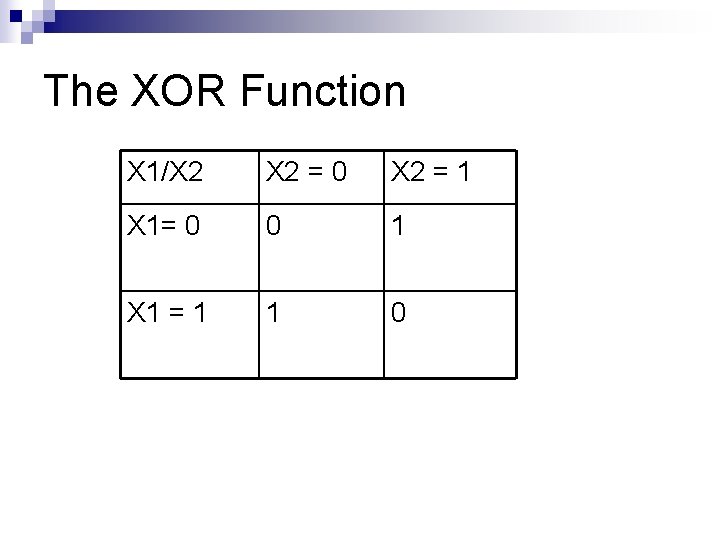
The XOR Function X 1/X 2 = 0 X 2 = 1 X 1= 0 0 1 X 1 = 1 1 0
The Input Pattern Space
The Decision planes
Multi-layer Feed-forward Network
Pattern Separation and NN architecture
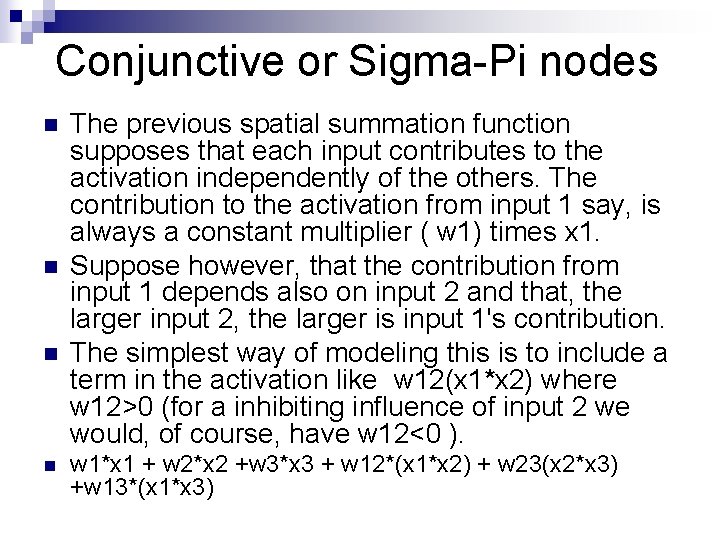
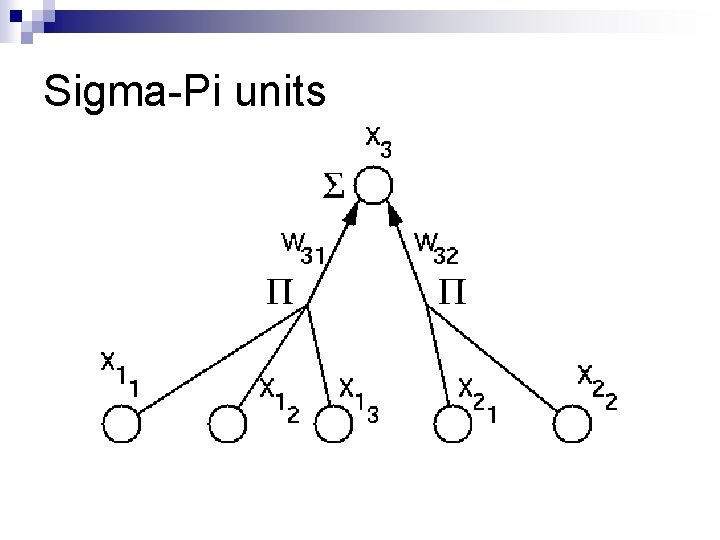
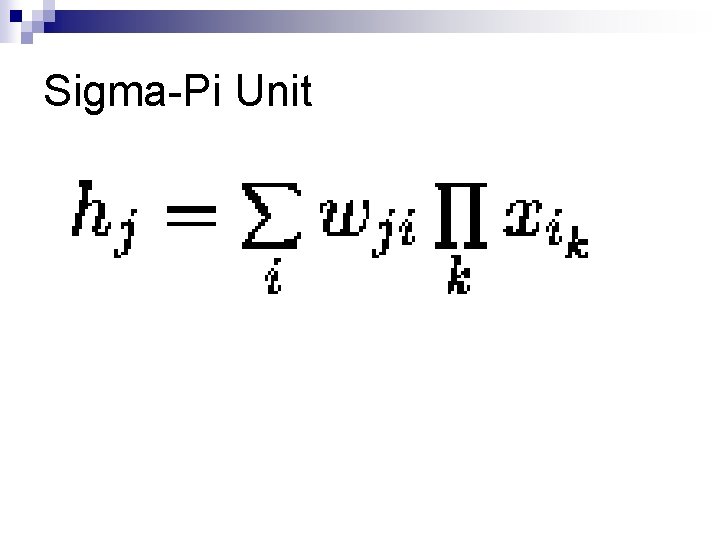
Conjunctive or Sigma-Pi nodes n n The previous spatial summation function supposes that each input contributes to the activation independently of the others. The contribution to the activation from input 1 say, is always a constant multiplier ( w 1) times x 1. Suppose however, that the contribution from input 1 depends also on input 2 and that, the larger input 2, the larger is input 1's contribution. The simplest way of modeling this is to include a term in the activation like w 12(x 1*x 2) where w 12>0 (for a inhibiting influence of input 2 we would, of course, have w 12<0 ). w 1*x 1 + w 2*x 2 +w 3*x 3 + w 12*(x 1*x 2) + w 23(x 2*x 3) +w 13*(x 1*x 3)
Sigma-Pi units
Sigma-Pi Unit
![Biological Evidence for Sigma-Pi Units n n n [axo-dendritic synapse] The stereotypical synapse consists](http://slidetodoc.com/presentation_image/360f0f78d4fb5ebfe398b4b433e05d66/image-44.jpg "Biological Evidence for Sigma-Pi Units n n n [axo-dendritic synapse] The stereotypical synapse consists")
Biological Evidence for Sigma-Pi Units n n n [axo-dendritic synapse] The stereotypical synapse consists of an electro-chemical connection between an axon and a dendrite - hence it is an axo-dendritic synapse [presynaptic inhibition] However there is a large variety of synaptic types and connection grouping. Of special importance are cases where the efficacy of the axo-dendritic synapse between axon 1 and the dendrite is modulated (inhibited) by the activity in axon 2 via the axo-axonic synapse between the two axons. This might therefore be modelled by a quadratic like w 12(x 1*x 2) [synapse cluster] Here the effect of the individual synapses will surely not be independent and we should look to model this with a multilinear term in all the inputs.
![Biological Evidence for Sigma-Pi units [axo-dendritic synapse] [presynaptic inhibition] [synapse cluster]](http://slidetodoc.com/presentation_image/360f0f78d4fb5ebfe398b4b433e05d66/image-45.jpg "Biological Evidence for Sigma-Pi units [axo-dendritic synapse] [presynaptic inhibition] [synapse cluster]")
Biological Evidence for Sigma-Pi units [axo-dendritic synapse] [presynaptic inhibition] [synapse cluster]
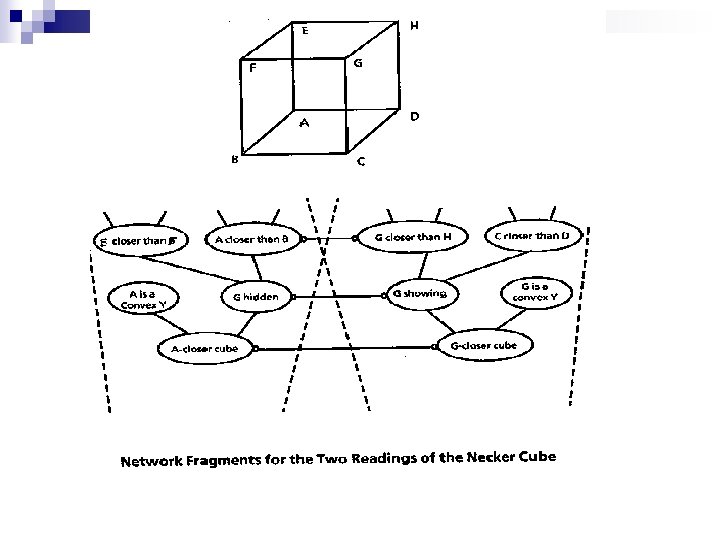
Link to Vision: The Necker Cube
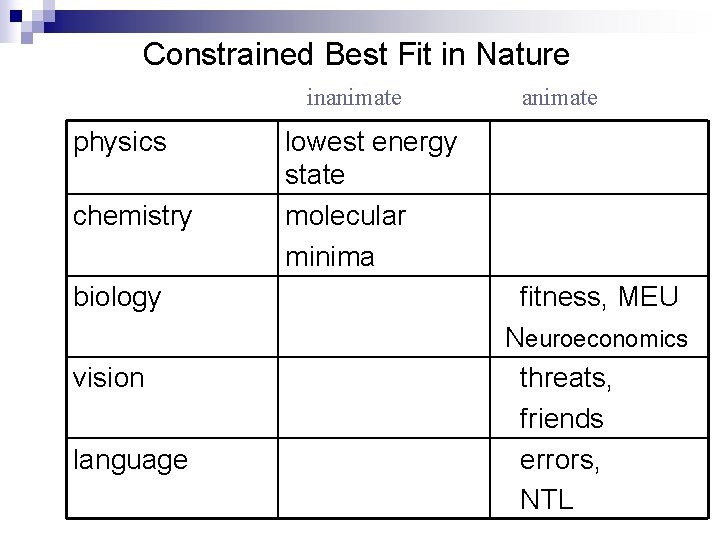
Constrained Best Fit in Nature inanimate physics chemistry biology vision language animate lowest energy state molecular minima fitness, MEU Neuroeconomics threats, friends errors, NTL
Computing other relations The 2/3 node is a useful function that activates its outputs (3) if any (2) of its 3 inputs are active n Such a node is also called a triangle node and will be useful for lots of representations. n
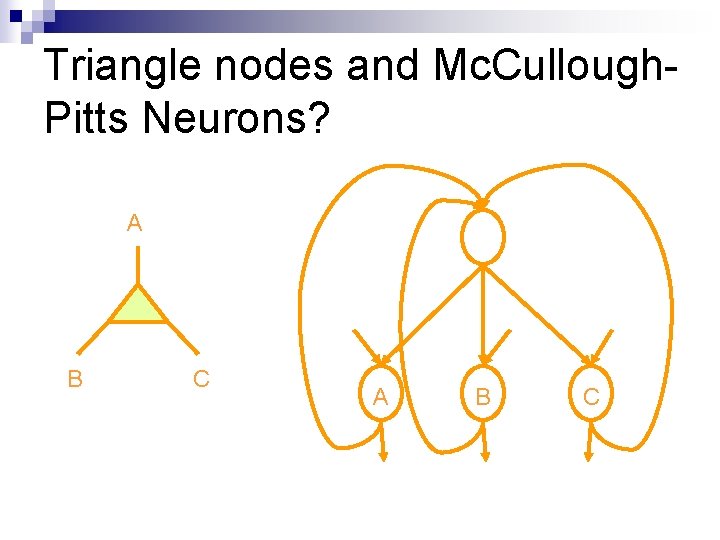
Triangle nodes and Mc. Cullough. Pitts Neurons? A B C
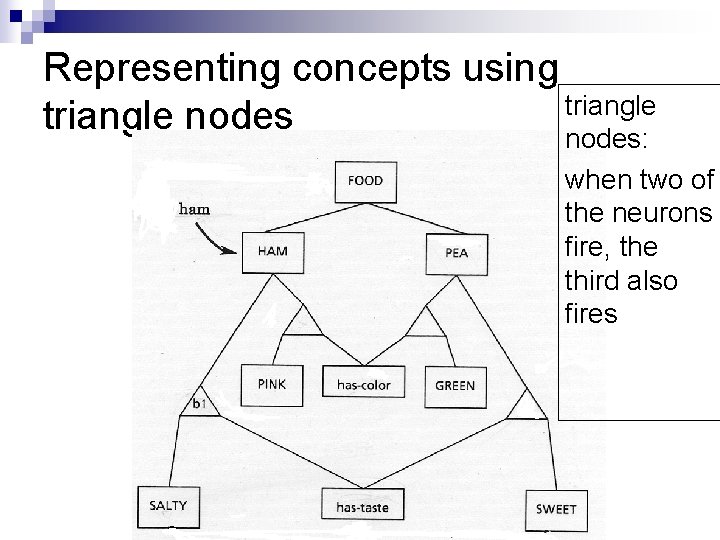
Representing concepts using triangle nodes: when two of the neurons fire, the third also fires
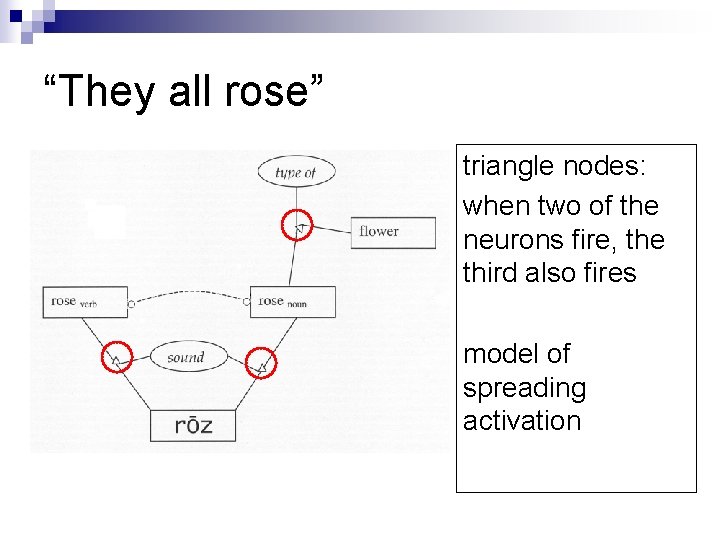
“They all rose” triangle nodes: when two of the neurons fire, the third also fires model of spreading activation
Basic Ideas behind the model n n n Parallel activation streams. Top down and bottom up activation combine to determine the best matching structure. Triangle nodes bind features of objects to values Mutual inhibition and competition between structures Mental connections are active neural connections
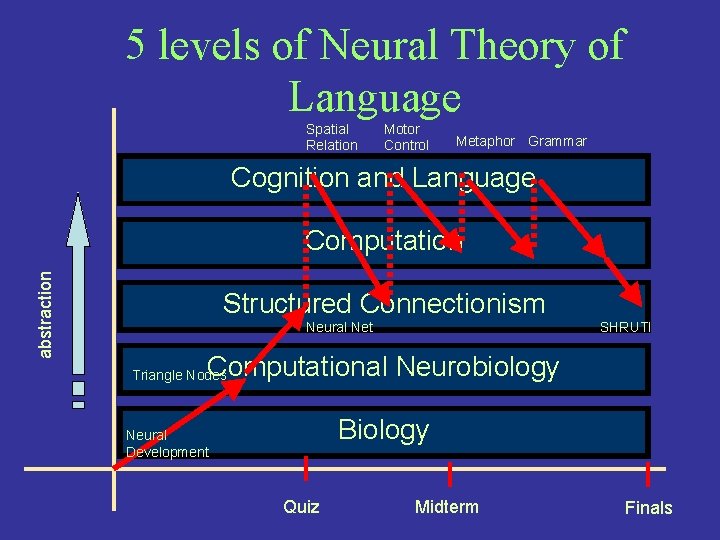
5 levels of Neural Theory of Language Spatial Relation Motor Control Metaphor Grammar Cognition and Language abstraction Computation Structured Connectionism Neural Net SHRUTI Computational Neurobiology Triangle Nodes Biology Neural Development Quiz Midterm Finals
Can we formalize/model these intuitions What is a neurally plausible computational model of spreading activation that captures these features. n What does semantics mean in neurally embodied terms n ¨ What are the neural substrates of concepts that underlie verbs, nouns, spatial predicates?
- Slides: 55