
Phantom Limb Lesson to be given to Biology
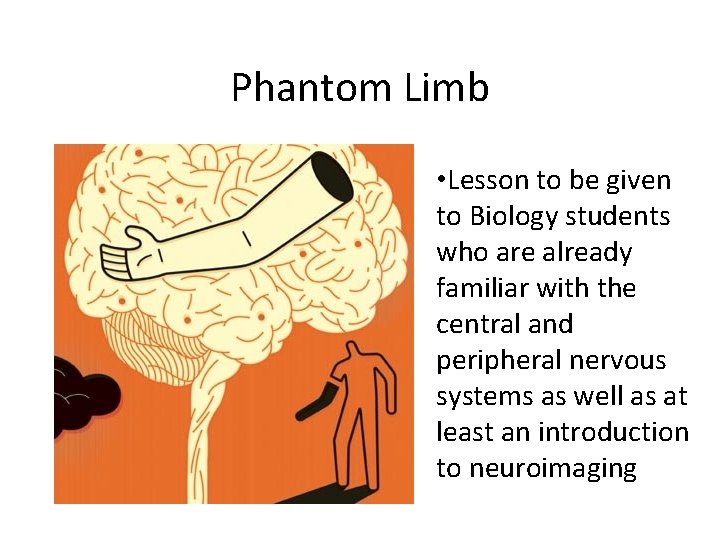
Phantom Limb • Lesson to be given to Biology students who are already familiar with the central and peripheral nervous systems as well as at least an introduction to neuroimaging
Guiding questions • How do your senses of touch and pain help you to navigate your surroundings? • What roles do touch and pain play in your awareness of your own body throughout your day? • How does the nervous system allow you to sense touch and pain? • How can sensations of touch and pain be observed in the brain noninvasively in humans? • Have you ever felt a touch or a pain that was not aligned with reality? If so, is there a scientific explanation?
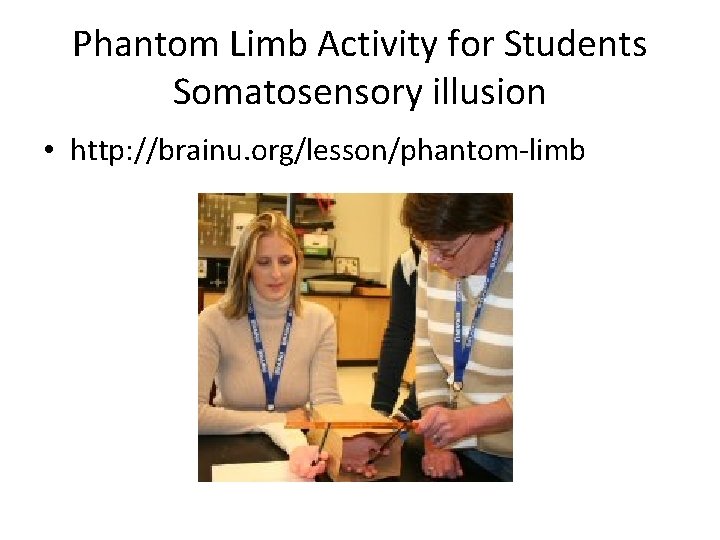
Phantom Limb Activity for Students Somatosensory illusion • http: //brainu. org/lesson/phantom-limb
Phantom Limb in non-humans • Cat video! • https: //upload. wikimedia. org/wikipedia/com mons/4/4 f/Cat_with_phantom_forelimb. web mhd. webm
Phantom Limb • Homework/in-class reading for students: -“The perception of phantom limbs” by V. S. Ramachandran and William Hirstein -Selected excerpts from Phantoms in the Brain by V. S. Ramachandran -Selected excerpts from Oliver Sacks book(s) • What is going on in the brains of patients who are experiencing phantom limb? -Students will discuss and write their answer(s) to be shared with the rest of the class, using their notes and readings
Phantom Limb • Phantom limb pain (the perception of pain, paresthesia, itching, tingling, and other sensations of a missing limb) occurs in more than 90% of those who have lost a limb to amputation. 1 This phenomenon has been documented for centuries in medical textbooks and in literature. While the perception of phantom limb pain may be a mild painless annoyance to some, in others it is very disruptive and interferes with work or sleep. Phantom limb pain is a hallucination created in the subconscious mind that a missing limb still exists. This hallucination involves a very realistic perception of the missing limb even though the conscious mind clearly conceptualizes the lost limb. • Particularly interesting is that phantom limb pain has been noted in those who are missing limbs due to birth defects. 2 People who never had a limb can still have the perception of phantom limb pain. This points to the prospect that the brain is disposed to an interaction with its limbs. The brain is hardwired to send and receive neurotransmissions with the various body parts. The perception of having limbs is implanted into the brain rather than learned. In response to this knowledge, Ronald Melzack introduced the concept of the presence of a neuromatrix. 1
Phantom Limb • Most, but not all phantom limb sensations are painful – Ex. the feeling that a phantom arm is longer than it should be, the sensation of fingers touching each other on a phantom hand • Not all phantom limb sensations result from amputations • -Ex. a woman born without arms may feel sensations of extending her arms

Phantom Limb
Phantom Limb • Can you “amputate” a phantom limb? • How important is visual feedback in nonvisual sensations such as touch and pain? • Can phantom pains be cured with medication? • Can phantom pains be cured without medication? • How have people with phantom limbs responded to various treatments?
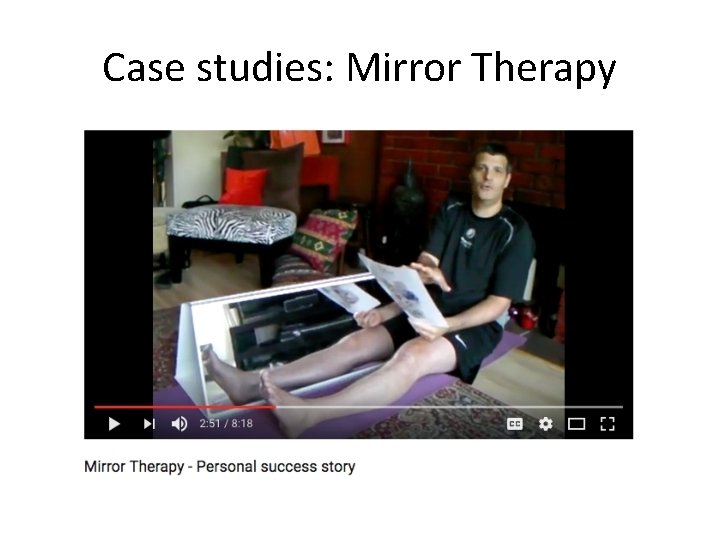
Case studies: Mirror Therapy
Student Discussion • Imagine that you are an elected official who needs to make an informed recommendation to a population of either diabetic or war veteran (or both!) amputees in Connecticut who are experiencing recurrent phantom pain, but you do not yet have all of the information that you need to make an informed decision. • Write at least 6 questions that you still have about this situation. What else do you need to know? • Write a list of at least 4 sources/people/associations etc to theoretically contact to answer these questions. Think about professions of people who may be able to help you with your decision.
- Slides: 12