
Phaco Tip Displacement and Working Frequencies of different


- Slides: 11
Phaco Tip Displacement and Working Frequencies of different Phaco Machines Daniele Tognetto MD, Pia Leon MD, Paolo Cecchini MD, Silvia Rinaldi MD, Giuseppe Ravalico MD University Eye Clinic of Trieste (Italy) Head: Prof. Giuseppe Ravalico The Authors have no proprietary interest in any products or devices discussed in this presentation Aim of the study: Step 1. determine the working frequency of the phaco machines Step 2. evaluate the extent of the longitudinal stroke of the phaco machines Step 3. analyze the shape and the dynamics of the stroke of two phaco machines working with lateral tip movements
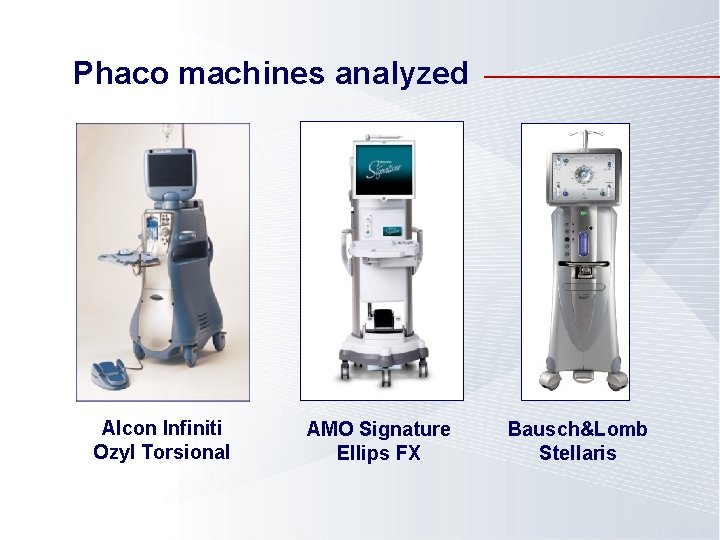
Phaco machines analyzed Alcon Infiniti Ozyl Torsional AMO Signature Ellips FX Bausch&Lomb Stellaris
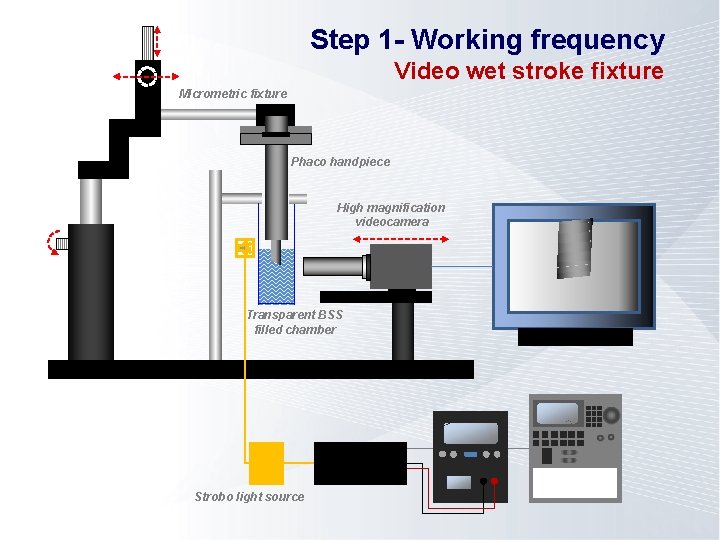
Step 1 - Working frequency Video wet stroke fixture Micrometric fixture Phaco handpiece High magnification videocamera Transparent BSS filled chamber Strobo light source
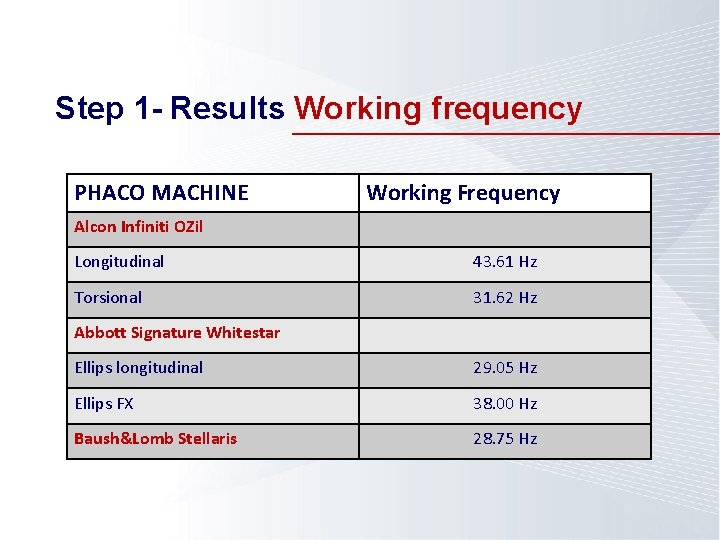
Step 1 - Results Working frequency PHACO MACHINE Working Frequency Alcon Infiniti OZil Longitudinal 43. 61 Hz Torsional 31. 62 Hz Abbott Signature Whitestar Ellips longitudinal 29. 05 Hz Ellips FX 38. 00 Hz Baush&Lomb Stellaris 28. 75 Hz
Step 2 -Tip dynamics Video wet stroke fixture X and Y superimposed measurement lines Light source x y x Phaco handpiece y Camera Micrometric video controller Transparent BSS filled chamber High magnification videocamera External peristaltic pump A shiny spot is used as a surface landmark which generates a visible trace varying in shape and length according to the tip movement
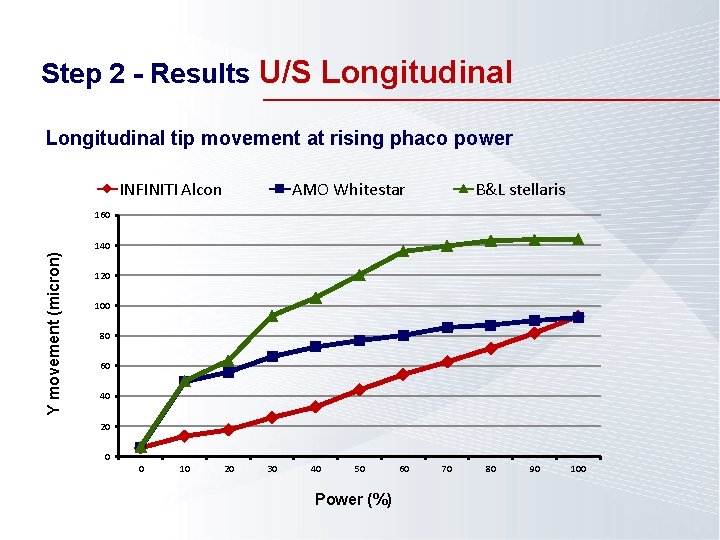
Step 2 - Results U/S Longitudinal tip movement at rising phaco power INFINITI Alcon AMO Whitestar B&L stellaris 160 Y movement (micron) 140 120 100 80 60 40 20 0 0 10 20 30 40 50 Power (%) 60 70 80 90 100
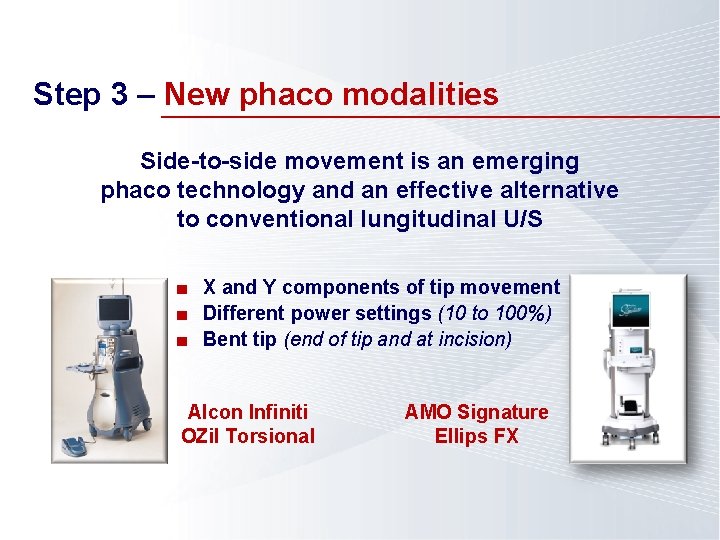
Step 3 – New phaco modalities Side-to-side movement is an emerging phaco technology and an effective alternative to conventional lungitudinal U/S ■ X and Y components of tip movement ■ Different power settings (10 to 100%) ■ Bent tip (end of tip and at incision) Alcon Infiniti OZil Torsional AMO Signature Ellips FX
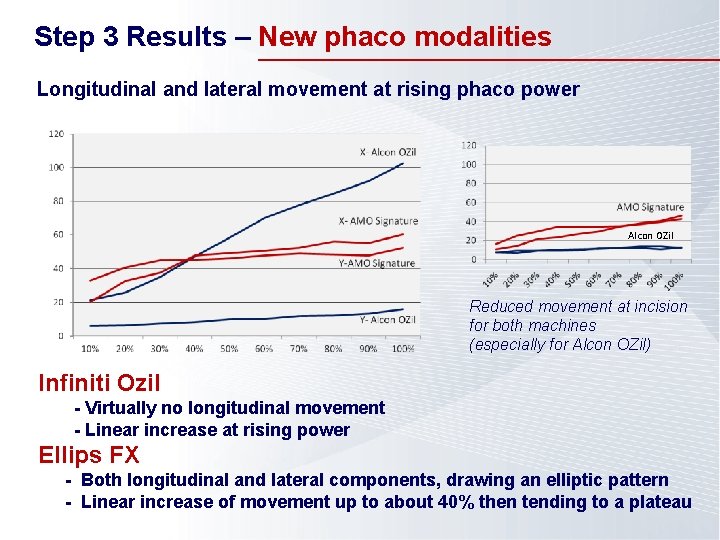
Step 3 Results – New phaco modalities Longitudinal and lateral movement at rising phaco power Alcon OZil Reduced movement at incision for both machines (especially for Alcon OZil) Infiniti Ozil - Virtually no longitudinal movement - Linear increase at rising power Ellips FX - Both longitudinal and lateral components, drawing an elliptic pattern - Linear increase of movement up to about 40% then tending to a plateau
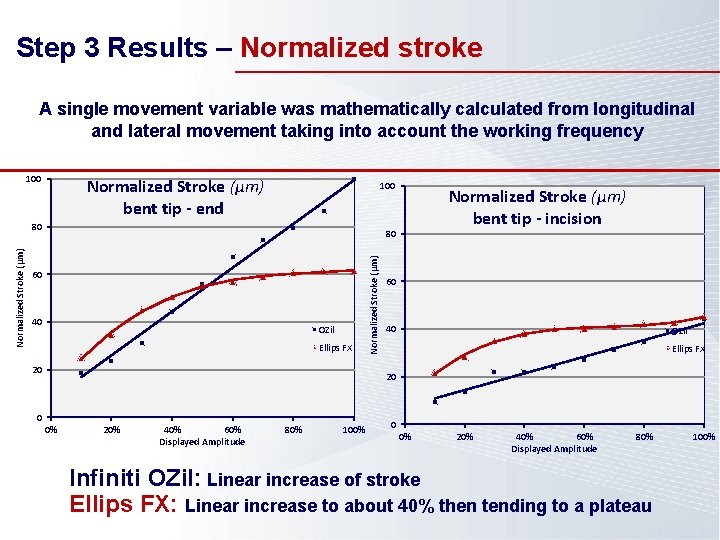
Step 3 Results – Normalized stroke A single movement variable was mathematically calculated from longitudinal and lateral movement taking into account the working frequency 100 Normalized Stroke (µm) bent tip - end 100 80 60 40 OZil Ellips FX 20 Normalized Stroke (µm) 80 Normalized Stroke (µm) bent tip - incision 60 40 OZil Ellips FX 20 0 0% 20% 40% 60% Displayed Amplitude 80% 100% 0 0% 20% 40% 60% Displayed Amplitude 80% Infiniti OZil: Linear increase of stroke Ellips FX: Linear increase to about 40% then tending to a plateau 100%
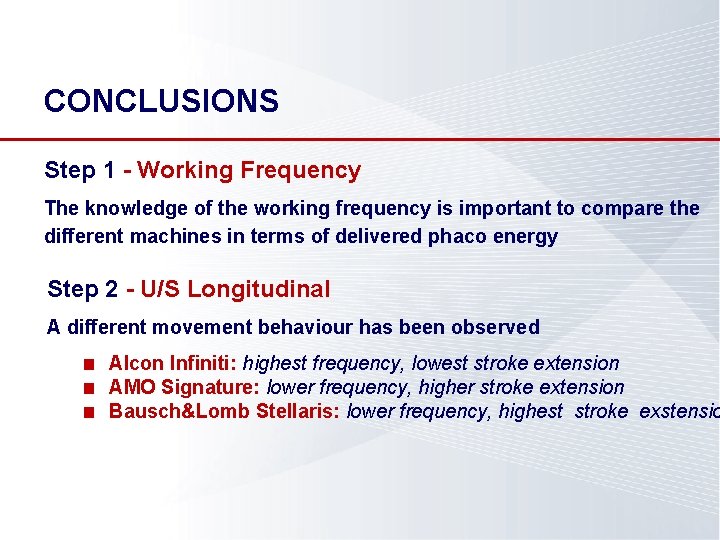
CONCLUSIONS Step 1 - Working Frequency The knowledge of the working frequency is important to compare the different machines in terms of delivered phaco energy Step 2 - U/S Longitudinal A different movement behaviour has been observed ■ Alcon Infiniti: highest frequency, lowest stroke extension ■ AMO Signature: lower frequency, higher stroke extension ■ Bausch&Lomb Stellaris: lower frequency, highest stroke exstensio
CONCLUSIONS Step 3 - Torsional and transversal mode ■ Infiniti OZil: - Horizontal stroke with linear power delivery - Longitudinal stroke almost absent ■ Ellips FX: - Mostly horizontal stroke up to 40% - Mostly longitudinal stroke tending to a plateau over 40% power The stroke dynamic is an important variable affecting phaco cutting efficiency Its knowledge is crucial to exploit the advantages of these new phaco devices