
PH 244 Pre Health Physics 2 Electric Potential


- Slides: 8
PH 244 Pre Health Physics 2
Electric Potential Energy • A small positive charge q+ is moved at constant velocity against the electric field E in a straight line from the negative to the positive an external force is required to equal the electric force • F = q +E • There is work done by this force W = Fd • Therefore W = q+Ed • And we remember from before that W= ΔU • So ΔU = q+Ed
Electric Potential Difference • The electric potential difference (ΔV) between any two points in space is defined as the change in potential energy per unit positive test charge. • ΔV = ΔU/q+ • Where ΔV is the electric potential difference and the SI unit is the joule per coulomb J/C or volt (V)
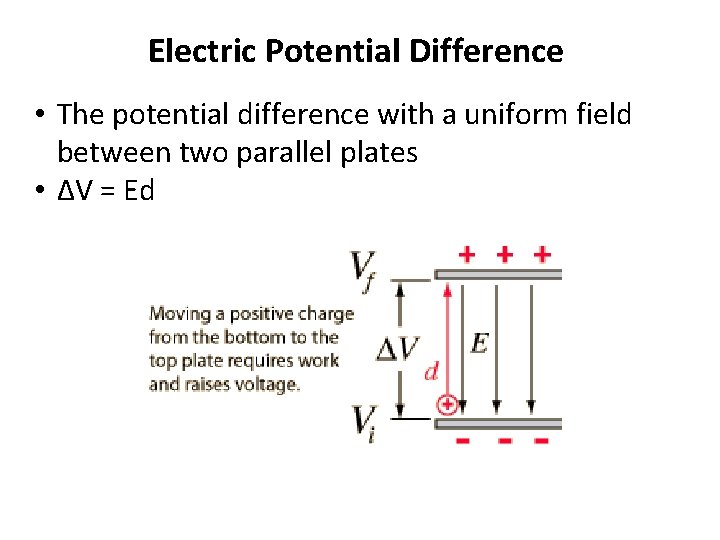
Electric Potential Difference • The potential difference with a uniform field between two parallel plates • ΔV = Ed
Electric Potential Difference • The electrical potential at a very large distance from a point charge is usually chosen to be zero • The electric potential V at a distance r from the point charge is: • V = kq/r
Electric Potential Difference • For a pair of oppositely charged parallel plates, the positively charged plate is at a higher electric potential than the negatively charged plate by an amount equal to ΔV. • Why? • What if ΔV was equal to 0?
Electric Potential Difference • Positive charges, when released in an electric field, accelerate towards regions of lower electric potential • Negative charges, when released in an electric field, accelerate towards regions of higher electric potential
• Pg. 591: 1 -3,