
PGT 101 Chapter 5 CAPACITORS INDUCTORS BY MDM
PGT 101 Chapter 5 CAPACITORS & INDUCTORS BY MDM DAYANG KHADIJAH BT HAMZAH
Overview • This chapter will introduce two new linear circuit elements: • The capacitor • The inductor • Unlike resistors, these elements do not dissipate energy • They instead store energy • We will also look at how to analyze them in a circuit 2
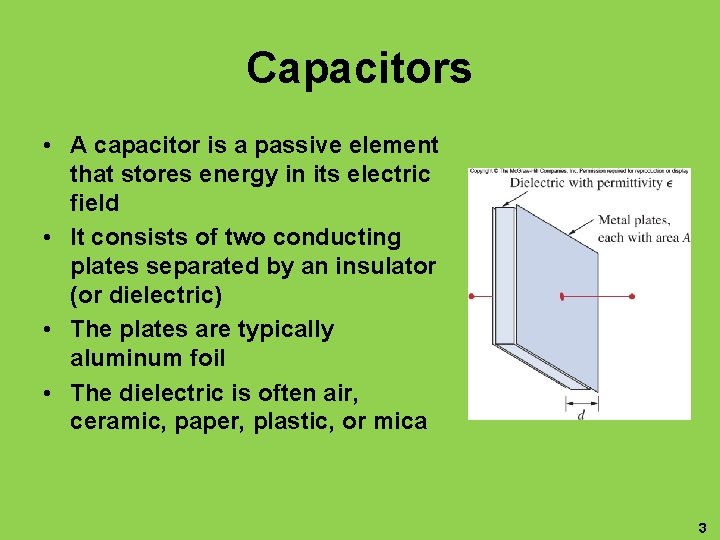
Capacitors • A capacitor is a passive element that stores energy in its electric field • It consists of two conducting plates separated by an insulator (or dielectric) • The plates are typically aluminum foil • The dielectric is often air, ceramic, paper, plastic, or mica 3
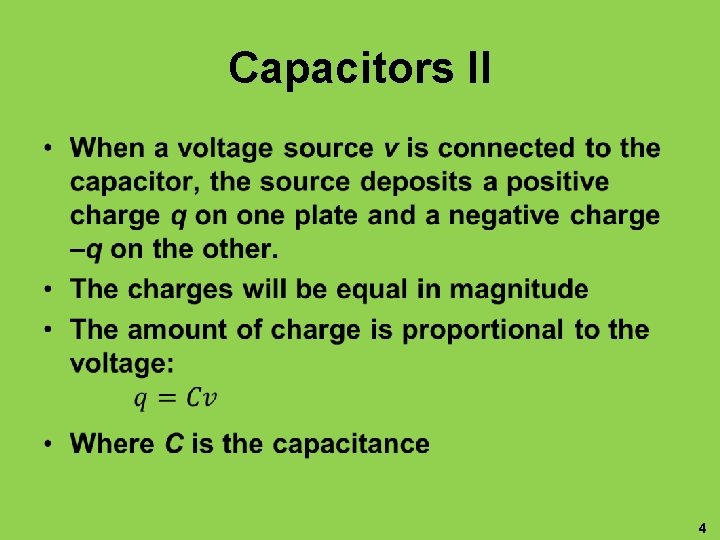
Capacitors II • 4
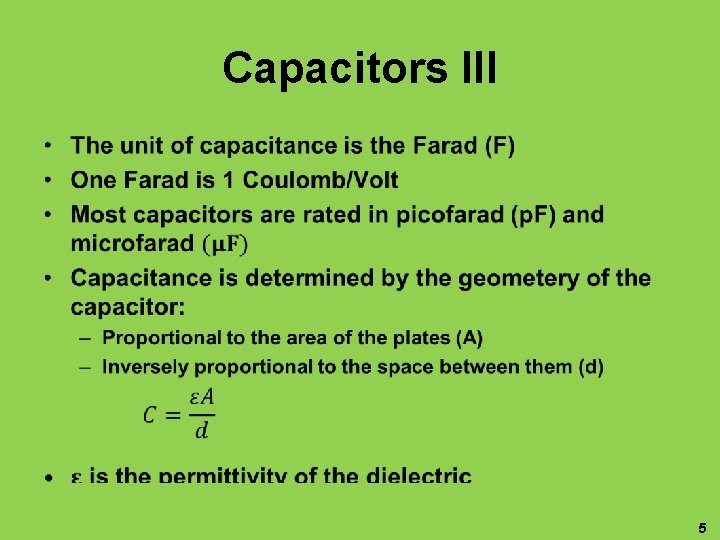
Capacitors III • 5
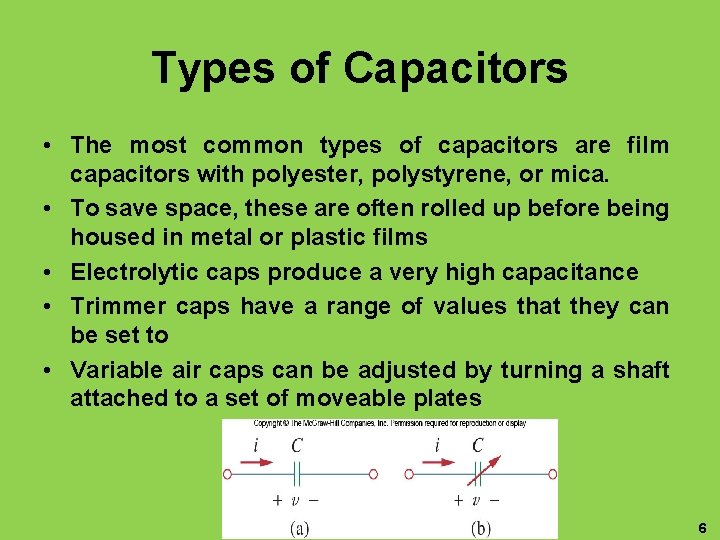
Types of Capacitors • The most common types of capacitors are film capacitors with polyester, polystyrene, or mica. • To save space, these are often rolled up before being housed in metal or plastic films • Electrolytic caps produce a very high capacitance • Trimmer caps have a range of values that they can be set to • Variable air caps can be adjusted by turning a shaft attached to a set of moveable plates 6
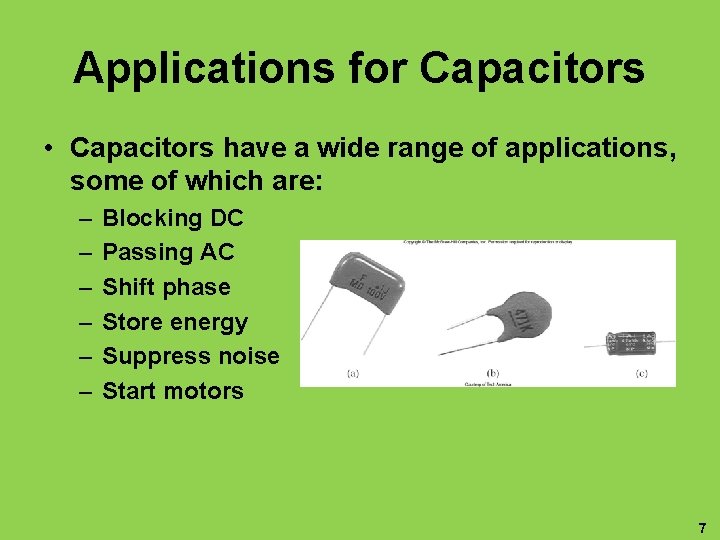
Applications for Capacitors • Capacitors have a wide range of applications, some of which are: – – – Blocking DC Passing AC Shift phase Store energy Suppress noise Start motors 7
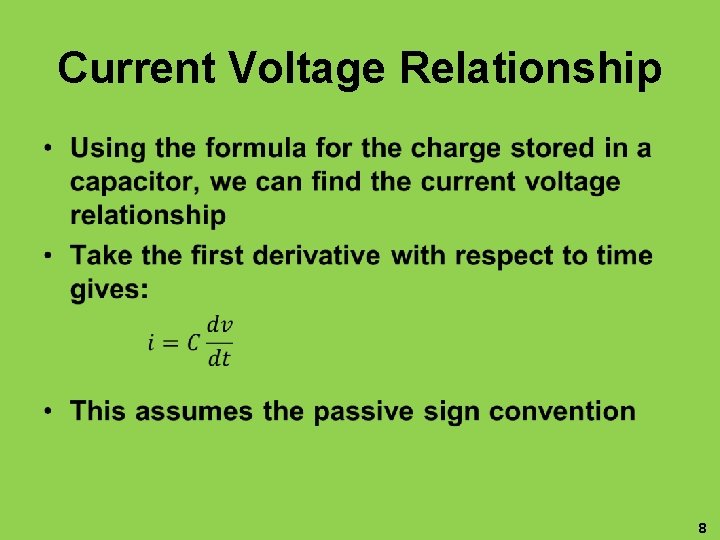
Current Voltage Relationship • 8
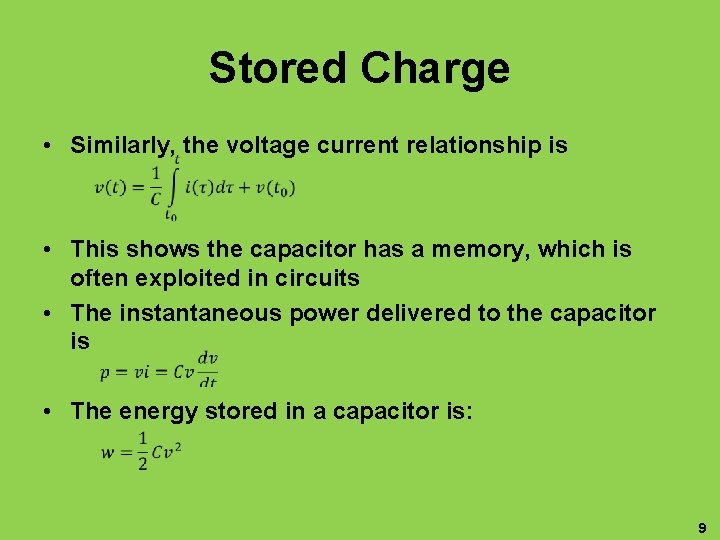
Stored Charge • Similarly, the voltage current relationship is • • This shows the capacitor has a memory, which is often exploited in circuits • The instantaneous power delivered to the capacitor is • • The energy stored in a capacitor is: • 9
Properties of Capacitors • Ideal capacitors all have these characteristics: • When the voltage is not changing, the current through the cap is zero. • This means that with DC applied to the terminals no current will flow. • Except, the voltage on the capacitor’s plates can’t change instantaneously. • An abrupt change in voltage would require an infinite current! • This means if the voltage on the cap does not equal the applied voltage, charge will flow and the voltage will finally reach the applied voltage. 10
Properties of capacitors II • An ideal capacitor does not dissipate energy, meaning stored energy may be retrieved later • A real capacitor has a parallel-model leakage resistance, leading to a slow loss of the stored energy internally • This resistance is typically very high, on the order of 100 MΩ and thus can be ignored for many circuit applications. 11

Parallel Capacitors • 12
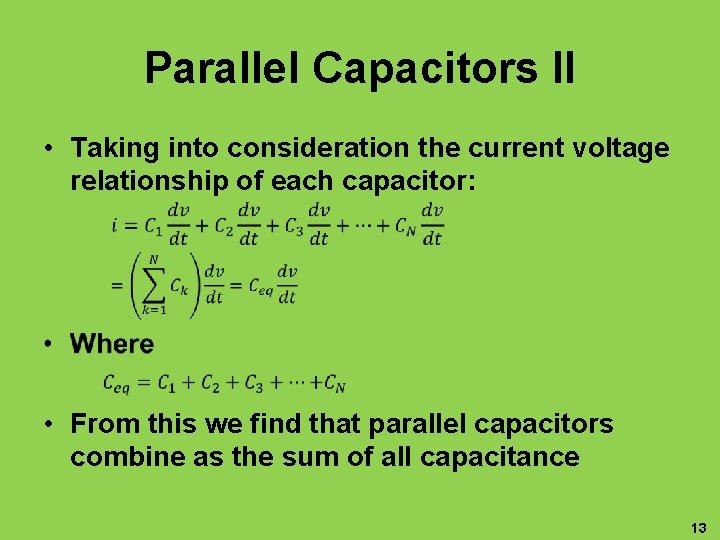
Parallel Capacitors II • Taking into consideration the current voltage relationship of each capacitor: • • From this we find that parallel capacitors combine as the sum of all capacitance 13
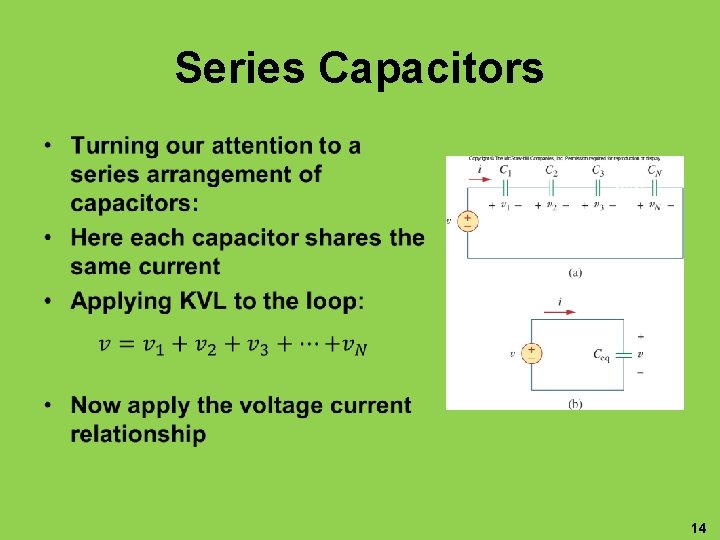
Series Capacitors • 14
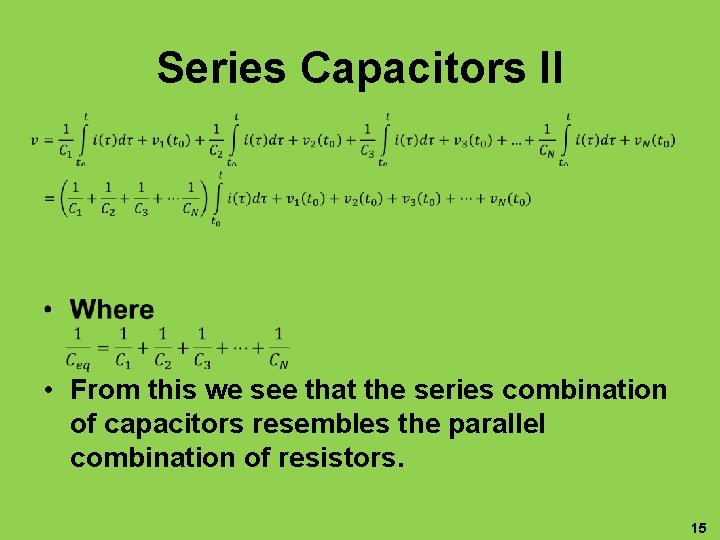
Series Capacitors II • • From this we see that the series combination of capacitors resembles the parallel combination of resistors. 15
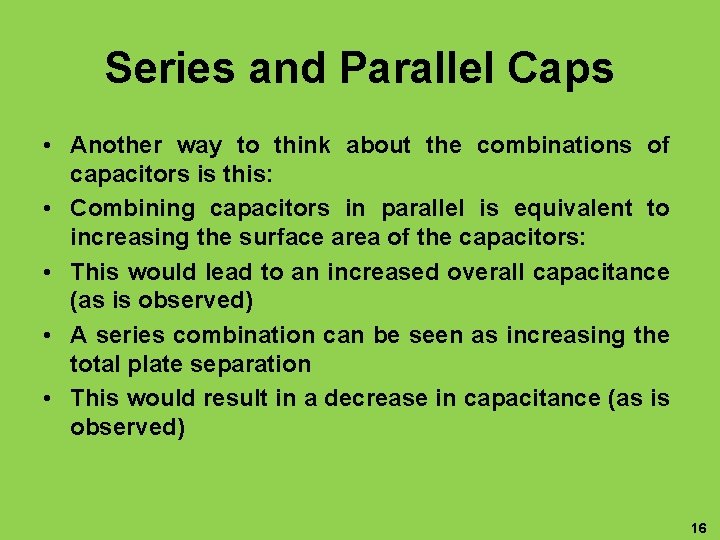
Series and Parallel Caps • Another way to think about the combinations of capacitors is this: • Combining capacitors in parallel is equivalent to increasing the surface area of the capacitors: • This would lead to an increased overall capacitance (as is observed) • A series combination can be seen as increasing the total plate separation • This would result in a decrease in capacitance (as is observed) 16
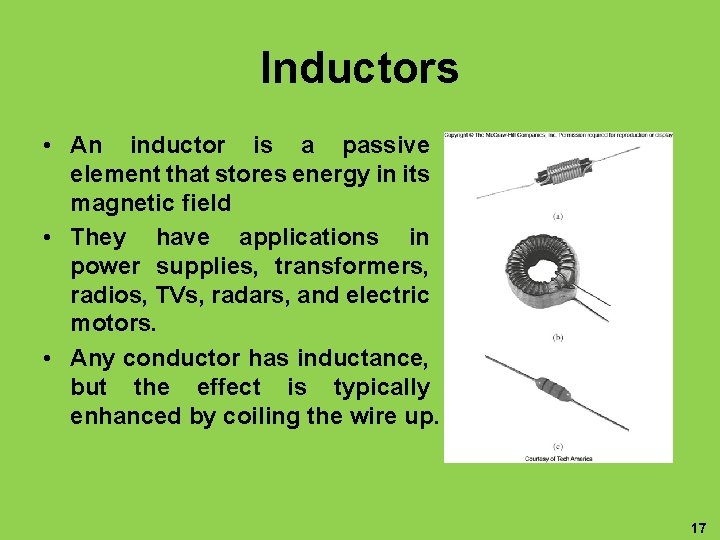
Inductors • An inductor is a passive element that stores energy in its magnetic field • They have applications in power supplies, transformers, radios, TVs, radars, and electric motors. • Any conductor has inductance, but the effect is typically enhanced by coiling the wire up. 17
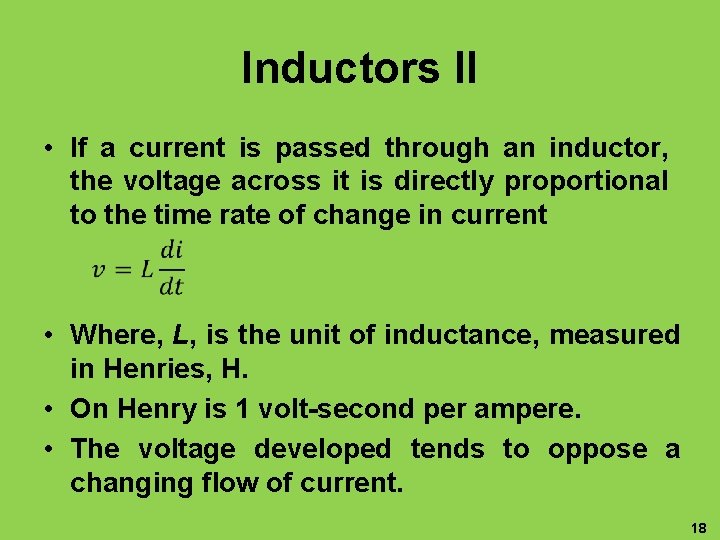
Inductors II • If a current is passed through an inductor, the voltage across it is directly proportional to the time rate of change in current • • Where, L, is the unit of inductance, measured in Henries, H. • On Henry is 1 volt-second per ampere. • The voltage developed tends to oppose a changing flow of current. 18
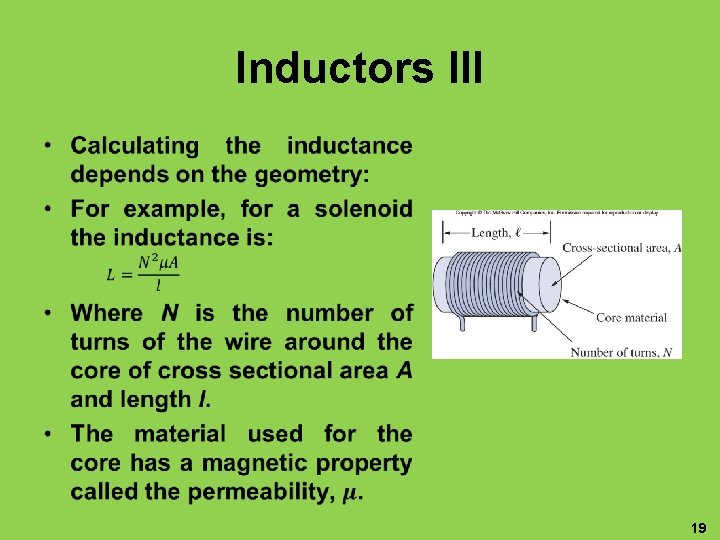
Inductors III • 19
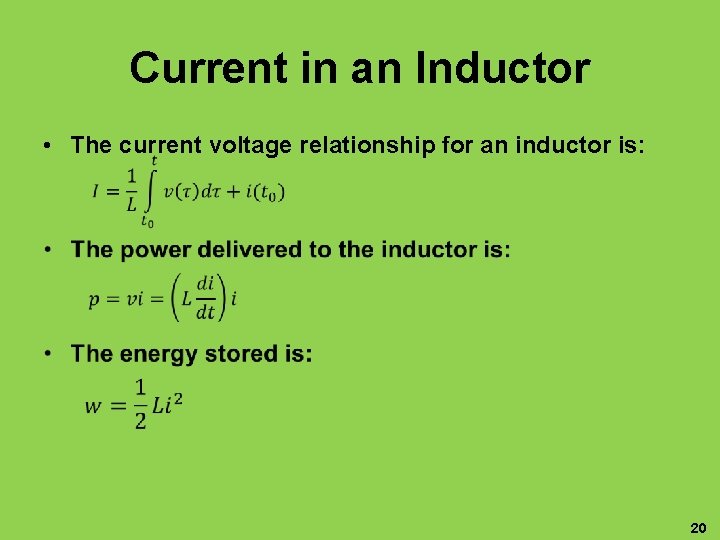
Current in an Inductor • The current voltage relationship for an inductor is: • • • 20
Properties of Inductors • If the current through an inductor is constant, the voltage across it is zero • Thus an inductor acts like a short for DC • The current through an inductor cannot change instantaneously • If this did happen, the voltage across the inductor would be infinity! • This is an important consideration if an inductor is to be turned off abruptly; it will produce a high voltage 21
Properties of Inductors II • Like the ideal capacitor, the ideal inductor does not dissipate energy stored in it. • Energy stored will be returned to the circuit later • In reality, inductors do have internal resistance due to the wiring used to make them. • A real inductor thus has a winding resistance in series with it. • There is also a small winding capacitance due to the closeness of the windings • These two characteristics are typically small, though at high frequencies, the capacitance may matter. 22
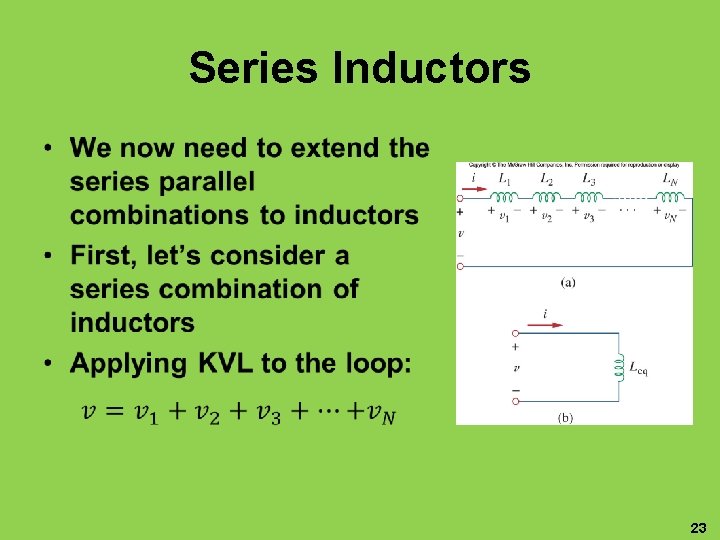
Series Inductors • 23
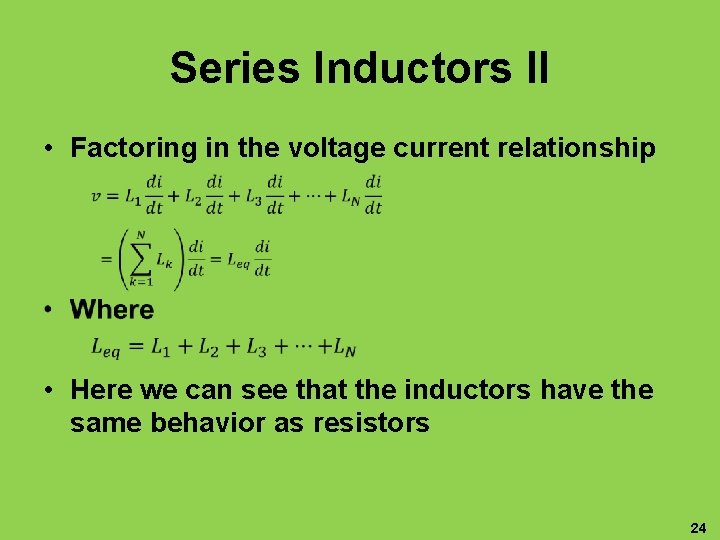
Series Inductors II • Factoring in the voltage current relationship • • Here we can see that the inductors have the same behavior as resistors 24
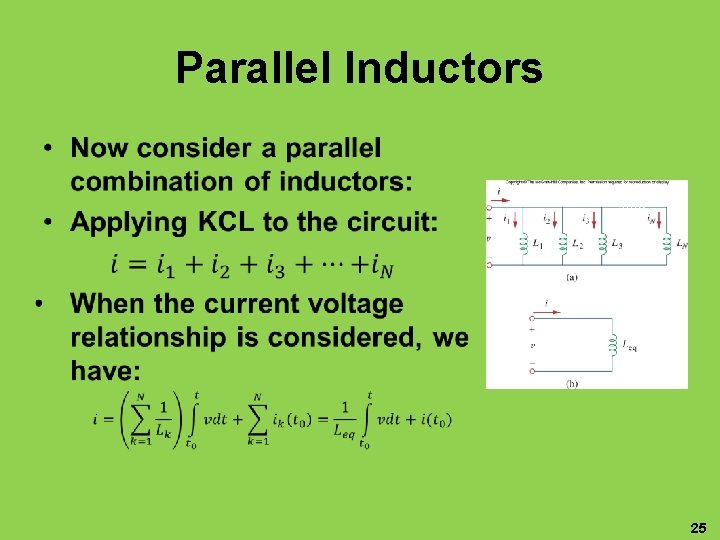
Parallel Inductors 25
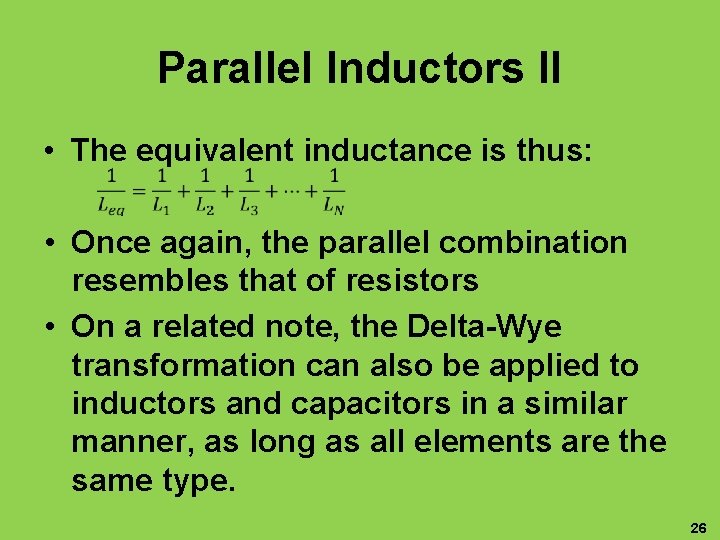
Parallel Inductors II • The equivalent inductance is thus: • • Once again, the parallel combination resembles that of resistors • On a related note, the Delta-Wye transformation can also be applied to inductors and capacitors in a similar manner, as long as all elements are the same type. 26
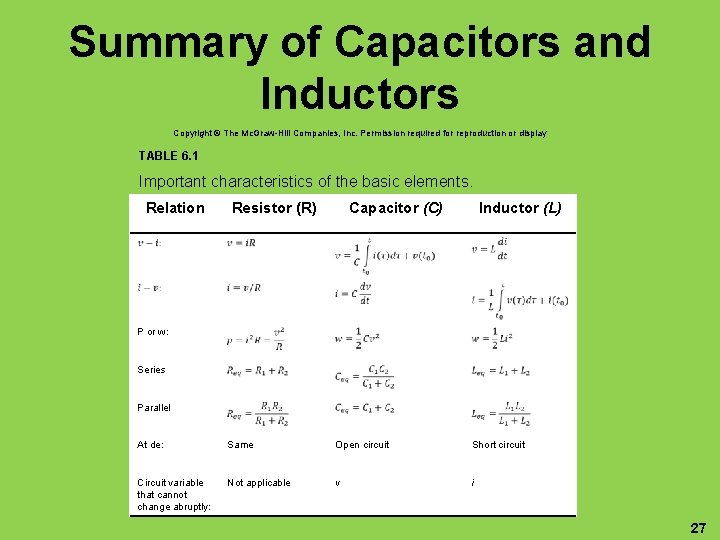
Summary of Capacitors and Inductors Copyright © The Mc. Graw-Hill Companies, Inc. Permission required for reproduction or display TABLE 6. 1 Important characteristics of the basic elements. Relation Resistor (R) Capacitor (C) Inductor (L) P or w: Series Parallel At de: Same Open circuit Short circuit Circuit variable that cannot change abruptly: Not applicable v i 27
- Slides: 27