
PGCE Science Week 2 Childrens ideas and constructivism




- Slides: 52
PGCE Science Week 2 Children’s ideas and constructivism University of Winchester. PGCEFT 2011 -12 1
Directed Tasks § Harlen and Qualter (2009) Ch 1 and Ch 2. What aspects of these case studies would you draw on to suggest approaches to primary science teaching. Consider the differences/similarities between KS 1 and KS 2. § Oliver (2006)-discuss your views on creative science teaching with your peers. Were you taught science in this way? § Safety Workshop- reminder that all activities should be risk assessed. University of Winchester. PGCEFT 2011 -12 2
Learning intentions Develop enquiry skills of predicting, hypothesising, fair testing Explore the importance of children’s ideas in science Know the importance of constructivist theory in science teaching Identify some common misconceptions, elicitation strategies, models and analogies using materials as our context Consider progression of ideas for school planning View QCA schemes of work for science University of Winchester. PGCEFT 2011 -12 3
Safety in Primary Science “Risk assessment is little more than common sense and prudent primary teachers do it informally as a matter of course” (Ellis 2001, p 7)
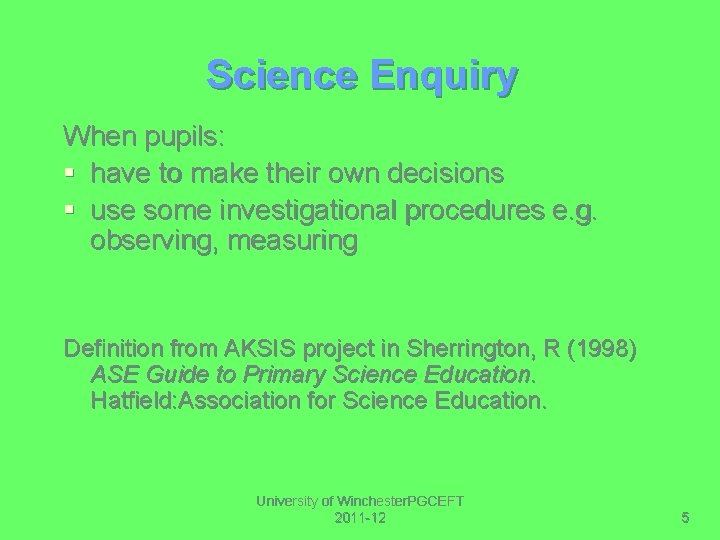
Science Enquiry When pupils: § have to make their own decisions § use some investigational procedures e. g. observing, measuring Definition from AKSIS project in Sherrington, R (1998) ASE Guide to Primary Science Education. Hatfield: Association for Science Education. University of Winchester. PGCEFT 2011 -12 5
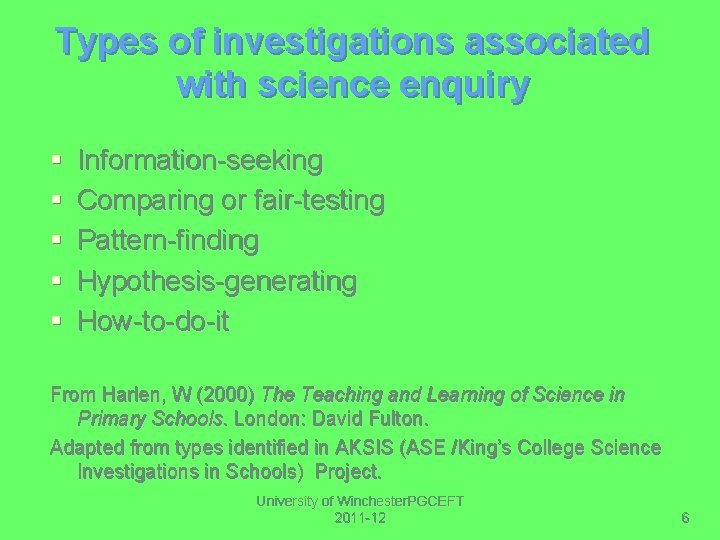
Types of investigations associated with science enquiry § § § Information-seeking Comparing or fair-testing Pattern-finding Hypothesis-generating How-to-do-it From Harlen, W (2000) The Teaching and Learning of Science in Primary Schools. London: David Fulton. Adapted from types identified in AKSIS (ASE /King’s College Science Investigations in Schools) Project. University of Winchester. PGCEFT 2011 -12 6
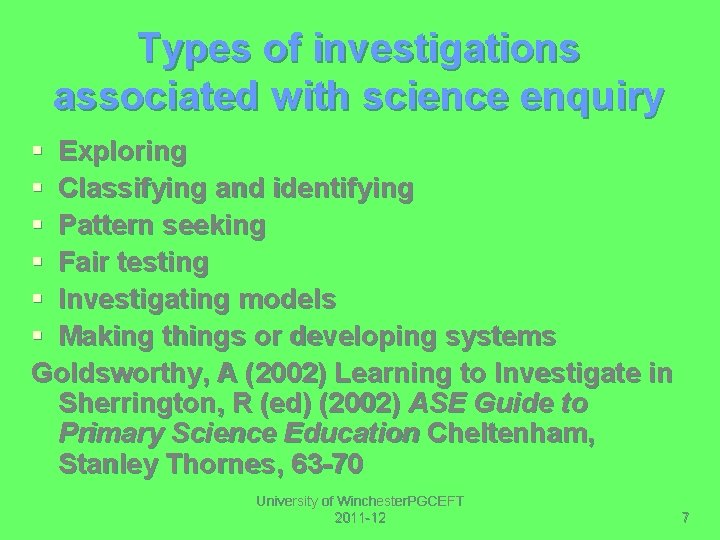
Types of investigations associated with science enquiry § Exploring § Classifying and identifying § Pattern seeking § Fair testing § Investigating models § Making things or developing systems Goldsworthy, A (2002) Learning to Investigate in Sherrington, R (ed) (2002) ASE Guide to Primary Science Education Cheltenham, Stanley Thornes, 63 -70 University of Winchester. PGCEFT 2011 -12 7
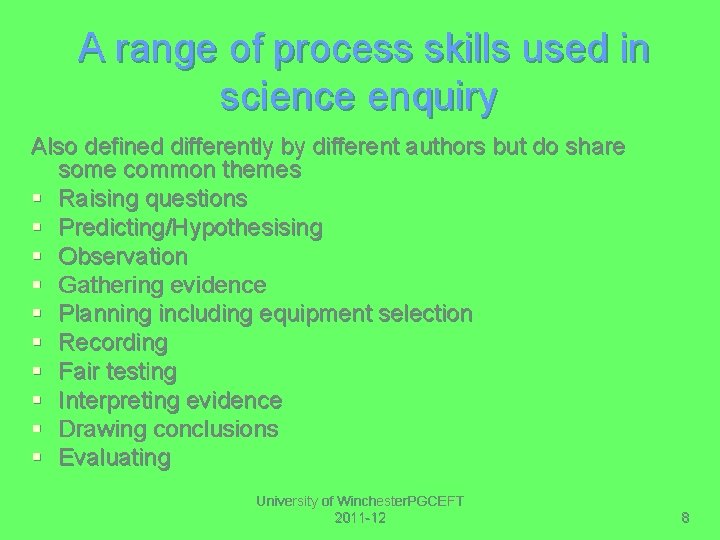
A range of process skills used in science enquiry Also defined differently by different authors but do share some common themes § Raising questions § Predicting/Hypothesising § Observation § Gathering evidence § Planning including equipment selection § Recording § Fair testing § Interpreting evidence § Drawing conclusions § Evaluating University of Winchester. PGCEFT 2011 -12 8
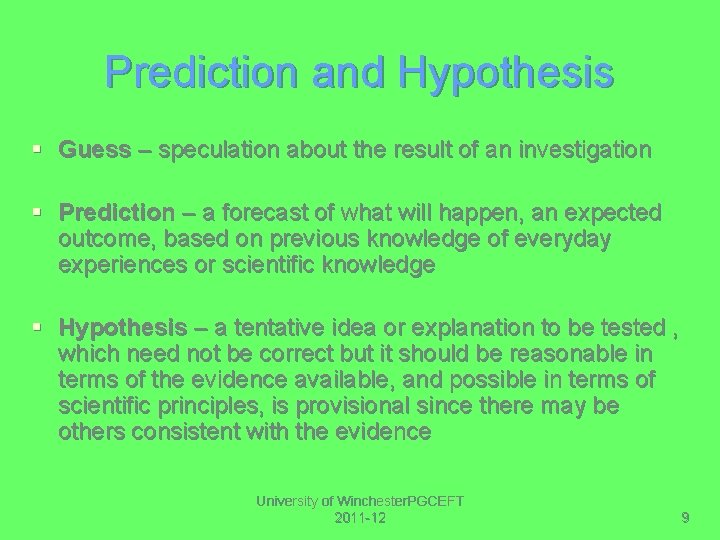
Prediction and Hypothesis § Guess – speculation about the result of an investigation § Prediction – a forecast of what will happen, an expected outcome, based on previous knowledge of everyday experiences or scientific knowledge § Hypothesis – a tentative idea or explanation to be tested , which need not be correct but it should be reasonable in terms of the evidence available, and possible in terms of scientific principles, is provisional since there may be others consistent with the evidence University of Winchester. PGCEFT 2011 -12 9
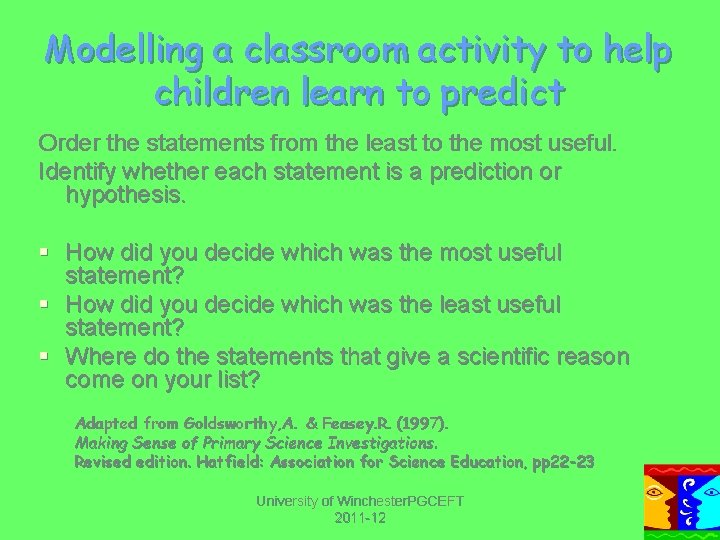
Modelling a classroom activity to help children learn to predict Order the statements from the least to the most useful. Identify whether each statement is a prediction or hypothesis. § How did you decide which was the most useful statement? § How did you decide which was the least useful statement? § Where do the statements that give a scientific reason come on your list? Adapted from Goldsworthy, A. & Feasey. R. (1997). Making Sense of Primary Science Investigations. Revised edition. Hatfield: Association for Science Education, pp 22 -23 University of Winchester. PGCEFT 2011 -12 10
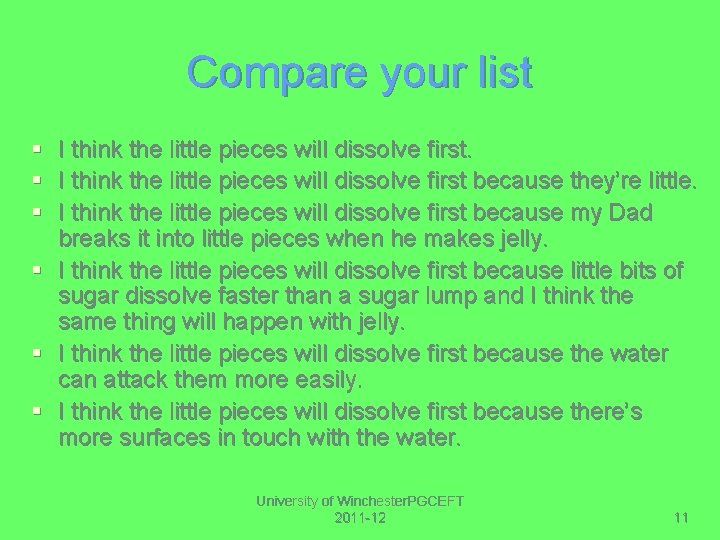
Compare your list § § § I think the little pieces will dissolve first because they’re little. I think the little pieces will dissolve first because my Dad breaks it into little pieces when he makes jelly. § I think the little pieces will dissolve first because little bits of sugar dissolve faster than a sugar lump and I think the same thing will happen with jelly. § I think the little pieces will dissolve first because the water can attack them more easily. § I think the little pieces will dissolve first because there’s more surfaces in touch with the water. University of Winchester. PGCEFT 2011 -12 11
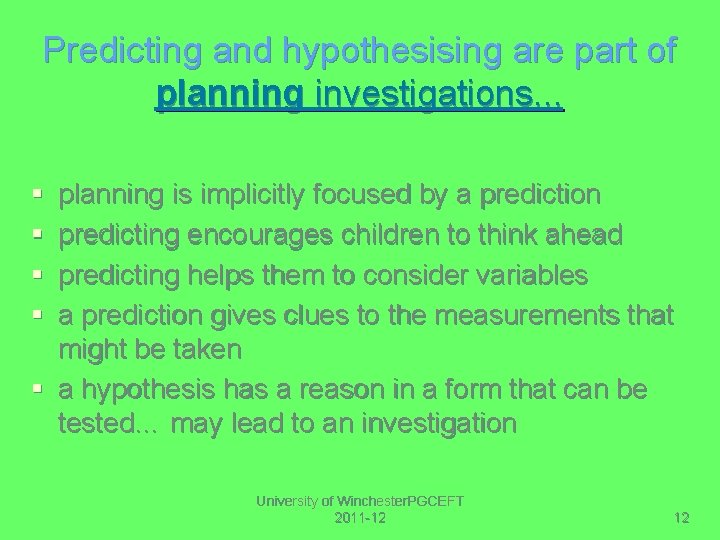
Predicting and hypothesising are part of planning investigations. . . § § planning is implicitly focused by a prediction predicting encourages children to think ahead predicting helps them to consider variables a prediction gives clues to the measurements that might be taken § a hypothesis has a reason in a form that can be tested… may lead to an investigation University of Winchester. PGCEFT 2011 -12 12
Controversy…. . § Feasey and Goldsworthy (1997) suggest predicting becomes hypothesising. . . § Harlen (2000) suggests a prediction is invariably based on a hypothesis (implicitly if not explicitly) § Predicting and hypothesising are closely related University of Winchester. PGCEFT 2011 -12 13
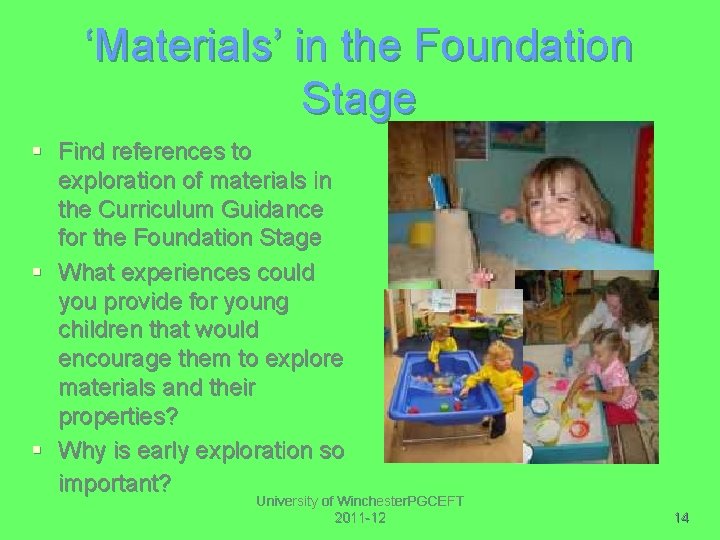
‘Materials’ in the Foundation Stage § Find references to exploration of materials in the Curriculum Guidance for the Foundation Stage § What experiences could you provide for young children that would encourage them to explore materials and their properties? § Why is early exploration so important? University of Winchester. PGCEFT 2011 -12 14
Sc 3 Materials and their properties § § Refer to the National Curriculum: Science (1999) Make a list of the materials that they suggest pupils should be taught about. Then identify the properties that they suggest pupils should be taught about. Can you link the materials and the properties? Which materials will you use to develop pupils’ ideas about properties? Where there is a good match of materials and properties then here is a good opportunity for you to develop Sc 1. Where there is a weak match, here is the place to develop meaning, of materials, or properties and of the nature of science. University of Winchester. PGCEFT 2011 -12 15
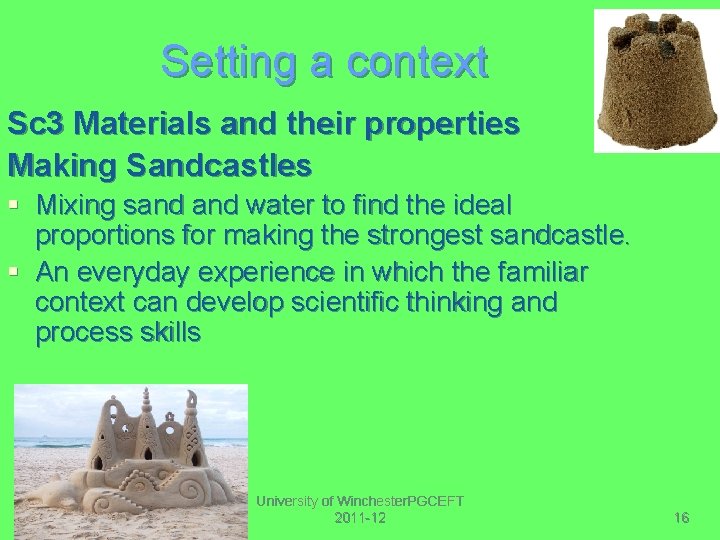
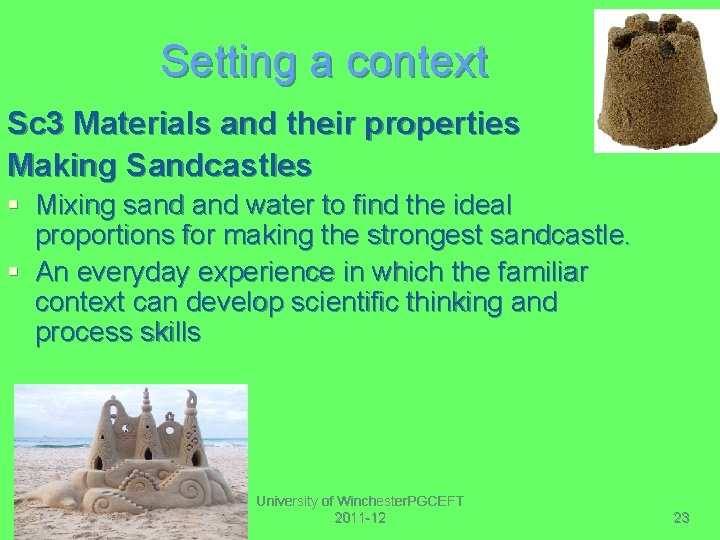
Setting a context Sc 3 Materials and their properties Making Sandcastles § Mixing sand water to find the ideal proportions for making the strongest sandcastle. § An everyday experience in which the familiar context can develop scientific thinking and process skills University of Winchester. PGCEFT 2011 -12 16
Fair Testing § … occurs within the context of planning and carrying out investigations. § … is set up to answer a question such as ‘What will happen if? ’ § 6 - 7 year olds can consider fairness AFTER carrying out a test. § Older pupils can consider fairness BEFORE doing a test. § Fairness involves a discussion about variables. University of Winchester. PGCEFT 2011 -12 17
What are variables? § Factors in an investigation that can be changed or kept the same. § Within Key Stages 1 & 2 children will proceed from not requiring variables to manipulating one variable. University of Winchester. PGCEFT 2011 -12 18
Why do I need to know about variables? § § So you can: Help children succeed with their investigations Manage investigations in class Understand the progression in Sc 1 Assess children’s attainment in Sc 1 University of Winchester. PGCEFT 2011 -12 19
Variables (factors) § INDEPENDENT VARIABLES (IV) - identify what is to change. Changed by choice, different each time. § DEPENDENT VARIABLES (DV) - identify what is to be observed. Dependent on our actions. Measured to obtain results. § CONTROLLED VARIABLES - identify what is to be kept the same so that the effect of the IV can be observed. University of Winchester. PGCEFT 2011 -12 20
Planning Boards § § § Introduction Uses : Children need help to identify variables. This can be done through questioning. What are you trying to find out? What do you want to observe/measure? What do you want to change? What will you need to keep the same? § Recording the variables. University of Winchester. PGCEFT 2011 -12 21 21
Modelling § Model making is an observation activity… in this case the task encourages close observation of a natural form and the way it behaves … through… § watching behaviour, drawing, asking questions…and then… § planning, making, testing and evaluating. And building confidence in problem solving. § You can provide a starter question to scaffold the learning taking place. University of Winchester. PGCEFT 2011 -12 22
Setting a context Sc 3 Materials and their properties Making Sandcastles § Mixing sand water to find the ideal proportions for making the strongest sandcastle. § An everyday experience in which the familiar context can develop scientific thinking and process skills University of Winchester. PGCEFT 2011 -12 23
Sandcastles § Select a variable for investigation § Note why you think this variable will have an effect - note prediction and hypothesis § Use a planning board to organise your investigation § Consider safety § Carry out the investigation - note use of observation, prediction, hypothesis, fair testing University of Winchester. PGCEFT 2011 -12 24
Evaluation Evaluate carefully your investigative procedures. How did you begin this task? § How accurate was your prediction? § What aspects of your procedure might you change if you were to carry out the investigation again? § What surprises were there? What did you discover that you hadn’t thought about or predicted? § What process skills did you use? What level did you work at? University of Winchester. PGCEFT 2011 -12 25
Section 2 University of Winchester. PGCEFT 2011 -12 26
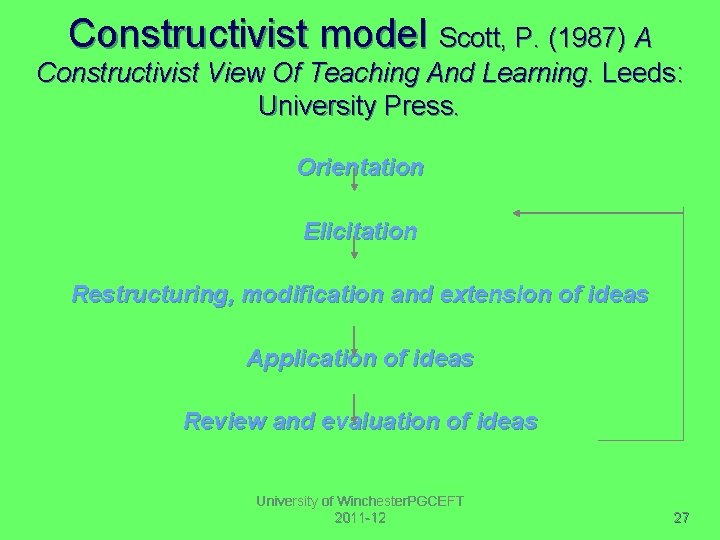
Constructivist model Scott, P. (1987) A Constructivist View Of Teaching And Learning. Leeds: University Press. Orientation Elicitation Restructuring, modification and extension of ideas Application of ideas Review and evaluation of ideas University of Winchester. PGCEFT 2011 -12 27
Constructivism Orientation Arousing children’s interest and curiosity Setting the scene Relating to a real life context University of Winchester. PGCEFT 2011 -12 28
Constructivism Elicitation/Structuring Helping children to find out and clarify what they think Making ideas explicit to themselves, peers, teachers. University of Winchester. PGCEFT 2011 -12 29
Constructivism Intervention/Restructuring Encouraging children to test their ideas: to extend, develop or replace them ‘Making sense’ of ideas University of Winchester. PGCEFT 2011 -12 30
Constructivism Application Evaluation continues Using new ideas in familiar and new contexts Helping children to relate what they have learned to their everyday lives University of Winchester. PGCEFT 2011 -12 31
Constructivism Review Helping children to recognise the significance of what they have found out, how they have changed their thinking University of Winchester. PGCEFT 2011 -12 32
Constructivism § Children have strongly held ideas § Learning involves the active construction of new meaning § Children may appear to understand new ideas presented to them, but not believe them § Shared meanings, reinforced by social interaction, are difficult to change. § Constructivism has its own language – e. g. children’s ideas, alternative frameworks, University of Winchester. Partmisconceptions. time PGCE Science 2010 -2011 EB University of Winchester. PGCEFT 2011 -12 33
Concept Mapping …helps children to explore the structure of their current understanding. Consider: What does a concept map look like? What does it show? Why is it used? How is it used? When is it used? University of Winchester. PGCEFT 2011 -12 34
Concept Mapping – more info SEE www. azteachscience. co. uk for Professional Development Unit on concept mapping University of Winchester. PGCEFT 2011 -12 35
Concept Mapping - method § § § Devise list of key words Use lines to join the words Add arrowheads on the lines to show to read the relation § Annotate the lines with words or phrases to illustrate nature of relationship Materials – devise your own concept map University of Winchester. PGCEFT 2011 -12 36
Concept Mapping - advantages Not a test situation Children’s ideas cannot be marked ‘wrong’ Child has ownership They are meaningful to the children Variations are extensive Can be used as formative assessment tool Provides a good starting point for discussion Can be reviewed and built upon Can be motivating University of Winchester. PGCEFT 2011 -12 37
TASK Solids, liquids and gases – the states of matter To elicit our ideas on solids, liquids and gases, i. e. the states of matter § You have a set of everyday materials. § Please sort them into solids, liquids and gases. § Sort them as they are, and don’t include the container in your decisions. These materials have been chosen to match what we think are suitable for you. You may need to adapt the selection of materials to match your pupils in school. University of Winchester. PGCEFT 2011 -12 38
Definitions Nuffield Primary Science (1993) Materials Key Stage 2 Teachers Guide, London Collins Educational. § “A solid has definite shape. It remains that shape unless a force acts on it. . Cotton wool can be easily changed [but] it does have a definite shape. ” P 91 § “A liquid has no fixed shape but it keeps the same volume when it is poured into a different container” p 91 § “A gas has no fixed shape or volume. . . Fill [s] the whole of the space in which it is contained. ” P 91 University of Winchester. PGCEFT 2011 -12 39
Children’s ideas § Particles are different according to their state eg gas molecules are round, solid cubic § Size of molecule determined by state eg gas = small, solid = large § SOLID – hard, heavy, powders seen as liquids, soft solids such as pastes difficult to classify § LIQUID – flow, pour, compared to water, viscous liquids difficult § GAS – most difficult, air as one gas, include sprays/smoke, gas as dangerous University of Winchester. PGCEFT 2011 -12 40
Elicitation – concept cartoons § § § § Visual representation of scientific ideas Dialogue form Give alternative viewpoints Scientific ideas applied in everyday situations Alternatives given equal status Scientifically acceptable viewpoint included See Keogh and Naylor concept cartoon materials Keogh, B. and Naylor, S. (2000) Concept Cartoons in Science Education Sandbach: Millgate § See www. conceptcartoons. com § See www. azteachscience. co. uk § University of Winchester. PGCEFT 2011 -12 41
TASK § Use the same set of materials § This time decide which are pure substances and which are mixtures. University of Winchester. Parttime PGCE 2010 -2011 University of Science Winchester. PGCEFT 2011 -12 EB 42
Progression § Moving forward through a defined sequence of learning targets § A sequence of increasingly demanding activities § Development in learning from one understanding to another broader or deeper understanding( refer to Harlen and Qualter (2009) p. 124) University of Winchester. PGCEFT 2011 -12 43
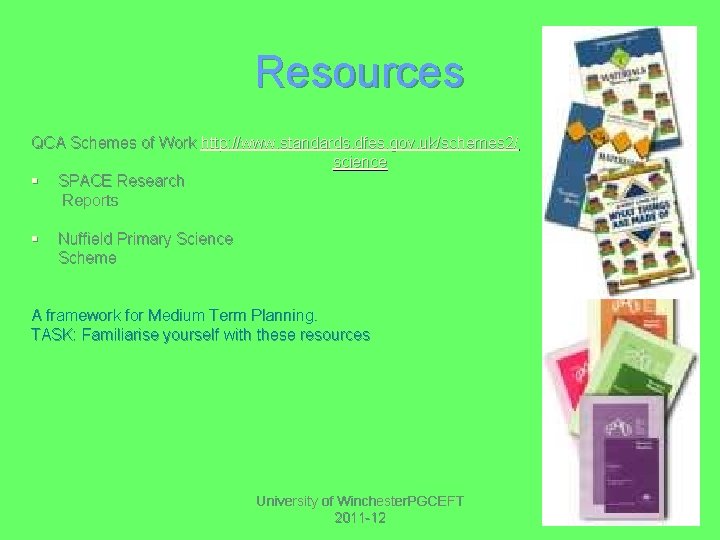
Resources QCA Schemes of Work http: //www. standards. dfes. gov. uk/schemes 2/ science § SPACE Research Reports § Nuffield Primary Science Scheme A framework for Medium Term Planning. TASK: Familiarise yourself with these resources University of Winchester. PGCEFT 2011 -12 44
Section 3 § Student Activities University of Winchester. PGCEFT 2011 -12 45
Student led Practical ‘Changing Materials’ § Rusty nails/ items § Chocolate buttons/ ice § Balloons, narrow necked small bottles, bicarb and vinegar § Salt /sugar / spoons / beakers /water § glass mirrors / cans of liquid cold from the fridge § dough and bread § popcorn and popped corn § clay & pottery § Plaster of Paris as powder and as set *NOTE SAFETY § alcohol hand gel Talk about: What you notice before and after the change? Is this change - physical or chemical? - reversible or irreversible? Can you talk about how energy is involved? Note Sc 1 skills of predicting and hypothesising University of Winchester. PGCEFT 2011 -12 46
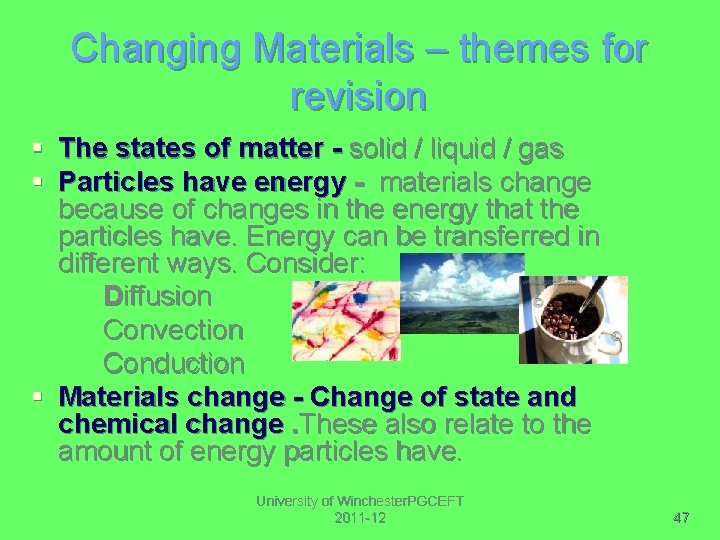
Changing Materials – themes for revision § The states of matter - solid / liquid / gas § Particles have energy - materials change because of changes in the energy that the particles have. Energy can be transferred in different ways. Consider: Diffusion Convection Conduction § Materials change - Change of state and chemical change. These also relate to the amount of energy particles have. University of Winchester. PGCEFT 2011 -12 47
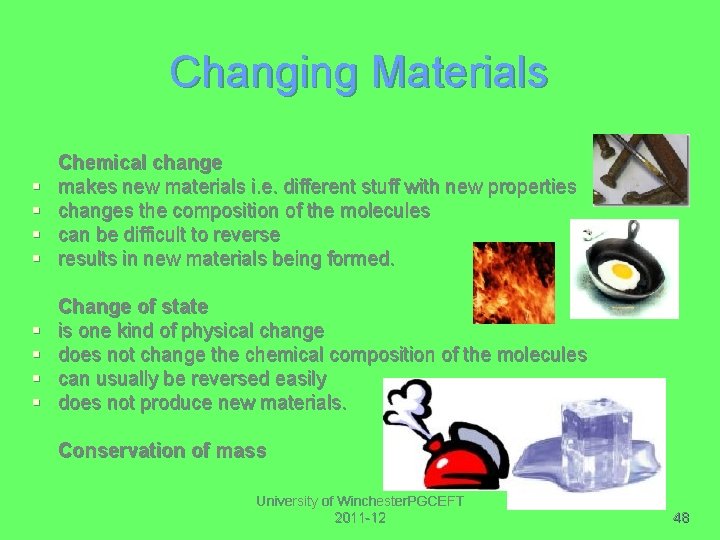
Changing Materials § § Chemical change makes new materials i. e. different stuff with new properties changes the composition of the molecules can be difficult to reverse results in new materials being formed. § § Change of state is one kind of physical change does not change the chemical composition of the molecules can usually be reversed easily does not produce new materials. Conservation of mass University of Winchester. PGCEFT 2011 -12 48
Children’s ideas § identify melting in water but do not generalise to others situations § use ‘melting’ / ‘dissolving’ / ‘turning into water’ as the same thing § KS 1 – evaporation – water disappears § KS 2 – evaporation – water turns into air, rather than vapour in air (Russell et al. 1991) University of Winchester. PGCEFT 2011 -12 49
Student Activities § Give your 5 min lesson to a small group of your peers. § Once each person has given their lesson discuss and reflect on this activity. Consider what skills and knowledge were used. What questions were raised by yourself and others in the group. How did you feel whilst you were delivering your lesson. Was it well timed? Was the activity/ resources/ vocabulary suitable? How did you know? Keep a record in your reflective journal. How did you recognise if learning was taking place? University of Winchester. PGCEFT 2011 -12 50
Directed tasks § 1. Read Roden (2005) Use the ‘personal response’ tasks to prompt reflection for next session. § Read Harlen and Qualter (2009) Ch. 5 ‘Children’s Own Ideas’ & Ch. 9 ‘Helping development of scientific ideas § Complete the CONFIDENCE AUDIT on the Learning Network (LN) University of Winchester. PGCEFT 2011 -12 51
Directed Tasks Preparation for next week READ: Harlen and Qualter (2009) Ch 12 ‘Teachers’ and children’s questions § Next week you will discuss and practise using different types of questions. § What is the difference between ‘productive’ and ‘unproductive’ questions? § What types of productive questions are there and what is the purpose of each in encouraging children’s scientific enquiry? § What reasons do H&Q (2009) present for the use of open and personcentred rather than closed and subject centred questions? § What are the implications from this reading for your planning on SE? University of Winchester. PGCEFT 2011 -12 52