
Pg 298 Damping Underdamping Overdamping Critical damping reaches
- Slides: 24
Pg. 298 – Damping • Underdamping • Overdamping • Critical damping – reaches equilibrium in shortest time possible (See examples at bottom of page) 11 -6: Forced Vibrations; Resonance • Objects have a natural frequency (f 0) due to properties of that object • We can also exert a force that has its own frequency (f)—this causes a forced vibration. • Amplitude of forced vibration depends on difference between f and f 0 ; it is at maximum when f 0 = f—this is known as resonance. • f 0 is also called resonant frequency. • Examples
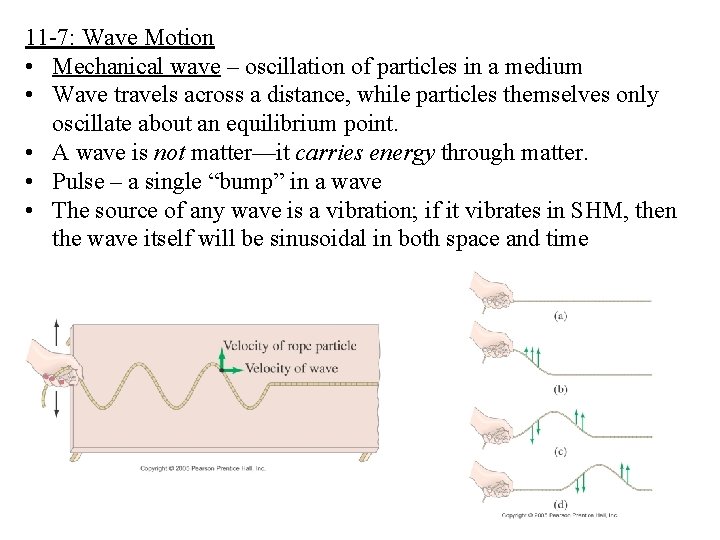
11 -7: Wave Motion • Mechanical wave – oscillation of particles in a medium • Wave travels across a distance, while particles themselves only oscillate about an equilibrium point. • A wave is not matter—it carries energy through matter. • Pulse – a single “bump” in a wave • The source of any wave is a vibration; if it vibrates in SHM, then the wave itself will be sinusoidal in both space and time
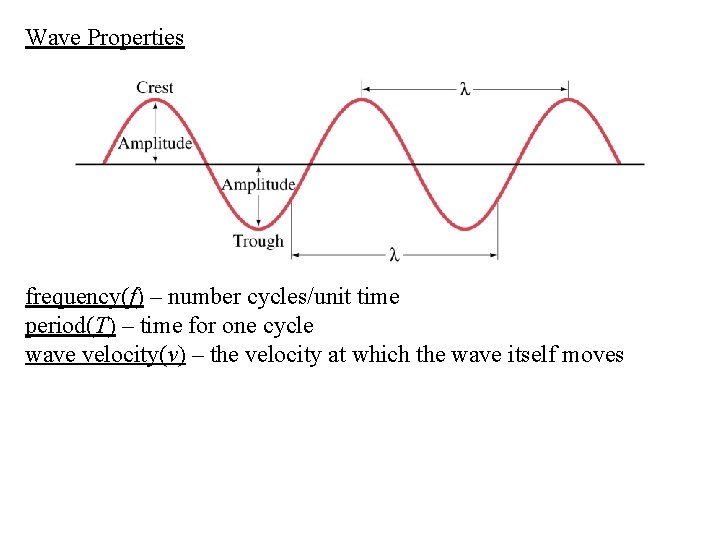
Wave Properties frequency(f) – number cycles/unit time period(T) – time for one cycle wave velocity(v) – the velocity at which the wave itself moves
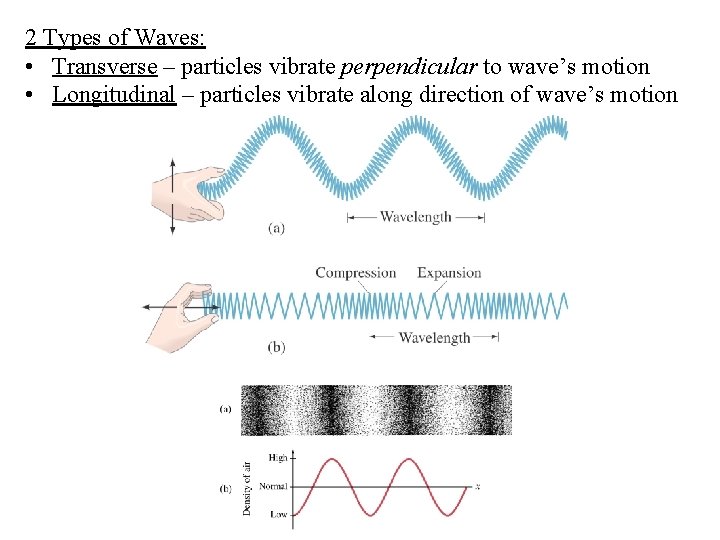
2 Types of Waves: • Transverse – particles vibrate perpendicular to wave’s motion • Longitudinal – particles vibrate along direction of wave’s motion
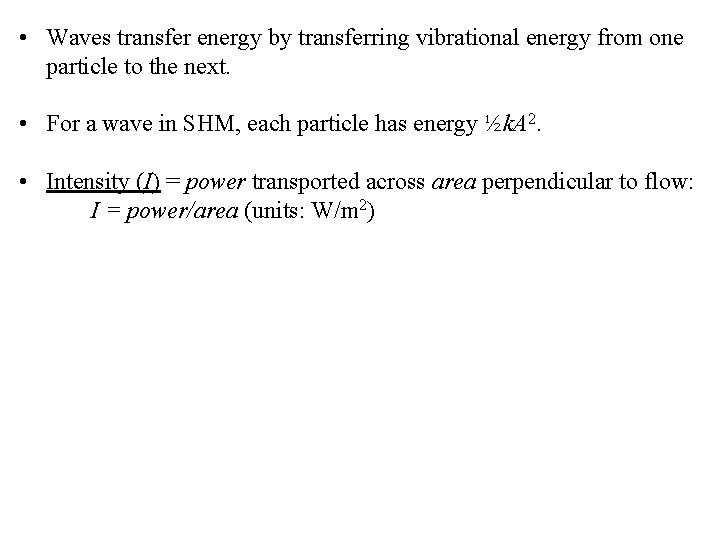
• Waves transfer energy by transferring vibrational energy from one particle to the next. • For a wave in SHM, each particle has energy ½k. A 2. • Intensity (I) = power transported across area perpendicular to flow: I = power/area (units: W/m 2)
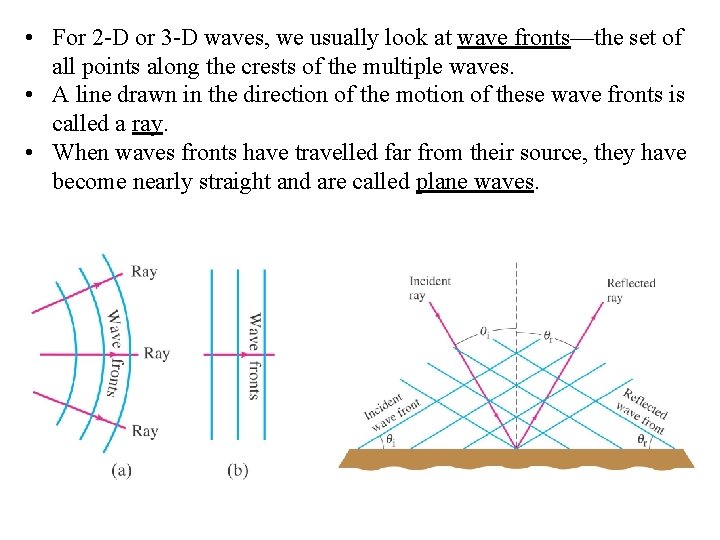
• For 2 -D or 3 -D waves, we usually look at wave fronts—the set of all points along the crests of the multiple waves. • A line drawn in the direction of the motion of these wave fronts is called a ray. • When waves fronts have travelled far from their source, they have become nearly straight and are called plane waves.
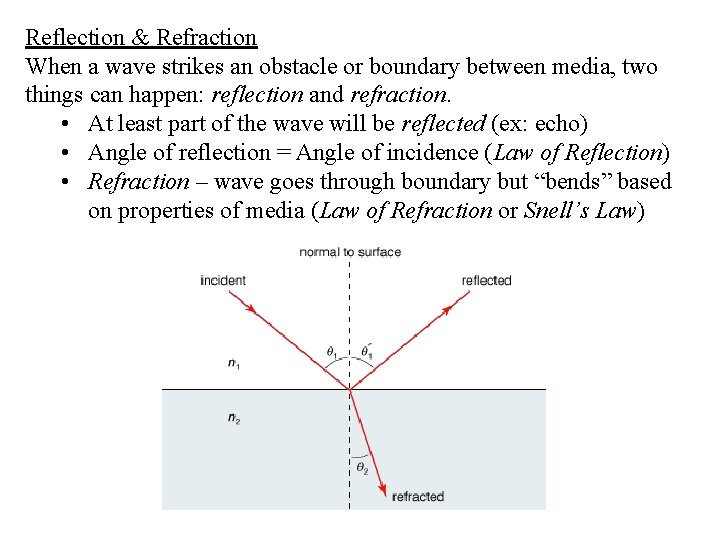
Reflection & Refraction When a wave strikes an obstacle or boundary between media, two things can happen: reflection and refraction. • At least part of the wave will be reflected (ex: echo) • Angle of reflection = Angle of incidence (Law of Reflection) • Refraction – wave goes through boundary but “bends” based on properties of media (Law of Refraction or Snell’s Law)
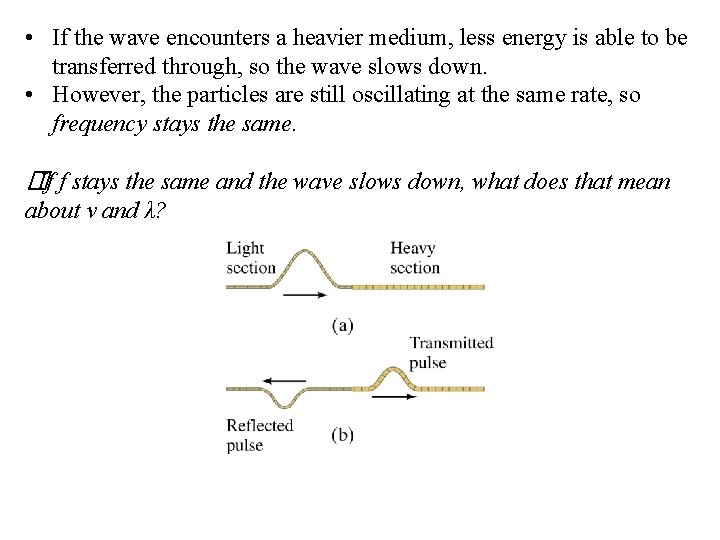
• If the wave encounters a heavier medium, less energy is able to be transferred through, so the wave slows down. • However, the particles are still oscillating at the same rate, so frequency stays the same. �If f stays the same and the wave slows down, what does that mean about v and λ?
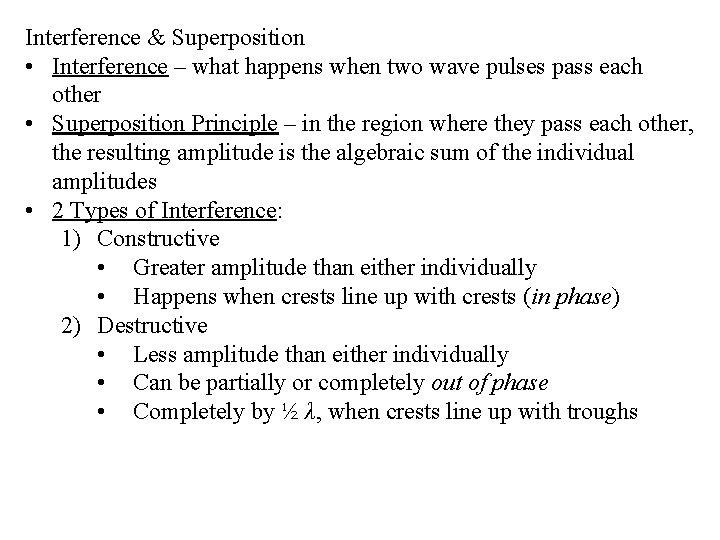
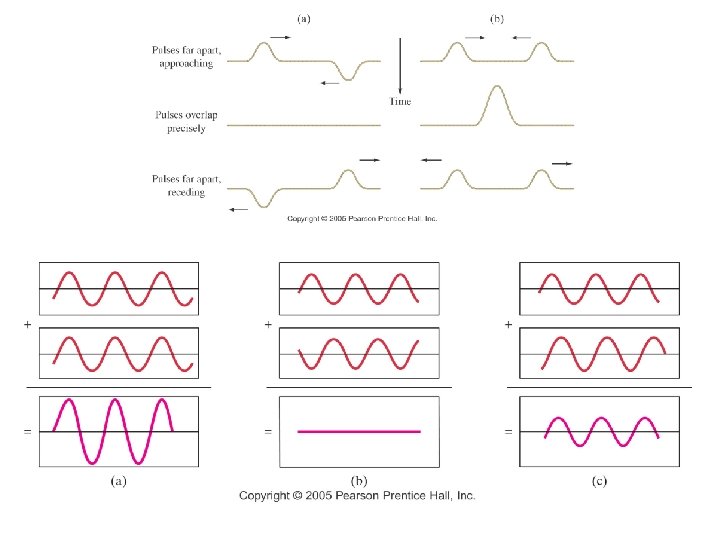
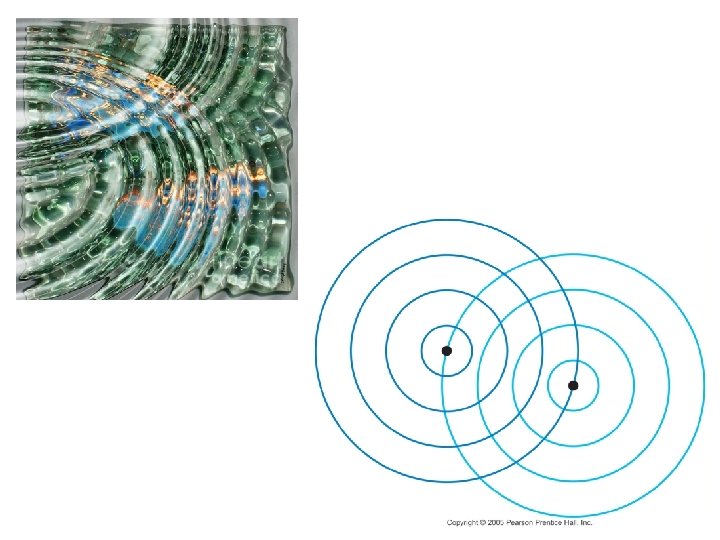
Interference & Superposition • Interference – what happens when two wave pulses pass each other • Superposition Principle – in the region where they pass each other, the resulting amplitude is the algebraic sum of the individual amplitudes • 2 Types of Interference: 1) Constructive • Greater amplitude than either individually • Happens when crests line up with crests (in phase) 2) Destructive • Less amplitude than either individually • Can be partially or completely out of phase • Completely by ½ λ, when crests line up with troughs
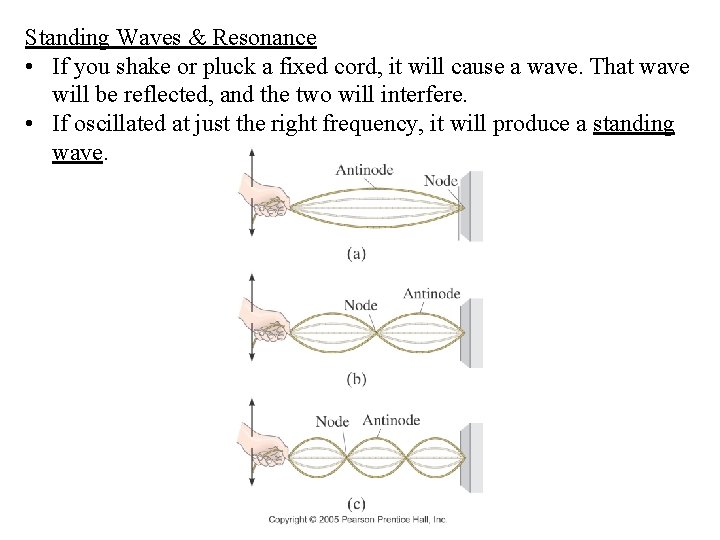
Standing Waves & Resonance • If you shake or pluck a fixed cord, it will cause a wave. That wave will be reflected, and the two will interfere. • If oscillated at just the right frequency, it will produce a standing wave.
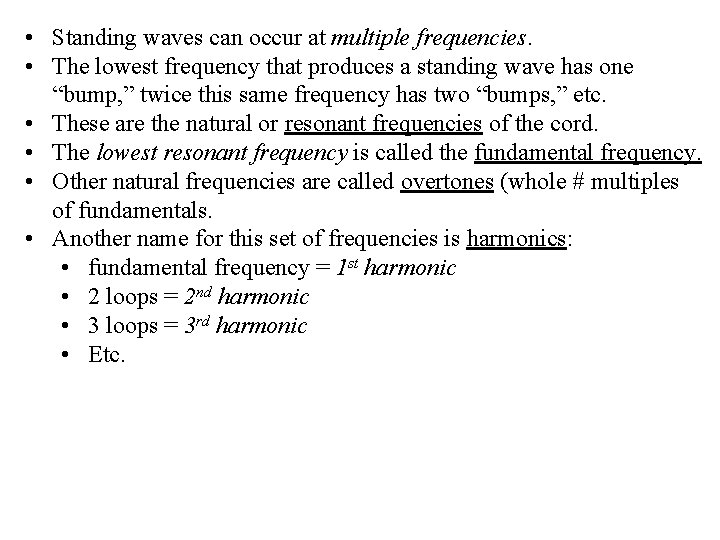
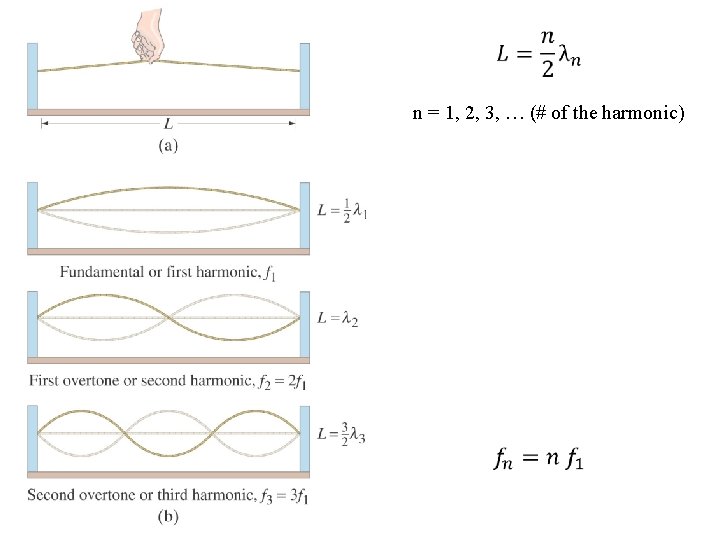
• Standing waves can occur at multiple frequencies. • The lowest frequency that produces a standing wave has one “bump, ” twice this same frequency has two “bumps, ” etc. • These are the natural or resonant frequencies of the cord. • The lowest resonant frequency is called the fundamental frequency. • Other natural frequencies are called overtones (whole # multiples of fundamentals. • Another name for this set of frequencies is harmonics: • fundamental frequency = 1 st harmonic • 2 loops = 2 nd harmonic • 3 loops = 3 rd harmonic • Etc.
n = 1, 2, 3, … (# of the harmonic)
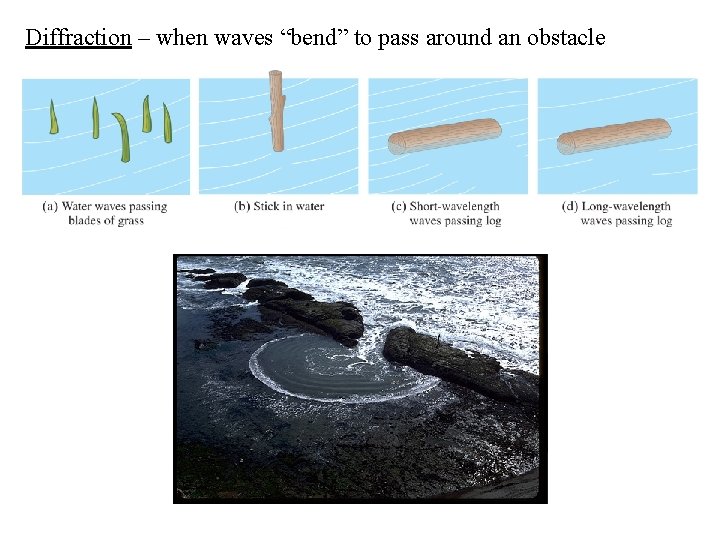
Diffraction – when waves “bend” to pass around an obstacle
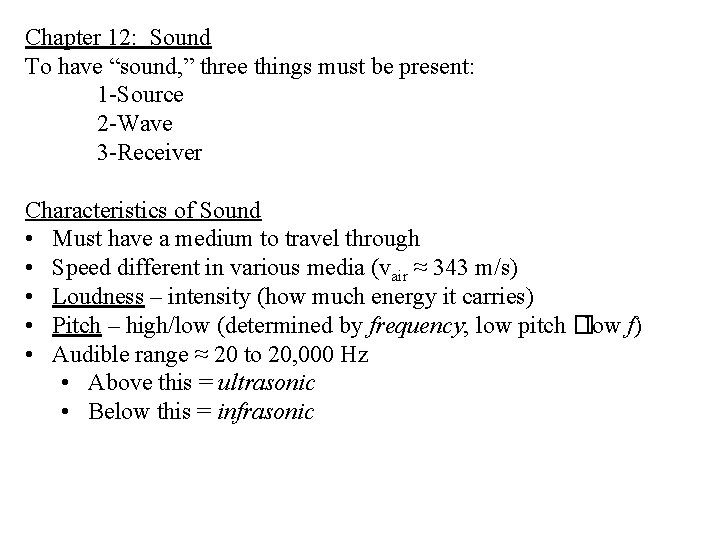
Chapter 12: Sound To have “sound, ” three things must be present: 1 -Source 2 -Wave 3 -Receiver Characteristics of Sound • Must have a medium to travel through • Speed different in various media (vair ≈ 343 m/s) • Loudness – intensity (how much energy it carries) • Pitch – high/low (determined by frequency; low pitch �low f) • Audible range ≈ 20 to 20, 000 Hz • Above this = ultrasonic • Below this = infrasonic
Intensity • Intensity = amplitude • energy transferred per unit area (W/m 2) • Due to way humans perceive sound, logarithmic scale is used: Units: bel Commonly used: decibel (1 d. B = 0. 1 bel)
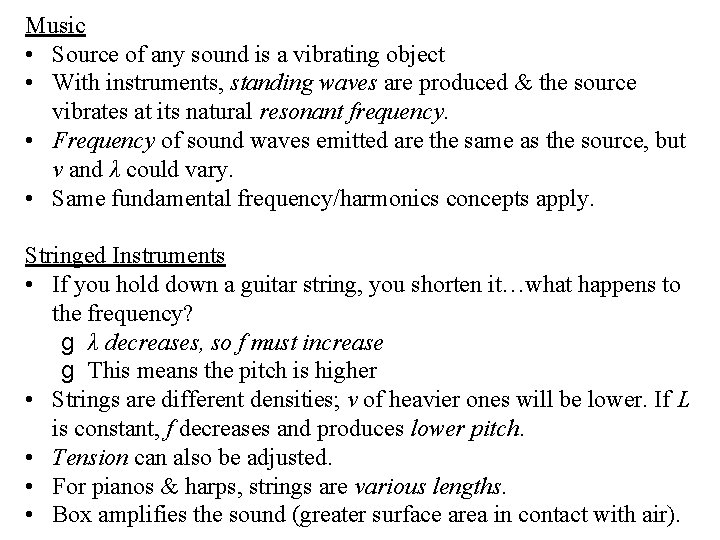
Music • Source of any sound is a vibrating object • With instruments, standing waves are produced & the source vibrates at its natural resonant frequency. • Frequency of sound waves emitted are the same as the source, but v and λ could vary. • Same fundamental frequency/harmonics concepts apply. Stringed Instruments • If you hold down a guitar string, you shorten it…what happens to the frequency? g λ decreases, so f must increase g This means the pitch is higher • Strings are different densities; v of heavier ones will be lower. If L is constant, f decreases and produces lower pitch. • Tension can also be adjusted. • For pianos & harps, strings are various lengths. • Box amplifies the sound (greater surface area in contact with air).
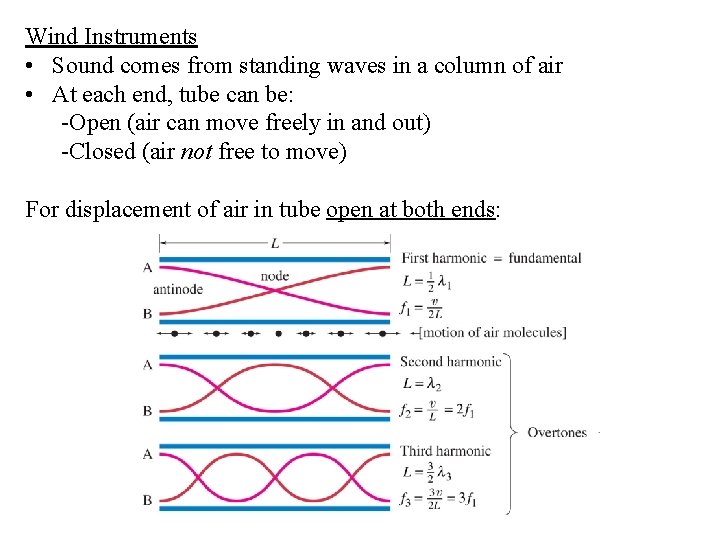
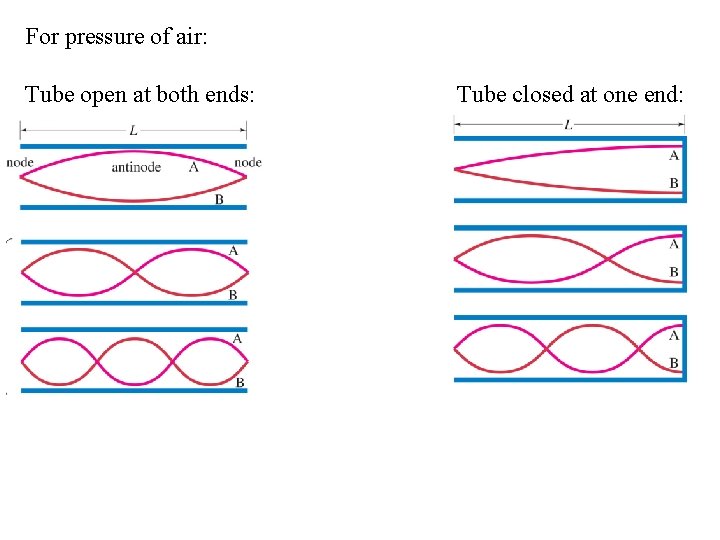
Wind Instruments • Sound comes from standing waves in a column of air • At each end, tube can be: -Open (air can move freely in and out) -Closed (air not free to move) For displacement of air in tube open at both ends:
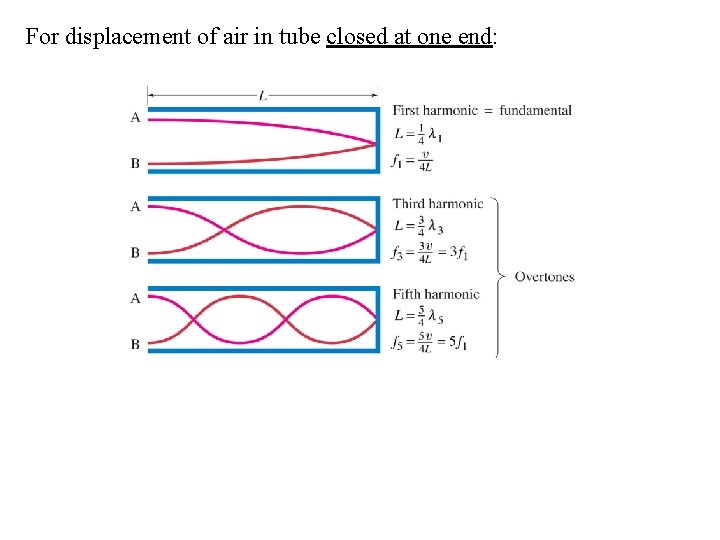
For displacement of air in tube closed at one end:
For pressure of air: Tube open at both ends: Tube closed at one end:
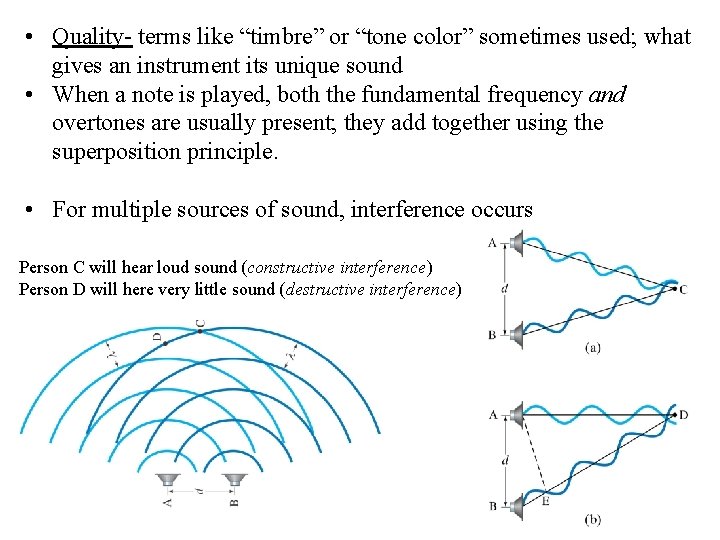
• Quality- terms like “timbre” or “tone color” sometimes used; what gives an instrument its unique sound • When a note is played, both the fundamental frequency and overtones are usually present; they add together using the superposition principle. • For multiple sources of sound, interference occurs Person C will hear loud sound (constructive interference) Person D will here very little sound (destructive interference)
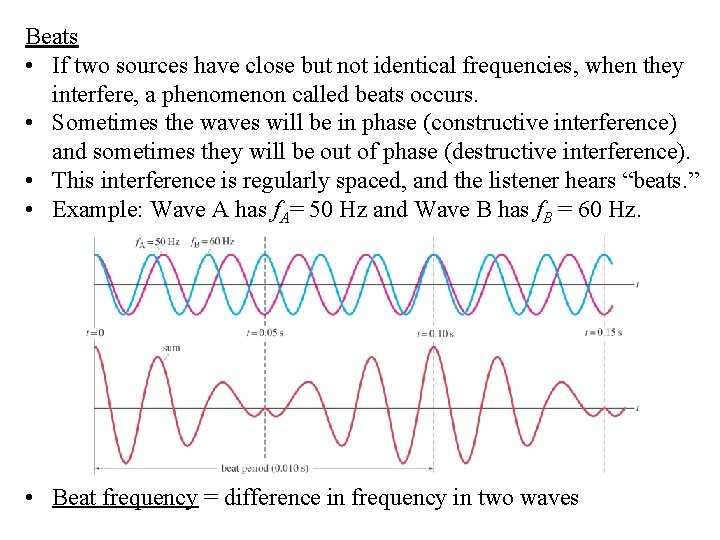
Beats • If two sources have close but not identical frequencies, when they interfere, a phenomenon called beats occurs. • Sometimes the waves will be in phase (constructive interference) and sometimes they will be out of phase (destructive interference). • This interference is regularly spaced, and the listener hears “beats. ” • Example: Wave A has f. A= 50 Hz and Wave B has f. B = 60 Hz. • Beat frequency = difference in frequency in two waves
Doppler Effect • Occurs when a source of sound is moving with respect to the listener • Source moving toward you �pitch is higher than it is at rest • Source moving away from you �pitch is lower than it is at rest • The same effect occurs when the source is at rest and the listener is moving