
PFT Nuances DR H Objectives Review of Lung

PFT Nuances DR H
Objectives Review of Lung Volumes Caveats to PFT Interpretation Obstruction Restriction Mixed Obstruction/Restriction Bronchodilator Response Degree of Change Over Time
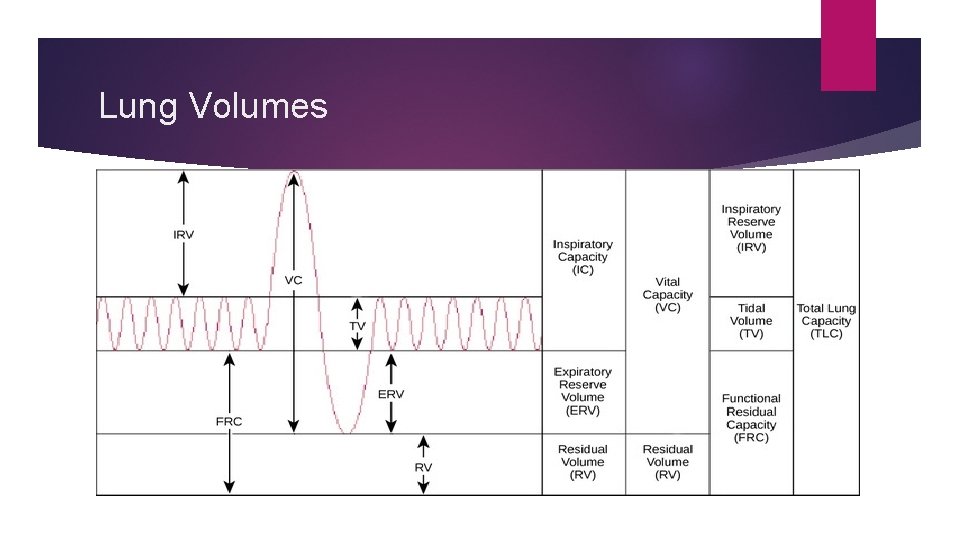
Lung Volumes
Caveats Ensure that you first check to see if the results are valid, if they aren’t – DO NOT INTERPRET! Labs should use LLN for age, sex, and race to predict a patient’s “normal, ” know what your lab does We tend to believe that ALL smokers will get obstructive lung disease, the percentage is actually about 20% VC is better than FVC Technically you can calculate VC by TLC-RV (mind you this is imperfect) Describe what ratio you are using whether it be: FEV 1/VC or FEV 1/FVC or FEV 1/SVC or FEV 1/IVC You should use the largest of these vital capacities, not the smallest. Many false POSITIVE results (not negative) occur when using FEV 1/FVC, particularly if you are using a “ 5 th percentile” margin
Obstruction FEV 1/FVC <0. 70 (or 70%) of LLN If you see the flow-volume loop scooping, you may call early obstruction (suggest smoking cessation in your report) If you see the FEF 25 -75% reduced, you may call small airways disease
Restriction TLC <80% of LLN If ERV is very low and BMI is high, you can consider body habitus as the cause of restriction.
Mixed Obstruction/Restriction You still need a reduced ratio and a reduced TLC. Technically the degree of defect is uninterpretable as the two processes oppose one another. You need to say this in your report. Comparing FEV 1 to TLC may account for this. FEV 1/TLC = appropriate FEV 1
Grading This varies by institution and individual (it is quite arbitrary) Use the POST-BRONCHODILATOR FEV 1 (I actually just pick the larger of the two) State in your report which criteria you are using Also if the numbers cross different degrees you can put in a range! Of note, I like FVC for grading restriction, you can use FEV 1 by ATS, or TLC by others… RV > 120 indicates air trapping; TLC >120 indicates hyperinflation

Grading ATS Criteria Degree of Severity Mild Moderately Severe Very Severe GOLD Criteria FEV 1 % Pred >70 60 -69 50 -59 35 -49 <35 Degree of Severity Mild Moderate Severe Very Severe FEV 1 % Pred >80 50 -79 30 -49 <30
Bronchodilator Response >12% and 200 m. L improvement If there is no response, you need to put a statement in reflecting the following: Lack of bronchodilator response does not preclude their use for symptomatic benefit. I have seen primary care providers STOP inhalers when this statement is not placed. Seems obvious to us, but, it is not obvious to everyone.
Degree of Change Over Time 12% and 200 m. L change (whether it be higher or lower) This is worth putting in your report
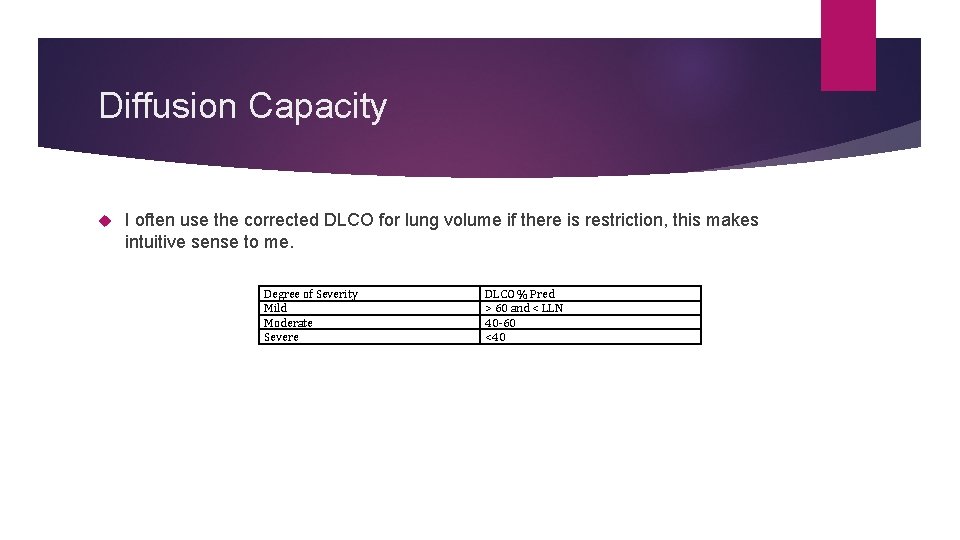
Diffusion Capacity I often use the corrected DLCO for lung volume if there is restriction, this makes intuitive sense to me. Degree of Severity Mild Moderate Severe DLCO % Pred > 60 and < LLN 40 -60 <40
Report Is there obstruction? Is there restriction? Do they smoke? Are they obese? What is the ERV? Is the diffusion capacity preserved?
- Slides: 13