
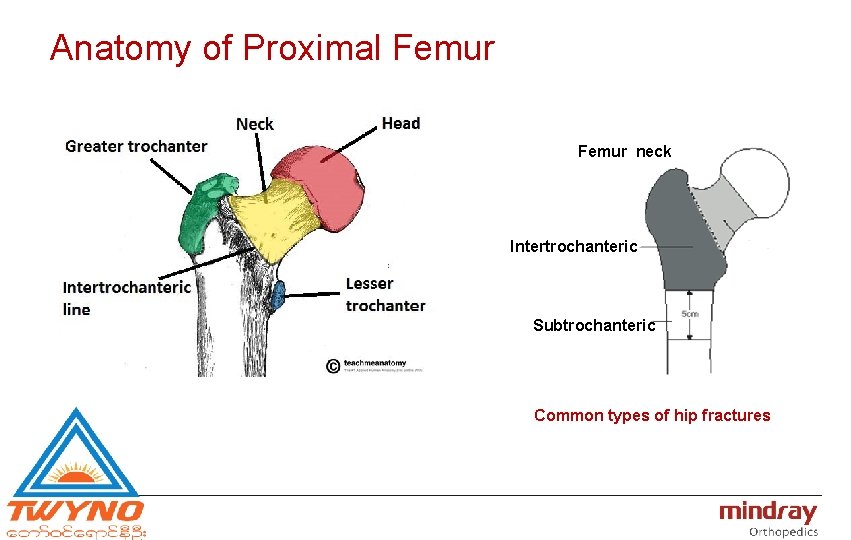
PFNAProximal Femoral Nail Antirotation Anatomy of Proximal Femur


- Slides: 22
PFNA(Proximal Femoral Nail, Anti-rotation)
Anatomy of Proximal Femur neck Intertrochanteric Subtrochanteric Common types of hip fractures
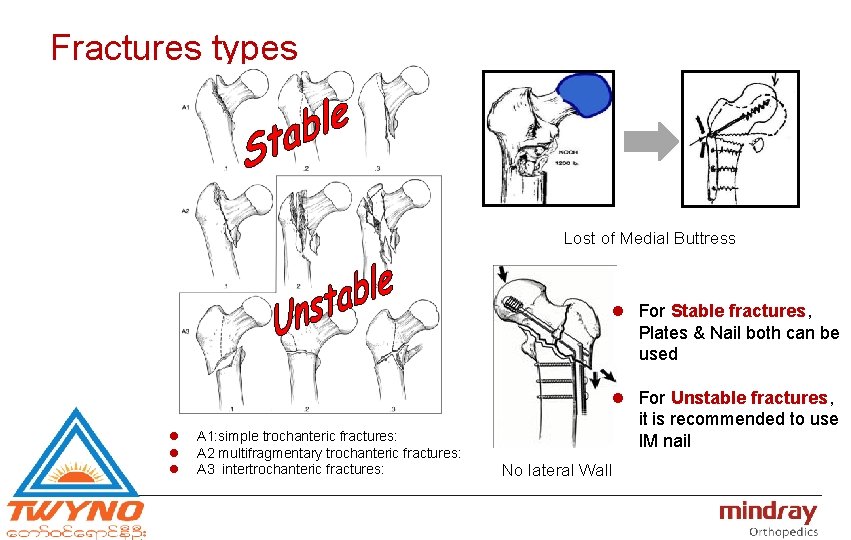
Fractures types Lost of Medial Buttress l For Stable fractures, Plates & Nail both can be used l l l A 1: simple trochanteric fractures: A 2 multifragmentary trochanteric fractures: A 3 intertrochanteric fractures: l For Unstable fractures, it is recommended to use IM nail No lateral Wall
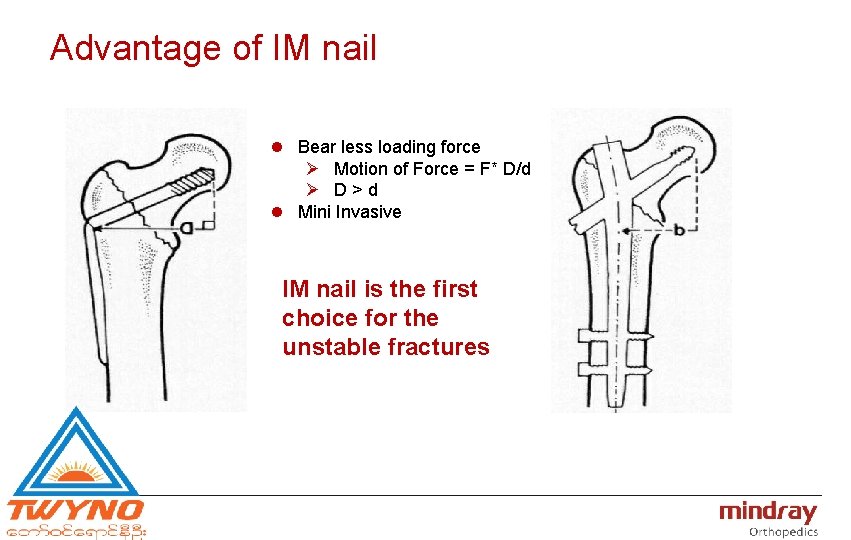
Advantage of IM nail l Bear less loading force Ø Motion of Force = F* D/d Ø D>d l Mini Invasive IM nail is the first choice for the unstable fractures
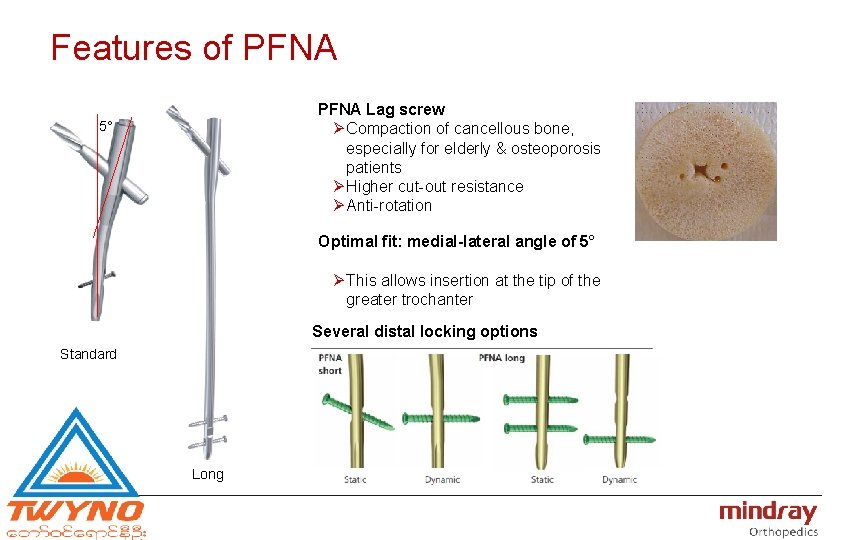
Features of PFNA Lag screw Ø Compaction of cancellous bone, especially for elderly & osteoporosis patients Ø Higher cut-out resistance Ø Anti-rotation 5° Optimal fit: medial-lateral angle of 5° Ø This allows insertion at the tip of the greater trochanter Several distal locking options Standard Long
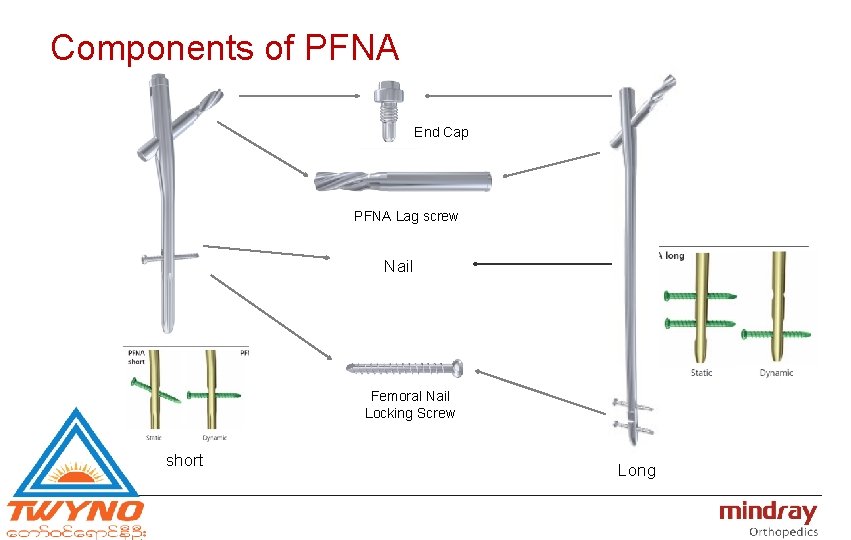
Components of PFNA End Cap PFNA Lag screw Nail Femoral Nail Locking Screw short Long
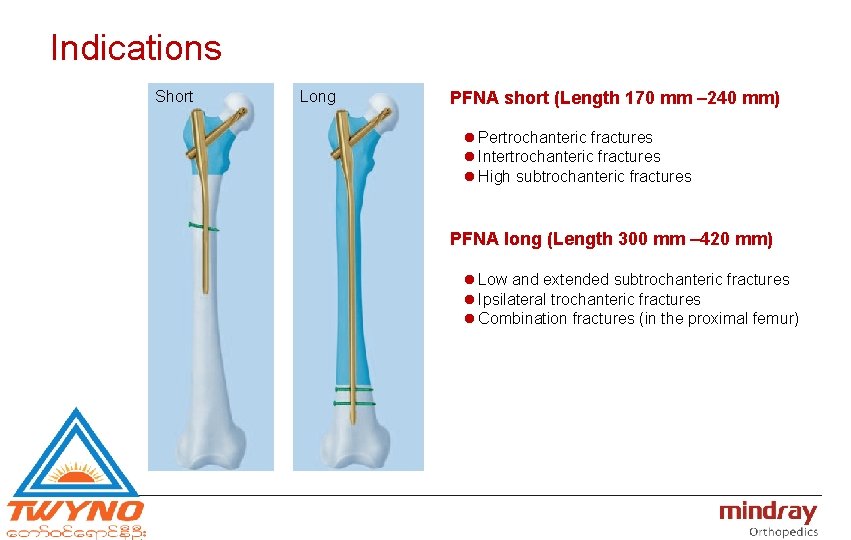
Indications Short Long PFNA short (Length 170 mm – 240 mm) l Pertrochanteric fractures l Intertrochanteric fractures l High subtrochanteric fractures PFNA long (Length 300 mm – 420 mm) l Low and extended subtrochanteric fractures l Ipsilateral trochanteric fractures l Combination fractures (in the proximal femur)
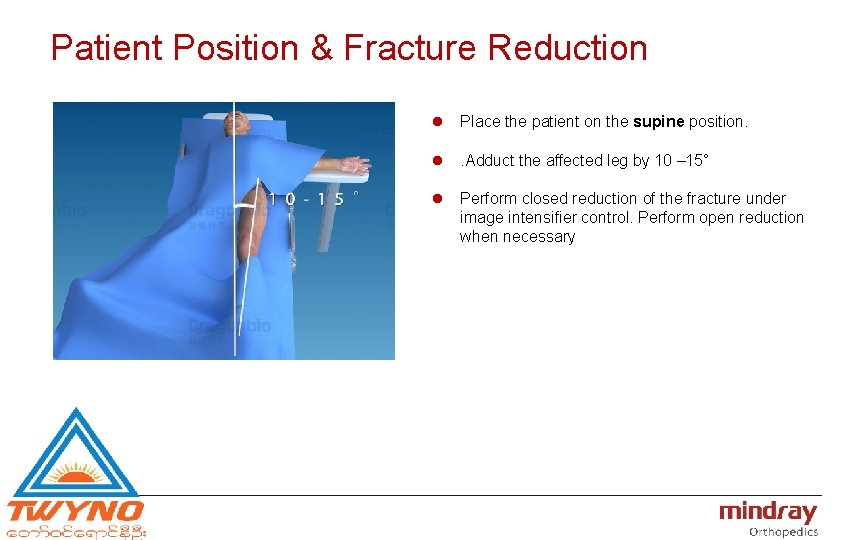
Patient Position & Fracture Reduction l Place the patient on the supine position. l. Adduct the affected leg by 10 – 15° l Perform closed reduction of the fracture under image intensifier control. Perform open reduction when necessary
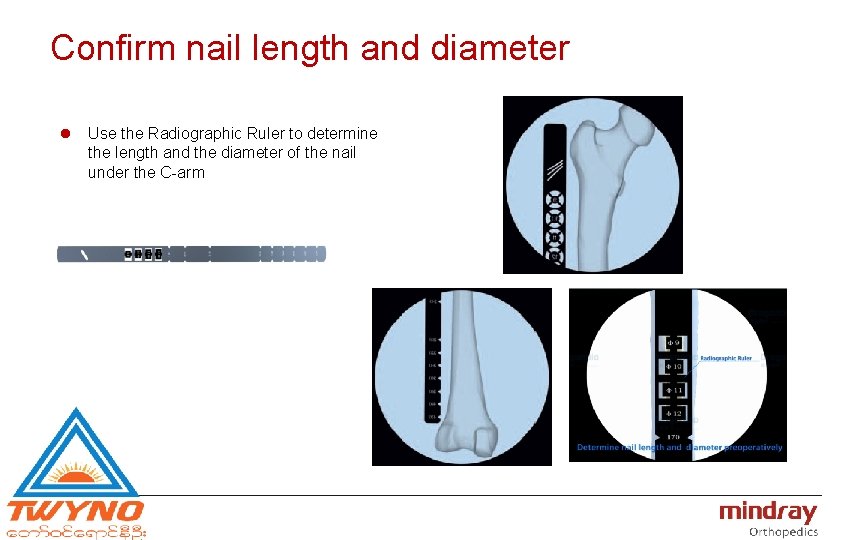
Confirm nail length and diameter l Use the Radiographic Ruler to determine the length and the diameter of the nail under the C-arm
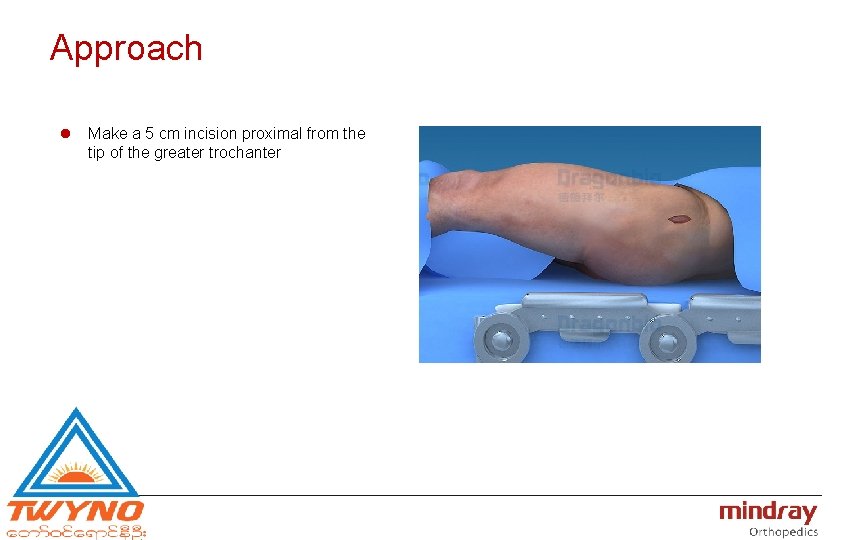
Approach l Make a 5 cm incision proximal from the tip of the greater trochanter
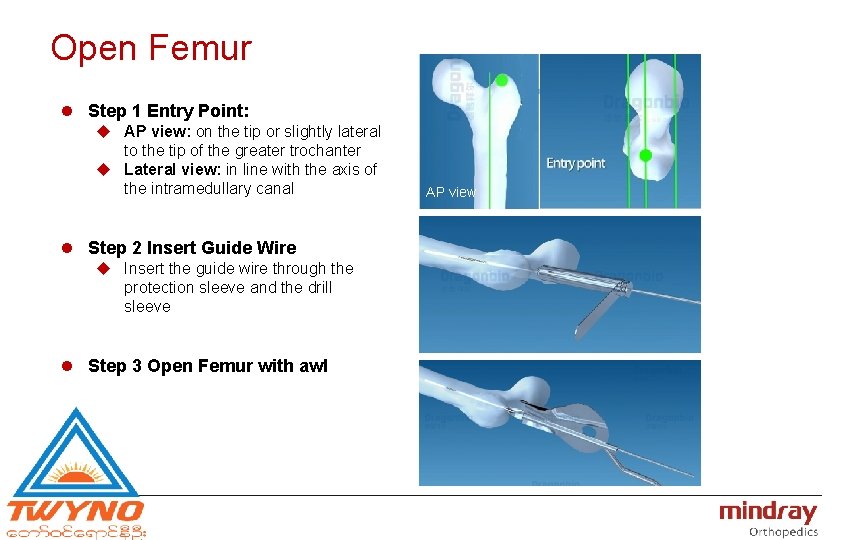
Open Femur l Step 1 Entry Point: u AP view: on the tip or slightly lateral to the tip of the greater trochanter u Lateral view: in line with the axis of the intramedullary canal l Step 2 Insert Guide Wire u Insert the guide wire through the protection sleeve and the drill sleeve l Step 3 Open Femur with awl AP view
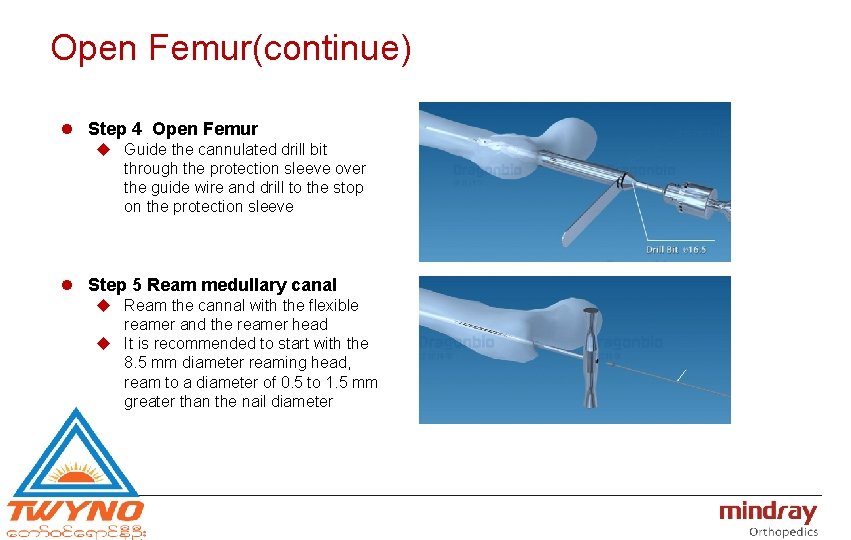
Open Femur(continue) l Step 4 Open Femur u Guide the cannulated drill bit through the protection sleeve over the guide wire and drill to the stop on the protection sleeve l Step 5 Ream medullary canal u Ream the cannal with the flexible reamer and the reamer head u It is recommended to start with the 8. 5 mm diameter reaming head, ream to a diameter of 0. 5 to 1. 5 mm greater than the nail diameter
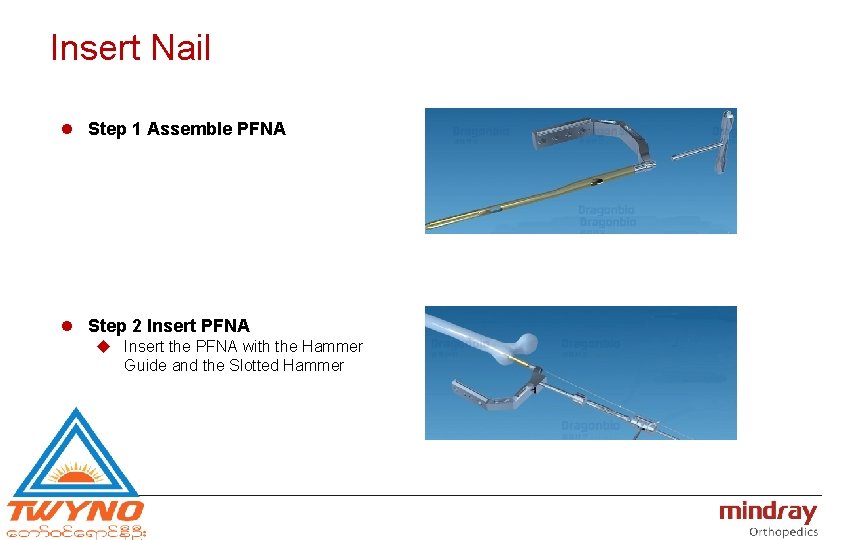
Insert Nail l Step 1 Assemble PFNA l Step 2 Insert PFNA u Insert the PFNA with the Hammer Guide and the Slotted Hammer
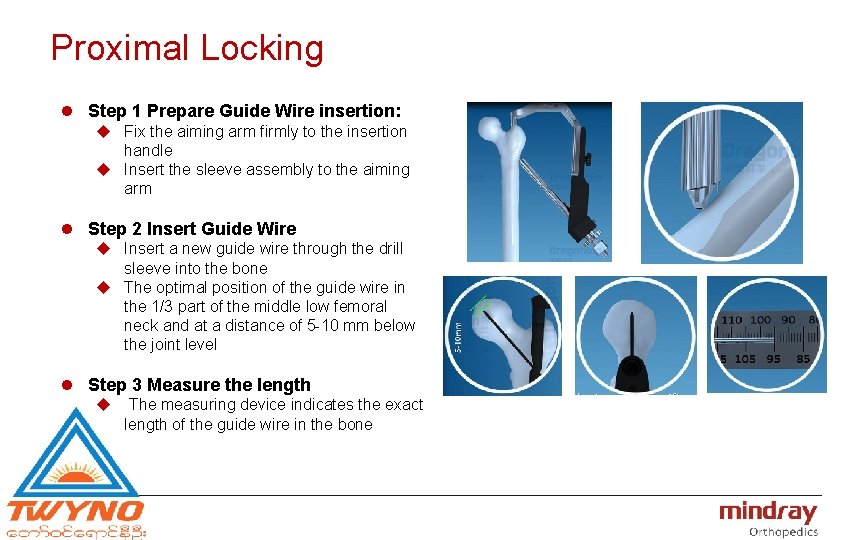
Proximal Locking l Step 1 Prepare Guide Wire insertion: u Fix the aiming arm firmly to the insertion handle u Insert the sleeve assembly to the aiming arm l Step 2 Insert Guide Wire u Insert a new guide wire through the drill sleeve into the bone u The optimal position of the guide wire in the 1/3 part of the middle low femoral neck and at a distance of 5 -10 mm below the joint level l Step 3 Measure the length u The measuring device indicates the exact length of the guide wire in the bone
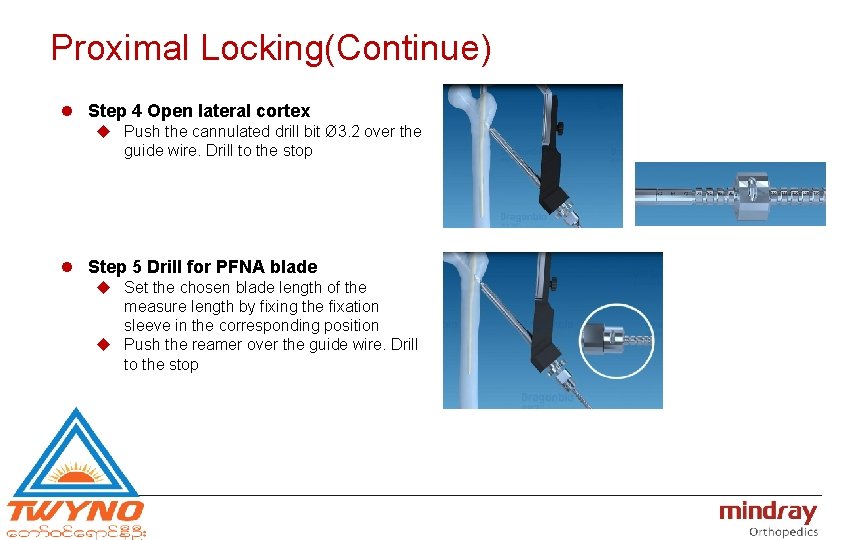
Proximal Locking(Continue) l Step 4 Open lateral cortex u Push the cannulated drill bit Ø 3. 2 over the guide wire. Drill to the stop l Step 5 Drill for PFNA blade u Set the chosen blade length of the measure length by fixing the fixation sleeve in the corresponding position u Push the reamer over the guide wire. Drill to the stop
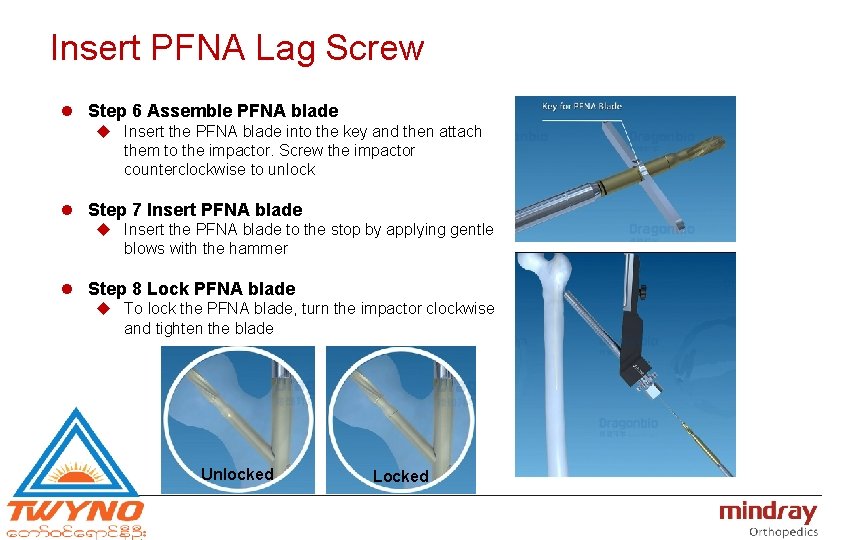
Insert PFNA Lag Screw l Step 6 Assemble PFNA blade u Insert the PFNA blade into the key and then attach them to the impactor. Screw the impactor counterclockwise to unlock l Step 7 Insert PFNA blade u Insert the PFNA blade to the stop by applying gentle blows with the hammer l Step 8 Lock PFNA blade u To lock the PFNA blade, turn the impactor clockwise and tighten the blade Unlocked Locked
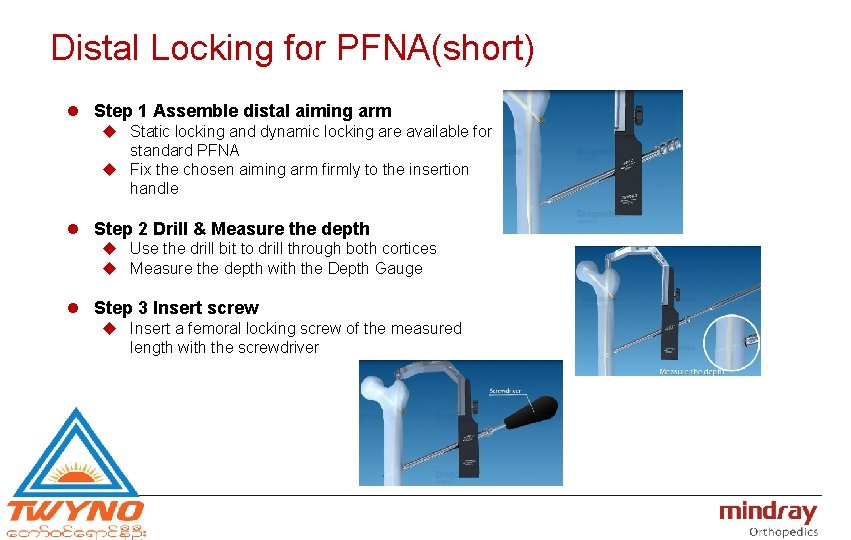
Distal Locking for PFNA(short) l Step 1 Assemble distal aiming arm u Static locking and dynamic locking are available for standard PFNA u Fix the chosen aiming arm firmly to the insertion handle l Step 2 Drill & Measure the depth u Use the drill bit to drill through both cortices u Measure the depth with the Depth Gauge l Step 3 Insert screw u Insert a femoral locking screw of the measured length with the screwdriver
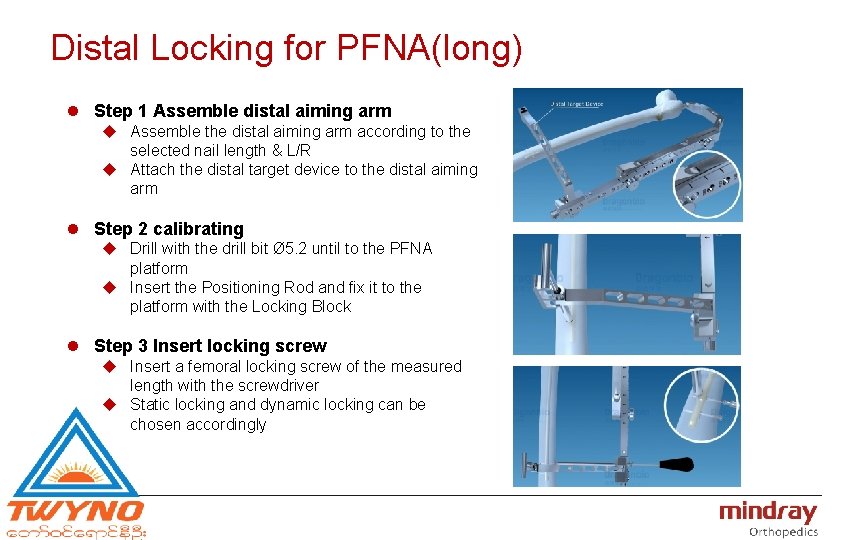
Distal Locking for PFNA(long) l Step 1 Assemble distal aiming arm u Assemble the distal aiming arm according to the selected nail length & L/R u Attach the distal target device to the distal aiming arm l Step 2 calibrating u Drill with the drill bit Ø 5. 2 until to the PFNA platform u Insert the Positioning Rod and fix it to the platform with the Locking Block l Step 3 Insert locking screw u Insert a femoral locking screw of the measured length with the screwdriver u Static locking and dynamic locking can be chosen accordingly
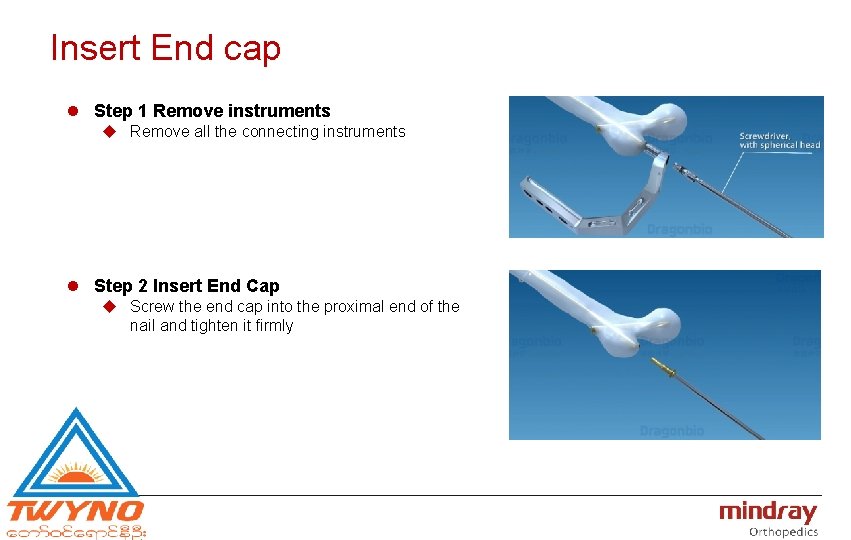
Insert End cap l Step 1 Remove instruments u Remove all the connecting instruments l Step 2 Insert End Cap u Screw the end cap into the proximal end of the nail and tighten it firmly
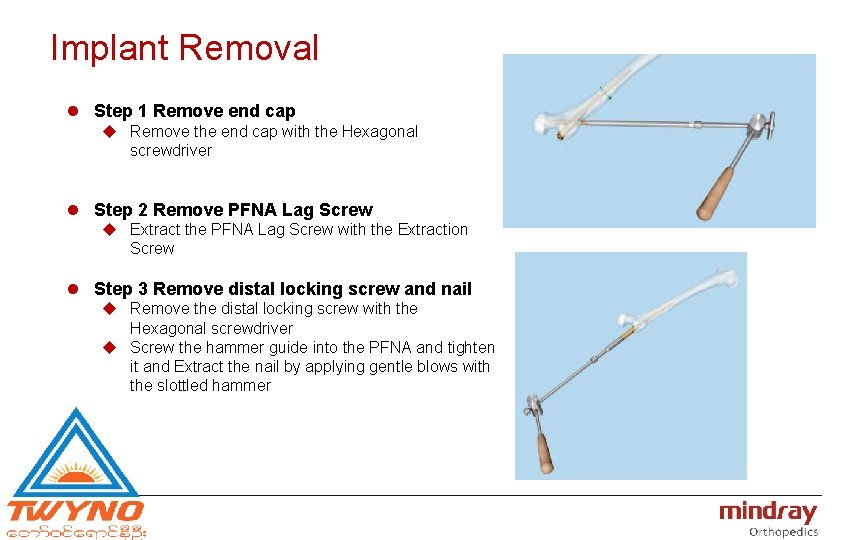
Implant Removal l Step 1 Remove end cap u Remove the end cap with the Hexagonal screwdriver l Step 2 Remove PFNA Lag Screw u Extract the PFNA Lag Screw with the Extraction Screw l Step 3 Remove distal locking screw and nail u Remove the distal locking screw with the Hexagonal screwdriver u Screw the hammer guide into the PFNA and tighten it and Extract the nail by applying gentle blows with the slottled hammer
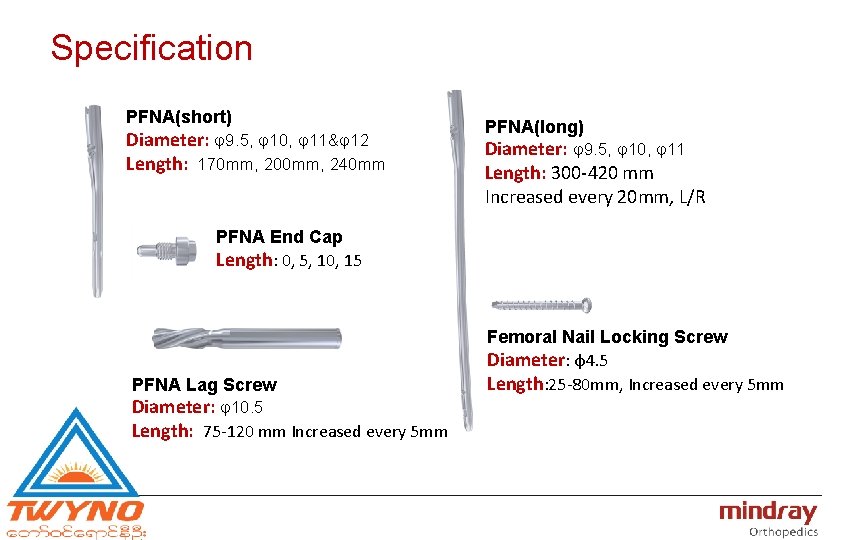
Specification PFNA(short) Diameter: φ9. 5, φ10, φ11&φ12 Length: 170 mm, 200 mm, 240 mm PFNA(long) Diameter: φ9. 5, φ10, φ11 Length: 300 -420 mm Increased every 20 mm, L/R PFNA End Cap Length: 0, 5, 10, 15 PFNA Lag Screw Diameter: φ10. 5 Length: 75 -120 mm Increased every 5 mm Femoral Nail Locking Screw Diameter: φ4. 5 Length: 25 -80 mm, Increased every 5 mm
Thank You