
PFC requirements Basic requirements Carbon based bakeable to
PFC requirements · Basic requirements - Carbon based, bakeable to 350 C - Provisions for: · NBI armor · Trim coil armor · Inboard limiter / coverage · Divertor baffles and plates · Divertor “pumping” · Energetic ion loss armor - Make first plasma, field line mapping, ohmic operation - 0. 2 MW for 0. 3 s - > 60 % of power to divertor region, balance can be intercepted by walls - Provide penetrations, accommodate in-vessel diagnostics mounted on VV · Upgrade requirements - Geometric tolerance of FW surface TBD, should be tune-able Capable to bias the individual panels electrically 1 k. V Full coverage of surfaces with carbon 12 MW for 1. 2 s
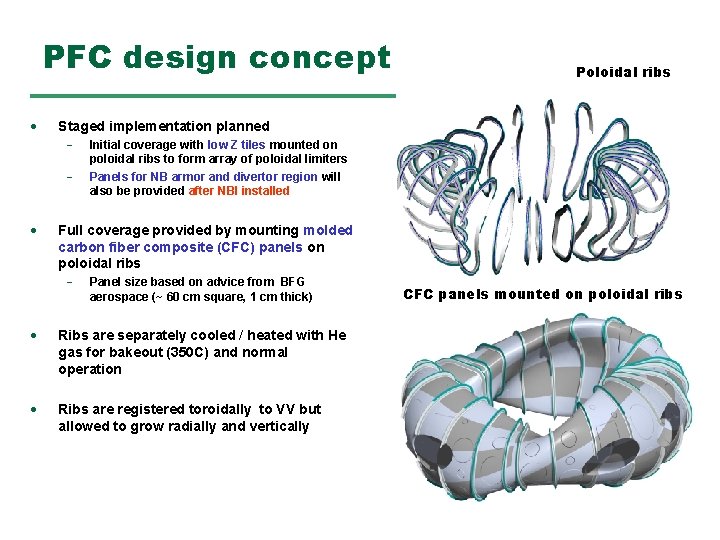
PFC design concept · Staged implementation planned - · Poloidal ribs Initial coverage with low Z tiles mounted on poloidal ribs to form array of poloidal limiters Panels for NB armor and divertor region will also be provided after NBI installed Full coverage provided by mounting molded carbon fiber composite (CFC) panels on poloidal ribs - Panel size based on advice from BFG aerospace (~ 60 cm square, 1 cm thick) · Ribs are separately cooled / heated with He gas for bakeout (350 C) and normal operation · Ribs are registered toroidally to VV but allowed to grow radially and vertically CFC panels mounted on poloidal ribs
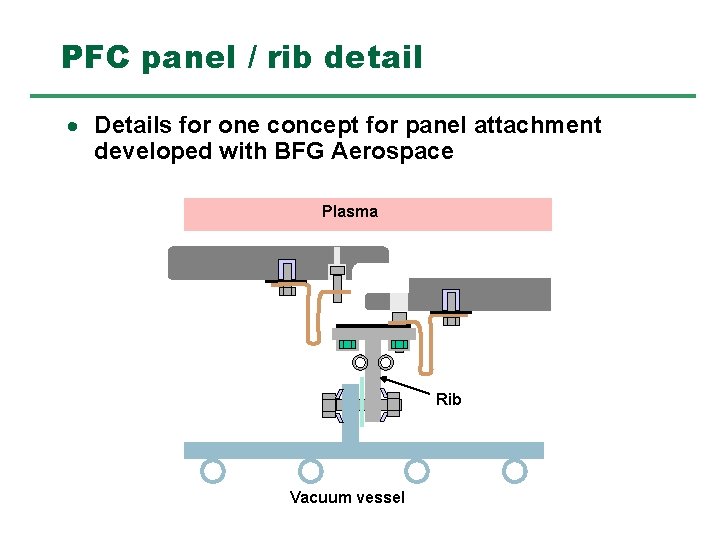
PFC panel / rib detail · Details for one concept for panel attachment developed with BFG Aerospace Plasma Rib Vacuum vessel
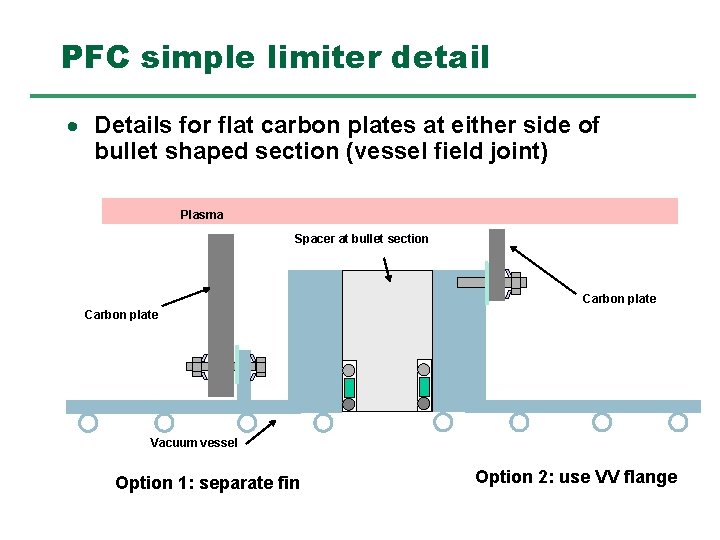
PFC simple limiter detail · Details for flat carbon plates at either side of bullet shaped section (vessel field joint) Plasma Spacer at bullet section Carbon plate Vacuum vessel Option 1: separate fin Option 2: use VV flange
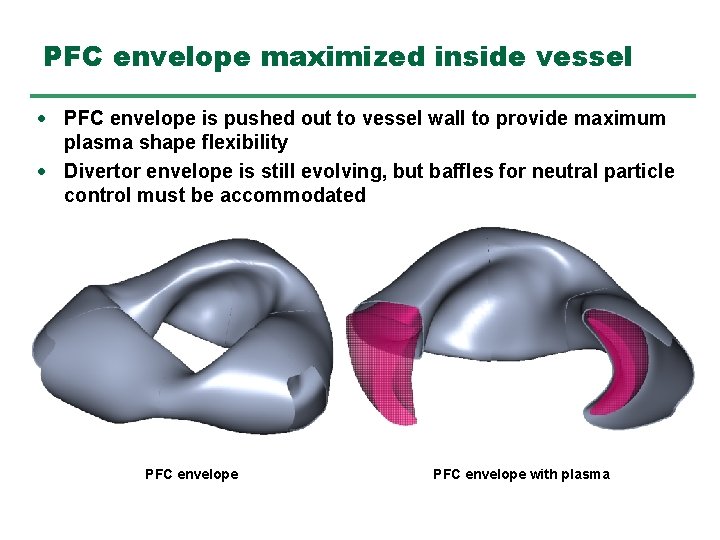
PFC envelope maximized inside vessel · PFC envelope is pushed out to vessel wall to provide maximum plasma shape flexibility · Divertor envelope is still evolving, but baffles for neutral particle control must be accommodated PFC envelope with plasma
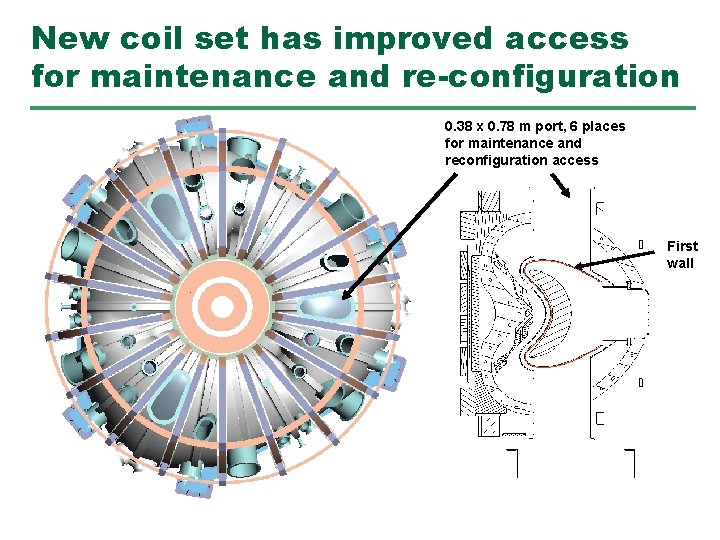
New coil set has improved access for maintenance and re-configuration 0. 38 x 0. 78 m port, 6 places for maintenance and reconfiguration access First wall
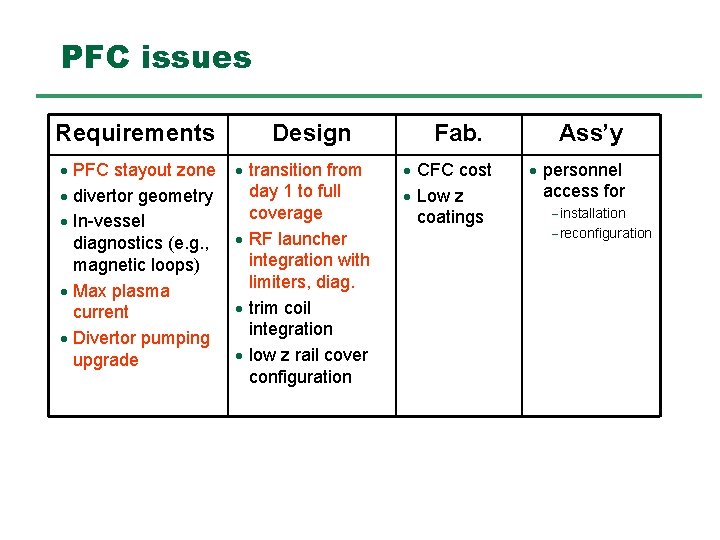
PFC issues Requirements · PFC stayout zone · divertor geometry · In-vessel diagnostics (e. g. , magnetic loops) · Max plasma current · Divertor pumping upgrade Design · transition from day 1 to full coverage · RF launcher integration with limiters, diag. · trim coil integration · low z rail cover configuration Fab. · CFC cost · Low z coatings Ass’y · personnel access for -installation -reconfiguration

PFC implementation: Stage 1 · NO Rib structure with cooling/heating lines · Ribs protected with low Z coating by: a) B 4 C spray coating b) Sheet metal covers with B 4 C coating c) Carbon (e. g. Poco, ATJ) tiles mounted directly to VV · Plasma Carbon limiters are installed only at v=1/2 (bullet) cross section, but are semi-continuous poloidally (a) (b) Vacuum vessel (c)
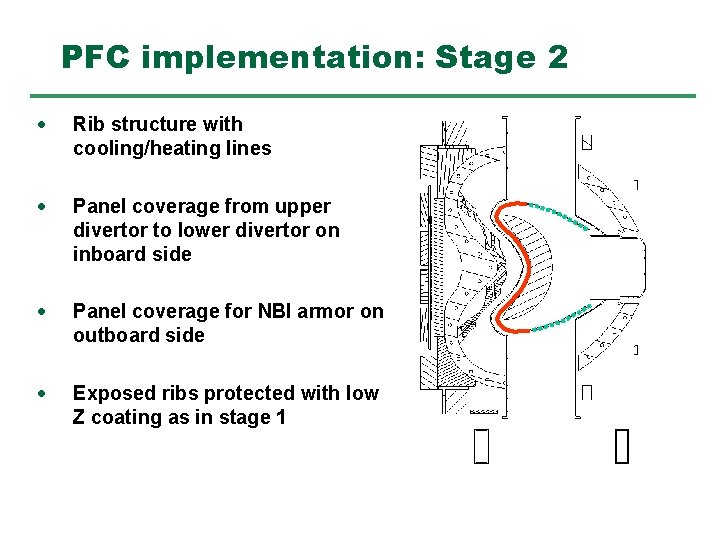
PFC implementation: Stage 2 · Rib structure with cooling/heating lines · Panel coverage from upper divertor to lower divertor on inboard side · Panel coverage for NBI armor on outboard side · Exposed ribs protected with low Z coating as in stage 1
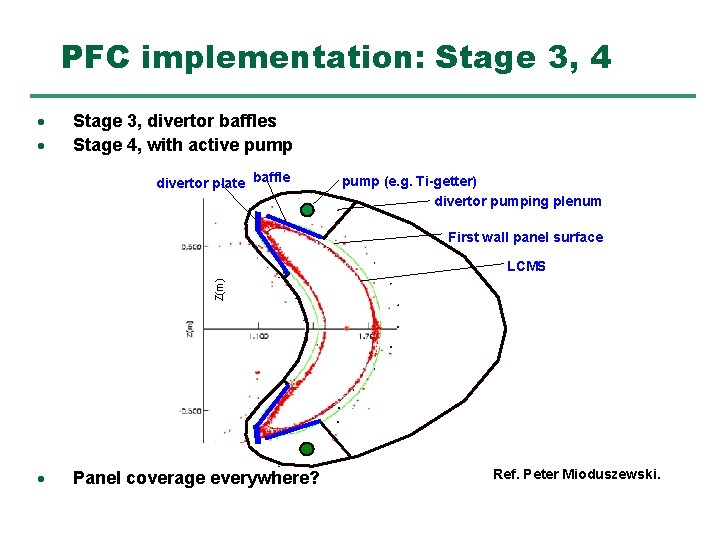
PFC implementation: Stage 3, 4 · · Stage 3, divertor baffles Stage 4, with active pump divertor plate baffle pump (e. g. Ti-getter) divertor pumping plenum First wall panel surface Z(m) LCMS · Panel coverage everywhere? Ref. Peter Mioduszewski.
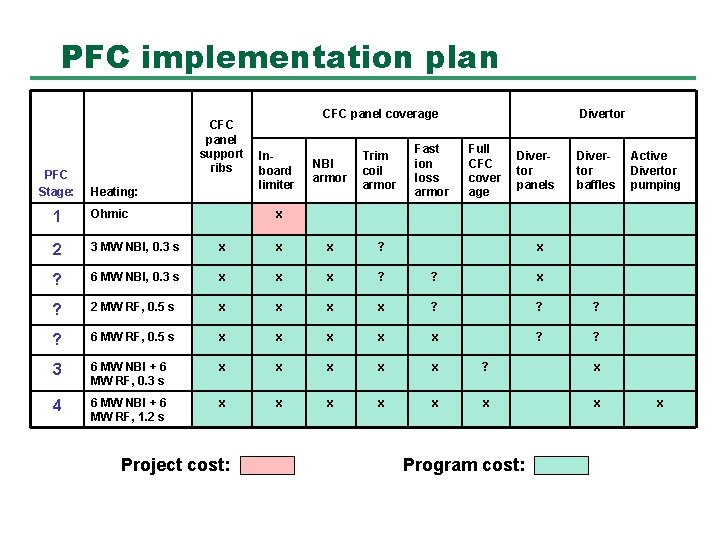
PFC implementation plan PFC Stage: CFC panel support ribs Heating: CFC panel coverage Inboard limiter NBI armor Trim coil armor Fast ion loss armor Divertor Full CFC cover age Divertor panels Divertor baffles 1 Ohmic 2 3 MW NBI, 0. 3 s x x x ? ? 6 MW NBI, 0. 3 s x x x ? ? x ? 2 MW RF, 0. 5 s x x ? ? 6 MW RF, 0. 5 s x x x ? ? 3 6 MW NBI + 6 MW RF, 0. 3 s x x x ? x 4 6 MW NBI + 6 MW RF, 1. 2 s x x x x Active Divertor pumping x Project cost: x Program cost: x
- Slides: 11