
PFAS Treatment with Granular Activated Carbon Performance Economics
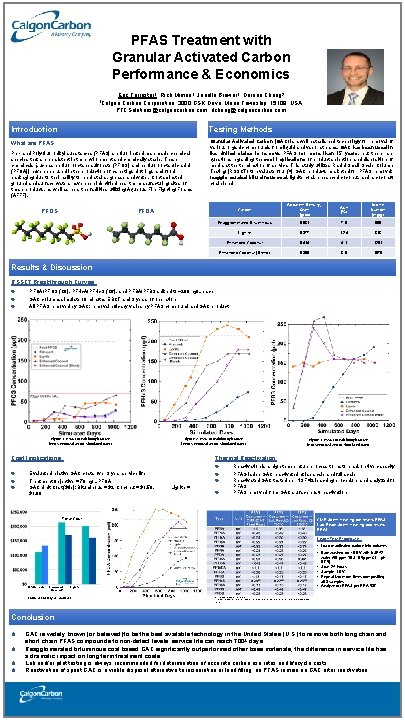
PFAS Treatment with Granular Activated Carbon Performance & Economics Eric Forrester 1, Rich Mimna 1, Jenalle Brewer 1, Doreen Chong 2 Carbon Corporation, 3000 GSK Drive, Moon Township, 15108, USA PFCSolutions@calgoncarbon. com, dchong@calgoncarbon. com 1 Calgon Introduction Testing Methods What are PFAS: Granular Activated Carbon (GAC) is a well established technology for removal of various organic compounds from liquid and vapor streams. GAC has been used in the United states to remove PFAS for more than 15 years, but there are questions regarding the cost implications of product selection and disposition of media at the termination of service. This study utilizes Rapid Small Scale Column Testing (RSSCT) to evaluate four (4) GAC products marketed for PFAS removal: reagglomerated bituminous coal, lignite coal, enhanced coconut, and a coconutcoal blend. Per- and Poly-fluoroalkyl substances (PFAS) are fluorinated man-made chemical species that are persistent in the environment and chemically stable. These chemicals [such as perfluorooctane sulfonate (PFOS) and perfluorooctanoic acid (PFOA)] have been used in the production of carpeting, clothing, and food packaging due to their ability to repel stains, grease and water. Contaminated ground and surface waters have been identified near the manufacturing sites of these products, as well as near the facilities utilizing Aqueous Fire Fighting Foams (AFFF). PFOS Carbon Apparent Density, Oven (g/cc) Ash (%) Iodine Number (mg/g) Reagglomerated Bituminous Lignite 0. 561 7. 8 999 0. 377 12. 4 616 Enhanced Coconut 0. 414 4. 1 1291 Enhanced Coconut (Blend) 0. 388 6. 9 1070 PFOA Results & Discussion RSSCT Breakthrough Curves: PFOA/PFOS (C 8), PFHx. A/PFHx. S (C 6), and PFBA/PFBS spiked to ~200 ng/L each GAC columns simulate 10 minutes EBCT and 3 years of operation All PFAS removed by GAC; removal efficacy varies by PFAS compound and GAC product Figure 1: RSSCT Breakthrough Curve (PFOS Removal versus Simulated Days) Figure 2: RSSCT Breakthrough Curve (PFHx. S Removal versus Simulated Days) Cost Implications: Figure 3: RSSCT Breakthrough Curve (PFBS Removal versus Simulated Days) Thermal Reactivation: Evaluated relative GAC costs over 3 year service life Treatment Objective = 70 ng/L PFOA GAC Unit Cost ($/lb): Bituminous = $2, Coconut = $1. 50, $1. 00 Reactivation is a high temperature process to restore adsorptive capacity PFAS-laden GAC reactivated at lab scale and full scale Reactivated GAC tested per NSF 42 leaching procedure and analyzed for PFAS removed from GAC surface post-reactivation Lignite = Total Cost CMR Spent treating ppt levels PFAS Lab React Spent treating ppb levels PFAS Leach Test Procedure: • Load reactivated carbon into columns • Backwashed for ~8 BV with NSF 42 water (50 ppm TDS, 0. 5 ppm Cl - , p. H 6. 75) • Soak 24 hours. • Sample 1 BV. • Repeat two more times compositing all 3 samples Bituminous Enhanced Coconut • Analyze for PFAS per EPA 537 Lignite Figure 4: Elasticity of Total Cost B: Compound was found in blank J: Result is less than the RL but greater than or equal to the MDL and the concentration is an approximate value Conclusion GAC is widely known (or believed) to be the best available technology in the United States (U. S. ) to remove both long chain and short chain PFAS compounds to non-detect levels; service life can reach 700+ days. Reagglomerated bituminous coal based GAC significantly outperformed other base materials; the difference in service life has a dramatic impact on long term treatment costs Lab and/or pilot testing is always recommended for determination of accurate carbon use rates and lifecycle costs Reactivation of spent GAC is a viable disposal alternative to incineration or land filling; no PFAS remain on GAC after reactivation
- Slides: 1