
PFAS in Sunscreen NEMP or NOPE Emmylou Cooke
- Slides: 1
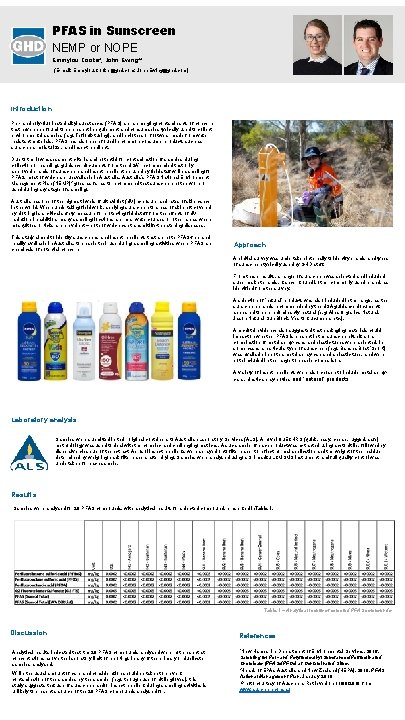
PFAS in Sunscreen NEMP or NOPE Emmylou Cooke*, John Ewing** (E-mail: Emmylou. Cooke@ghd. com; John. Ewing@ghd. com) Introduction Per- and poly-fluorinated alkyl substances (PFAS) are a emerging contaminants of concern that have been found to be present in equipment and consumables typically used to collect environmental samples (e. g. Teflon® tubing), and in clothes or footwear made from water resistant materials. PFAS has also been found in common consumer products such as sunscreen, moisturizer, and insect repellent. Due to the low assessment criteria and potential for contamination of samples during collection or handling, guidance documents from the USA 1 recommended that only approved brands of sunscreen and insect repellent be used by field staff while sampling for PFAS, most of which are unavailable in Australia’s PFAS National Environment Management Plan (NEMP)2 goes as far as to recommend that sunscreen not be worn or used during any stage of sampling. Australia has one of the highest levels of ultraviolet (UV) exposure and rates of skin cancer in the world. When undertaking field work, applying sunscreen to areas of skin not covered by clothing is a critical safety measure for protecting field staff from the effects of UV radiation. In addition, many sampling locations are near watercourses or other areas where mosquitoes or ticks are prevalent – both of which can transmit life-threatening diseases. This study aimed to identify sunscreens and insect repellents that are both PFAS-free and readily available in Australia, to enable their use during sampling activities where PFAS are chemicals of potential concern. Approach An initial survey was undertaken internally to identify brands and types of sunscreen typically used by GHD staff. From these results, a range of sunscreen was selected and included supermarket brands, Cancer Council, other commonly used brands as identified from the survey. A selection of ‘natural’ products was also included in the range, as the sunscreen brands recommended by the USA guidance documents 1 appeared to be predominantly natural (e. g. Alba Organics Natural, Jason Natural Sun Block, Yes to Cucumbers etc. ). Anecdotal evidence also suggested that packaging materials could impact on whether PFAS is present in the sunscreen itself, so a combination of metal spray-cans and plastic tubes were selected. In some cases a particular type of sunscreen (e. g. Banana Boat ‘Sport’) was available in both a metal spray-can and a plastic tube, and were both included in the range to enable comparison. A variety of insect repellents were also chosen to include metal spraycans, plastic spray-bottles and ‘natural’ products. Laboratory analysis Samples were submitted in their original containers to Australian Laboratory Services (ALS). A novel Qu. ECHRS (quick, easy, cheap, rugged, safe) methodology was used to deal with the complex and challenging matrices. A sub-sample of each product was extracted using acetonitrile, followed by dispersive clean up of the extract. Aerosol insect repellents were sprayed onto filter paper to reflect normal application and the weight of the residue determined by weighing back filter papers after drying. Samples were analysed using a Shimadzu LCMSMS instrument, and full quality control was undertaken for each sample. Results Samples were analysed for 28 PFAS compounds, with analytical results for selected compounds presented in. Table 1 – Analytical results of selected PFAS compounds Discussion Analytical results indicated that the 28 PFAS compounds analysed were not present at concentrations above the laboratory limit of reporting, in any of the primary or duplicate samples analysed. While the usual amount of care and consideration should be taken to prevent contamination of the samples by the sampler (e. g. through use of nitrile gloves), this study suggests that use of sunscreen and/or insect repellent during sampling activities is unlikely to present a source of the 28 PFAS compounds analysed for. References 1 New Hampshire Department of Environmental Services. 2016. Sampling for Per- and Polyfluoroalkyl Substances/Perfluorinated Chemicals (PFASs/PFCs) at Contaminated Sites. 2 Heads of EPAs Australia and New Zealand (HEPA). 2018. PFAS National Management Plan. January 2018 3 Photo courtesy of Auscreen. Retrieved on 11/09/2018 from www. auscreen. com. au