
PF Debate Offensive Cyber Operations Resolved The benefits
PF Debate --------------Offensive Cyber Operations . Resolved: The benefits of the United States federal government’s use of offensive cyber operations outweigh the harms.
PF Debate --------------Offensive Cyber Operations Use/Offensive Cyber Operations Use – Carry out, to do ● ● Offensive Cyber Operation James Lewis, Director and Senior Fellow, Strategic Technologies Program, Center for Strategic and International Studies, 2015, https: //ccdcoe. org/uploads/2018/10/TP_08_2015_0. pd, The Role of Offensive Cyber Operations in NATO’s Collective Defence Offensive capabilities, unlike NATO’s current defensive posture, involve deliberate intrusions into opponent networks or systems with the intention of causing disruption, damage or destruction ” Max Smeets defined OCOs as “computer activities to disrupt, degrade, and or destroy. ” 1” >Offensive Track: Deploys a proactive approach to security through the use of ethical hacking >Cyber bombs that would detonate in a conflict >Server jamming >retaliation >Counterinfluence >Espiionage If you retaliate with cyber is that offensive? Is threatening cyber war offensive ?
PF Debate --------------Offensive Cyber Operations Use/Offensive Cyber Operations
PF Debate --------------Offensive Cyber Operations Use/Offensive Cyber Operations HERBERT LIN and AMY ZEGART, 2016, Bytes, Bombs, and Spies ( p. 1). Brookings Institution Press. Kindle Edition, Senior Researcher for cybersecurity policy and security at the Center for International Security and Cooperation and Hank J. Holland Fellow in Cyber Policy and Security at the Hoover Institution, both at Stanford University. His research interests relate broadly to the policy dimensions of cybersecurity and cyberspace, with particular focus on the use of offensive operations in cyberspace as instruments of national policy. He is also Chief Scientist, Emeritus, for the Computer Science and Telecommunications Board, National Research Council of the National Academies, where he served from 1990 through 2014 as study director of major projects on public policy and information technology, and Adjunct Senior Research Scholar and Senior Fellow in Cybersecurity (nonresident) at the Saltzman Institute for War and Peace Studies of the School for International and Public Affairs at Columbia University. , Amy Zegart is the Davies Family Senior Fellow at the Hoover Institution, a Senior Fellow at the Center for International Security and Cooperation, and Professor of Political Science, by courtesy, at Stanford University. She is also a contributing editor to The Atlantic. Her research examines U. S. intelligence challenges, cybersecurity, drone warfare, and American foreign policy. Her publications include Spying Blind: The CIA, the FBI, and the Origins of 9/11 (Princeton University Press, 2007) and, with Condoleezza Rice, Political Risk: How Businesses and Organizations Can Anticipate Global Insecurity (Twelve, 2018). Before coming to Stanford in 2011 she was Professor of Public Policy at UCLA’s Luskin School of Public Affairs and spent several years as a Mc. Kinsey & Company management consultant, Bytes, Bombs, and Spies (p. 6). Brookings Institution Press. Kindle Edition. In this volume we define offensive cyber operations more specifically as: the use of cyber capabilities for national security purposes intended to compromise the confidentiality, integrity, or availability of an adversary’s information technology systems or networks; devices controlled by these systems or networks; or information resident in or passing through these systems or networks.
PF Debate --------------Offensive Cyber Operations Resolution Notes ● Resolution implies a change from the status quo, though it doesn’t require a change from the status quo – there is no proposed policy change
PF Debate --------------Offensive Cyber Status Quo -- Use Ken Dilanian is a correspondent covering intelligence and national security for the NBC News Investigative Unit, June 23, 2019, https: //www. nbcnews. com/politics/national-security/under-trump-u-s-military-ramps-cyber-offensive-againstother-n 1019281, Under Trump, U. S. military ramps up cyber offensive against other countries WASHINGTON — With little public scrutiny, the U. S. military has drastically stepped up its secret hacking of foreign computer networks in a new effort to keep China, Russia, Iran and other adversaries on their heels, current and former U. S. officials tell NBC News. Empowered with new legal authority from both Congress and President Donald Trump, the military's elite cyber force has conducted more operations in the first two years of the Trump administration than it did in eight years under Obama, officials say — including against Russia, despite Trump's well-documented affinity for Vladimir Putin. The general in charge of the push, Paul Nakasone, has spoken about the new policy in cryptic terms such as "persistent engagement, " and "defending forward, " without explaining what that means. Multiple current and former American officials briefed on the matter say military hackers are breaking into foreign networks, striking at enemy hackers and planting cyber bombs that would disable infrastructure in the event of a conflict.
PF Debate --------------Offensive Cyber Operations Pro Alternative is War Deterrence/Check aggression -- Need to “defend forward” (a) Bomb planting (b) Stop infiltration (c) Need to jam electronic systems of other countries Others do Espionage US Democracy/Election Security
PF Debate Offensive Cyber Operations Pro -- Scenarios / Iran China/SCS North Korea Russia NATO
PF Debate Offensive Cyber Operations A 2: Con Arguments / A 2: Defensive Deterrence/Retaliation A 2: Arms Control A 2: Disarmament A 2: Resilience A 2: Diplomacy Better

PF Debate Offensive Cyber Operations Pro Framework / It’s inevitable, we should be the only one -- realism Justin Rohrlich, December 19, 2018, https: //qz. com/1500647/the-pentagon-asks-researchers-for-helpplanning-for-cyberattacks/, The Pentagon thinks cyber ops could be the next WMDs In recent years, Russia, China, North Korea, and a number of violent extremist organizations have launched offensive cyberspace operations against the US. PASCC says the cyber attacks are becoming more sophisticated—and a more integral part of US adversaries’ military strategy. PASCC points out that a powerful enough cyberstrike could destroy critical infrastructure, take the financial system offline, or compromise the accuracy of essential military systems. It also noted the potential threat of social media, which it says could be used to spread “false rumors and innuendo designed to strain alliances, divide polities, and undercut public confidence in institutional integrity and social cohesion. ”
PF Debate --------------Offensive Cyber Con General War -- US likely to initiate -- Doesn’t require political sign-off -- Implants risk preemptive strikes Hair trigger -- Don’t know where it is coming from -- Pressure to respond Russia -- We have more to lose (more civilian infrastructure) China Iran North Korea Targeting civilian infrastructure is immoral Nuclear crisis – use them or lose them
PF Debate --------------Offensive Cyberwarfare A 2: Deterrence Other tools – general military, diplomatic pressure Triggers escalation Risks accidents and escalation Blueprint for attacks It’s immoral (civilian) Deterrence can break down, we can’t rely on it Offensive cyber operations don’t change behavior– they aren’t enough Destroying networks means we can’t spy
PF Debate --------------Offensive Cyber Con Strategy Contentions should include ●. (a) Offensive reasons why deterrence fails/is undermined by offensive cyber (b) Scenario-specific turns (to popular scenarios) are useful
PF Debate --------------Offensive Cyber Con Framework (a) Offensive war postures generally bad (b) Security focus generally bad (c) Gender IR? Only risk of real war is US offensive postures ●. Haarknett, 2018, Dr. Richard J. Harknett is Professor and Head of the Department of Political Science at the University of Cincinnati. In 2017, he was an inaugural Fulbright Scholar in Cyber Studies at Oxford University and in 2016 served as the inaugural Scholar-in-Residence at US Cyber Command the National Security Agency, where he assisted at the Command in examining strategic approaches to cyberspace. He was consulted, along with others in government and academia, in the drafting of the new strategy, March 23, United States Cyber Command’s New Vision: What It Entails and Why It Matters, https: //www. lawfareblog. com/unitedstates-cyber-commands-new-vision-what-it-entails-and-why-it-matters The Command’s strategic approach makes some critical assumptions about cyberspace as a domain, which have either not been explicit in the past or represent important shifts from previous U. S. thinking. First and foremost is the recognition that adversary behavior intentionally set below the threshold of armed aggression has strategic effect. This insight moves away from the conventional bifurcation of looking at cyber activity as “hacking” and binning it as either nuisance (crime) or as a potential surprise attack against critical infrastructure. Instead, the strategy focuses on adversarial cyber operations for what they are—well thought out campaigns seeking to degrade U. S. power and advance their own relative capacities, while avoiding significant American reaction. Moving away from the ‘hack, ’ ‘breach, ’ ‘incident, ’ ‘attack’ framing toward a recognition that what is significantly putting at risk American strength are sophisticated campaigns that undermine diplomatic, economic, and military power as well as social cohesion is an important step forward in U. S. thinking. The vision realizes that unlike in the terrestrial spaces where strategic effects have required territorial aggression (or the threat thereof), cyber operations have opened a new seam in the distribution of power and can impact relative power without traditional armed aggression.
PF Debate --------------Offensive Cyber More Vocabulary Grey zone warfare Operations other than war ●.
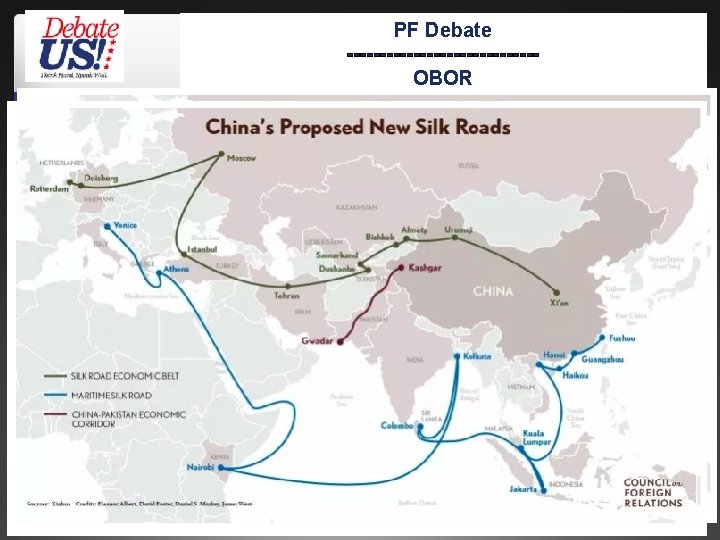
PF Debate --------------OBOR Direct Commercial Sales
PF Debate --------------OBOR Video https: //www. youtube. com/watch? v=Ev. XROXi. Ipv. Q&t=23 s BRI – Belt Road Initiative OBOR – One Belt, One Road MSRI – Maritime Silk Road Initiative Nadage Rolland, Senior Fellow for Political and Security Affairs, National Bureau of Asian Research, January 15, 2018, U. S. -CHINA ECONOMIC AND SECURITY REVIEW COMMISSION HOLDS A HEARING TO ASSESS THE STATUS OF CHINA'S BELT AND ROAD INITIATIVE FIVE YEARS ON, https: //www. uscc. gov/sites/default/files/transcripts/Hearing%20 Transcript%20%20 January%2025%2 C%202018_0. pdf So, let me elaborate on each of these points. First, BRI is generally perceived as an infrastructure project. It is true, but it's not just that. It's really a comprehensive vision for a regional, political, economic and financial integration under Beijing's helm.
PF Debate --------------BRI European Union. The European Union (EU) is a political and economic union of 28 member states that are located primarily in Europe. [12] It has an area of 4, 475, 757 km 2 (1, 728, 099 sq mi) and an estimated population of about 513 million. EU has said it will not join as a bloc. One half (struggling to get list). of the countries have joined/partnered. Sixteen East European countries have joined, but not Wester European (why Italy joining is a big deal) In April 2018, European Union envoys to China issued a statement saying the BRI ran 'counter' to their agenda for liberalising trade and 'pushed the balance of power in favour of subsidised Chinese companies’ (Kashmir Times, May 3, 2019) Teams will need to argue why EU
PF Debate --------------OBOR Why Should the EU Join? EU unity – EU split now, especially over Italy Countries that joined governed by EU policy, EU can override EU can provide capital and financing to complete the project Follow EU trade rules Appropriate trade corridors will be designed
PF Debate --------------OBOR EU’s Strategy Daily Times, September 30, 2018, EU Challenge to the BRI, nexis The EU is the latest actor to enter the Great Game. For the 28 -member bloc is launching its own 'Connectivity Strategy' aimed at linking Europe to Asia. Pundits are inevitably viewing this as a direct challenge to China's Brick and Road Initiative (BRI). They are right to do so. Despite its overriding focus on transport, digital and energy links the main priority remains infrastructure. For, as experts point out, this is the driving force behind increased connectivity. China has thus far offered the initiative a cautious welcome. While the EU is playing coy as it continues to peddle the myth that Brussels is not trying to usurp Beijing; but introduce a certain set of standards. Thus the EU strives to persuade how, under its stewardship, all ventures will be free from so-called debt-trap diplomacy. Towards this end it has directed that no project should create a climate of political and financial dependency. Moreover, in a bid to push this claimed moral high ground home even further the bloc has stressed the need for sustainability while demanding that all enterprises respect labour and environmental rights. This sounds good on paper. Though in reality it smacks of opportunism. Especially given that many EU clothing giants are still outsourcing production to Asian-based sweatshops. This is to say nothing of how European and American IT and technology industries turn to China and its overwhelmingly under-regulated electronics The broader picture suggests that Brussels is sending a clear signal not just to Beijing but to also to Moscow that it is a contender in the race to secure competing spheres of influence. As far as the US goes, the EU may well wish to present itself as a multilateral alternative to American unilateralism. Of course, in truth, this amounts to little more than semantics. For Washington has long used the Union, as well as NATO, to further its European and Central Asian interests; as witnessed in Kosovo at the close of last century. Meaning that the US will not regard such EU manoeuvrings as a threat to its regional interests. But, more likely, as supplementing these. assembly hub to put together end products.
PF Debate --------------BRI Benefits Europe Helps Europe’s economy generally (a) Joining BRI will increase Europe's exports to China, reducing Europe's trade deficit with China (b) Stronger trade infrastructure in Europe will increase trade within Europe (c) If Europe joins as a bloc, there will be more unity in Europe and trade within Europe. Current agreements cause conflict within the EU because the EU is supposed to have a unified trade market (d) Europe gets access to needed capital from China European unity -- If Europe joins as a bloc that will reduce status quo conflicts that are created when individual countries join EU environmental standards (a) Right now China controls the BRI. If Europe joins that means Europe can push its own environmental standards EU Human Rights Standards (a) Right now China controls the BRI. If Europe joins that means Europe can push its own human rights standards Europe gets access to China's 5 G technology, 5 G good (for Europe) Status quo means telecommunications relies on sea cables, BRI creates land cables that create redundancy and reduce the risk of internet disruptions Science & Technology Cooperation good Helps Europe build ties to other countries in South Asia that are included with the BRI.
PF Debate --------------BRI Good For China Whoever is able to build and control the infrastructure linking the two ends of Eurasia will rule the world. Maçães, Bruno. Belt and Road (p. 3). Hurst. Kindle Edition. China's economy (a) BRI supports China's steel, aluminum, and cement industries. Those are important to its economy. These industries might also be important for China's security. (b) Generally increase China's exports (c) Chinese companies benefit because they build most of the infrastructure (d) Supports dredging industry (e) Supports rail industry (f) Supports energy industry -- 30 million potentially unemployed Reduces China conflict with the US (a) Provides an alternate trade partner for China BRI supports nuclear power development, nuclear power good BRI promotes China's global leadership, China global leadership good
PF Debate --------------OBOR Good for the World EU capital investment sustains the BRI, BRI generally good Climate Change (a) China-EU cooperation means there is investment into sustainable energy funds, helping the world meet the Paris targets. (b) EU will push China to meet climate targets, incorporate sustainable development Rail routes to Europe good (a) Rail routes reduce air pollution from plans (b) Rail routes reduce ocean pollution from ships BRI Promotes development, China's development model best -- BRI is a more socialist or "state managed capitalism" alternative to global development and that is best for global development. Teams may also read "democracy bad" and "capitalism bad" impacts to this. Reduces debt traps -- Right now the initiative is entirely controlled by China, now Europe has influence and the EU joining would bring in European capital

PF Debate --------------OBOR Good for the World BRI supports a multipolar world, multipolarity good Promotes China’s world leadership/Chinese world leadership best/US hegemony bad -- Why does it increase China's World Leadership? (a) Cement's China's economic ties with at least 28 European countries (b) Undermines US relations with Europe (c) Creates two stronger poles in the world -- Europe and China, making the world more multipolar Increased availability of capital from EU/China means countries can rely less on IMF/World Bank, IMF/World Bank Bad
PF Debate --------------BRI Bad for Europe Disrupts relations with the US -- It would be a radical change in allegiances to have Western European countries join Charles Stevens, the founder of The New Silk Road Projecttells, March 13, 2018, New Silk Road Project founder: Developments in Azerbaijan are significant, Nexis Q. : What would it mean for Western European countries to join the Belt and Road initiative? Do you expect more countries to join it in future? A. : I think it would mark a great success for BRI as a strategy. With the UK leaving the European Union the economic region has had a jolt to its confidence. Whilst the EU does not have a united policy towards BRI some countries, particularly in Eastern Europe have been more receptive. This includes Belarus which is not formally part of the EU but participates in the EU's Eastern Partnership. It would signal a decisive shift in strategic direction and historic allegiances were Western European countries to align more closely with BRI. China has been clever in presenting BRI as a development which is open for any countries to participate in this includes the U. S. - Trump is against Europe just launched a project to counter – “Connectivity Project”
PF Debate --------------BRI Bad for Europe Requirements for European companies are bad Hurts Europe's economy (a) Disrupts (trade) relations with the US (b) If Europe gets more loans from China the European companies will just be dependent on the loans without increasing exports, creating a transfer of more wealth out of Europe (c) China will dominate the trading relationship Europe gets access to China's 5 G technology, being on China's 5 G network is bad (spies on Europe, threatens cyber security, etc) BRI gives China more Data, AI based on Data, China over takes US (and European allies) on AI BRI supports a multipolar world, multipolarity bad BRI will undermine Europe's trade standards, including investment, labor, and environmental standards BRI will cause infighting in Europe and weaken European unity
PF Debate --------------BRI Bad for the World Promotes China’s world leadership/China’s world leadership bad/US hegemony good China-dominated Eurasia will replace the US-led global liberal world order Increased China empire/threat Reduced US power, Reduced US port access Debt trap BRI Promotes development, China's development model bad -- BRI is a more socialist or "state managed capitalism" alternative to global development and that is bad for global development/capitalism is better. Teams may also read "democracy good" impacts to this. China violates human rights (a) Europe won't be able to criticize if it joins BRI (b) Europe should not support China when China is a human rights violator (Instead, Europe should shun China) (c) There are HR violations during BRI projects, Pro expands BRI Alternative energy development hurts the economies of oil producing countries New energy technologies lower oil prices, making the transition to new energy technologies difficult
PF Debate --------------BRI Bad for the World Environmental problems, pollution Sustains the BRI, BRI generally bad (a)Deforestation (b) More dams, dams bad (c)General environmental harms Economic dependence on China bad BRI supports the development of a strong dredging industry in China, strong dredging industry supports China's aggression in the South China Sea.
PF Debate --------------BRI The Resolution The European Union should join China’s Belt and Road Initiative ”Join” What perspective/Framework * Europe *US (allies) *World Peace *Overall Benefits
- Slides: 29