
Pewter Casting Step by Step 1 Collect the
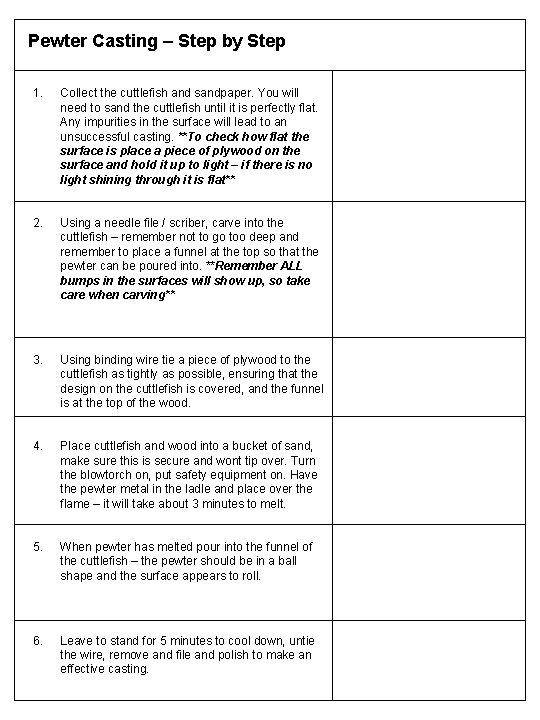
Pewter Casting – Step by Step 1. Collect the cuttlefish and sandpaper. You will need to sand the cuttlefish until it is perfectly flat. Any impurities in the surface will lead to an unsuccessful casting. **To check how flat the surface is place a piece of plywood on the surface and hold it up to light – if there is no light shining through it is flat** 2. Using a needle file / scriber, carve into the cuttlefish – remember not to go too deep and remember to place a funnel at the top so that the pewter can be poured into. **Remember ALL bumps in the surfaces will show up, so take care when carving** 3. Using binding wire tie a piece of plywood to the cuttlefish as tightly as possible, ensuring that the design on the cuttlefish is covered, and the funnel is at the top of the wood. 4. Place cuttlefish and wood into a bucket of sand, make sure this is secure and wont tip over. Turn the blowtorch on, put safety equipment on. Have the pewter metal in the ladle and place over the flame – it will take about 3 minutes to melt. 5. When pewter has melted pour into the funnel of the cuttlefish – the pewter should be in a ball shape and the surface appears to roll. 6. Leave to stand for 5 minutes to cool down, untie the wire, remove and file and polish to make an effective casting.
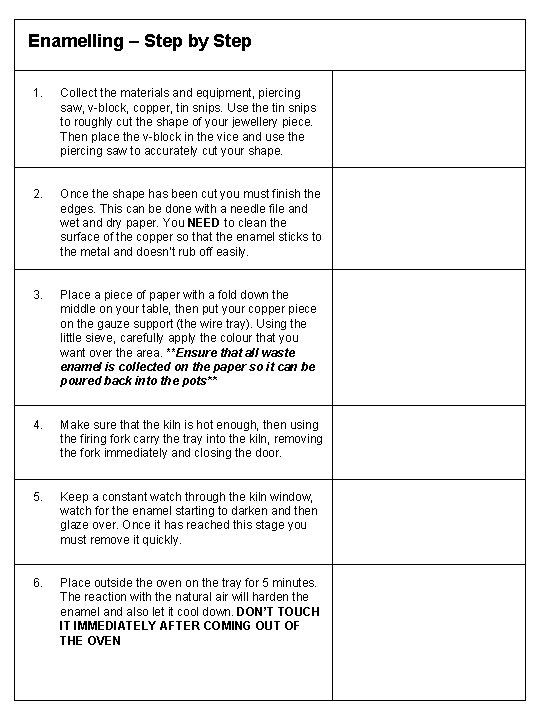
Enamelling – Step by Step 1. Collect the materials and equipment, piercing saw, v-block, copper, tin snips. Use the tin snips to roughly cut the shape of your jewellery piece. Then place the v-block in the vice and use the piercing saw to accurately cut your shape. 2. Once the shape has been cut you must finish the edges. This can be done with a needle file and wet and dry paper. You NEED to clean the surface of the copper so that the enamel sticks to the metal and doesn’t rub off easily. 3. Place a piece of paper with a fold down the middle on your table, then put your copper piece on the gauze support (the wire tray). Using the little sieve, carefully apply the colour that you want over the area. **Ensure that all waste enamel is collected on the paper so it can be poured back into the pots** 4. Make sure that the kiln is hot enough, then using the firing fork carry the tray into the kiln, removing the fork immediately and closing the door. 5. Keep a constant watch through the kiln window, watch for the enamel starting to darken and then glaze over. Once it has reached this stage you must remove it quickly. 6. Place outside the oven on the tray for 5 minutes. The reaction with the natural air will harden the enamel and also let it cool down. DON’T TOUCH IT IMMEDIATELY AFTER COMING OUT OF THE OVEN
- Slides: 2