
PETS components and waveguide connections CLIC Workshop 2007
- Slides: 14
PETS components and waveguide connections CLIC Workshop 2007 David Carrillo
Index A design to connect PETS with accelerating structures will be discussed l choke flange And also we will deal with two components for testing the PETS l Input coupler l Single test bar device David Carrillo CIEMAT
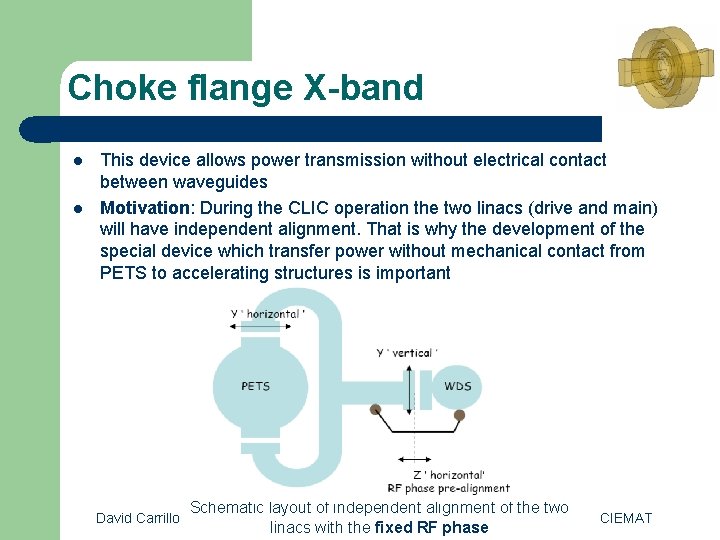
Choke flange X-band l l This device allows power transmission without electrical contact between waveguides Motivation: During the CLIC operation the two linacs (drive and main) will have independent alignment. That is why the development of the special device which transfer power without mechanical contact from PETS to accelerating structures is important David Carrillo Schematic layout of independent alignment of the two linacs with the fixed RF phase CIEMAT
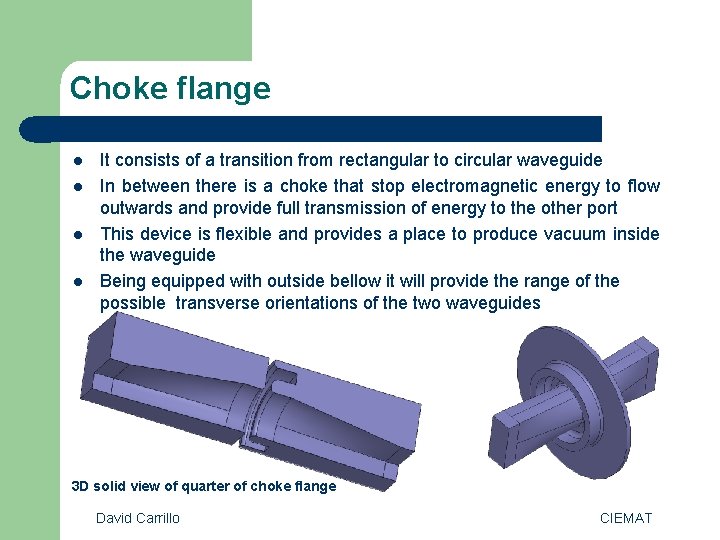
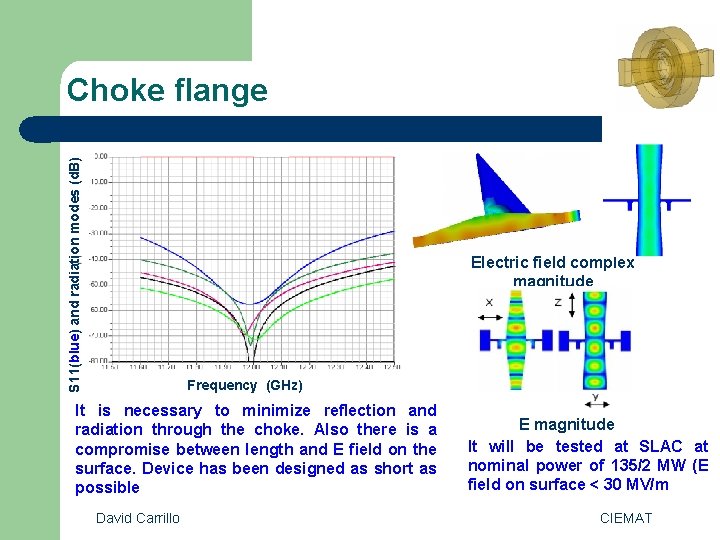
Choke flange l l It consists of a transition from rectangular to circular waveguide In between there is a choke that stop electromagnetic energy to flow outwards and provide full transmission of energy to the other port This device is flexible and provides a place to produce vacuum inside the waveguide Being equipped with outside bellow it will provide the range of the possible transverse orientations of the two waveguides 3 D solid view of quarter of choke flange David Carrillo CIEMAT
S 11(blue) and radiation modes (d. B) Choke flange Electric field complex magnitude Frequency (GHz) It is necessary to minimize reflection and radiation through the choke. Also there is a compromise between length and E field on the surface. Device has been designed as short as possible David Carrillo E magnitude It will be tested at SLAC at nominal power of 135/2 MW (E field on surface < 30 MV/m CIEMAT
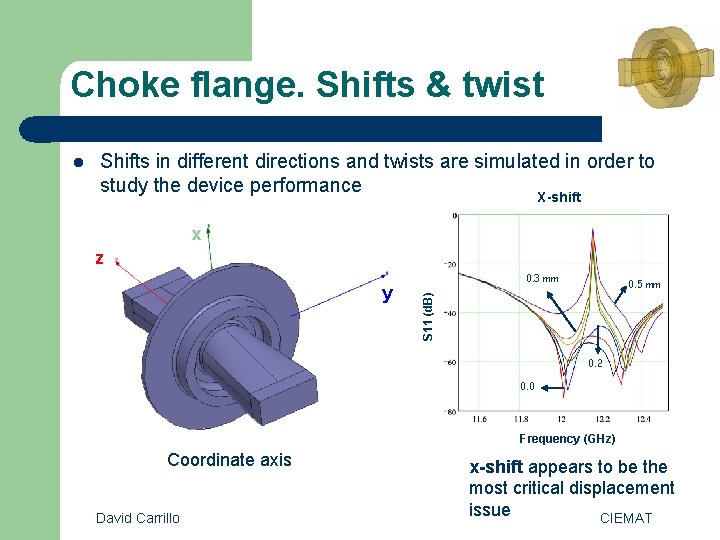
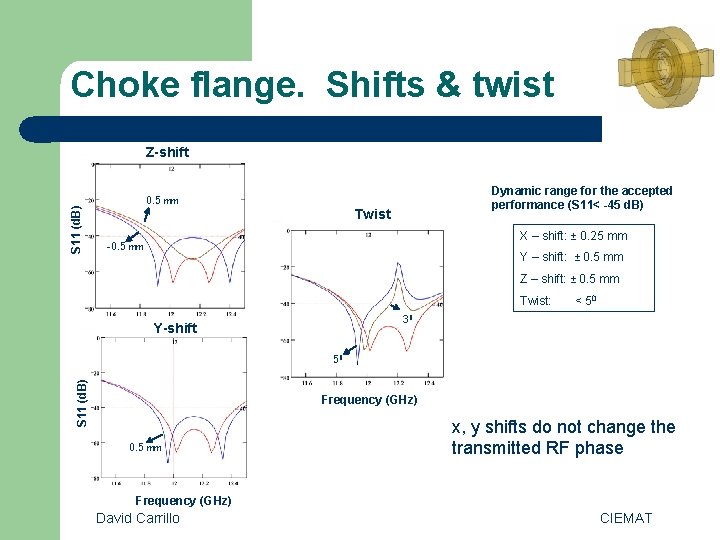
Choke flange. Shifts & twist Shifts in different directions and twists are simulated in order to study the device performance X-shift x z y 0. 3 mm 0. 5 mm S 11 (d. B) l 0. 2 0. 0 Frequency (GHz) Coordinate axis David Carrillo x-shift appears to be the most critical displacement issue CIEMAT
Choke flange. Shifts & twist S 11 (d. B) Z-shift 0. 5 mm Dynamic range for the accepted performance (S 11< -45 d. B) Twist X – shift: ± 0. 25 mm -0. 5 mm Y – shift: ± 0. 5 mm Z – shift: ± 0. 5 mm Twist: < 50 30 Y-shift S 11 (d. B) 50 Frequency (GHz) 0. 5 mm x, y shifts do not change the transmitted RF phase Frequency (GHz) David Carrillo CIEMAT
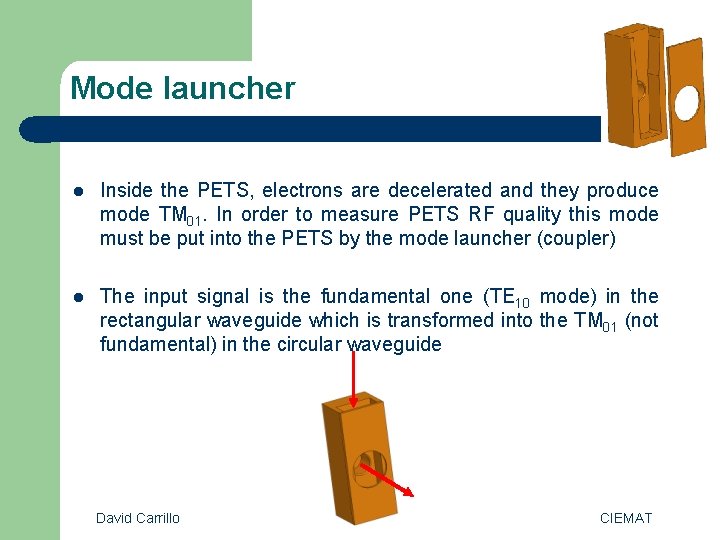
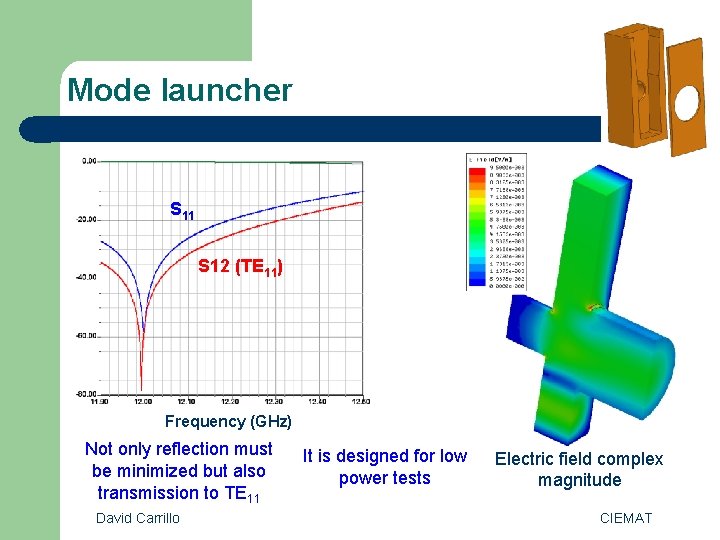
Mode launcher l Inside the PETS, electrons are decelerated and they produce mode TM 01. In order to measure PETS RF quality this mode must be put into the PETS by the mode launcher (coupler) l The input signal is the fundamental one (TE 10 mode) in the rectangular waveguide which is transformed into the TM 01 (not fundamental) in the circular waveguide David Carrillo CIEMAT
Mode launcher S 11 S 12 (TE 11) Frequency (GHz) Not only reflection must be minimized but also transmission to TE 11 David Carrillo It is designed for low power tests Electric field complex magnitude CIEMAT
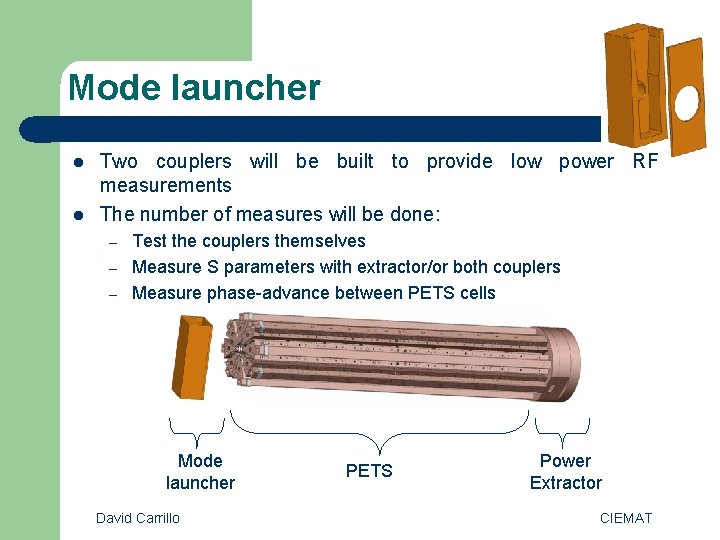
Mode launcher l l Two couplers will be built to provide low power RF measurements The number of measures will be done: – – – Test the couplers themselves Measure S parameters with extractor/or both couplers Measure phase-advance between PETS cells Mode launcher David Carrillo PETS Power Extractor CIEMAT
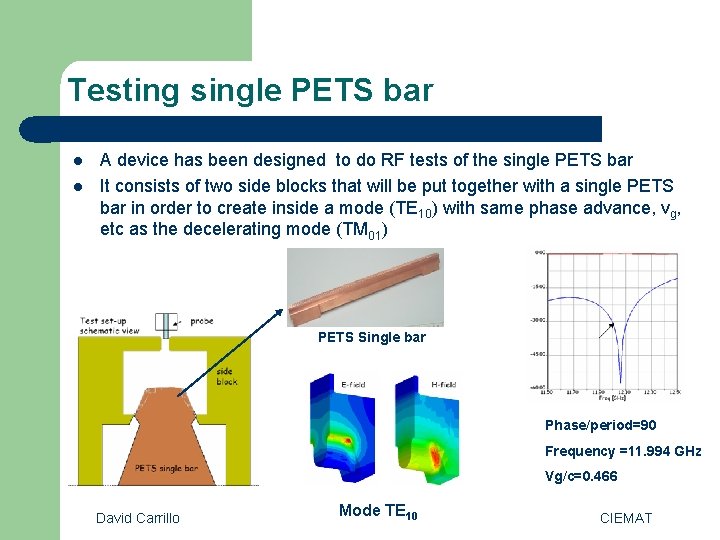
Testing single PETS bar l l A device has been designed to do RF tests of the single PETS bar It consists of two side blocks that will be put together with a single PETS bar in order to create inside a mode (TE 10) with same phase advance, vg, etc as the decelerating mode (TM 01) PETS Single bar Phase/period=90 Frequency =11. 994 GHz Vg/c=0. 466 David Carrillo Mode TE 10 CIEMAT
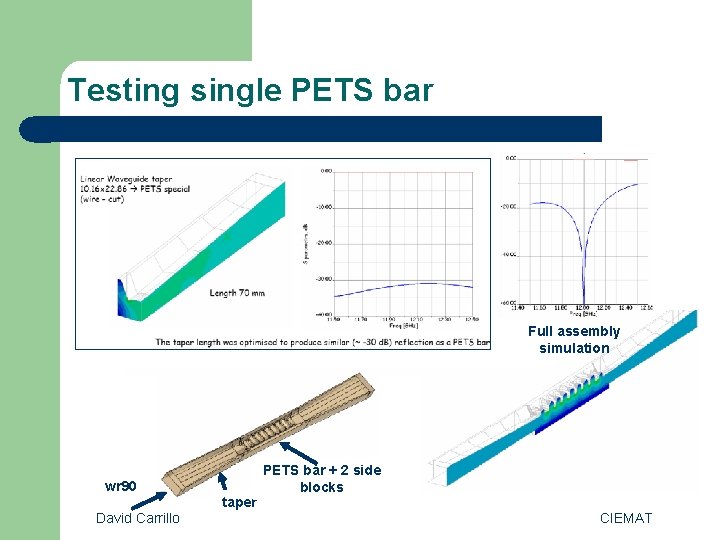
Testing single PETS bar Full assembly simulation wr 90 David Carrillo taper PETS bar + 2 side blocks CIEMAT
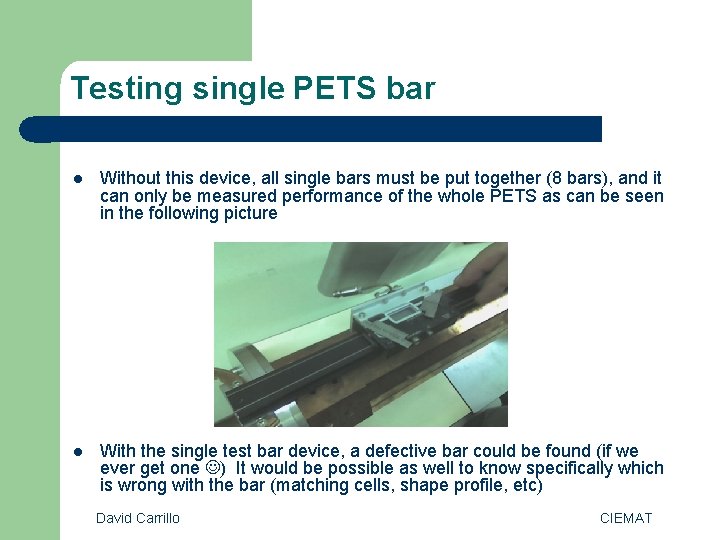
Testing single PETS bar l Without this device, all single bars must be put together (8 bars), and it can only be measured performance of the whole PETS as can be seen in the following picture l With the single test bar device, a defective bar could be found (if we ever get one ) It would be possible as well to know specifically which is wrong with the bar (matching cells, shape profile, etc) David Carrillo CIEMAT
Conclusions l A Choke flange design has been done, which will allow a flexible connection between PETS and accelerating structures and also will provide a vacuum port l Single bar test device will allow us to measure RF quality of single bars before putting all together l Mode launcher designed will be used to introduce and extract power in order to test phase-shift and S parameters for PETS David Carrillo CIEMAT