
Petroleum Substances Special Considerations for Interpreting HPV Data
Petroleum Substances: Special Considerations for Interpreting HPV Data Characterizing Chemicals in Commerce: Using Data on High Production Volume (HPV) Chemicals December 13, 2006 Thomas M. Gray, M. S. , D. A. B. T. API Technical Manager, Petroleum HPV Testing Group 1
Petroleum Substance: Special Considerations Presentation Outline • • Petroleum HPV Testing Group (TG) Petroleum Substances – – • Category Approach for Meeting Data Commitments – – • Most Highly Complex Mixtures Major Chemical Classes of Compounds Sources of Compositional Uniqueness, Complexity and Variability Definitions Rationale, Grouping, Category Justification, and Methods Used for Predicting Values for Untested Substances TG Categories Impact of Substance Composition on HPV Properties – – Physical/Chemical Environmental Fate Ecotoxicity Mammalian Toxicity Characterizing Chemicals in Commerce: Using Data on High Production Volume (HPV) Chemicals – December 13, 2006 2
Petroleum Substances – Special Considerations Petroleum HPV Testing Group (TG) • 60 Member Companies – – American Petroleum Institute (Program Administrator) Asphalt Institute Gas Processors Association National Petrochemical & Refiners Association • 405 Substances – Hundreds of refinery streams in the program because each is isolated at a refinery – Multiple product types are blended from the various streams Characterizing Chemicals in Commerce: Using Data on High Production Volume (HPV) Chemicals – December 13, 2006 3
Petroleum Substances – Special Considerations Petroleum Substances • Most are complex mixtures (TSCA Class 2 Substances) – “…may have unknown or variable compositions or be composed of a complex combination of different molecules. ” – “…each UVCB can be considered to be category of molecules, often closely related. ” • Compositional variability means most substances will have a range of HPV values Characterizing Chemicals in Commerce: Using Data on High Production Volume (HPV) Chemicals – December 13, 2006 4
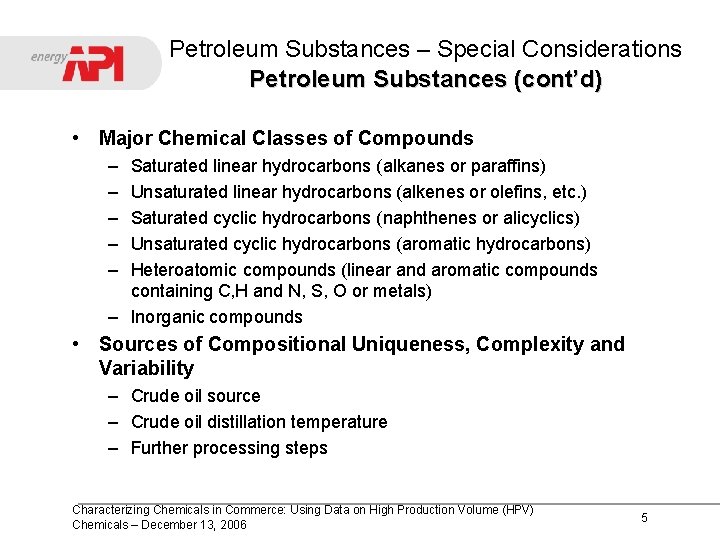
Petroleum Substances – Special Considerations Petroleum Substances (cont’d) • Major Chemical Classes of Compounds – – – Saturated linear hydrocarbons (alkanes or paraffins) Unsaturated linear hydrocarbons (alkenes or olefins, etc. ) Saturated cyclic hydrocarbons (naphthenes or alicyclics) Unsaturated cyclic hydrocarbons (aromatic hydrocarbons) Heteroatomic compounds (linear and aromatic compounds containing C, H and N, S, O or metals) – Inorganic compounds • Sources of Compositional Uniqueness, Complexity and Variability – Crude oil source – Crude oil distillation temperature – Further processing steps Characterizing Chemicals in Commerce: Using Data on High Production Volume (HPV) Chemicals – December 13, 2006 5
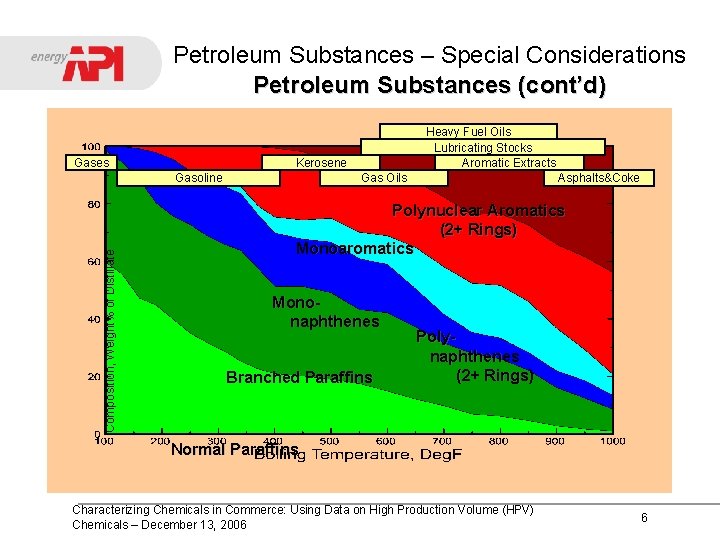
Petroleum Substances – Special Considerations Petroleum Substances (cont’d) Gases Kerosene Gasoline Composition, Weight% of Distillate Heavy Fuel Oils Lubricating Stocks Aromatic Extracts Gas Oils Asphalts&Coke Polynuclear Aromatics (2+ Rings) Monoaromatics Mononaphthenes Branched Paraffins Polynaphthenes (2+ Rings) Normal Paraffins Characterizing Chemicals in Commerce: Using Data on High Production Volume (HPV) Chemicals – December 13, 2006 6
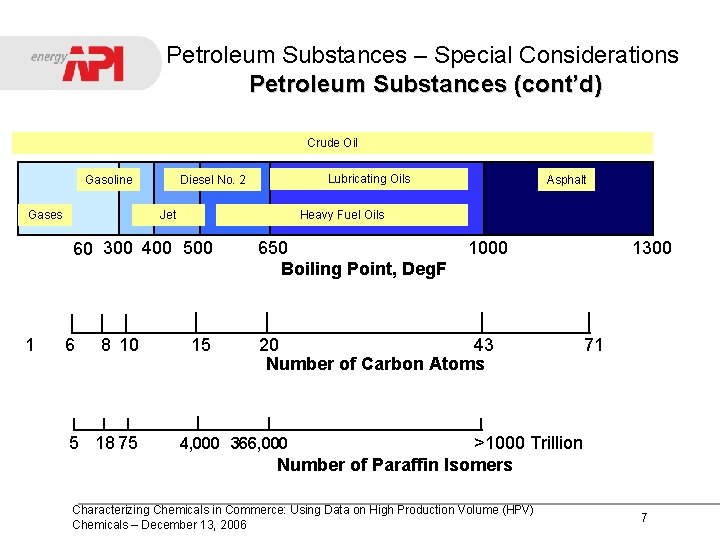
Petroleum Substances – Special Considerations Petroleum Substances (cont’d) Crude Oil Gasoline Gases Jet 6 8 10 5 18 75 Asphalt Heavy Fuel Oils 60 300 400 500 1 Lubricating Oils Diesel No. 2 15 650 Boiling Point, Deg. F 1000 20 43 Number of Carbon Atoms 1300 71 >1000 Trillion Number of Paraffin Isomers 4, 000 366, 000 Characterizing Chemicals in Commerce: Using Data on High Production Volume (HPV) Chemicals – December 13, 2006 7
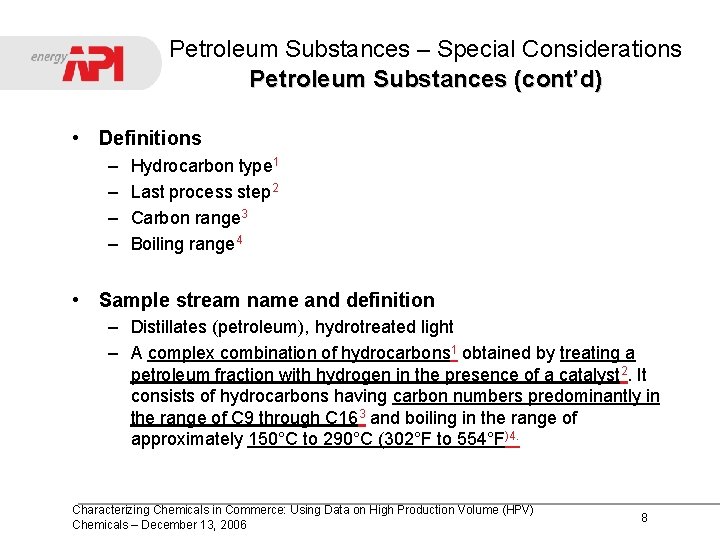
Petroleum Substances – Special Considerations Petroleum Substances (cont’d) • Definitions – – Hydrocarbon type 1 Last process step 2 Carbon range 3 Boiling range 4 • Sample stream name and definition – Distillates (petroleum), hydrotreated light – A complex combination of hydrocarbons 1 obtained by treating a petroleum fraction with hydrogen in the presence of a catalyst 2. It consists of hydrocarbons having carbon numbers predominantly in the range of C 9 through C 163 and boiling in the range of approximately 150°C to 290°C (302°F to 554°F)4. Characterizing Chemicals in Commerce: Using Data on High Production Volume (HPV) Chemicals – December 13, 2006 8
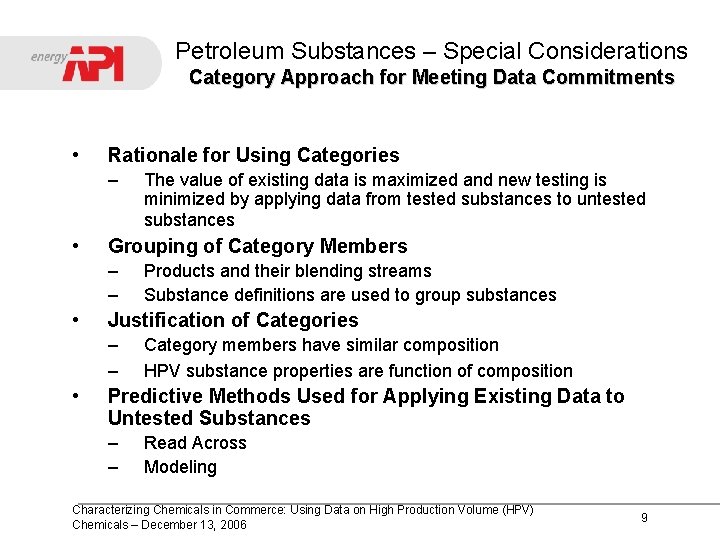
Petroleum Substances – Special Considerations Category Approach for Meeting Data Commitments • Rationale for Using Categories – • Grouping of Category Members – – • Products and their blending streams Substance definitions are used to group substances Justification of Categories – – • The value of existing data is maximized and new testing is minimized by applying data from tested substances to untested substances Category members have similar composition HPV substance properties are function of composition Predictive Methods Used for Applying Existing Data to Untested Substances – – Read Across Modeling Characterizing Chemicals in Commerce: Using Data on High Production Volume (HPV) Chemicals – December 13, 2006 9
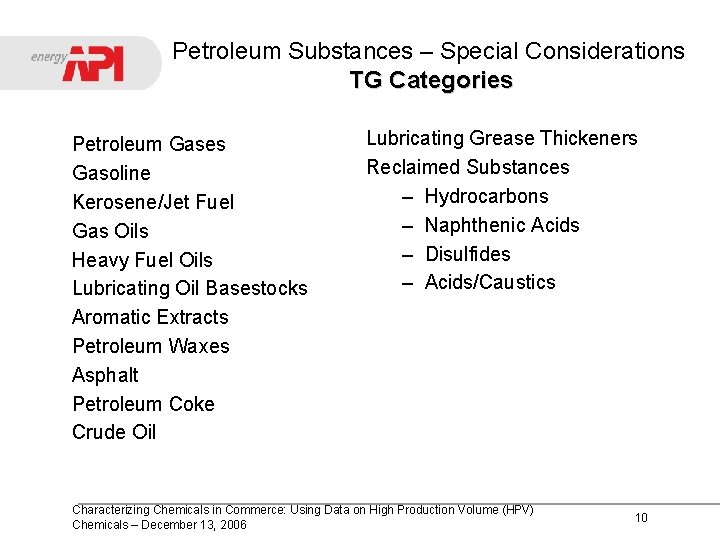
Petroleum Substances – Special Considerations TG Categories Petroleum Gases Gasoline Kerosene/Jet Fuel Gas Oils Heavy Fuel Oils Lubricating Oil Basestocks Aromatic Extracts Petroleum Waxes Asphalt Petroleum Coke Crude Oil Lubricating Grease Thickeners Reclaimed Substances – Hydrocarbons – Naphthenic Acids – Disulfides – Acids/Caustics Characterizing Chemicals in Commerce: Using Data on High Production Volume (HPV) Chemicals – December 13, 2006 10
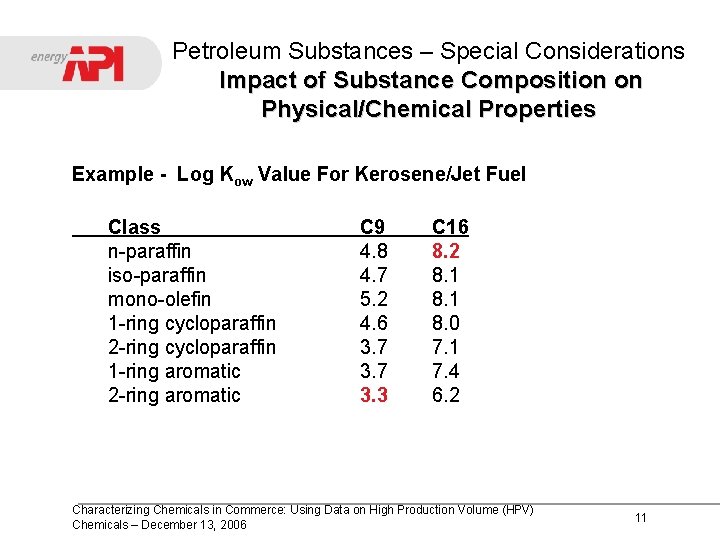
Petroleum Substances – Special Considerations Impact of Substance Composition on Physical/Chemical Properties Example - Log Kow Value For Kerosene/Jet Fuel Class n-paraffin iso-paraffin mono-olefin 1 -ring cycloparaffin 2 -ring cycloparaffin 1 -ring aromatic 2 -ring aromatic C 9 4. 8 4. 7 5. 2 4. 6 3. 7 3. 3 C 16 8. 2 8. 1 8. 0 7. 1 7. 4 6. 2 Characterizing Chemicals in Commerce: Using Data on High Production Volume (HPV) Chemicals – December 13, 2006 11
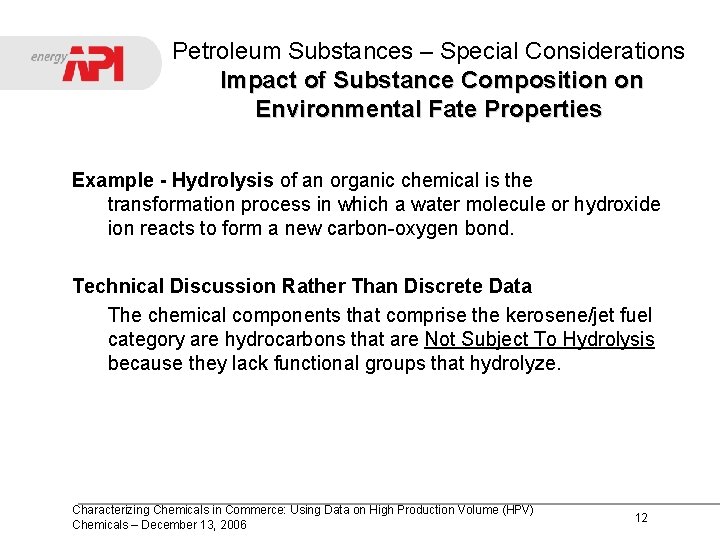
Petroleum Substances – Special Considerations Impact of Substance Composition on Environmental Fate Properties Example - Hydrolysis of an organic chemical is the transformation process in which a water molecule or hydroxide ion reacts to form a new carbon-oxygen bond. Technical Discussion Rather Than Discrete Data The chemical components that comprise the kerosene/jet fuel category are hydrocarbons that are Not Subject To Hydrolysis because they lack functional groups that hydrolyze. Characterizing Chemicals in Commerce: Using Data on High Production Volume (HPV) Chemicals – December 13, 2006 12
Petroleum Substances – Special Considerations Impact of Substance Composition on Toxicity Testing • Ecotoxicity – • Experiments conducted and reported as water accommodated fractions or loading rates Mammalian – Route of administration appropriate for human risk assessment • Inhalation • Dermal Characterizing Chemicals in Commerce: Using Data on High Production Volume (HPV) Chemicals – December 13, 2006 13
Petroleum Substances – Special Considerations For more information • http: //www. epa. gov/HPV/ • Tom Gray: grayt@api. org Characterizing Chemicals in Commerce: Using Data on High Production Volume (HPV) Chemicals – December 13, 2006 14
- Slides: 14