
Peter Zukowski Biometry Seminar of Multimedia Peter Zukowski
Peter Zukowski Biometry Seminar of Multimedia
Peter Zukowski Biometry Why biometry? Three methods of identification: knowledge (e. g. password, PIN) possession (e. g. key, card) biometry (physiological characteristics) Biometric characteristics cannot be lost, copied, stolen, etc. need not to be kept, remembered, etc. are naturally fixed to the user
Peter Zukowski Biometry Contents Biological background DNA and genetic code Reproduction Inheritance and gene expression Biometry in general Biometric characteristics Biometric systems Biometric standards and interfaces Biometric techniques Voice recognition Iris recognition Fingerprint recognition
Peter Zukowski Biometry DNA Everyone of us has got approx. 1014 cells. Each of them (with some exceptions) contains our whole genetic information called the “genome”. This information is encoded in 4 kinds of nucleobases: A Adenine G Guanine C Cytosine T Thymine Sequence of these bases genetic code. Connected to a chain: the DNA is located on chromosomes in the cell core.
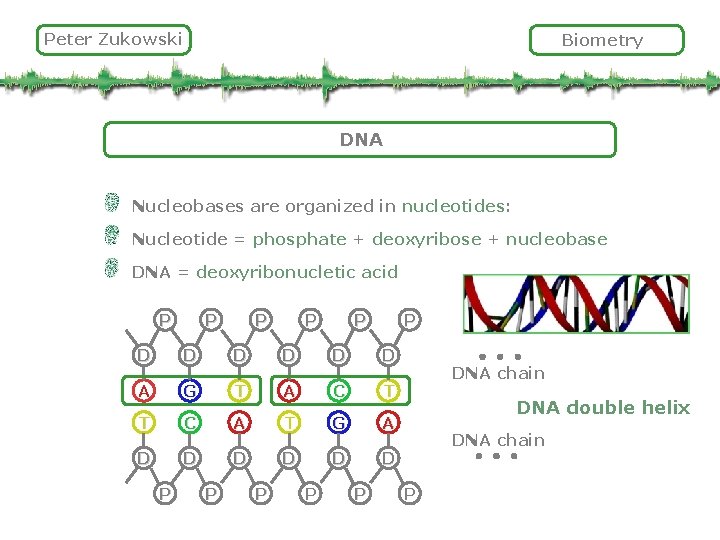
Peter Zukowski Biometry DNA Nucleobases are organized in nucleotides: Nucleotide = phosphate + deoxyribose + nucleobase DNA = deoxyribonucletic acid P P P D D D A G T A C T T C A T G A D D D P P P DNA chain DNA double helix DNA chain P
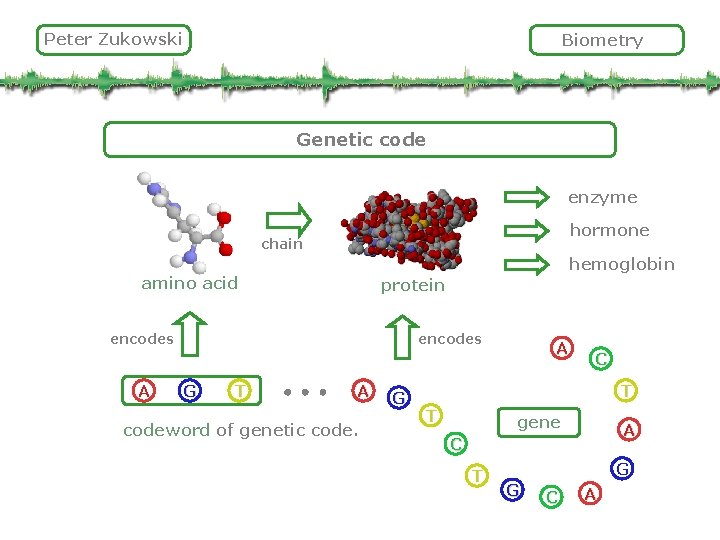
Peter Zukowski Biometry Genetic code enzyme hormone chain hemoglobin amino acid protein encodes A encodes G T A codeword of genetic code. G A C T T gene A C T G G C A
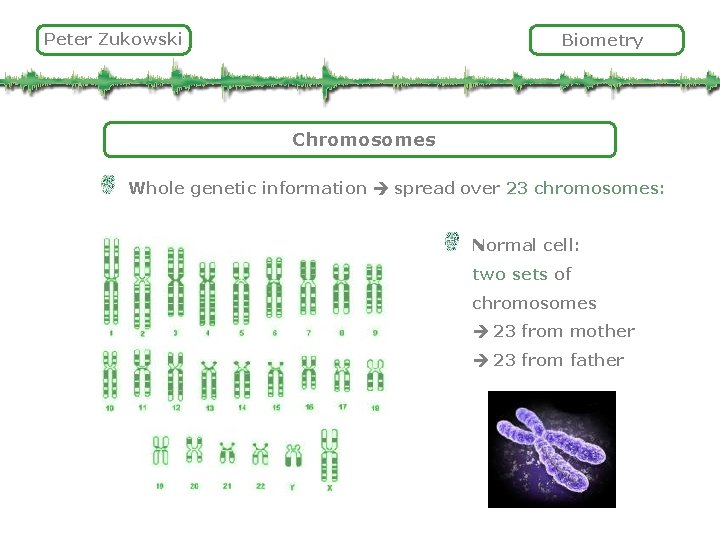
Peter Zukowski Biometry Chromosomes Whole genetic information spread over 23 chromosomes: Normal cell: two sets of chromosomes 23 from mother 23 from father
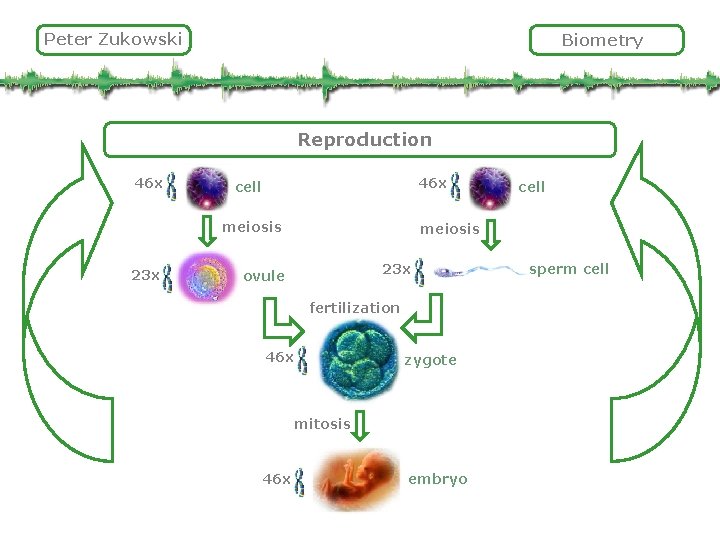
Peter Zukowski Biometry Reproduction 46 x cell meiosis 23 x ovule fertilization 46 x zygote mitosis 46 x cell embryo sperm cell
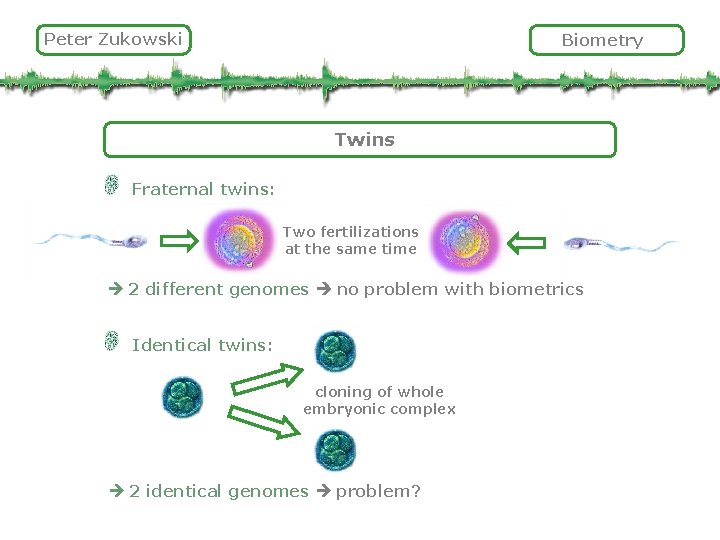
Peter Zukowski Biometry Twins Fraternal twins: Two fertilizations at the same time 2 different genomes no problem with biometrics Identical twins: cloning of whole embryonic complex 2 identical genomes problem?
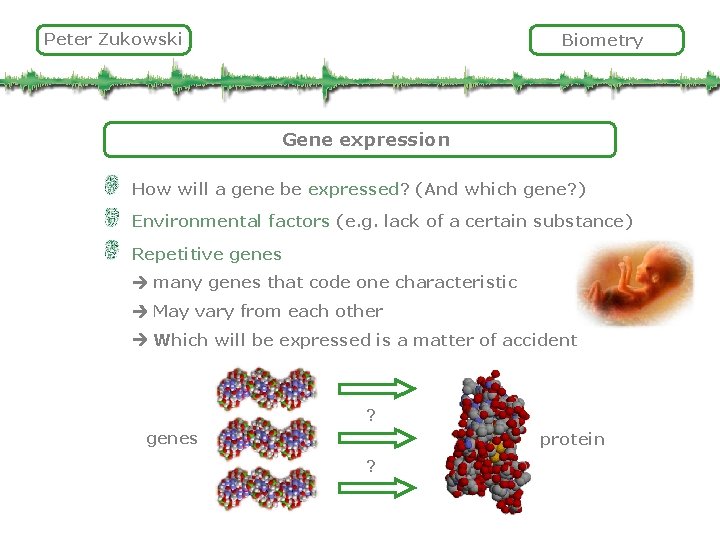
Peter Zukowski Biometry Gene expression How will a gene be expressed? (And which gene? ) Environmental factors (e. g. lack of a certain substance) Repetitive genes many genes that code one characteristic May vary from each other Which will be expressed is a matter of accident ? genes protein ?
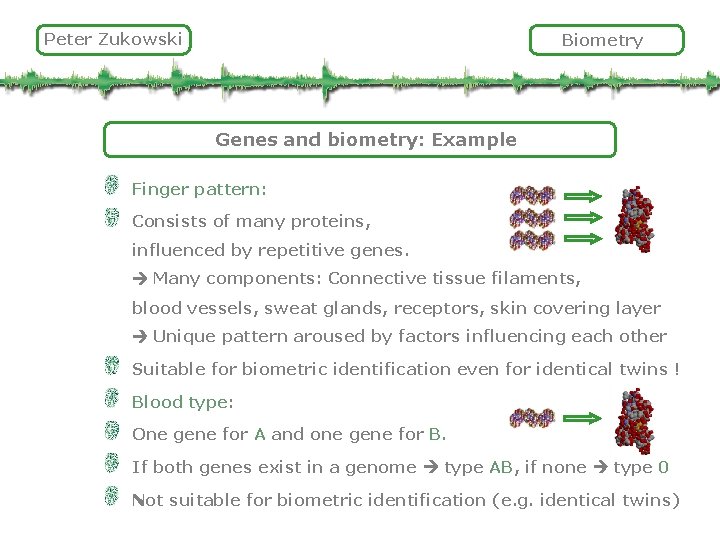
Peter Zukowski Biometry Genes and biometry: Example Finger pattern: Consists of many proteins, influenced by repetitive genes. Many components: Connective tissue filaments, blood vessels, sweat glands, receptors, skin covering layer Unique pattern aroused by factors influencing each other Suitable for biometric identification even for identical twins ! Blood type: One gene for A and one gene for B. If both genes exist in a genome type AB, if none type 0 Not suitable for biometric identification (e. g. identical twins)
Peter Zukowski Biometry Conclusion for biometry Genotypic characteristics: Inheritance / genetic code Randotypic characteristics: gene expression during development. Mutual influence of genes enables unique combinations. Applicable even for identical twins (and clones) !
Peter Zukowski Biometry Contents Biological background DNA and genetic code Reproduction Inheritance and gene expression Biometry in general biometric characteristics biometric systems biometric standards and interfaces Biometric processes Voice recognition Iris recognition Fingerprint recognition
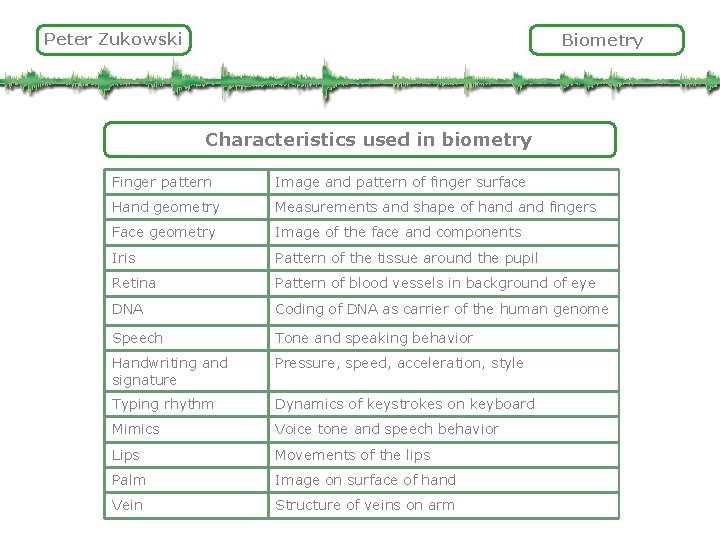
Peter Zukowski Biometry Characteristics used in biometry Finger pattern Image and pattern of finger surface Hand geometry Measurements and shape of hand fingers Face geometry Image of the face and components Iris Pattern of the tissue around the pupil Retina Pattern of blood vessels in background of eye DNA Coding of DNA as carrier of the human genome Speech Tone and speaking behavior Handwriting and signature Pressure, speed, acceleration, style Typing rhythm Dynamics of keystrokes on keyboard Mimics Voice tone and speech behavior Lips Movements of the lips Palm Image on surface of hand Vein Structure of veins on arm
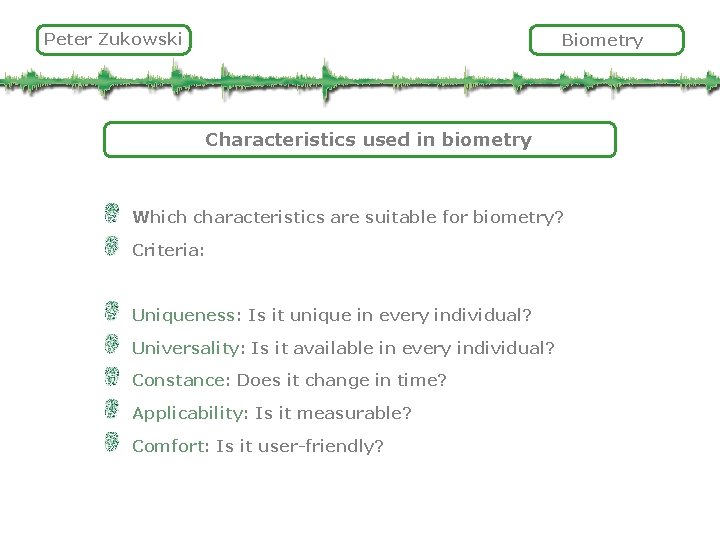
Peter Zukowski Biometry Characteristics used in biometry Which characteristics are suitable for biometry? Criteria: Uniqueness: Is it unique in every individual? Universality: Is it available in every individual? Constance: Does it change in time? Applicability: Is it measurable? Comfort: Is it user-friendly?
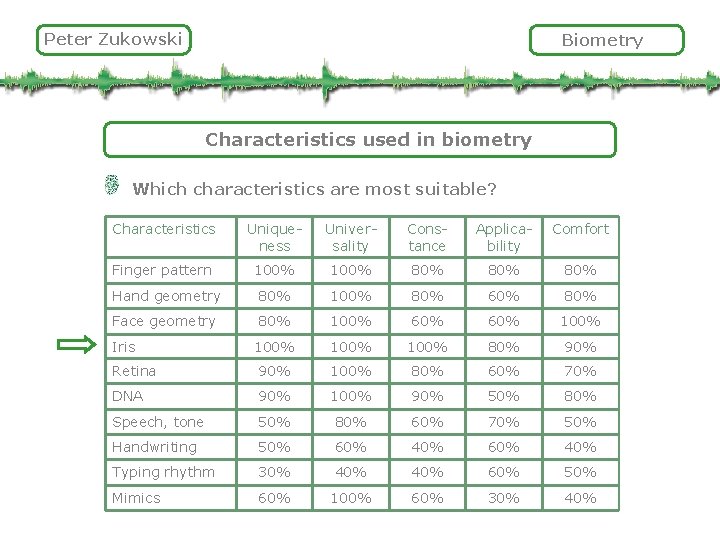
Peter Zukowski Biometry Characteristics used in biometry Which characteristics are most suitable? Characteristics Uniqueness Universality Constance Applicability Comfort Finger pattern 100% 80% 80% Hand geometry 80% 100% 80% 60% 80% Face geometry 80% 100% 60% 100% 80% 90% Retina 90% 100% 80% 60% 70% DNA 90% 100% 90% 50% 80% Speech, tone 50% 80% 60% 70% 50% Handwriting 50% 60% 40% Typing rhythm 30% 40% 60% 50% Mimics 60% 100% 60% 30% 40% Iris
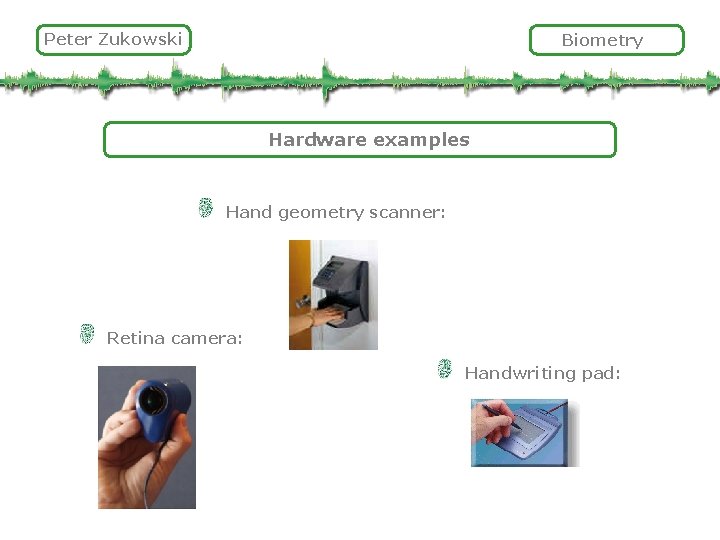
Peter Zukowski Biometry Hardware examples Hand geometry scanner: Retina camera: Handwriting pad:
Peter Zukowski Biometry Identification systems User registers himself: “enrollment” process User comes back for “identification” or “verification” Identification: User recognized out of many individuals. 1: n “Who is he/she ? ” Verification: A requested identification is accepted or rejected. 1: 1 “Is it him/her ? ”
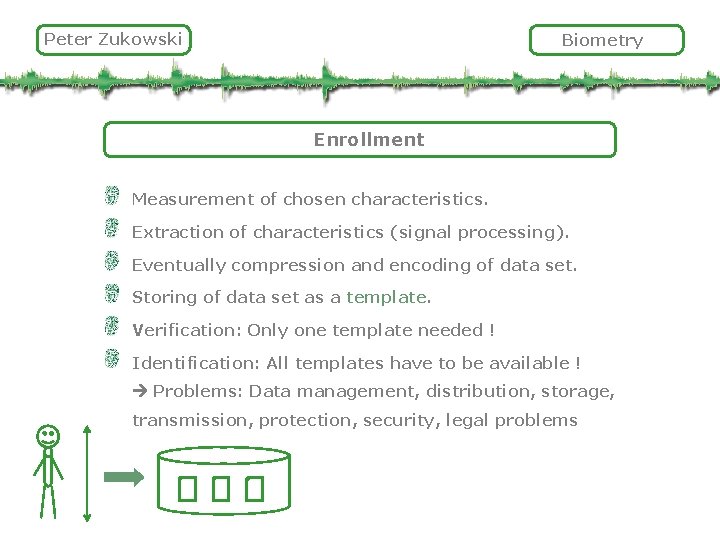
Peter Zukowski Biometry Enrollment Measurement of chosen characteristics. Extraction of characteristics (signal processing). Eventually compression and encoding of data set. Storing of data set as a template. Verification: Only one template needed ! Identification: All templates have to be available ! Problems: Data management, distribution, storage, transmission, protection, security, legal problems
Peter Zukowski Biometry Identification Authorized person must not be rejected. False reject rate Unauthorized person must not be accepted. False accept rate Usually data sets are classified (faster search) Never an exact matching is requested. Matching within a certain tolerance field ! Choice of tolerance rates and threshold values is major problem training and adjustment of system by developer (e. g. iris) or/and by user (e. g. speech)
Peter Zukowski Biometry Application fields Forensics (e. g. AFIS, FBI) Access security (buildings, etc. ) National security (e. g. US-VISIT, US home dep. of security) Staff identification in company Log-in / Log-out Personalization (e. g. profiles in computer) Protection of devices (e. g. memory sticks) Smart cards …
Peter Zukowski Biometry Standardization and APIs Bio. API Bio API Consortium Human Authentication API (HA-API) US-department of defense Speaker Verification API (SVAPI) SRAPI Consortium Common Biometric Exchange File Format (CBEFF) Novell, NIST (Nat. Institute of Std. and Technol. )
Peter Zukowski Biometry Contents Biological background DNA and genetic code Reproduction Inheritance and gene expression Biometry in general biometric characteristics biometric systems biometric standards and interfaces Biometric processes Voice recognition Iris recognition Fingerprint recognition
Peter Zukowski Biometry Why speaker recognition? Cheapest and most spread technique. Not very suitable for security applications but dominating on consumer market boom of speech recognition software. Speech recognition: text recognition, dictation systems, input of instructions. Speaker recognition: Speech rhythm and tone of voice. Text-dependent or text-independent. Disadvantage: time-consuming enrollment.
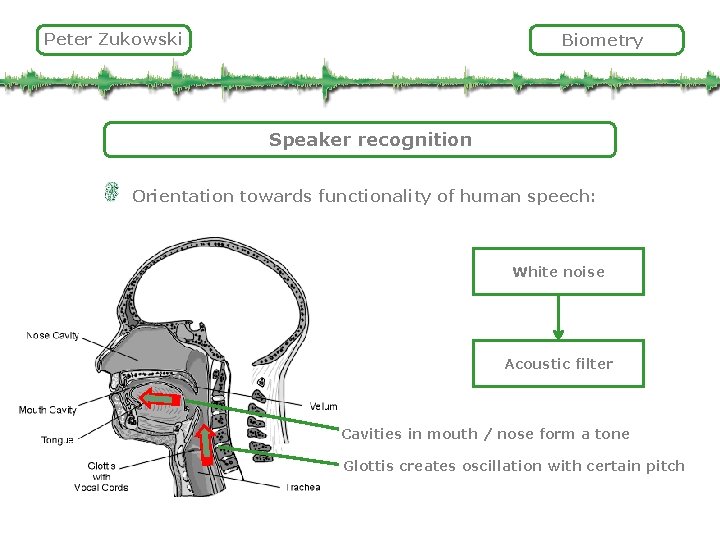
Peter Zukowski Biometry Speaker recognition Orientation towards functionality of human speech: White noise Acoustic filter Cavities in mouth / nose form a tone Glottis creates oscillation with certain pitch
Peter Zukowski Biometry Speaker recognition Recorded signal is divided into many time samples (10 – 30 ms). The signal is transformed into frequency domain. For each of the samples a digital filter is computed. A filter is described by e. g. 5 parameters. Training (enrollment): Storage of many templates for comparison. Storage of only one template but repetitive optimization.
Peter Zukowski Biometry Why iris recognition? Most reliable, exact and secure technique. Unfortunately most expensive technique. The iris the most unique and constant characteristic. Enrollment only once in a lifetime. Well protected by eye lids. Very quick enrollment (approx. 2 minutes) Not detrimental to health.
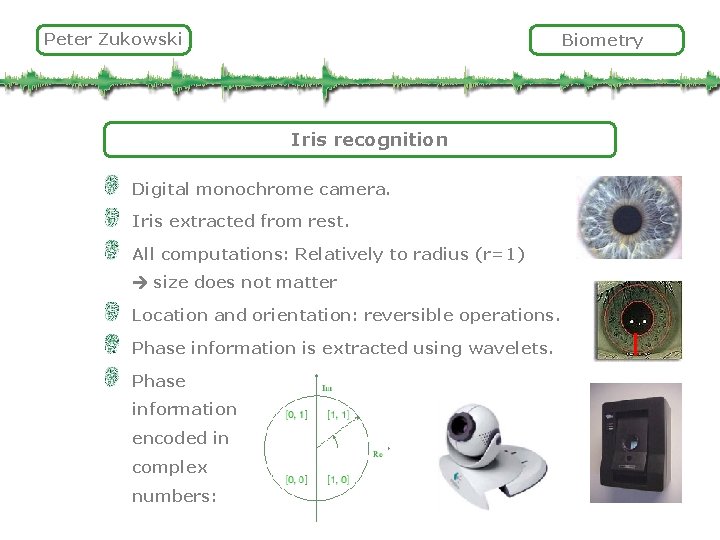
Peter Zukowski Biometry Iris recognition Digital monochrome camera. Iris extracted from rest. All computations: Relatively to radius (r=1) size does not matter Location and orientation: reversible operations. Phase information is extracted using wavelets. Phase information encoded in complex numbers:
Peter Zukowski Biometry Why fingerprint recognition? Fingerprints are unique even for identical twins. Normally this method can be applicable to every man. A fingerprint never changes during a lifetime (if no injuries, etc. ). Very old and experienced technique. Criminalistics: few hundred millions of fingerprints taken.
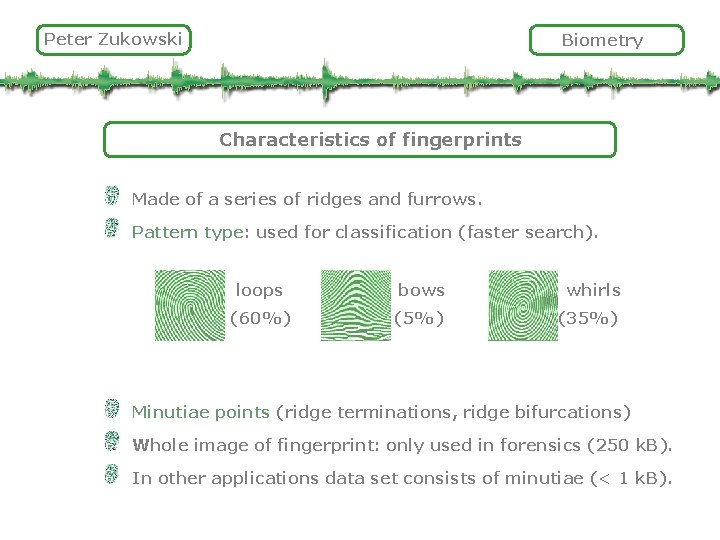
Peter Zukowski Biometry Characteristics of fingerprints Made of a series of ridges and furrows. Pattern type: used for classification (faster search). loops bows whirls (60%) (5%) (35%) Minutiae points (ridge terminations, ridge bifurcations) Whole image of fingerprint: only used in forensics (250 k. B). In other applications data set consists of minutiae (< 1 k. B).
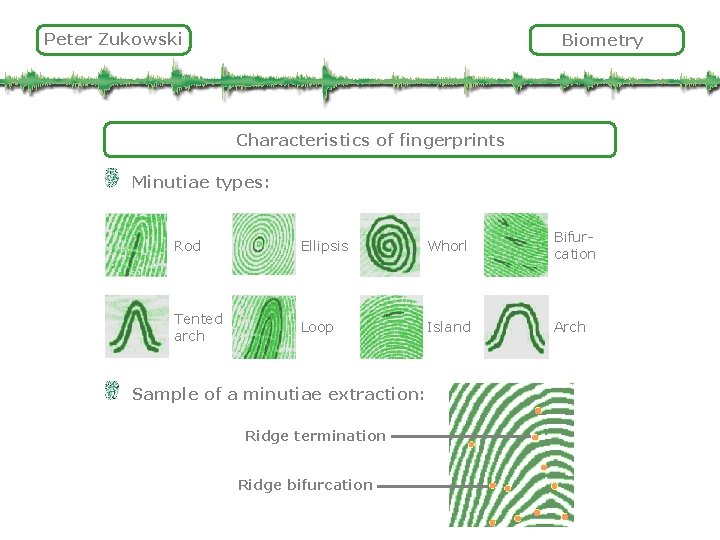
Peter Zukowski Biometry Characteristics of fingerprints Minutiae types: Rod Ellipsis Whorl Bifurcation Tented arch Loop Island Arch Sample of a minutiae extraction: Ridge termination Ridge bifurcation
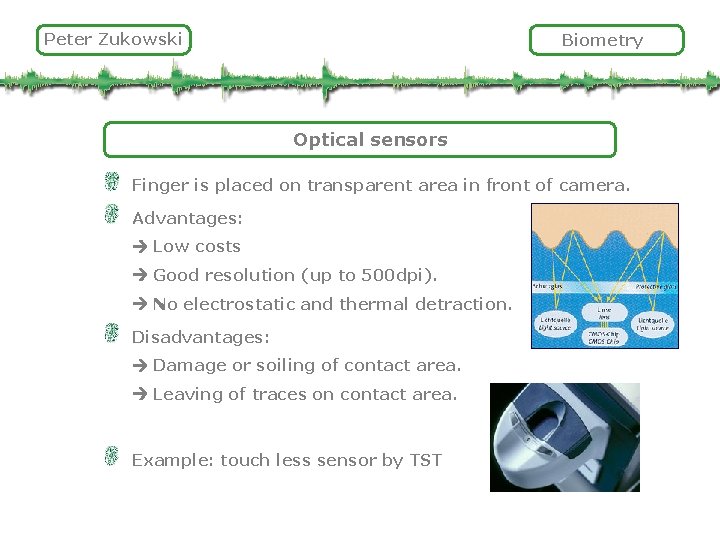
Peter Zukowski Biometry Optical sensors Finger is placed on transparent area in front of camera. Advantages: Low costs Good resolution (up to 500 dpi). No electrostatic and thermal detraction. Disadvantages: Damage or soiling of contact area. Leaving of traces on contact area. Example: touch less sensor by TST
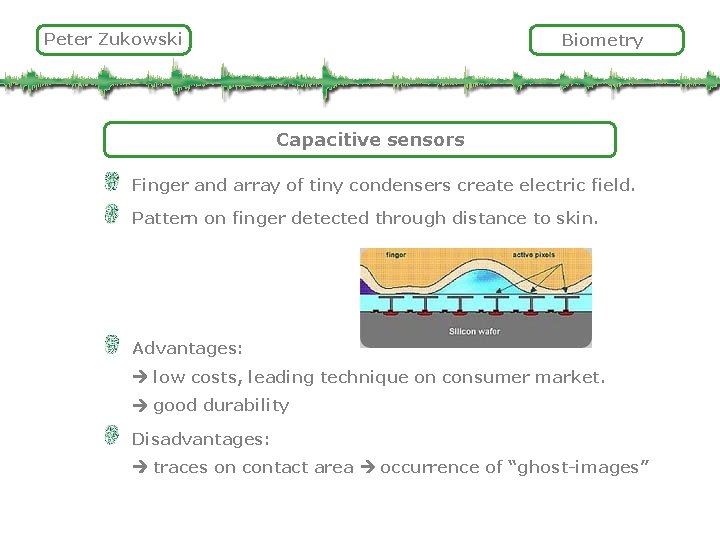
Peter Zukowski Biometry Capacitive sensors Finger and array of tiny condensers create electric field. Pattern on finger detected through distance to skin. Advantages: low costs, leading technique on consumer market. good durability Disadvantages: traces on contact area occurrence of “ghost-images”
Peter Zukowski Biometry Other sensor techniques Thermal sensors: detect temperature differences on skin. difficult operation but not susceptible to latent traces Ultrasound sensors: detect reflection characteristics on skin. Very complex but also very secure Life checks (detection of pulse): acoustic (sound of heartbeat) capturing of motion of finger image ox metric pulse detection (as used in ambulances): detection of oxygen level in blood through light rays
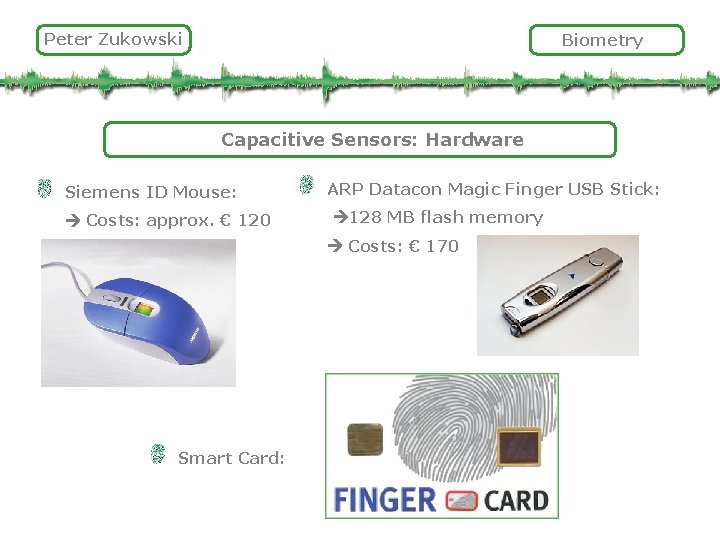
Peter Zukowski Biometry Capacitive Sensors: Hardware Siemens ID Mouse: Costs: approx. € 120 ARP Datacon Magic Finger USB Stick: 128 MB flash memory Costs: € 170 Smart Card:
Peter Zukowski Biometry Conclusions Very significant and interesting topic. Very sensitive field, legally and ethically. Vast application field. Much to do for a computer scientist. Many companies from Germany. Much to do in standardization. Still developing but growing quickly. There is more yet to come …
Peter Zukowski Biometry The End Thank You for Your attention !
- Slides: 37