
PETER PAZMANY SEMMELWEIS UNIVERSITY www itk ppke hu
- Slides: 24
PETER PAZMANY SEMMELWEIS UNIVERSITY www. itk. ppke. hu CATHOLIC UNIVERSITY Development of Complex Curricula for Molecular Bionics and Infobionics Programs within a consortial* framework** Consortium leader PETER PAZMANY CATHOLIC UNIVERSITY Consortium members SEMMELWEIS UNIVERSITY, DIALOG CAMPUS PUBLISHER The Project has been realised with the support of the European Union and has been co-financed by the European Social Fund *** **Molekuláris bionika és Infobionika Szakok tananyagának komplex fejlesztése konzorciumi keretben ***A projekt az Európai Unió támogatásával, az Európai Szociális Alap társfinanszírozásával valósul meg. 2021. 06. 05. . TÁMOP – 4. 1. 2 -08/2/A/KMR-2009 -0006 1
Peter Pazmany Catholic University Faculty of Information Technology www. itk. ppke. hu Biomedical imaging (Orvosbiológiai képalkotás) PHARMACOLOGICAL FMRI (f. MRI alkalmazása a gyógyszerkutatásban) VIKTOR GÁL, ZOLTÁN VIDNYÁNSZKY 2010. 23 TÁMOP – 4. 1. 2 -08/2/A/KMR-2009 -0006 2
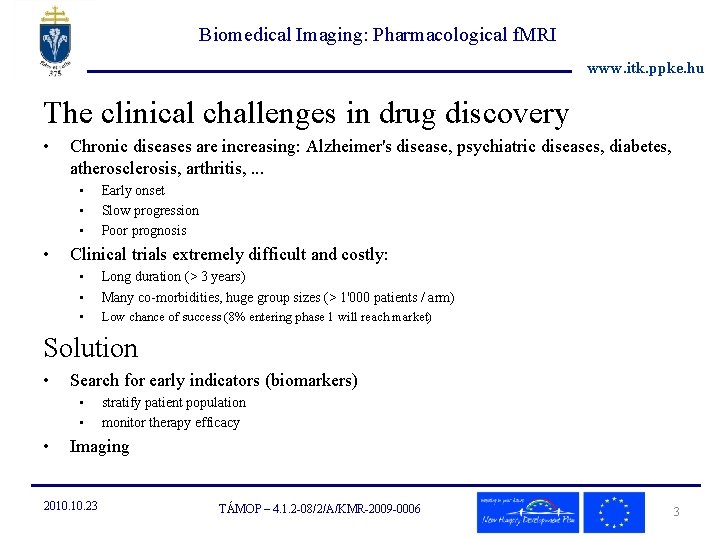
Biomedical Imaging: Pharmacological f. MRI www. itk. ppke. hu The clinical challenges in drug discovery • Chronic diseases are increasing: Alzheimer's disease, psychiatric diseases, diabetes, atherosclerosis, arthritis, . . . • • Early onset Slow progression Poor prognosis Clinical trials extremely difficult and costly: • • Long duration (> 3 years) Many co-morbidities, huge group sizes (> 1'000 patients / arm) • Low chance of success (8% entering phase 1 will reach market) Solution • Search for early indicators (biomarkers) • • • stratify patient population monitor therapy efficacy Imaging 2010. 23 TÁMOP – 4. 1. 2 -08/2/A/KMR-2009 -0006 3
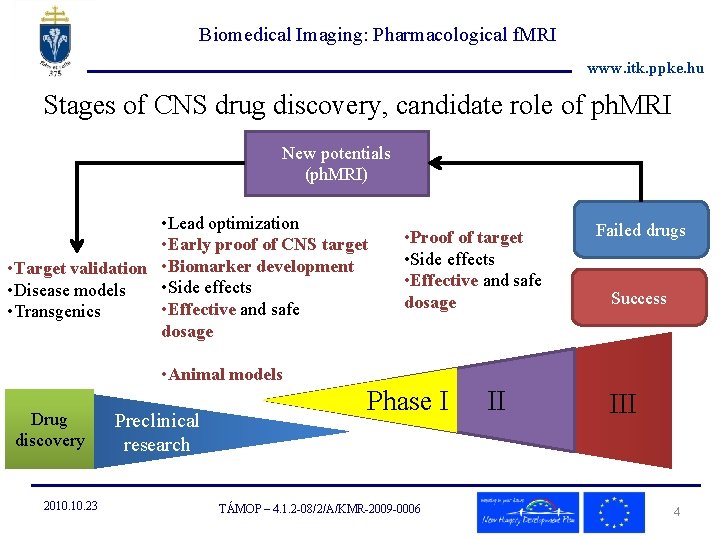
Biomedical Imaging: Pharmacological f. MRI www. itk. ppke. hu Stages of CNS drug discovery, candidate role of ph. MRI New potentials (ph. MRI) • Lead optimization • Early proof of CNS target • Target validation • Biomarker development • Side effects • Disease models • Effective and safe • Transgenics dosage • Proof of target • Side effects • Effective and safe dosage Failed drugs Success • Animal models Drug discovery 2010. 23 Preclinical research Phase I TÁMOP – 4. 1. 2 -08/2/A/KMR-2009 -0006 II III 4
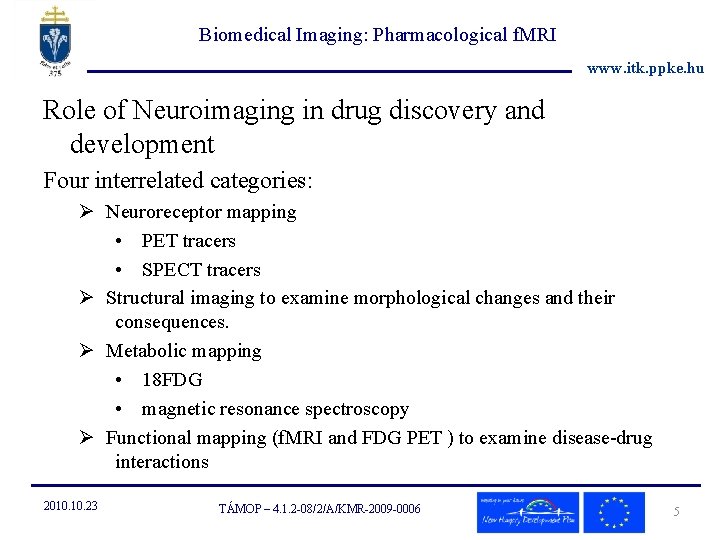
Biomedical Imaging: Pharmacological f. MRI www. itk. ppke. hu Role of Neuroimaging in drug discovery and development Four interrelated categories: Ø Neuroreceptor mapping • PET tracers • SPECT tracers Ø Structural imaging to examine morphological changes and their consequences. Ø Metabolic mapping • 18 FDG • magnetic resonance spectroscopy Ø Functional mapping (f. MRI and FDG PET ) to examine disease-drug interactions 2010. 23 TÁMOP – 4. 1. 2 -08/2/A/KMR-2009 -0006 5
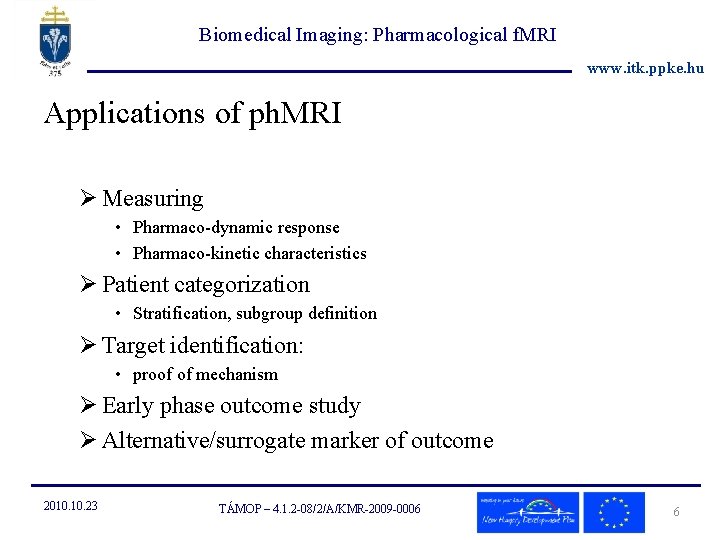
Biomedical Imaging: Pharmacological f. MRI www. itk. ppke. hu Applications of ph. MRI Ø Measuring • Pharmaco-dynamic response • Pharmaco-kinetic characteristics Ø Patient categorization • Stratification, subgroup definition Ø Target identification: • proof of mechanism Ø Early phase outcome study Ø Alternative/surrogate marker of outcome 2010. 23 TÁMOP – 4. 1. 2 -08/2/A/KMR-2009 -0006 6
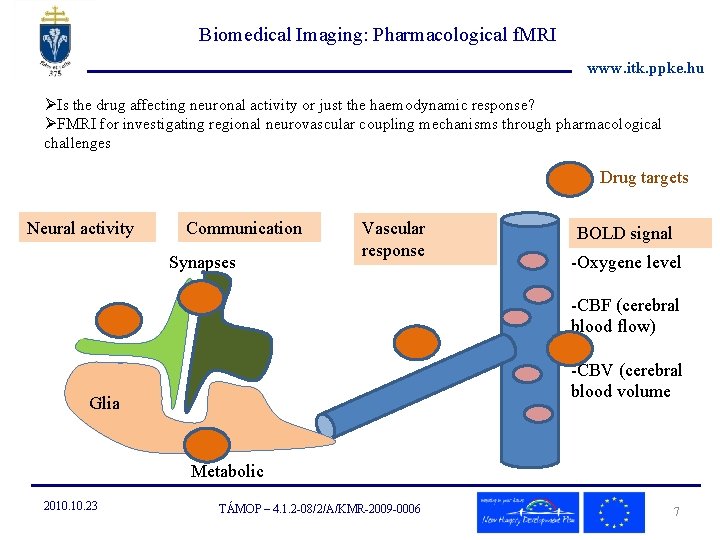
Biomedical Imaging: Pharmacological f. MRI www. itk. ppke. hu ØIs the drug affecting neuronal activity or just the haemodynamic response? ØFMRI for investigating regional neurovascular coupling mechanisms through pharmacological challenges Drug targets Neural activity Communication Synapses Vascular response BOLD signal -Oxygene level -CBF (cerebral blood flow) -CBV (cerebral blood volume Glia Metabolic 2010. 23 TÁMOP – 4. 1. 2 -08/2/A/KMR-2009 -0006 7
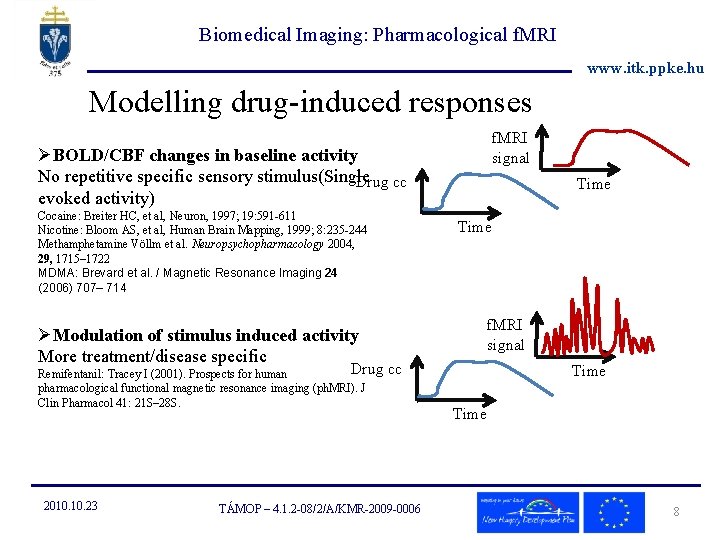
Biomedical Imaging: Pharmacological f. MRI www. itk. ppke. hu Modelling drug-induced responses f. MRI signal ØBOLD/CBF changes in baseline activity No repetitive specific sensory stimulus(Single Drug cc evoked activity) Cocaine: Breiter HC, et al, Neuron, 1997; 19: 591 -611 Nicotine: Bloom AS, et al, Human Brain Mapping, 1999; 8: 235 -244 Methamphetamine Völlm et al. Neuropsychopharmacology 2004, 29, 1715– 1722 MDMA: Brevard et al. / Magnetic Resonance Imaging 24 (2006) 707– 714 ØModulation of stimulus induced activity More treatment/disease specific Drug Remifentanil: Tracey I (2001). Prospects for human pharmacological functional magnetic resonance imaging (ph. MRI). J Clin Pharmacol 41: 21 S– 28 S. 2010. 23 Time f. MRI signal cc TÁMOP – 4. 1. 2 -08/2/A/KMR-2009 -0006 Time 8
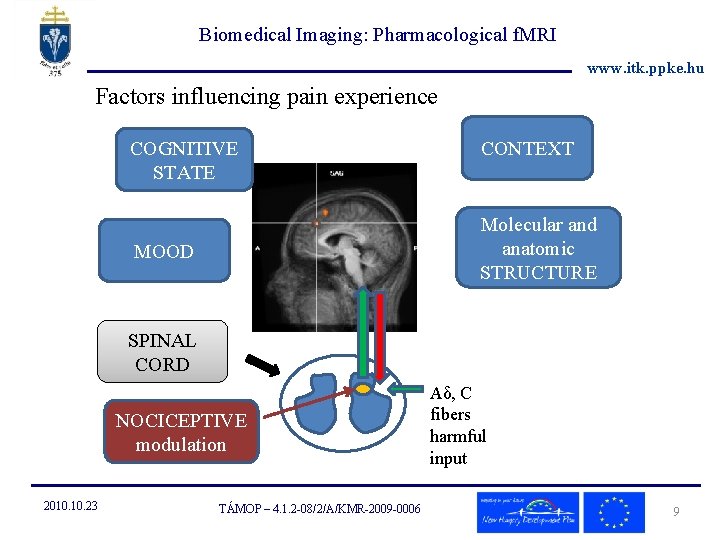
Biomedical Imaging: Pharmacological f. MRI www. itk. ppke. hu Factors influencing pain experience COGNITIVE STATE CONTEXT Molecular and anatomic STRUCTURE MOOD SPINAL CORD NOCICEPTIVE modulation 2010. 23 TÁMOP – 4. 1. 2 -08/2/A/KMR-2009 -0006 Aδ, C fibers harmful input 9
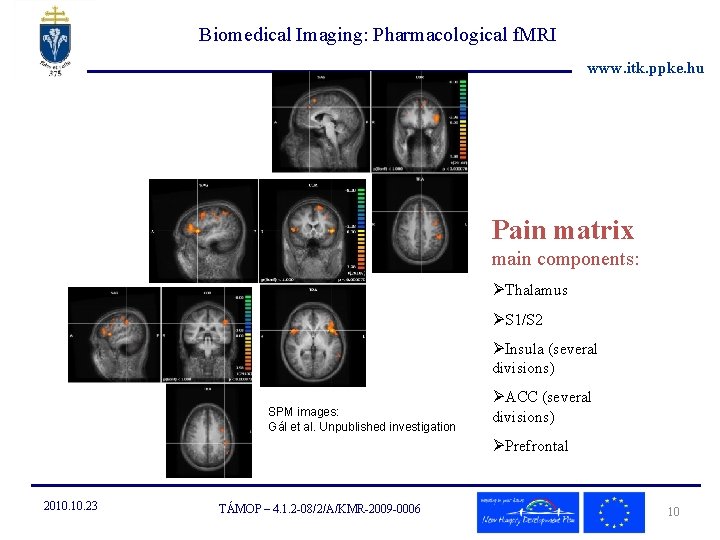
Biomedical Imaging: Pharmacological f. MRI www. itk. ppke. hu Pain matrix main components: ØThalamus ØS 1/S 2 ØInsula (several divisions) SPM images: Gál et al. Unpublished investigation ØACC (several divisions) ØPrefrontal 2010. 23 TÁMOP – 4. 1. 2 -08/2/A/KMR-2009 -0006 10
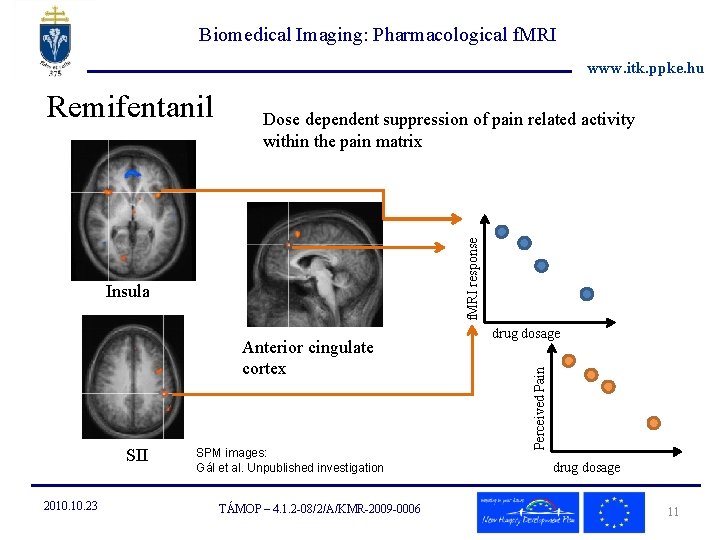
Biomedical Imaging: Pharmacological f. MRI www. itk. ppke. hu Dose dependent suppression of pain related activity within the pain matrix f. MRI response Remifentanil Anterior cingulate cortex SII 2010. 23 SPM images: Gál et al. Unpublished investigation TÁMOP – 4. 1. 2 -08/2/A/KMR-2009 -0006 drug dosage Perceived Pain Insula drug dosage 11
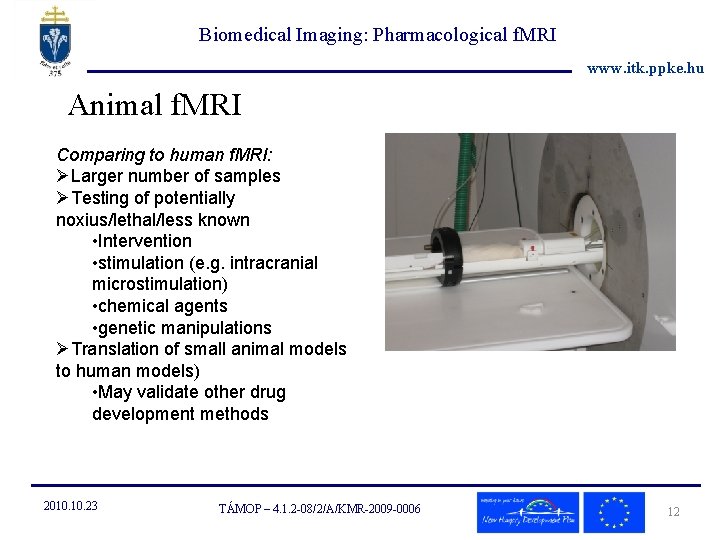
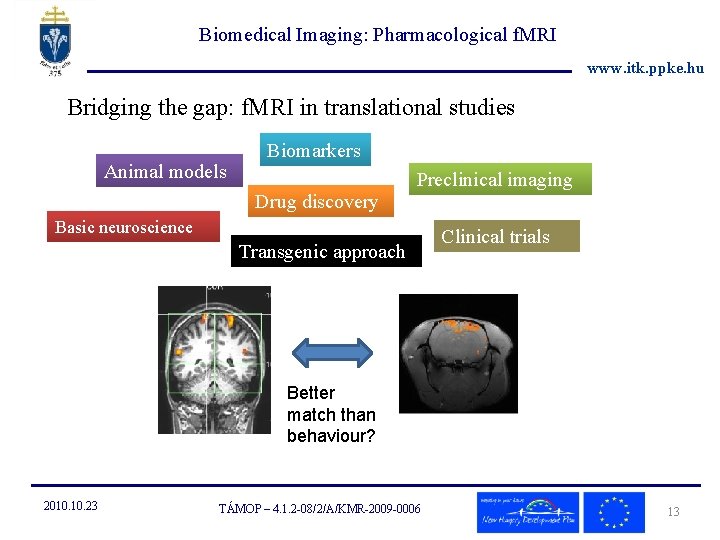
Biomedical Imaging: Pharmacological f. MRI www. itk. ppke. hu Animal f. MRI Comparing to human f. MRI: ØLarger number of samples ØTesting of potentially noxius/lethal/less known • Intervention • stimulation (e. g. intracranial microstimulation) • chemical agents • genetic manipulations ØTranslation of small animal models to human models) • May validate other drug development methods 2010. 23 TÁMOP – 4. 1. 2 -08/2/A/KMR-2009 -0006 12
Biomedical Imaging: Pharmacological f. MRI www. itk. ppke. hu Bridging the gap: f. MRI in translational studies Animal models Biomarkers Preclinical imaging Drug discovery Basic neuroscience Transgenic approach Clinical trials Better match than behaviour? 2010. 23 TÁMOP – 4. 1. 2 -08/2/A/KMR-2009 -0006 13
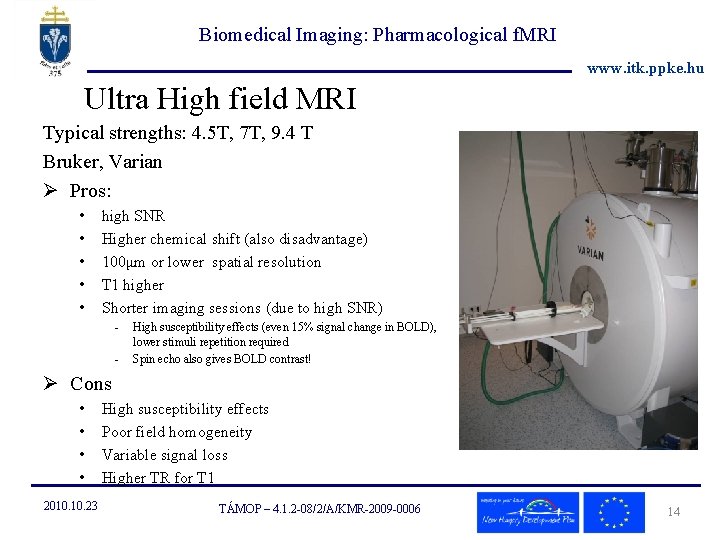
Biomedical Imaging: Pharmacological f. MRI www. itk. ppke. hu Ultra High field MRI Typical strengths: 4. 5 T, 7 T, 9. 4 T Bruker, Varian Ø Pros: • • • high SNR Higher chemical shift (also disadvantage) 100μm or lower spatial resolution T 1 higher Shorter imaging sessions (due to high SNR) - High susceptibility effects (even 15% signal change in BOLD), lower stimuli repetition required Spin echo also gives BOLD contrast! Ø Cons • • 2010. 23 High susceptibility effects Poor field homogeneity Variable signal loss Higher TR for T 1 TÁMOP – 4. 1. 2 -08/2/A/KMR-2009 -0006 14
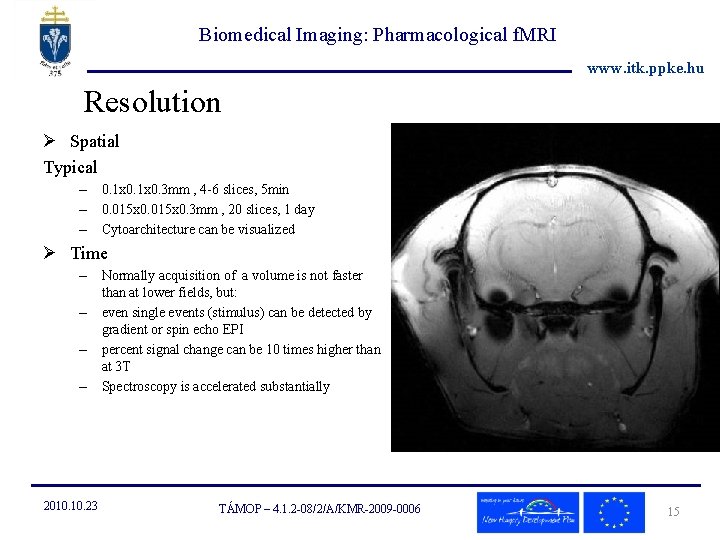
Biomedical Imaging: Pharmacological f. MRI www. itk. ppke. hu Resolution Ø Spatial Typical – 0. 1 x 0. 3 mm , 4 -6 slices, 5 min – 0. 015 x 0. 3 mm , 20 slices, 1 day – Cytoarchitecture can be visualized Ø Time – Normally acquisition of a volume is not faster than at lower fields, but: – even single events (stimulus) can be detected by gradient or spin echo EPI – percent signal change can be 10 times higher than at 3 T – Spectroscopy is accelerated substantially 2010. 23 TÁMOP – 4. 1. 2 -08/2/A/KMR-2009 -0006 15
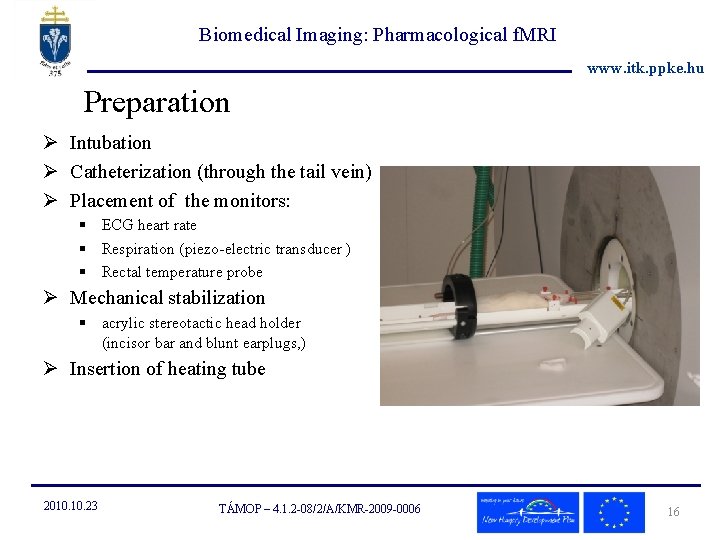
Biomedical Imaging: Pharmacological f. MRI www. itk. ppke. hu Preparation Ø Intubation Ø Catheterization (through the tail vein) Ø Placement of the monitors: § ECG heart rate § Respiration (piezo-electric transducer ) § Rectal temperature probe Ø Mechanical stabilization § acrylic stereotactic head holder (incisor bar and blunt earplugs, ) Ø Insertion of heating tube 2010. 23 TÁMOP – 4. 1. 2 -08/2/A/KMR-2009 -0006 16
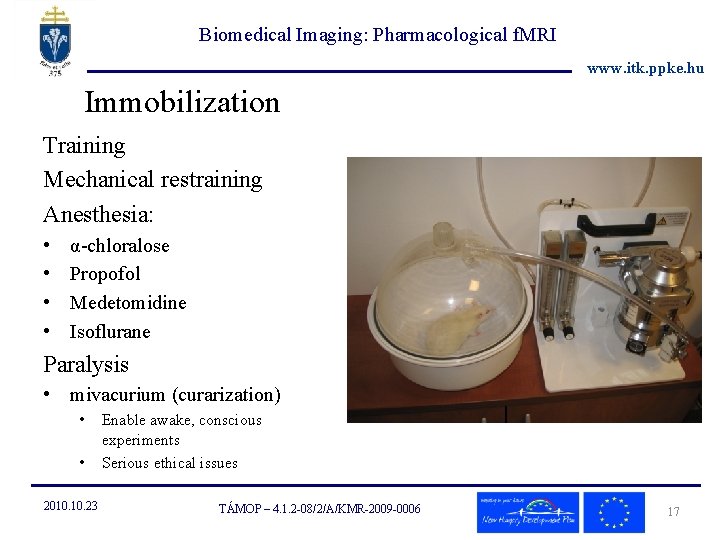
Biomedical Imaging: Pharmacological f. MRI www. itk. ppke. hu Immobilization Training Mechanical restraining Anesthesia: • • α-chloralose Propofol Medetomidine Isoflurane Paralysis • mivacurium (curarization) • • 2010. 23 Enable awake, conscious experiments Serious ethical issues TÁMOP – 4. 1. 2 -08/2/A/KMR-2009 -0006 17
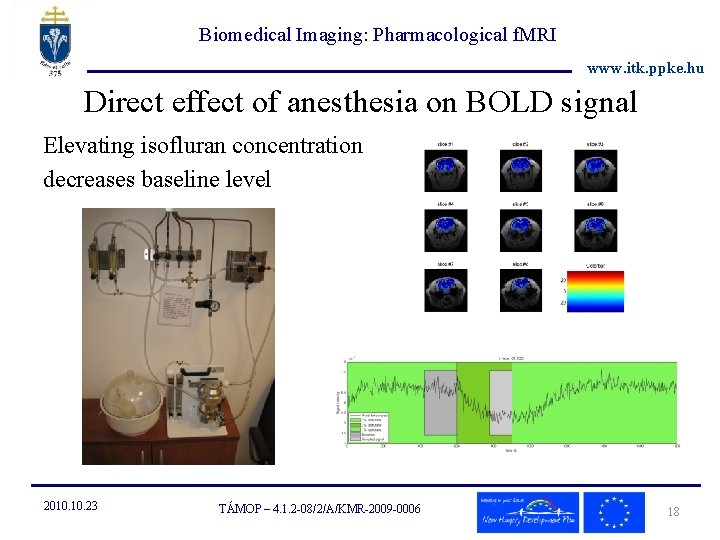
Biomedical Imaging: Pharmacological f. MRI www. itk. ppke. hu Direct effect of anesthesia on BOLD signal Elevating isofluran concentration decreases baseline level 2010. 23 TÁMOP – 4. 1. 2 -08/2/A/KMR-2009 -0006 18
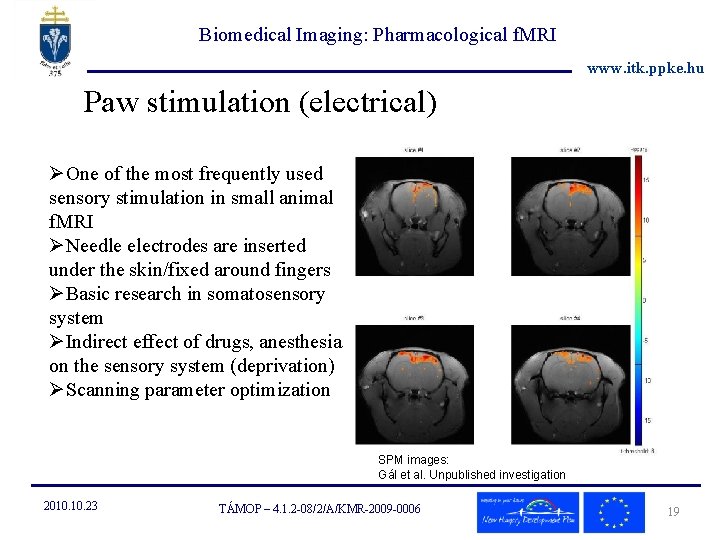
Biomedical Imaging: Pharmacological f. MRI www. itk. ppke. hu Paw stimulation (electrical) ØOne of the most frequently used sensory stimulation in small animal f. MRI ØNeedle electrodes are inserted under the skin/fixed around fingers ØBasic research in somatosensory system ØIndirect effect of drugs, anesthesia on the sensory system (deprivation) ØScanning parameter optimization SPM images: Gál et al. Unpublished investigation 2010. 23 TÁMOP – 4. 1. 2 -08/2/A/KMR-2009 -0006 19
Biomedical Imaging: Pharmacological f. MRI www. itk. ppke. hu MRI Contrast agents Animal MRI has the advantage to use potentially noxious contrast agents more freely than in human studies. Types of contrast materials used in clinical practice: Ø Oral Ø Intravascular – Gadolinium (and complexes): Paramagnetic – Manganese (and complexes): Paramagnetic – Iron oxide: Superparamagnetic • SPIO : Superparamagnetic Iron Oxide (SPIO) and Ultra. SPIO • Reduces T 2 and T 2* • Intravascular time: depending on particles size and coating – With long iv time they can be used as f. MRI contrast agent (next slide) 2010. 23 TÁMOP – 4. 1. 2 -08/2/A/KMR-2009 -0006 20
Biomedical Imaging: Pharmacological f. MRI www. itk. ppke. hu Potential Functional MRI Contrast agents Ø Indicators of change in local blood flow Ø MION-47, USPIO with long blood half-life Ø Indicators for Ca 2+ and other metal ions Ø BAPTA-based Gd 3+ complex Ø Mn 2+ as Ca 2+ mimetic Ø p. H indicators Ø Phosphonated Gd 3+ complex, Endogenous amide protons Ø Probes for metabolic activity Ø Exogenous hemoglobin Ø Genetically controlled contrast agents Ø Ferritin Ø Transferrin (Tf)- conjugated SPIOs Ø Artificial lysine-rich protein 2010. 23 TÁMOP – 4. 1. 2 -08/2/A/KMR-2009 -0006 21
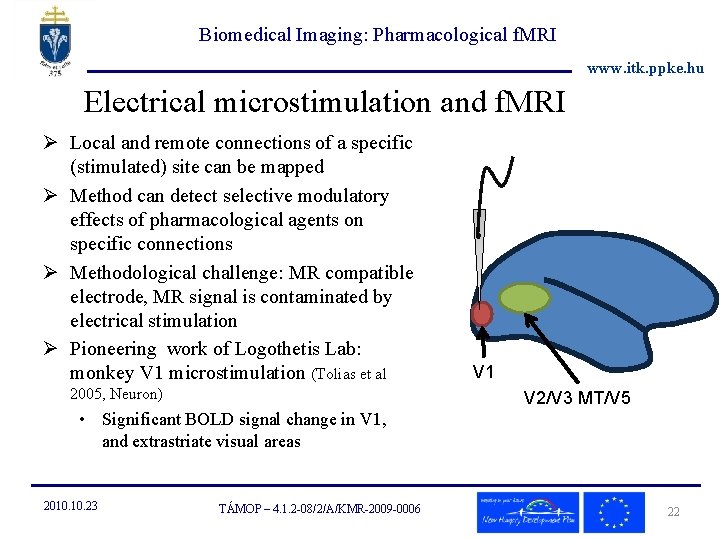
Biomedical Imaging: Pharmacological f. MRI www. itk. ppke. hu Electrical microstimulation and f. MRI Ø Local and remote connections of a specific (stimulated) site can be mapped Ø Method can detect selective modulatory effects of pharmacological agents on specific connections Ø Methodological challenge: MR compatible electrode, MR signal is contaminated by electrical stimulation Ø Pioneering work of Logothetis Lab: monkey V 1 microstimulation (Tolias et al 2005, Neuron) V 1 V 2/V 3 MT/V 5 • Significant BOLD signal change in V 1, and extrastriate visual areas 2010. 23 TÁMOP – 4. 1. 2 -08/2/A/KMR-2009 -0006 22
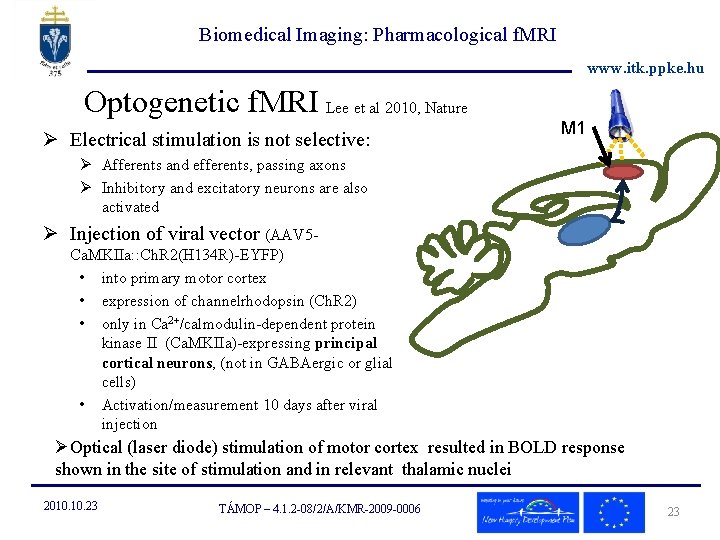
Biomedical Imaging: Pharmacological f. MRI www. itk. ppke. hu Optogenetic f. MRI Lee et al 2010, Nature Ø Electrical stimulation is not selective: M 1 Ø Afferents and efferents, passing axons Ø Inhibitory and excitatory neurons are also activated Ø Injection of viral vector (AAV 5 Ca. MKIIa: : Ch. R 2(H 134 R)-EYFP) • into primary motor cortex • expression of channelrhodopsin (Ch. R 2) • only in Ca 2+/calmodulin-dependent protein kinase II (Ca. MKIIa)-expressing principal cortical neurons, (not in GABAergic or glial cells) • Activation/measurement 10 days after viral injection ØOptical (laser diode) stimulation of motor cortex resulted in BOLD response shown in the site of stimulation and in relevant thalamic nuclei 2010. 23 TÁMOP – 4. 1. 2 -08/2/A/KMR-2009 -0006 23
Biomedical Imaging: Pharmacological f. MRI www. itk. ppke. hu Summary Examples demonstrate promising capabilities of ph. MRI in: Ø Measuring Pharmaco-dynamic response and pharmaco-kinetic characteristics Ø Patient categorization, target identification: Ø Early phase outcome or surrogate biomarker of outcome via BOLD/CBF changes in baseline activity or modulation of stimulus induced activity Animal f. MRI broaden the potential of ph. MRI enabling: ØLarger number of samples ØTesting of potentially noxius/lethal/less known chemical agents (drugs), intervention, stimulation (e. g. intracranial microstimulation) and genetic manipulations ØTranslation of small animal models to human models (bridging the gap) • May validate other drug development methods 2010. 23 TÁMOP – 4. 1. 2 -08/2/A/KMR-2009 -0006 24