
Petaflops SpecialPurpose Computer for Molecular Dynamics Simulations Makoto

- Slides: 25
Petaflops Special-Purpose Computer for Molecular Dynamics Simulations Makoto Taiji High-Performance Molecular Simulation Team Computational & Experimental Systems Biology Group Genomic Sciences Center, RIKEN (Next-Generation Supercomputer R&D Center, RIKEN)
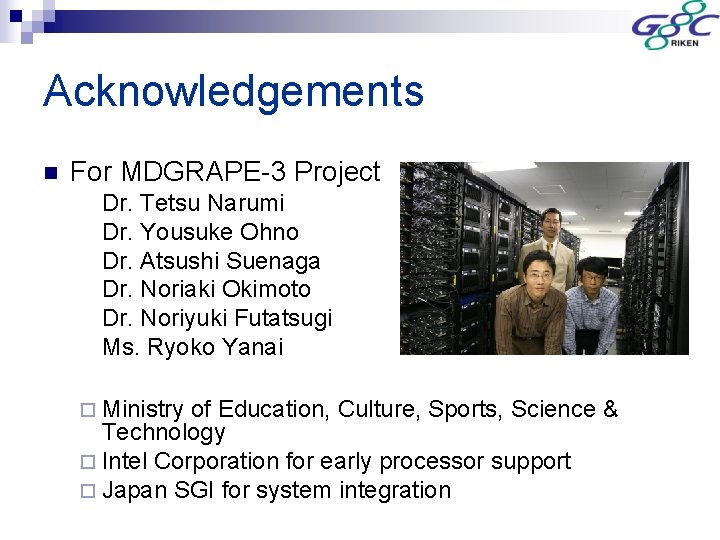
Acknowledgements n For MDGRAPE-3 Project Dr. Tetsu Narumi Dr. Yousuke Ohno Dr. Atsushi Suenaga Dr. Noriaki Okimoto Dr. Noriyuki Futatsugi Ms. Ryoko Yanai ¨ Ministry of Education, Culture, Sports, Science & Technology ¨ Intel Corporation for early processor support ¨ Japan SGI for system integration
Brief Introduction of RIKEN (Institute of Physical and Chemical Research) n n Only research institute covers whole range of natural science and technology in Japan ~3, 000 staffs Budget: ~700 million dollars/year 7 bioscience centers: ¨ ¨ ¨ ¨ n n Genomic Sciences Center SNP Research Center Plant Science Center for Allergy and Immunology Brain Science Institute Center for developmental biology Bio. Resource Center Next-Generation Supercomputer (10 PFLOPS at FY 2011) Genomic Science Center: ¨ ¨ The most important national center of genome/post-genome research National projects n n n Protein 3000 Project ENU Mouse mutagenesis Genome Network Project
What is GRAPE? GRAvity Pip. E n Special-purpose accelerator for classical particle simulations n ¨ Astrophysical N-body simulations ¨ Molecular Dynamics Simulations n MDGRAPE-3 : Petaflops GRAPE for Molecular Dynamics simulations J. Makino & M. Taiji, Scientific Simulations with Special-Purpose Computers, John Wiley & Sons, 1997.
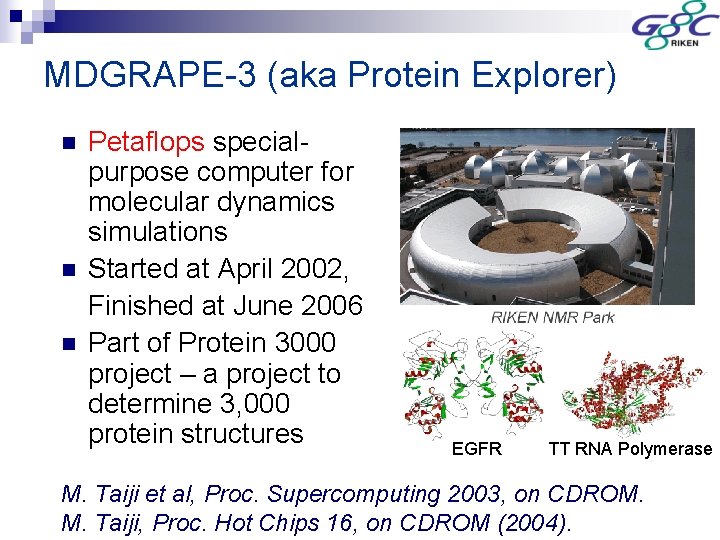
MDGRAPE-3 (aka Protein Explorer) n n n Petaflops specialpurpose computer for molecular dynamics simulations Started at April 2002, Finished at June 2006 Part of Protein 3000 project – a project to determine 3, 000 protein structures EGFR TT RNA Polymerase M. Taiji et al, Proc. Supercomputing 2003, on CDROM. M. Taiji, Proc. Hot Chips 16, on CDROM (2004).
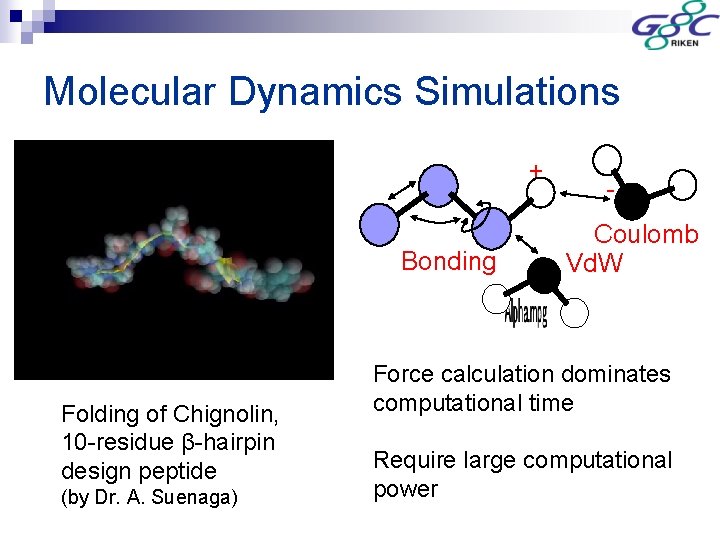
Molecular Dynamics Simulations + Bonding Folding of Chignolin, 10 -residue β-hairpin design peptide (by Dr. A. Suenaga) Coulomb Vd. W Force calculation dominates computational time Require large computational power
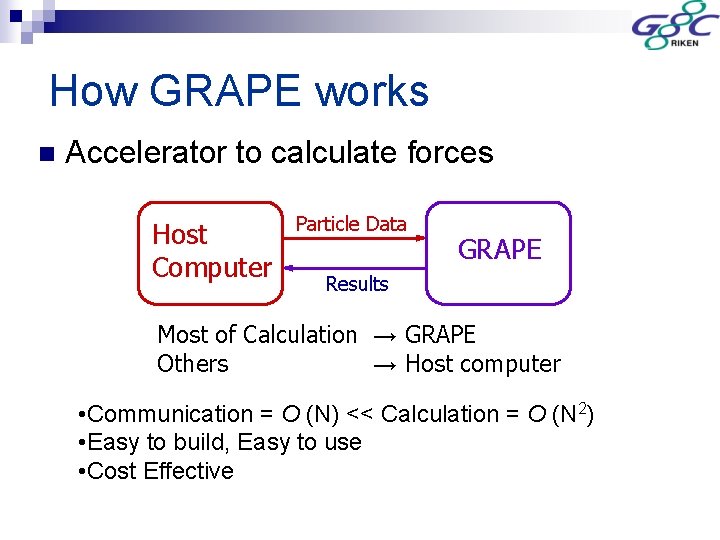
How GRAPE works n Accelerator to calculate forces Host Computer Particle Data GRAPE Results Most of Calculation → GRAPE Others → Host computer • Communication = O (N) << Calculation = O (N 2) • Easy to build, Easy to use • Cost Effective
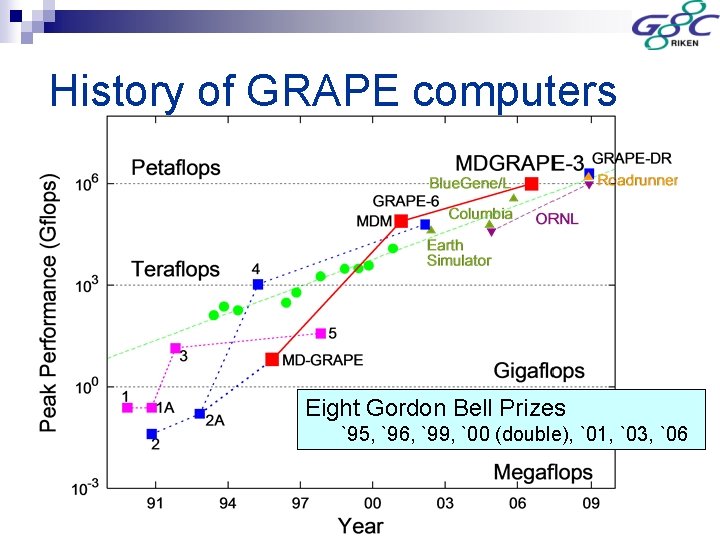
History of GRAPE computers Eight Gordon Bell Prizes `95, `96, `99, `00 (double), `01, `03, `06
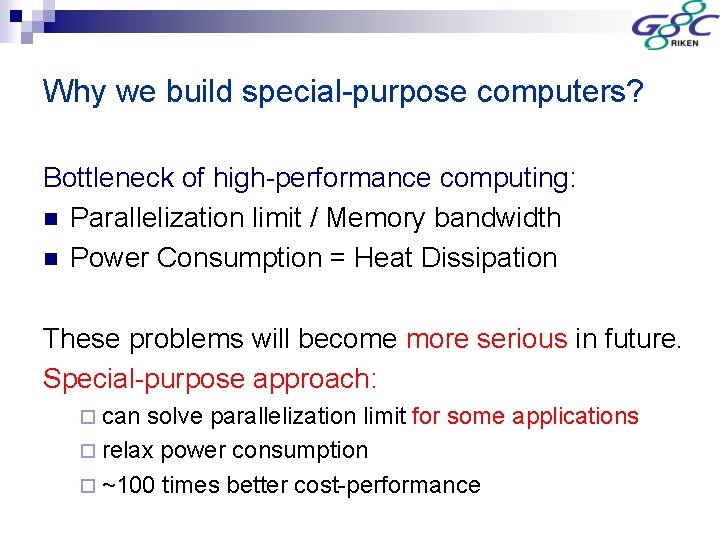
Why we build special-purpose computers? Bottleneck of high-performance computing: n Parallelization limit / Memory bandwidth n Power Consumption = Heat Dissipation These problems will become more serious in future. Special-purpose approach: ¨ can solve parallelization limit for some applications ¨ relax power consumption ¨ ~100 times better cost-performance
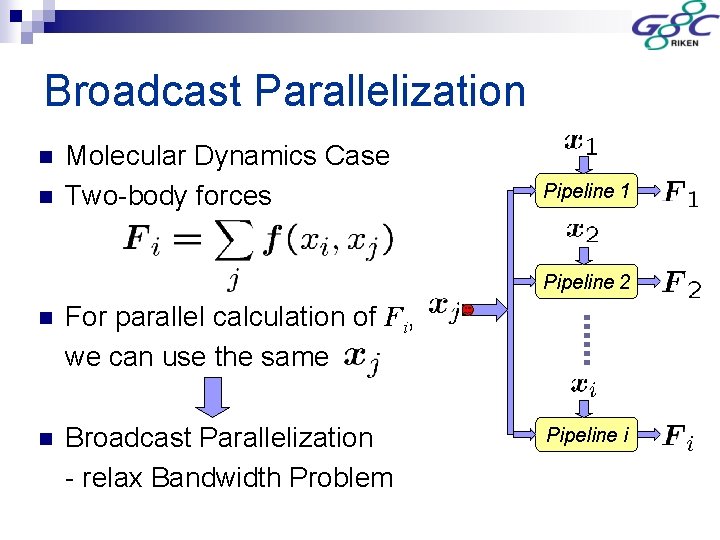
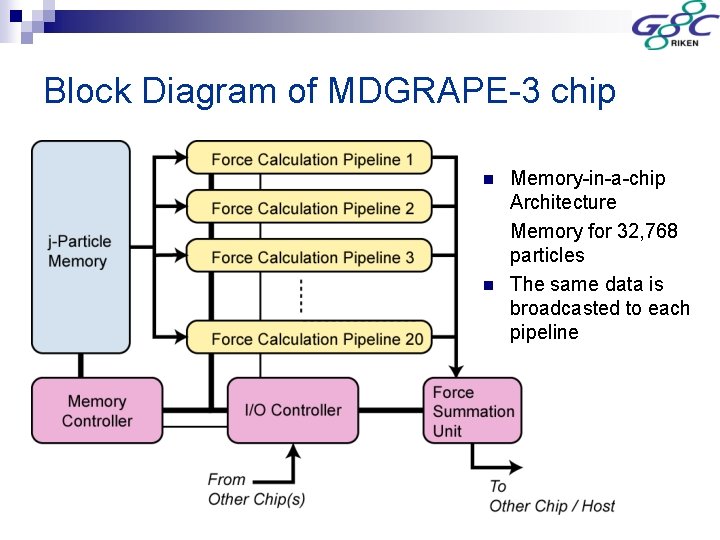
Broadcast Parallelization n n Molecular Dynamics Case Two-body forces Pipeline 1 Pipeline 2 n For parallel calculation of Fi, we can use the same n Broadcast Parallelization - relax Bandwidth Problem Pipeline i
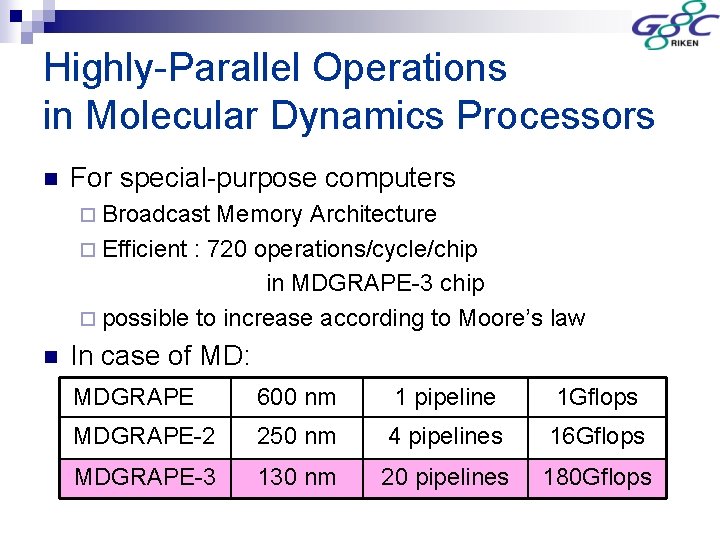
Highly-Parallel Operations in Molecular Dynamics Processors n For special-purpose computers ¨ Broadcast Memory Architecture ¨ Efficient : 720 operations/cycle/chip in MDGRAPE-3 chip ¨ possible to increase according to Moore’s law n In case of MD: MDGRAPE 600 nm 1 pipeline 1 Gflops MDGRAPE-2 250 nm 4 pipelines 16 Gflops MDGRAPE-3 130 nm 20 pipelines 180 Gflops
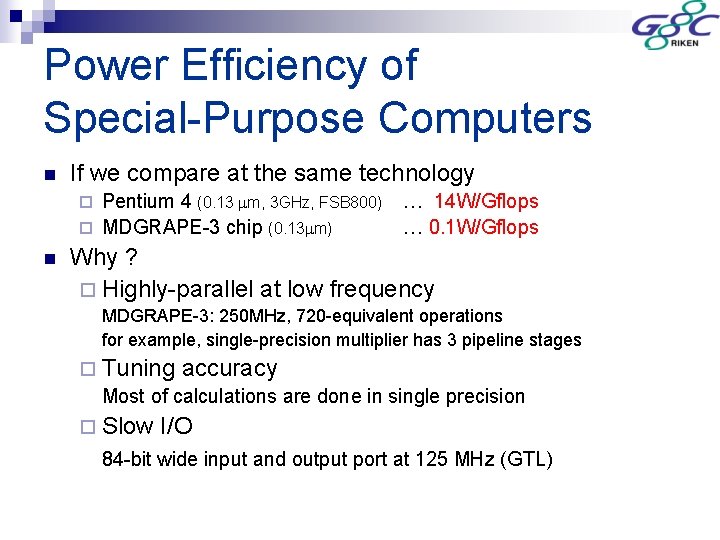
Power Efficiency of Special-Purpose Computers n If we compare at the same technology Pentium 4 (0. 13 mm, 3 GHz, FSB 800) ¨ MDGRAPE-3 chip (0. 13 mm) ¨ n … 14 W/Gflops … 0. 1 W/Gflops Why ? ¨ Highly-parallel at low frequency MDGRAPE-3: 250 MHz, 720 -equivalent operations for example, single-precision multiplier has 3 pipeline stages ¨ Tuning accuracy Most of calculations are done in single precision ¨ Slow I/O 84 -bit wide input and output port at 125 MHz (GTL)
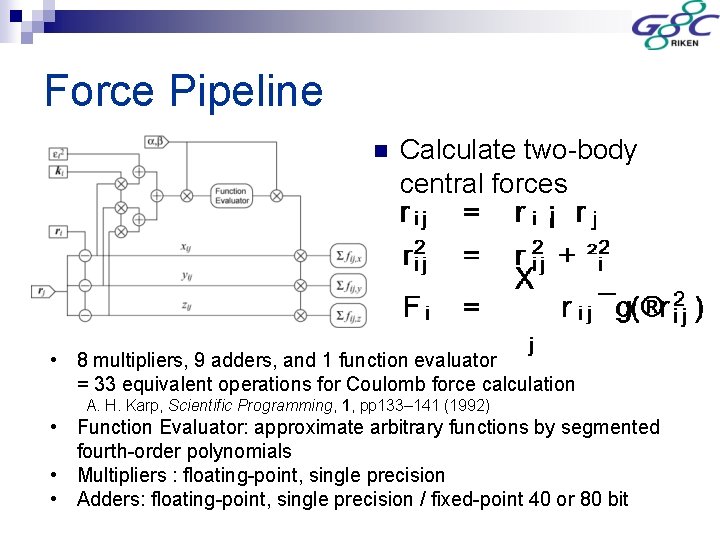
Force Pipeline n Calculate two-body central forces • 8 multipliers, 9 adders, and 1 function evaluator = 33 equivalent operations for Coulomb force calculation A. H. Karp, Scientific Programming, 1, pp 133– 141 (1992) • Function Evaluator: approximate arbitrary functions by segmented fourth-order polynomials • Multipliers : floating-point, single precision • Adders: floating-point, single precision / fixed-point 40 or 80 bit
Block Diagram of MDGRAPE-3 chip n n Memory-in-a-chip Architecture Memory for 32, 768 particles The same data is broadcasted to each pipeline
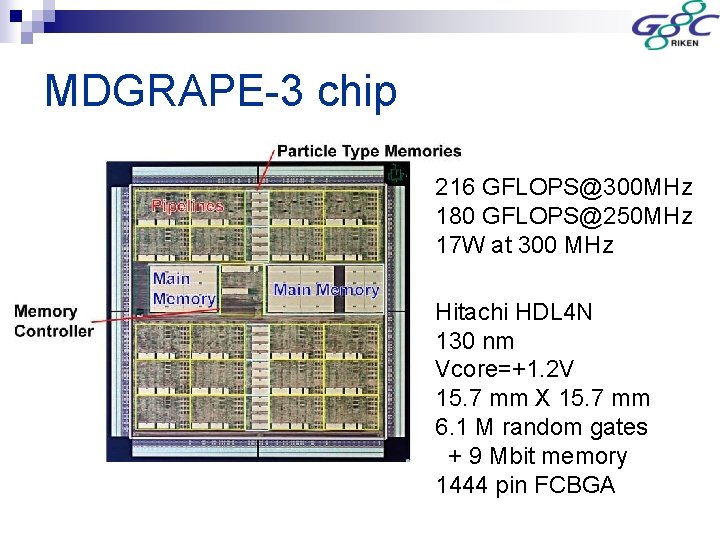
MDGRAPE-3 chip 216 GFLOPS@300 MHz 180 GFLOPS@250 MHz 17 W at 300 MHz Hitachi HDL 4 N 130 nm Vcore=+1. 2 V 15. 7 mm X 15. 7 mm 6. 1 M random gates + 9 Mbit memory 1444 pin FCBGA
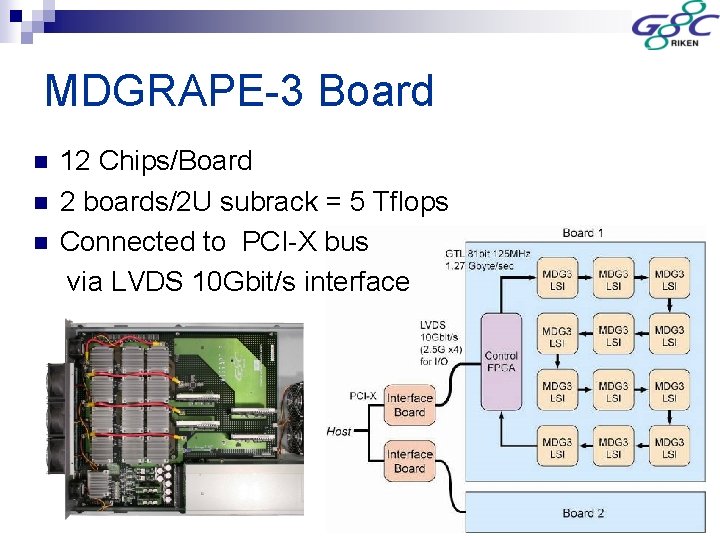
MDGRAPE-3 Board n n n 12 Chips/Board 2 boards/2 U subrack = 5 Tflops Connected to PCI-X bus via LVDS 10 Gbit/s interface
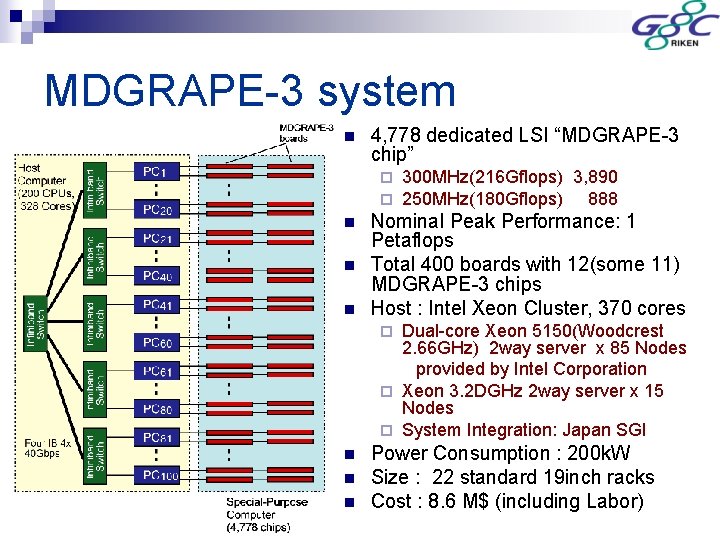
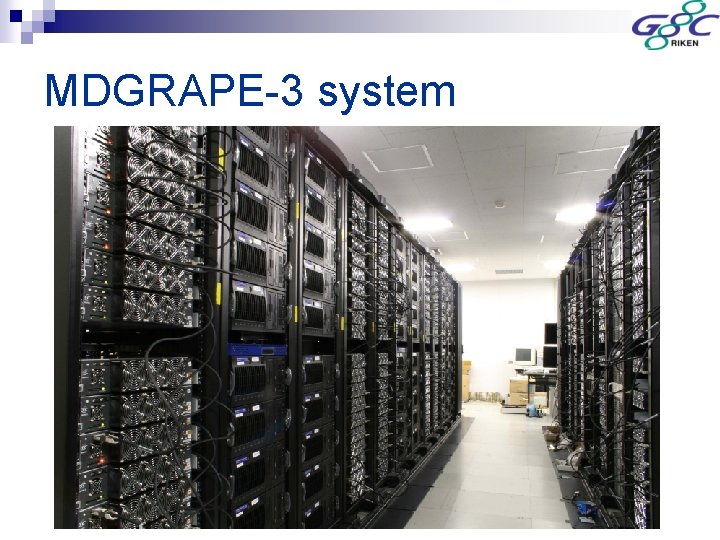
MDGRAPE-3 system n 4, 778 dedicated LSI “MDGRAPE-3 chip” ¨ ¨ n n n 300 MHz(216 Gflops) 3, 890 250 MHz(180 Gflops) 888 Nominal Peak Performance: 1 Petaflops Total 400 boards with 12(some 11) MDGRAPE-3 chips Host : Intel Xeon Cluster, 370 cores Dual-core Xeon 5150(Woodcrest 2. 66 GHz) 2 way server x 85 Nodes provided by Intel Corporation ¨ Xeon 3. 2 DGHz 2 way server x 15 Nodes ¨ System Integration: Japan SGI ¨ n n n Power Consumption : 200 k. W Size : 22 standard 19 inch racks Cost : 8. 6 M$ (including Labor)
MDGRAPE-3 system
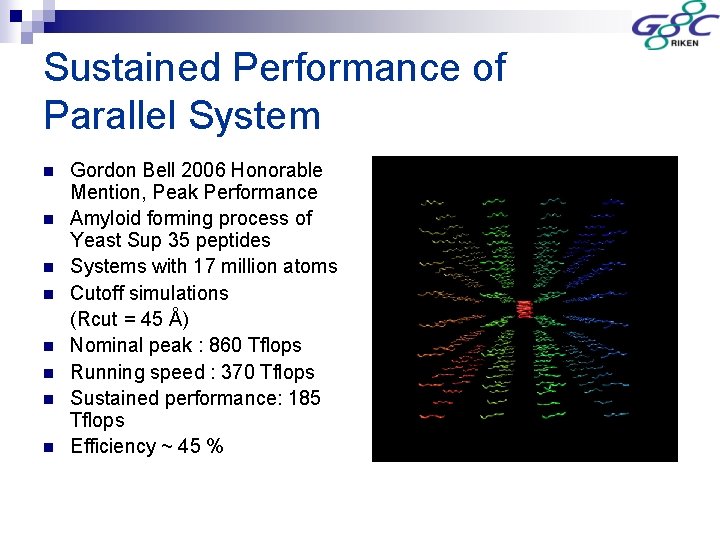
Sustained Performance of Parallel System n n n n Gordon Bell 2006 Honorable Mention, Peak Performance Amyloid forming process of Yeast Sup 35 peptides Systems with 17 million atoms Cutoff simulations (Rcut = 45 Å) Nominal peak : 860 Tflops Running speed : 370 Tflops Sustained performance: 185 Tflops Efficiency ~ 45 %
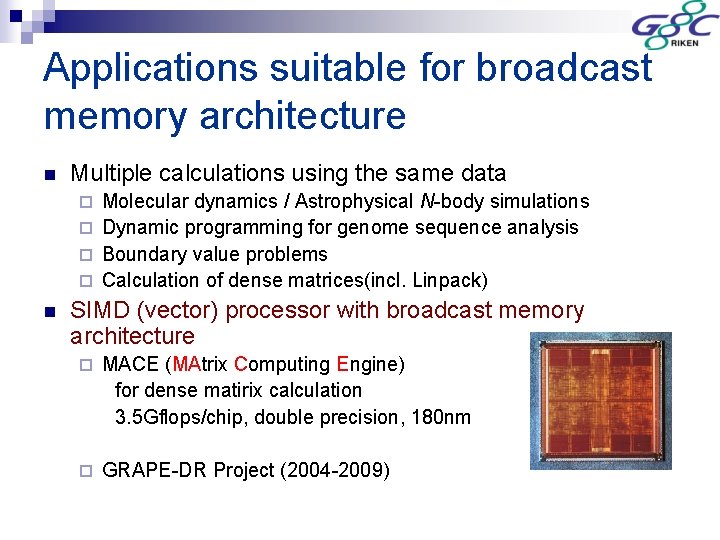
Applications suitable for broadcast memory architecture n Multiple calculations using the same data Molecular dynamics / Astrophysical N-body simulations ¨ Dynamic programming for genome sequence analysis ¨ Boundary value problems ¨ Calculation of dense matrices(incl. Linpack) ¨ n SIMD (vector) processor with broadcast memory architecture ¨ MACE (MAtrix Computing Engine) for dense matirix calculation 3. 5 Gflops/chip, double precision, 180 nm ¨ GRAPE-DR Project (2004 -2009)
GRAPE-DR Project n n n Greatly Reduced Array of Processor Elements with Data Reduction SIMD accelerator with broadcast memory architecture Full system: FY 2008 0. 5 TFLOPS / chip (single), 0. 25 TFLOPS (double) 2 PFLOPS / system Prof. Kei Hiraki (U. Tokyo) Prof. J. Makino (National Astronomical Observatory) Dr. T. Ebisuzaki (RIKEN)
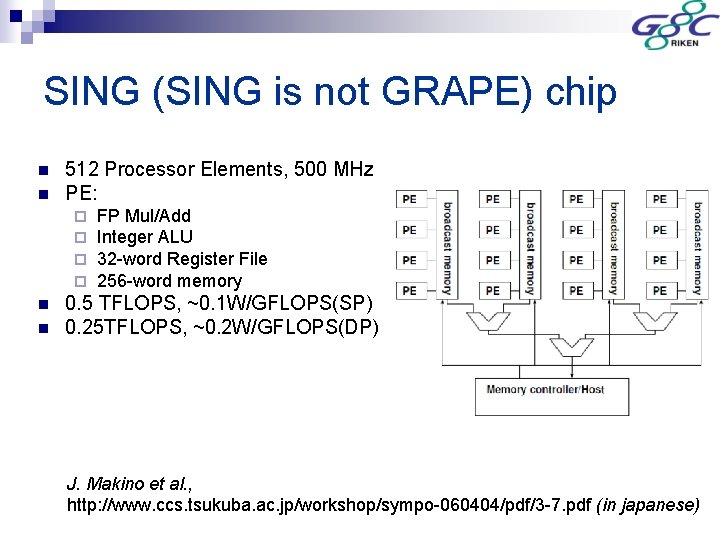
SING (SING is not GRAPE) chip n n 512 Processor Elements, 500 MHz PE: ¨ ¨ n n FP Mul/Add Integer ALU 32 -word Register File 256 -word memory 0. 5 TFLOPS, ~0. 1 W/GFLOPS(SP) 0. 25 TFLOPS, ~0. 2 W/GFLOPS(DP) J. Makino et al. , http: //www. ccs. tsukuba. ac. jp/workshop/sympo-060404/pdf/3 -7. pdf (in japanese)
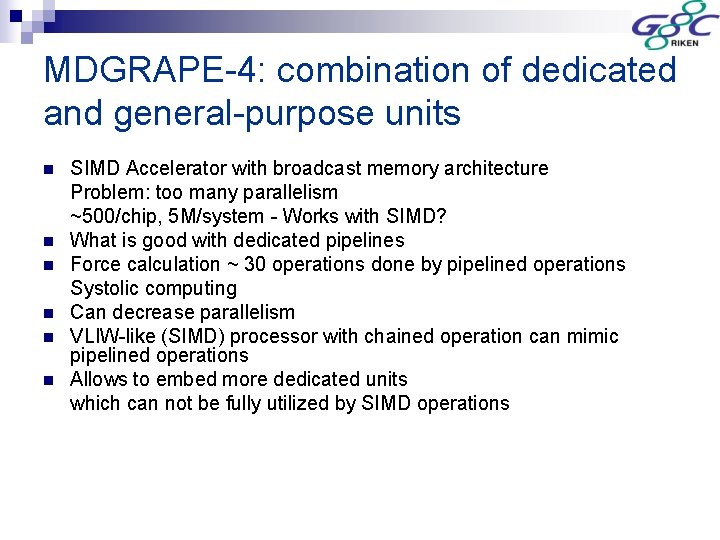
MDGRAPE-4: combination of dedicated and general-purpose units n n n SIMD Accelerator with broadcast memory architecture Problem: too many parallelism ~500/chip, 5 M/system - Works with SIMD? What is good with dedicated pipelines Force calculation ~ 30 operations done by pipelined operations Systolic computing Can decrease parallelism VLIW-like (SIMD) processor with chained operation can mimic pipelined operations Allows to embed more dedicated units which can not be fully utilized by SIMD operations
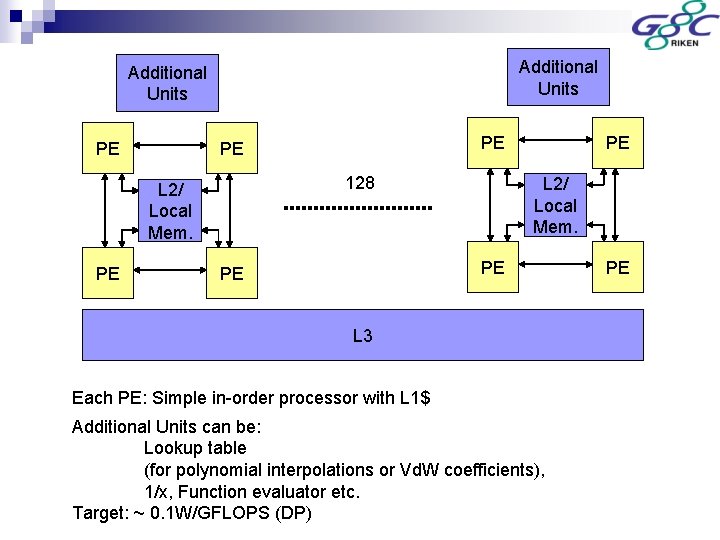
Additional Units PE 128 L 2/ Local Mem. PE PE L 2/ Local Mem. PE PE L 3 Each PE: Simple in-order processor with L 1$ Additional Units can be: Lookup table (for polynomial interpolations or Vd. W coefficients), 1/x, Function evaluator etc. Target: ~ 0. 1 W/GFLOPS (DP) PE
Summary MDGRAPE-3 achieved Peta. FLOPS nominal peak for 200 k. W n Dedicated parallel pipelines at modest speed of ~250 MHz results high performance/power n Generalized GRAPE approaches are being developed n