
Pet Loss and Grief Presentation developed by Emily
Pet Loss and Grief Presentation developed by Emily Armstrong, VSW intern
What is Grief? Grief is “an emotional suffering caused by death or bereavement. Grief involves a sequence of thoughts and feelings that follow the loss and accompanying mourning. Grief is a process, and as a result is not a specific emotion like fear or sadness but instead is a constellation of feelings that can be expressed by many thoughts, emotions, and behaviors. Grief is the internal meaning given to the external event”—A. Wolfelt
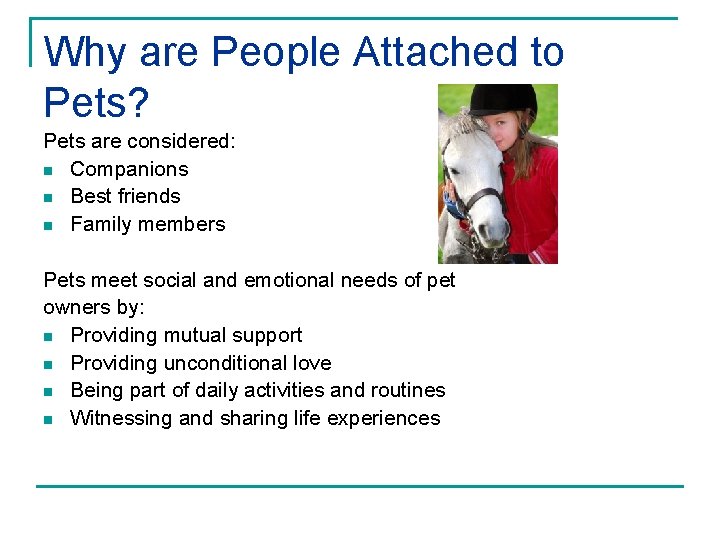
Why are People Attached to Pets? Pets are considered: n Companions n Best friends n Family members Pets meet social and emotional needs of pet owners by: n Providing mutual support n Providing unconditional love n Being part of daily activities and routines n Witnessing and sharing life experiences
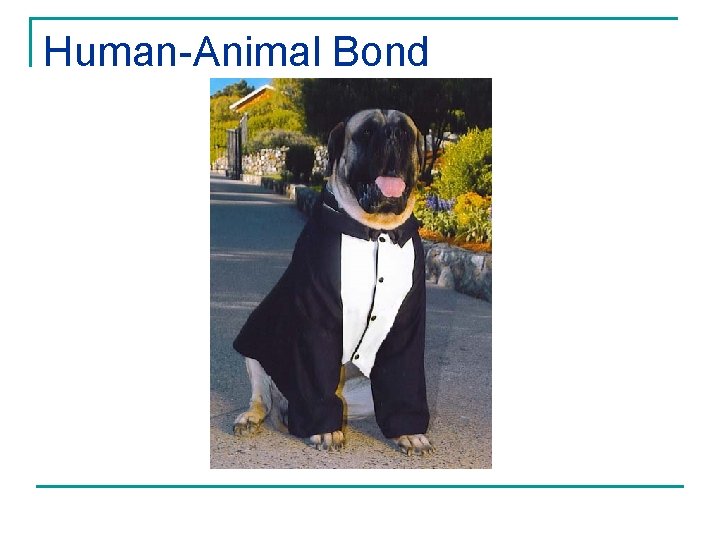
Human-Animal Bond
Human Animal Bond n Why do we get attached to animals? q q q q We saved them from death We relied on them during a difficult life transition We spent our childhood with them They are our main source of support We have spent a lot of resources on them They are our links to other people that have died Animals seem to have human-like traits
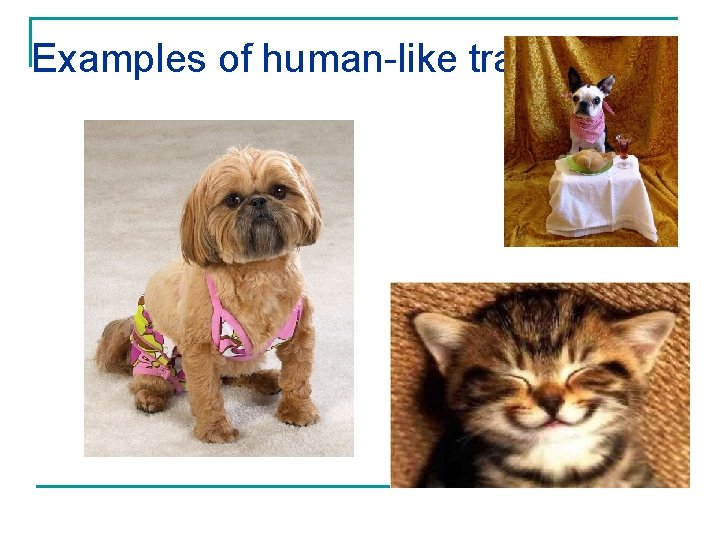
Examples of human-like traits
When the Bond is Broken… n n Losing a pet Experiencing grief
Theories on Grief n n 5 Stage Model of Grief (Kubler Ross 1969) Cowles and Rodgers (1991)
Pet Loss and Disenfranchised Grief n n n Pet loss is a minimized loss No recognized way of grieving Pet loss is not socially accepted
Symptoms of Grief Personal and individual process Aspects of grief may be influenced by, but not limited to, gender, cultural practices, religion, and societal norms n n n Physical Intellectual Emotional Social Spiritual
Physical Symptoms n n n n Fatigue Tearfulness Sleep disturbances Eating disturbances Shock Numbness Stomach ache Restlessness
Intellectual Symptoms n n n Denial Confusion Inability to concentrate Feeling preoccupied by the loss A need to talk about the loss Thoughts or fantasies about suicide
Emotional Symptoms n n n n Depression Anger Guilt Anxiety Blame Embarrassment Hopelessness Helplessness
Social Symptoms n n n n Isolation Withdrawal Increased dependency on others Rejection of others and/or by others Desire to move Feel the need to stay busy Change in friends
Spiritual Symptoms n n Bargaining with Higher Power Feeling anger or resentful towards Higher Power Searching for meaning Questioning one’s faith
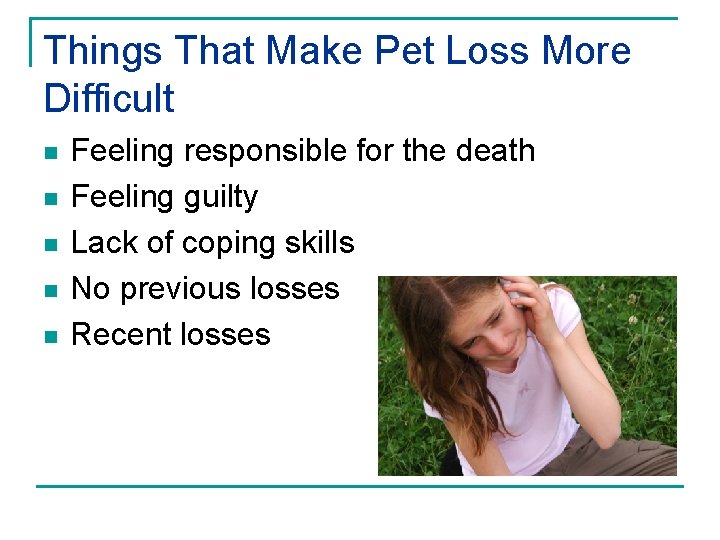
Things That Make Pet Loss More Difficult n n n Feeling responsible for the death Feeling guilty Lack of coping skills No previous losses Recent losses
Special Circumstances n n n Euthanasia When A Pet goes Missing Anticipating the Loss
Grief and Children n n n Do Children Grieve the Same Way? Euthanasia Accidents What will my child do? What Should I Say? What Should I NOT Say? What Should I Do?
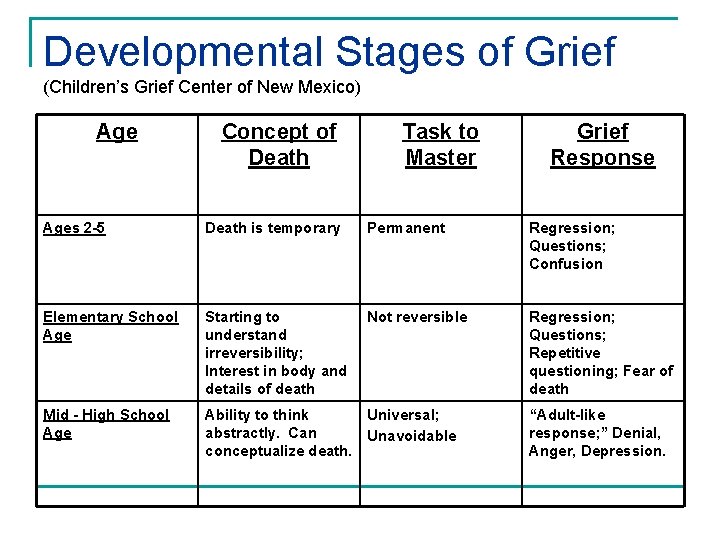
Developmental Stages of Grief (Children’s Grief Center of New Mexico) Age Concept of Death Task to Master Grief Response Ages 2 -5 Death is temporary Permanent Regression; Questions; Confusion Elementary School Age Starting to understand irreversibility; Interest in body and details of death Not reversible Regression; Questions; Repetitive questioning; Fear of death Mid - High School Age Ability to think Universal; abstractly. Can Unavoidable conceptualize death. “Adult-like response; ” Denial, Anger, Depression.
When Should I Get A New Pet? n n The timing is different for everyone! Questions to consider
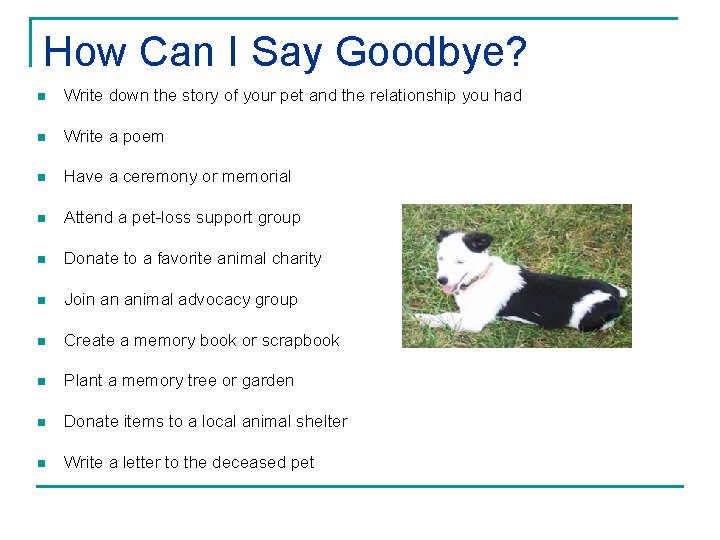
How Can I Say Goodbye? n Write down the story of your pet and the relationship you had n Write a poem n Have a ceremony or memorial n Attend a pet-loss support group n Donate to a favorite animal charity n Join an animal advocacy group n Create a memory book or scrapbook n Plant a memory tree or garden n Donate items to a local animal shelter n Write a letter to the deceased pet
References n n n n American Veterinary Medical Association (1993). "Report of the AVMA panel on euthanasia. " Journal of the American Veterinary Medical Association 202: 230 -249. American Veterinary Medical Association (2000). "Survey says: Owners taking good care of their pet. " Retrieved 09/12/08, from www. avma. org/onlnews. javma/feb 00/s 020100 d. asp. Bowlby, J. (1977). "The making and breaking of affectional bonds " British Journal of Psychiatry 130: 201 -210. Butler, C. L. and L. S. Lagoni (1996). Children and pet loss. Handbook of childhood death and bereavement. C. A. Corr and D. A. Corr. New York, Springer: 179 -200. Cain, A. O. (1985). "Pets as family mjembers. " Marriage and Family Reviews 8(3/4): 5 -10. Carmack, K. V. (1985). "The effects on family members and functioning after the death of a pet. " Marriage and Family Review 8(3/4): 149 -162 Clements, P. T. , K. M. Benasutti, et al. (2003). "Support for bereaved Owners of pets. " Perspectives in Psychiatric Care 39(2): 49 -54. Cowles, K. V. and B. L. Rodgers (1991). "The concept of grief: A foundation for nursing research and practice. " Research in Nursing and Health 14: 119 -127. Crow, S. and M. Bennett (1981). "Pet owner grief in a university hospital. " Archives of the Foundation of Thanatology 9(2): 16. Cusack, O. (1988). Pets and mental health. New York, Haworth Press. Donahue, K. M. (2005). "Pet loss: Implications for social work practice. " Social Work 50(2): 187 -190. Durrance, D. (1999). “Pet loss: When the human-animal bond is broken. ” Pet Loss: When the Human-Animal Bond is Broken, First Baptist Church of Knoxville, Tennessee. Fogel, B. and D. Abrahamson (1991). "Pet loss: A survey of the attitudes and feelings of practicing veterinarians. " Anthrozoos 33: 143 -150 Gage, M. G. and R. Holcomb (1991). "Couples' perception of stressfulness of death of the family pet. " Family Relations 40(1): 103 -105. Gerwolls, M. K. and S. M. Labott (1989). "Adjustment to the death of a companion animal. " Anthrozoos 7(3): 1720 -187. Gosse, G. H. (1989). "Factors associated with the human grief experience as a result of the death of a pet. " Dissertation Abstracts International 49(11 -B).
References n n n n Groeling, D. and T. Stringer. Missing animal companion. Veterinary Social Work at the UT College of Veterinary Medicine. Knoxville. Gunter, B. (1999). Pets and people: The psychology of pet ownership. London, Whurr Publishers. Harris, J. H. (1982). A study of client grief responses to death or loss in a companion animal veterinary practice. California Veterinarian. 36: 17 -19. Hart, L. A. , C. Rivero, et al. (1987). A pet loss support group: Evaluation of the first year. California Veterinarian: 13 -15. Hopkins, A. F. (1984). Pet Death: Effects on the client and the veterinarian. The pet connection: Its influence on our healh and qualily of life. Proceedings of the Minnesota-California confeerences on the human-animal bond. R. K. Anderson, B. L. Hart and L. A. Hart. Minneapolis, University of Minnesota: 276 -282. Jarolmen, J. (1998). "A comparison of the grief reaction of children and adults: Focusing on pet loss and bereavement. " Omega 37(2): 133 -150. Katcher, A. H. and M. A. Rosenburg (1979). "Euthanasia and the management of the client's grief. " Compendium on Continuing Education 1: 887 -891. Keddie, K. M. G. (1977). "Pathological mourning after the death of a domestic pet. " British Journal of Psychiatry 131: 21 -25. Kubler-Ross, E. (1969). On death and dying. New York, Mac. Millan. Lagoni, L. , C. Butler, et al. (1994). The human-animal bond and grief. Philadelphia, W. B. Saunders. Levinson, B. M. (1981). "Human grief in the loss of an animal companion. " Foundation of Thanatology: Archives 9(5). Margolies, L. (1999). "The long goodbye: Women, companion animals, and maternal loss. " Clinical Social Work Journal 27(3): 289 -304. Mc. Cutcheon, K. A. and S. J. Fleming (2001 -2002). "Grief resulting from euthanasia and natural death of companion animals. " Omega 44(2): 169 -188. Pennebaker, J. and J. Susman (1985). "Disclosure of traumas and psychosomatic processes. " Social Science and Medicine 26(3): 327 -332. Planchon, L. A. , D. I. Templer, et al. (2002). "Death of a companion cat or dog and human bereavement: Psychosocial variables. " Society and Animals 10(1): 93 -105. Podrazik, D. , S. Shackford, et al. (2000). "The death of a pet: Implications for loss and bereavement across the lifespan. " Journal of Personal and Interpersonal Loss 5: 361 -395.
References n n n n Quackenbush, J. (1982). "The social context of pet loss. " The Animal Health Technician 3: 333 -336. Quackenbush, J. and L. Glickman (1984). "Helping people adjust to the death of a pet. " Health and Social Work 9(1): 41 -48. Quackenbush, J. and D. Graveline (1985). When your pet dies: How to cope with your feelings. New York, Simon and Shuster. Quackenbush, J. E. (1984). Pet bereavement in older owners. The Pet Connection. R. K. Anderson, B. L. Hart and L. A. Hart. Minneapolis, University of Minnesota Press: 292 -299. Ross, C. B. (2005). Pet loss and children: Establishing a healthy relationship. New York, Routledge. Ross, C. B. and J. Baron-Sorensen (1998). Pet loss and human emotion. Philadelphia, Accelerated Development. Sharkin, B. S. and A. S. Bahrick (1990). "Pet loss: Implications for counselors. " Journal of Counseling and Development 68(Jan/Feb): 306 -208. Sharkin, B. S. and D. Knox (2003). "Pet loss: Issues and implications for the psychologist. " Professional Psychology: Research and Practice 34(4): 414 -421. Stallones, L. , M. Marx, et al. (1988). "Attachment to companion animals among older pet owners. " Anthrozoos 2: 118 -124. Toray, T. (2004). "The human-animal bond and loss: Providing support for grieving clients. " Journal of Mental Health Counseling 26(3): 244 -259. Tousley, M. (1996). Children and pet loss: A guide for helping. Companion Animal Association of Arizona. Phoenix, Our Pals Publishing Company. Triebenbacher, S. L. (2000). The companion animal qithin the family system: The manner in which animals enhance life within the home. Handbook on animal-assisted therapy: Theoretical foundations and guidelines for practice. A. H. Fine. New York, Academic press: 357 -374. Trozzi, M. (1999). Talking with children about loss. New York, Berkley Publishing Group. United States Census Bureau (1998). Statistical abstract of the United States. U. S. Census Bureau. Washington, D. C. , U. S. Government Printing Office. Walshaw, S. O. (1981). "Consoling bereaved clients. " The Compendum on Continuing Education 26: 310 -314.
- Slides: 24