
PET exam writing guide Part 2 To get


- Slides: 8
PET exam writing guide
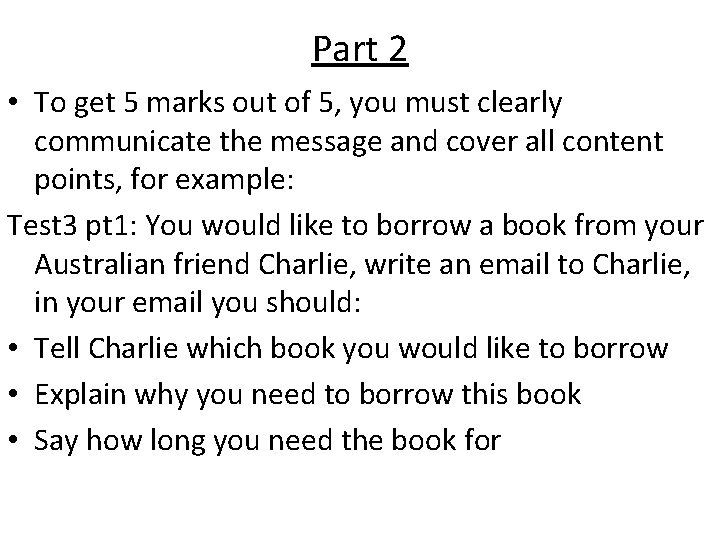
Part 2 • To get 5 marks out of 5, you must clearly communicate the message and cover all content points, for example: Test 3 pt 1: You would like to borrow a book from your Australian friend Charlie, write an email to Charlie, in your email you should: • Tell Charlie which book you would like to borrow • Explain why you need to borrow this book • Say how long you need the book for
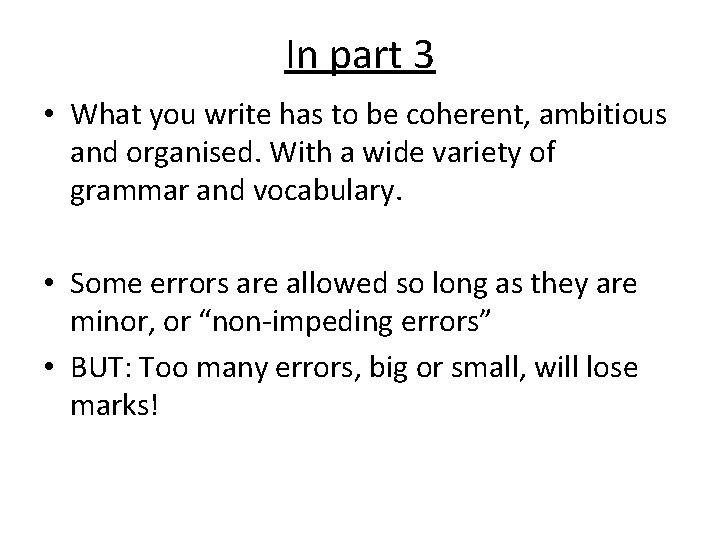
In part 3 • What you write has to be coherent, ambitious and organised. With a wide variety of grammar and vocabulary. • Some errors are allowed so long as they are minor, or “non-impeding errors” • BUT: Too many errors, big or small, will lose marks!
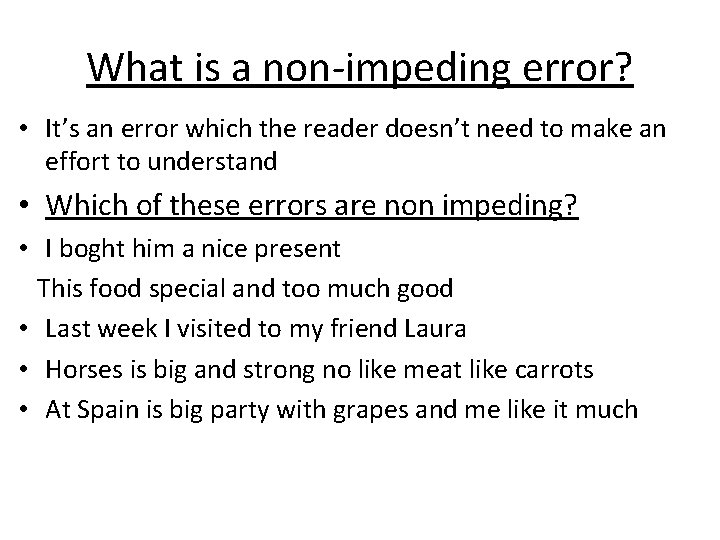
What is a non-impeding error? • It’s an error which the reader doesn’t need to make an effort to understand • Which of these errors are non impeding? • I boght him a nice present This food special and too much good • Last week I visited to my friend Laura • Horses is big and strong no like meat like carrots • At Spain is big party with grapes and me like it much
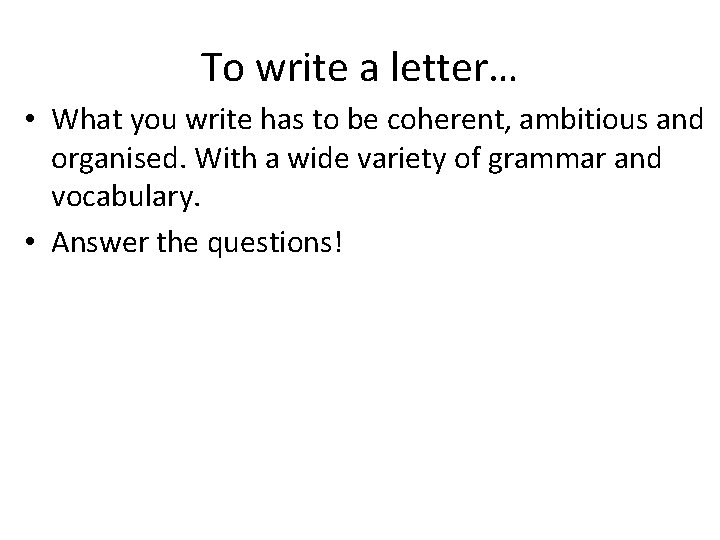
To write a letter… • What you write has to be coherent, ambitious and organised. With a wide variety of grammar and vocabulary. • Answer the questions!
To write a story… • What you write has to be coherent, ambitious and organised. With a wide variety of grammar and vocabulary. • Pay attention to the first sentence, is it written in the 1 st or the 3 rd person? • Make sure your story has a beginning, a middle (or “twist”), and an end.
What is a “twist”? • A twist is an event which makes the story change in direction • For example, the twist in Jurassic Park is when the dinosaurs escape. • The twist in “twilight” is when Bella discovers that Edward is a vampire.