
Pesticide Formulations Mr Fellenbaum Ag Science III Objectives
Pesticide Formulations Mr. Fellenbaum Ag Science III
Objectives • Define Pesticide Formulation • Define the different pesticide formulations • Discuss the pros and cons of each formulation
What is a pesticide formulation? • The composition of the pesticide • Made up of two things— a. Active ingredients-what controls the pest b. Inert ingredients-filler material to spread out the active ingredient
Emulsifiable Concentrates • Known as EC • Liquid formulation • Active ingredient dissolved in petroleum based solvent • Emulsifier added so that oil can disperse in water • White when added to H 20 • 2 -8 lbs. active ingredient/g
Pros • Easy to handle, transport, and store • Little agitation • Can use with a wide range of applicators • Nonabrasive to equipment • Does not plug
Cons • Rapidly absorbed through skin • Risk of phytotoxicity when temps are high • Can pit or discolor treated surface • May deteriorate rubber or plastic • Fire hazard (petroleum)
Solutions • Active ingredient dissolved in liquid solvent • May need diluted • Same pros and cons as EC’s • ULV-Ultra Low Volume -80 -100% Active Ingredient -Less frequent refills
Soluble Powders • Dissolves in water to form true solution • No extra mixing required • Similar Pros and Cons to WP’s, except they are not abrasive
Wettable Powders (WP) • Finely ground, dry formulation • 25 -80% Active ingredient • Forms a suspension when mixed with water -Suspension—does not dissolve, requires constant agitation
Pros • Easy to store, transport, and handle • Slow skin absorption • Low risk of phytotoxicity • Low cost
Cons • Constant agitation • Inhalation of dust • Abrasive • Clogs screens and nozzles • Difficult to mix in hard or alkaline water • Leaves residue
Flowables (F) • Powder in suspension of a liquid • • carrier 4 lbs/gallon of active ingredient Same cons as WP’s (except dust) Must shake containers Easy to handle
Dry Flowables (DF) & Water Dispersable Granules (WDG) • Like WP’s, except in granular form • Granules break apart when they hit H 20 • Less dust than WP’s • More easily measured and mixed than WP’s
Microencapsulated • Active ingredient encased in a capsule • Mixed in suspension • Slow release of active ingredient once applied
Pros • Safe and easy to handle • Capsule prevents dermal absorption by the applicator
Cons • Bees may carry capsules back to hive in pollen basket which can destroy the hive • May clog nozzle screens • Agitation required to keep suspended
Dusts (D) • 1 -10% Active Ingredient • Mixed with finely ground substance • No mixing, easy application • Drift is a problem • Wind and rain remove quickly • Irritating to user • Expensive for amount of AI
Baits (B) • AI mixed with edible substance • No special application eqpmnt. • May be attractive to non-target pests • Dead pests may stink • Cost high if repeated baiting needed
Granules (G) & Pellets (P) • 5 -20% AI, applied to porous, solid • • • material Used to control pests in soil AI absorbed by plant roots Little dust or drift hazard Need incorporation May be eaten by non target animals May get trapped in some plants
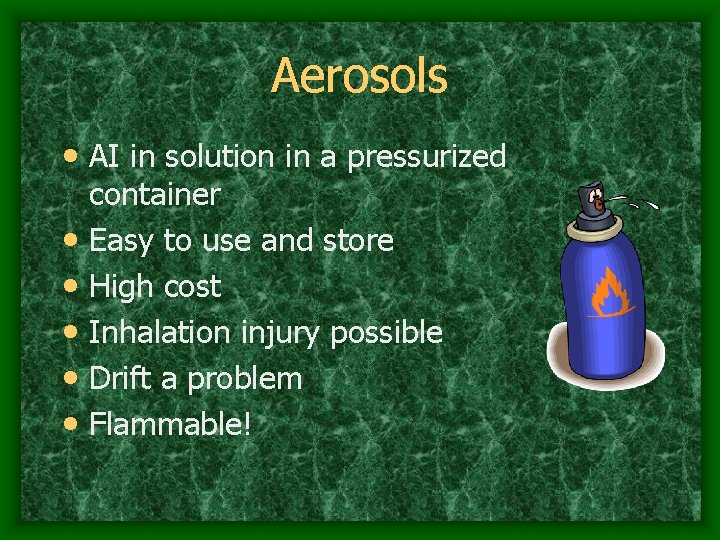
Aerosols • AI in solution in a pressurized • • • container Easy to use and store High cost Inhalation injury possible Drift a problem Flammable!
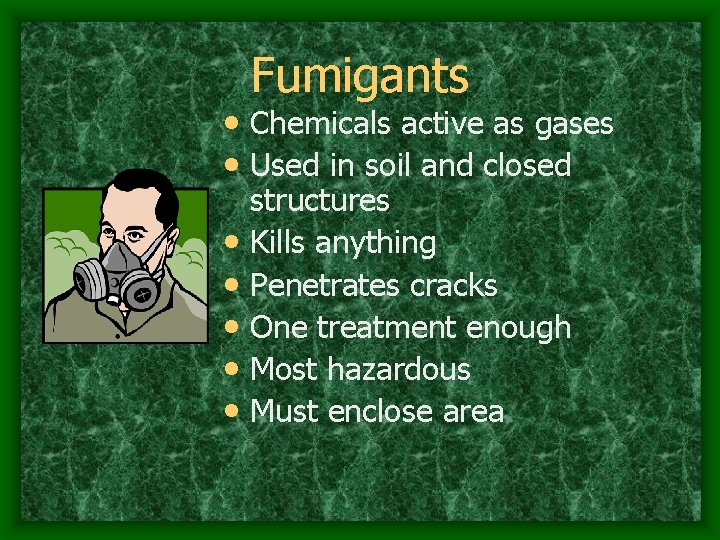
Fumigants • Chemicals active as gases • Used in soil and closed • • • structures Kills anything Penetrates cracks One treatment enough Most hazardous Must enclose area
- Slides: 21