
Pes Planus in Down Syndrome Problem Pathology or
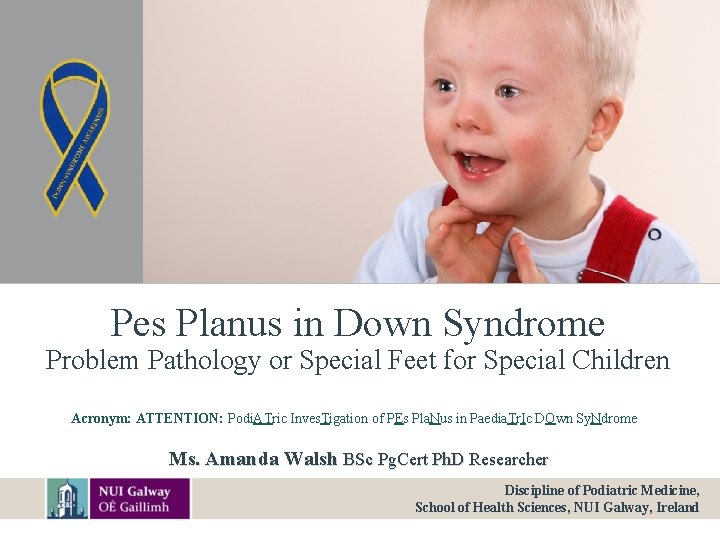
Pes Planus in Down Syndrome Problem Pathology or Special Feet for Special Children Acronym: ATTENTION: Podi. ATric Inves. Tigation of PEs Pla. Nus in Paedia. Tr. Ic DOwn Sy. Ndrome Ms. Amanda Walsh BSc Pg. Cert Ph. D Researcher Discipline of Podiatric Medicine, School of Health Sciences, NUI Galway, Ireland

Pes Planus -Current Evidence in DS Lack of Criteria/ classification of pes planus in DS 60 – 90% prevalence in DS Compared to 3 - 15% in non DS (Aprin et al, 1985; Galli et al, 2007; Evans, Nicholson & Zakarias, 2009; Garcia-Rodriguez et al, 1999) Calcaneal eversion fails to reduce with age Ligamentous laxity in DS = 88% prevalence in feet specifically Prevalence of Hypotonia in DS = 90% (Decaro. L, 2012) (Aprin et al, 1985) (Concolino et al, 2006 ) Discipline of Podiatric Medicine School of Health Sciences, NUI Galway
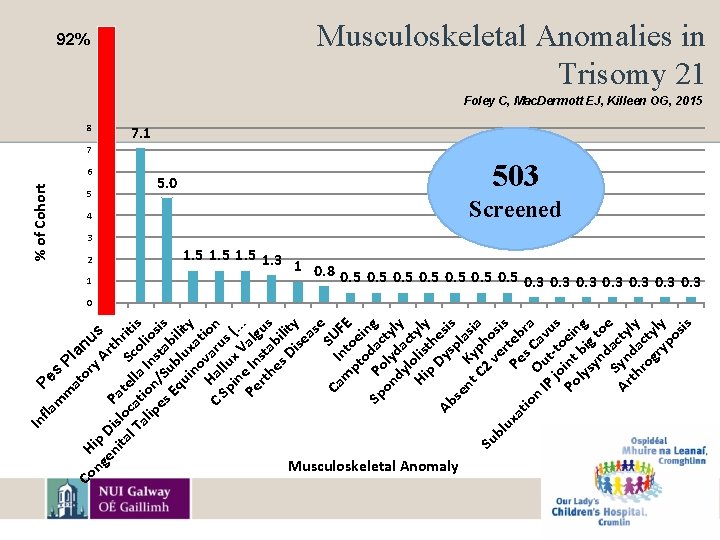
u an Pl H ry ng ip Ar en Di P th ita slo ate r l T ca lla Sco itis al tio In lio ip n/ s s es S ta is Eq ub bil ui lux ity no at v i C Hal aru on Sp lu s in x V (. . Pe e In alg. rth sta us es bil Di ity se as e Ca I SUF m nto E pt e o in Sp Po dac g on ly ty dy da ly l c Hi olis tyly p th Dy es Ab sp is se nt Ky lasi C 2 ph a Su ve osi bl r s ux Pe teb at s r io n Ou Ca a IP t vu jo -to s Po int ein ly big g sy nd toe a Ar Syn cty th da ly ro ct gr yly yp os is at o s Pe Co m m In fla % of Cohort 92% Musculoskeletal Anomalies in Trisomy 21 Foley C, Mac. Dermott EJ, Killeen OG, 2015 8 7. 1 7 6 5 5. 0 2 1 503 4 Screened 3 1. 5 1. 3 1 0. 8 0. 5 0. 3 0 s Musculoskeletal Anomaly

Current Practice Pes Planus Outcome Measures Natural History Foot Pathology in DS Screening Treatment Assessment Discipline of Podiatric Medicine School of Health Sciences, NUI Galway
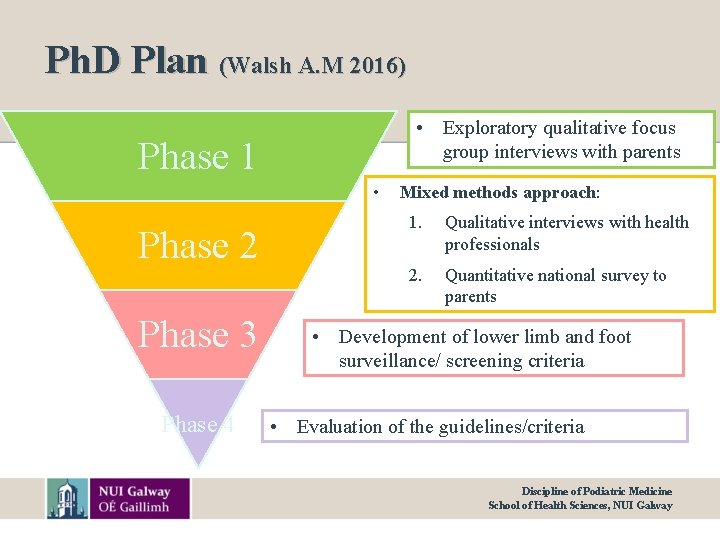
Ph. D Plan (Walsh A. M 2016) • Exploratory qualitative focus group interviews with parents Phase 1 • Phase 2 Phase 3 Phase 4 Mixed methods approach: 1. Qualitative interviews with health professionals 2. Quantitative national survey to parents • Development of lower limb and foot surveillance/ screening criteria • Evaluation of the guidelines/criteria Discipline of Podiatric Medicine School of Health Sciences, NUI Galway

Impact of Pes Planus Pathomechanics Discipline of Podiatric Medicine School of Health Sciences, NUI Galway
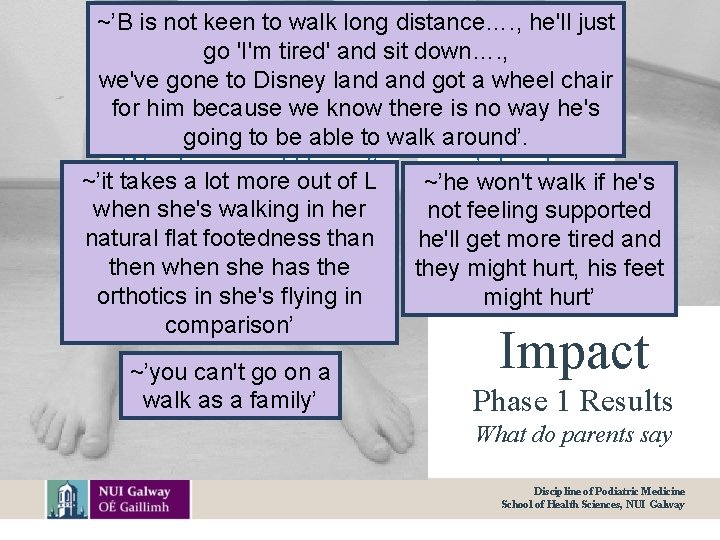
~’B is not keen to walk long distance…. , he'll just ~’when he stands up I can se the pressure its go 'I'm tired' and sit down…. , putting on his knees you know and then I just we've gone to Disney land got a wheel chair think in the future from the knees it goes to the for him because we know there is no way he's hips and…. . that's your whole frame really’ going to be able to walk around’. ~’when he ~’A's shoes would be quite ~’it takes a lot more out of L ~’he won't walk if he's stands I can worn on the inside of the when she's walking in her not feeling supported actually see his heel…. . , really worn, natural flat footedness than he'll get more tired and knees and that especially the school then when she has they might hurt, his feet they're caving in’ shoes’ orthotics in she's flying in might hurt’ comparison’ ~’you can't go on a walk as a family’ Impact Phase 1 Results What do parents say Discipline of Podiatric Medicine School of Health Sciences, NUI Galway
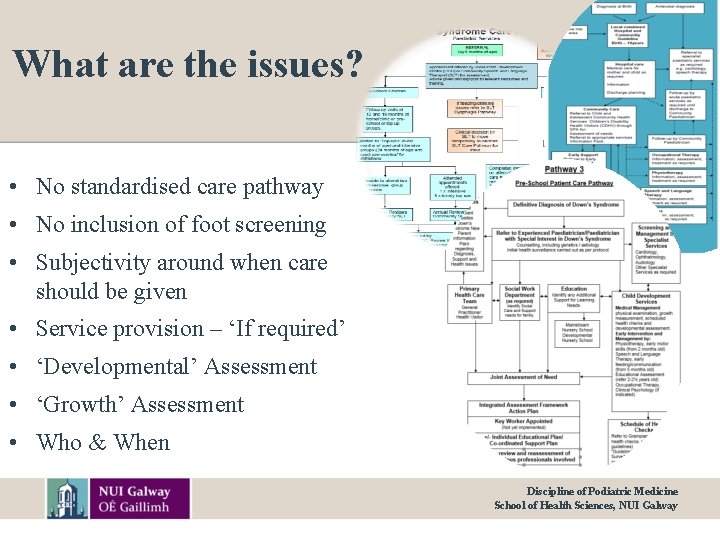
What are the issues? • No standardised care pathway • No inclusion of foot screening • Subjectivity around when care should be given • Service provision – ‘If required’ • ‘Developmental’ Assessment • ‘Growth’ Assessment • Who & When Discipline of Podiatric Medicine School of Health Sciences, NUI Galway
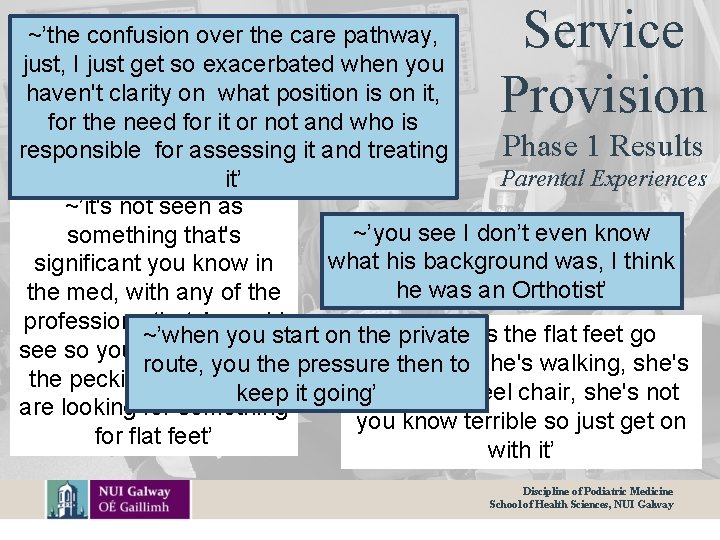
Service Provision ~’its ~’thethe confusion attitude is over he's the down caresyndrome, pathway, its just, normal I just for gethim so exacerbated to have flat feet when so you just haven't kind ofclarity you go onwith what theposition orthotics is and on it, that's for the it, and needthat's for itall or we've not and ever who really is Phase 1 Results responsible forbeen assessing told’ it and treating Parental Experiences it’ ~’it's not seen as ~’nobody's evereven saidknow or ~’you seehas I don’t something that's really explained what’s what his background was, I think significant you know in going on in feet’ he was anhis Orthotist’ the med, with any of the professions that A would far as the flat feet go ~’when you start on the~’as private see so you are way down attitude route, you the pressure thenisto- she's walking, she's the pecking order if you not in a wheel chair, she's not keep it going’ are looking for something you know terrible so just get on for flat feet’ with it’ Discipline of Podiatric Medicine School of Health Sciences, NUI Galway
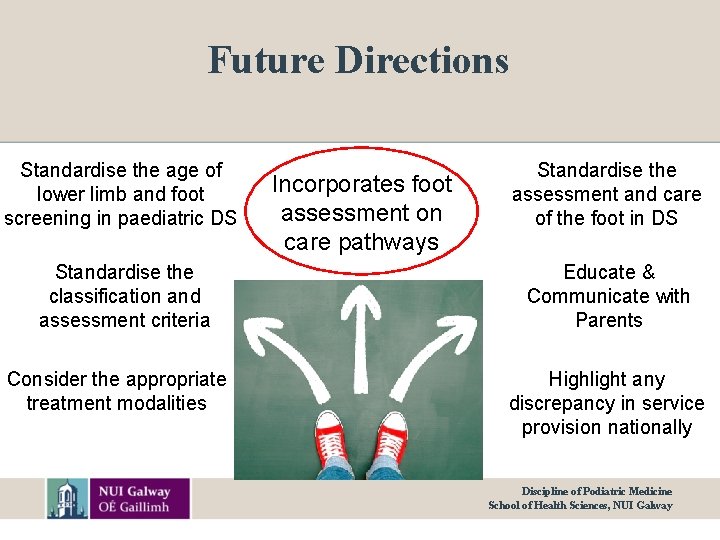
Future Directions Standardise the age of lower limb and foot screening in paediatric DS Standardise the classification and assessment criteria Consider the appropriate treatment modalities Incorporates foot assessment on care pathways Standardise the assessment and care of the foot in DS Educate & Communicate with Parents Highlight any discrepancy in service provision nationally Discipline of Podiatric Medicine School of Health Sciences, NUI Galway
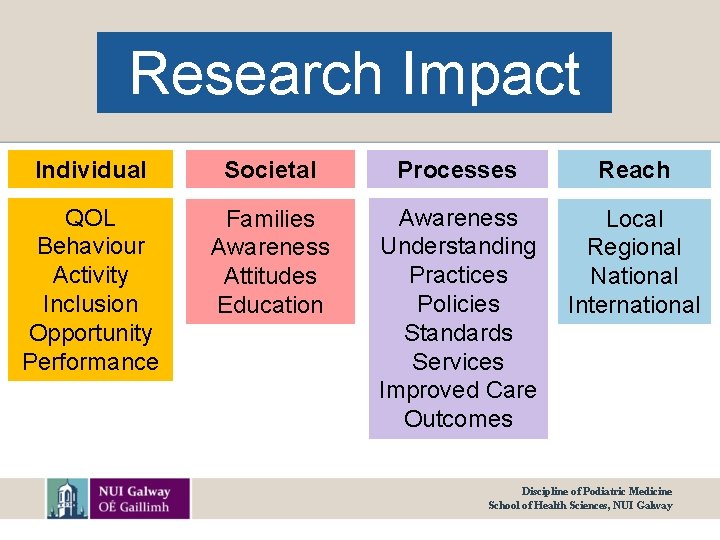
Research Impact Individual Societal Processes Reach QOL Behaviour Activity Inclusion Opportunity Performance Families Awareness Attitudes Education Awareness Understanding Practices Policies Standards Services Improved Care Outcomes Local Regional National International Discipline of Podiatric Medicine School of Health Sciences, NUI Galway
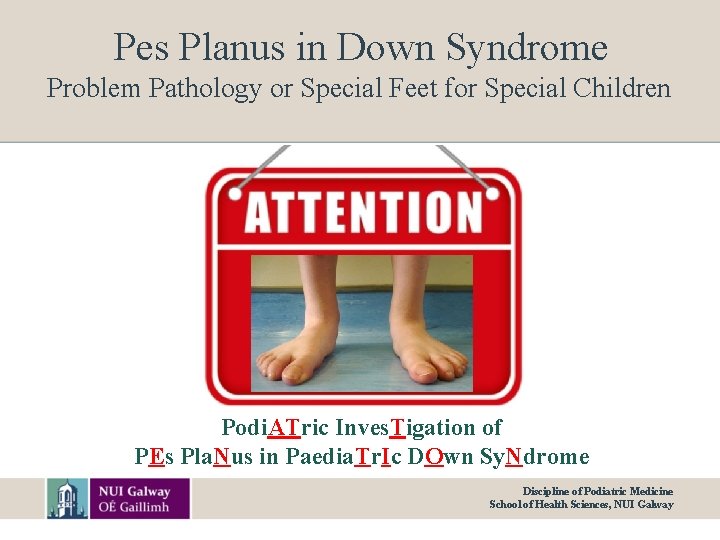
Pes Planus in Down Syndrome Problem Pathology or Special Feet for Special Children Podi. ATric Inves. Tigation of PEs Pla. Nus in Paedia. Tr. Ic DOwn Sy. Ndrome Discipline of Podiatric Medicine School of Health Sciences, NUI Galway
References Title slide image (Online) Available at www. theatlantic. com Aprin H, Zink, WP, Hall JE: Management of dislocation of the hip in Down syndrome. J Pediatr Orthop 5: 428, 1985. Concolino. D, Pasquzzi. A, Capalbo. G, Sinopoli. S, Strisciuglio. P (2006) Early detection of podiatric anomalies in children with Down syndrome. Acta Paediatrica. 95: 17 – 20 Decaro LJ (2012) Down Syndrome: A Serious Pediatric Podiatric Issue. Biomechanics & Orthotics. Sept 2012 Dey. A, Bhowmik. K, Chatterjee. A, Chakrabarty. PB, Sinha. S, Mukhopadhyay. K (2013) Down syndrome related muscle hypotonia: association with COL 6 A 3 function SNP rs 2270669. Frontiers in Genetics. 4: 57. Galli M, Cimolin M, Pau M, Costici P, Albertini G. (2013) Relationship between flat foot condition and gat pattern alterations in children with Down Syndrome. Journal of Intellectual Disability Research. 58: 3: pp 269 -276 Genetics Home Reference (2015/ Reviewed Nov 2013) Chromosome 21. (Online) Available at: http: //ghr. nlm. nih. gov/chromosome/21 (accessed: 08/12/15) HSE (2015) Down Syndrome. (Online) Available at: http: //www. hse. ie/eng/health/az/D/Down's-syndrome/Complications-of-Down's-syndrome. html (accessed: 08/12/15) Marder. L, Tulloh. R, Pascall. E (2014) Cardiac Problems in Down Syndrome. Paediatrics and Child Health. 25: 1: pp 23 -29. Pikora. T, Bourke. J, Bathgate. K, Foley. KR, Lennox. N, Leonard. H (2014) Health conditions and their impact among adolescents and young adults with Don syndrome. PLo. S ONE 9(5): e 96868. Roizen NJ, Patterson D. Down’s syndrome. Lancet. 2003; 361: 1281 -1289 as cited in Steingass. K, Chicoine. B, Mc. Guire. D, Roizen. N (2011) Developmental Disabilities Grown Up: Down Syndrome. Journal of Developmental & Behavioural Pediatrics. 32: 7 pp 548 - 558 Uppal. H, Chandran. S, Potluri. R (2015) Risk Factors for mortality in Down Syndrome. Journal of Intellectual Disability Research. 59: 9 pp 873 -881. Discipline of Podiatric Medicine School of Health Sciences, NUI Galway
- Slides: 13