
Pertuzumab Monotherapy Following TrastuzumabBased Treatment Activity and Tolerability
Pertuzumab Monotherapy Following Trastuzumab-Based Treatment: Activity and Tolerability in Patients with Advanced HER 2 -Positive Breast Cancer Cortés J et al. ASCO 2009; Abstract 1022. (Poster Discussion)
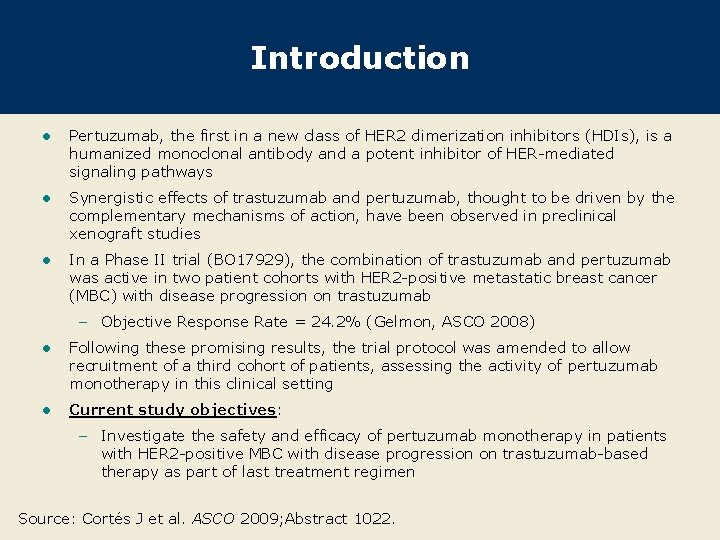
Introduction l Pertuzumab, the first in a new class of HER 2 dimerization inhibitors (HDIs), is a humanized monoclonal antibody and a potent inhibitor of HER-mediated signaling pathways l Synergistic effects of trastuzumab and pertuzumab, thought to be driven by the complementary mechanisms of action, have been observed in preclinical xenograft studies l In a Phase II trial (BO 17929), the combination of trastuzumab and pertuzumab was active in two patient cohorts with HER 2 -positive metastatic breast cancer (MBC) with disease progression on trastuzumab – Objective Response Rate = 24. 2% (Gelmon, ASCO 2008) l Following these promising results, the trial protocol was amended to allow recruitment of a third cohort of patients, assessing the activity of pertuzumab monotherapy in this clinical setting l Current study objectives: – Investigate the safety and efficacy of pertuzumab monotherapy in patients with HER 2 -positive MBC with disease progression on trastuzumab-based therapy as part of last treatment regimen Source: Cortés J et al. ASCO 2009; Abstract 1022.

Trastuzumab and Pertuzumab Bind to Different Regions on HER 2 receptor Pertuzumab Trastuzumab Subdomain 4 of HER 2 continually suppresses HER 2 activity Dimerisation domain of HER 2 l Trastuzumab l Pertuzumab inhibits HER 2 forming dimer pairs l Flags l Suppresses multiple HER signalling pathways l Does l Flags cells for destruction by the immune system not inhibit HER 2 dimerization Source: With permission from Cortés J. ASCO 2009; Abstract 1022.
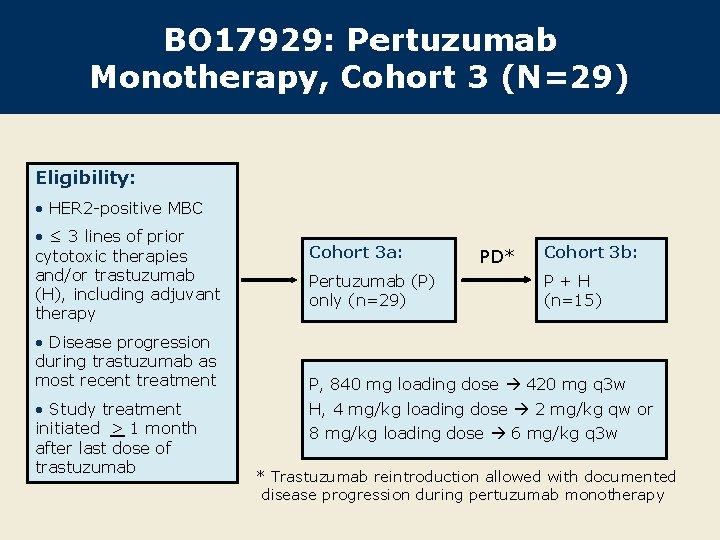
BO 17929: Pertuzumab Monotherapy, Cohort 3 (N=29) Eligibility: • HER 2 -positive MBC • ≤ 3 lines of prior cytotoxic therapies and/or trastuzumab (H), including adjuvant therapy • Disease progression during trastuzumab as most recent treatment • Study treatment initiated > 1 month after last dose of trastuzumab Cohort 3 a: Pertuzumab (P) only (n=29) PD* Cohort 3 b: P+H (n=15) P, 840 mg loading dose 420 mg q 3 w H, 4 mg/kg loading dose 2 mg/kg qw or 8 mg/kg loading dose 6 mg/kg q 3 w * Trastuzumab reintroduction allowed with documented disease progression during pertuzumab monotherapy
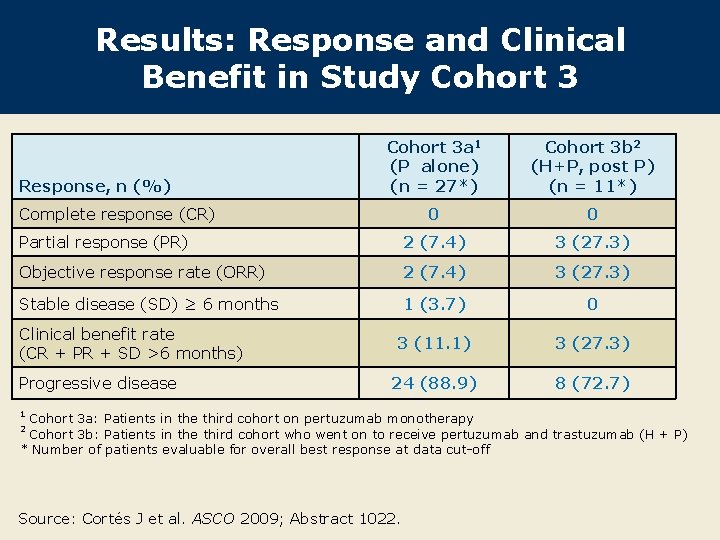
Results: Response and Clinical Benefit in Study Cohort 3 a 1 (P alone) (n = 27*) Cohort 3 b 2 (H+P, post P) (n = 11*) 0 0 Partial response (PR) 2 (7. 4) 3 (27. 3) Objective response rate (ORR) 2 (7. 4) 3 (27. 3) Stable disease (SD) ≥ 6 months 1 (3. 7) 0 3 (11. 1) 3 (27. 3) 24 (88. 9) 8 (72. 7) Response, n (%) Complete response (CR) Clinical benefit rate (CR + PR + SD >6 months) Progressive disease 1 Cohort 3 a: Patients in the third cohort on pertuzumab monotherapy Cohort 3 b: Patients in the third cohort who went on to receive pertuzumab and trastuzumab (H + P) * Number of patients evaluable for overall best response at data cut-off 2 Source: Cortés J et al. ASCO 2009; Abstract 1022.
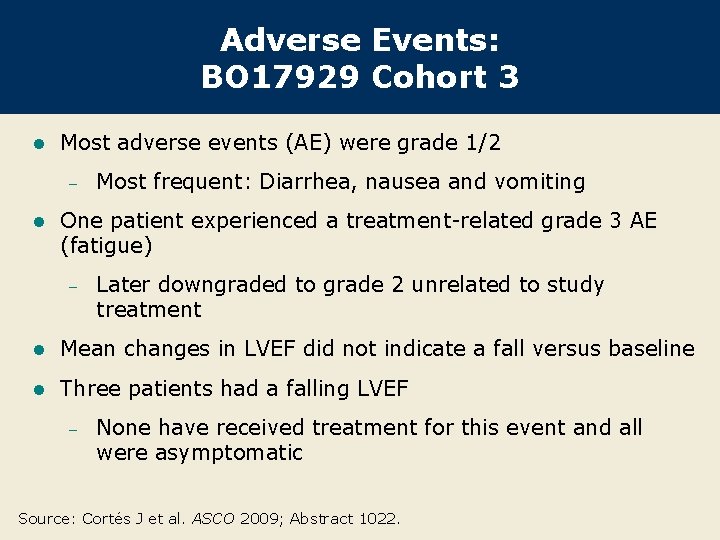
Adverse Events: BO 17929 Cohort 3 l Most adverse events (AE) were grade 1/2 l Most frequent: Diarrhea, nausea and vomiting One patient experienced a treatment-related grade 3 AE (fatigue) Later downgraded to grade 2 unrelated to study treatment l Mean changes in LVEF did not indicate a fall versus baseline l Three patients had a falling LVEF None have received treatment for this event and all were asymptomatic Source: Cortés J et al. ASCO 2009; Abstract 1022.

Summary and Conclusions l Pertuzumab monotherapy is active in patients with HER 2 -positive breast cancer with disease progression on trastuzumab l Trastuzumab/pertuzumab combination therapy is active in patients with disease progression on either trastuzumab or pertuzumab monotherapy l Pertuzumab monotherapy or in combination with trastuzumab was well tolerated. No clinically significant cardiac events were observed in this patient group l CLEOPATRA is a Phase III trial of trastuzumab + docetaxel ± pertuzumab in previously untreated HER 2 -positive metastatic breast cancer, and is open to recruitment Source: Cortés J et al. ASCO 2009; Abstract 1022.
- Slides: 7