
Persuasive Writing An Introduction Created by S Wilson

Persuasive Writing: An Introduction Created by S. Wilson GCHS – Fall 2009
Persuasive Writing What is Persuasive Writing? The writer takes a stand for or against a topic or an issue. The writer tries to convince readers to either do or believe something.
Persuasive Writing You’ve Been Persuaded Before… • Peer Pressure • Family, Friends, Teachers • Commercials For Example…
Persuasive Writing Format of Persuasive Argument Regardless of whether the argument is a television commercial or an essay, the following basic format should be followed: Introduction Body • Use of “hook” • Include thesis (argument) – It should be obvious to the reader • Introduce main ideas (without explaining them) • Evidence provided • Separate paragraphs for each point • Analyze, explain, support, examples… • Acknowledge opposing viewpoint Conclusion • Restate thesis • Summarize main points • Get reader to act on or think about topic
Persuasive Writing Format of Persuasive Argument THE INTRODUCTION… Using a “Hook” Interesting Quote: “It’s easy to quit smoking. I’ve done hundreds of times. ” – Mark Twain Question Have you ever wondered why cigarettes are so addicting? A “hook” is something used to catch the audience’s attention so they ‘stick around’ to hear your argument. Unusual Detail/Fact There are hundreds of chemicals found in a normal cigarette Exaggeration Everyone who smokes will die a slow and painful death Statistic Information An astounding 60% of high school students smoke Strong Statement Cigarettes are Canada’s number one killer Anecdote/Personal Story I smoked for three years before realizing I was killing myself
Persuasive Writing Format of Persuasive Argument THE BODY… Each body paragraph focuses on a main idea that you use to try and convince your audience of your argument. This is achieved by using a combination of: • Examples • Facts • Explanations • Reasons Typically, at least THREE main ideas to support the argument. her t o e d to. ar e e s r u e r, th t can be ience… e v e How ques tha the aud i ce techn d convin n try a
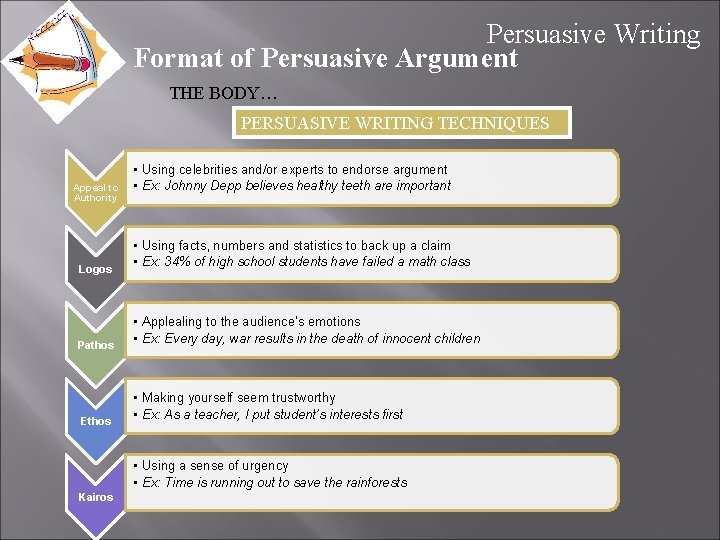
Persuasive Writing Format of Persuasive Argument THE BODY… PERSUASIVE WRITING TECHNIQUES Appeal to Authority Logos Pathos Ethos • Using celebrities and/or experts to endorse argument • Ex: Johnny Depp believes healthy teeth are important • Using facts, numbers and statistics to back up a claim • Ex: 34% of high school students have failed a math class • Applealing to the audience’s emotions • Ex: Every day, war results in the death of innocent children • Making yourself seem trustworthy • Ex: As a teacher, I put student’s interests first • Using a sense of urgency • Ex: Time is running out to save the rainforests Kairos
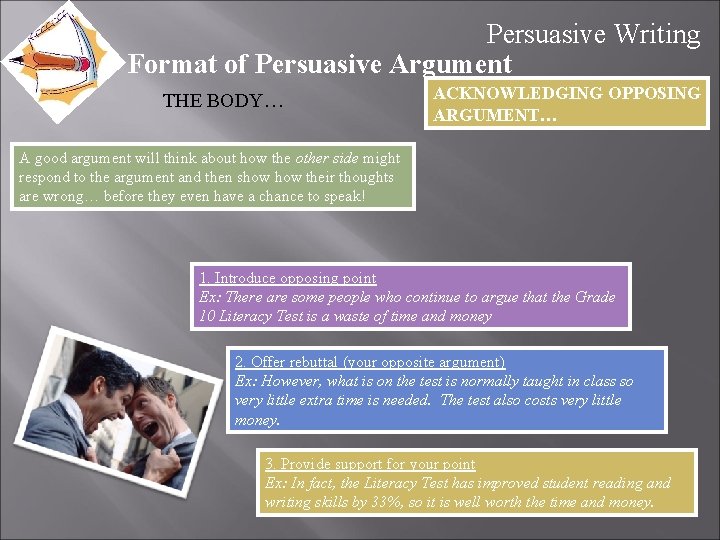
Persuasive Writing Format of Persuasive Argument THE BODY… ACKNOWLEDGING OPPOSING ARGUMENT… A good argument will think about how the other side might respond to the argument and then show their thoughts are wrong… before they even have a chance to speak! 1. Introduce opposing point Ex: There are some people who continue to argue that the Grade 10 Literacy Test is a waste of time and money 2. Offer rebuttal (your opposite argument) Ex: However, what is on the test is normally taught in class so very little extra time is needed. The test also costs very little money. 3. Provide support for your point Ex: In fact, the Literacy Test has improved student reading and writing skills by 33%, so it is well worth the time and money.
Persuasive Writing Format of Persuasive Argument THE CONCLUSION… The conclusion summarizes the argument and support for the reader. It includes: • Restated thesis • Restated main point • A memorable line to get the audience to remember the argument or act on your argument (Ex. A commercial might want you to act by buying something)
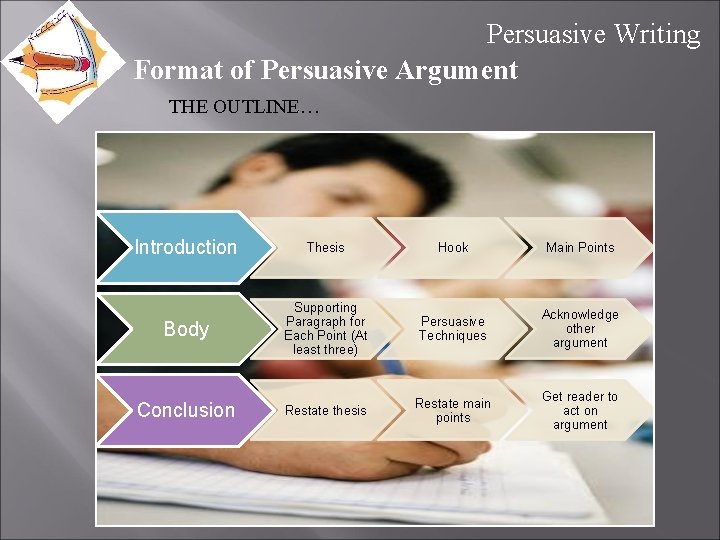
Persuasive Writing Format of Persuasive Argument THE OUTLINE… Introduction Thesis Hook Main Points Body Supporting Paragraph for Each Point (At least three) Persuasive Techniques Acknowledge other argument Conclusion Restate thesis Restate main points Get reader to act on argument
Persuasive Writing: An Introduction
- Slides: 11