
PERSUASIVE RESEARCH PAPER WHAT DOES IT MEAN TO

- Slides: 27
PERSUASIVE RESEARCH PAPER
WHAT DOES IT MEAN TO PERSUADE? TO GET OTHERS TO THINK, ACT, AND FEEL A PARTICULAR WAY ABOUT A SUBJECT. USUALLY YOU WANT THEM TO FEEL THE SAME WAY YOU DO ABOUT THE SITUATION/ SUBJECT. YOU ARE TRYING TO CONVINCE THE READER TO VIEW THINGS THE WAY YOU DO. YOU PERSUADE PEOPLE BY PRESENTING EVIDENCE AND FACTS THAT SUPPORT YOUR SIDE OF THE STORY.
SELECT A TOPIC QUESTIONS TO CONSIDER BEFORE YOU CHOOSE A TOPIC! 1. IS THIS A TOPIC THAT MAKES ME FEEL STRONGLY? 2. IS THIS A TOPIC THAT HAS MORE THAN ONE SIDE, A TOPIC ON WHICH PEOPLE MIGHT DISAGREE? 3. DO I HAVE ENOUGH TO SAY ABOUT THIS TOPIC TO PERSUADE OTHERS TO ACCEPT MY POSITION.
FORM AN OPINION SELECT A POSITION/ SIDE: PRO-FOR IT, OR CONAGAINST IT. ONCE YOU HAVE A TOPIC THINK ABOUT YOUR POSITION ON IT. SOMETIMES WHEN YOU LEARN MORE ABOUT A TOPIC, YOUR POSITION CHANGES. EXPLORING A TOPIC HELPS YOU DISCOVER WHETHER IT IS SUITABLE FOR A WRITING PROJECT. NEXT YOU NEED TO BRAINSTORM/ PREWRITE TO EXPLORE AND ORGANIZE YOUR IDEAS.
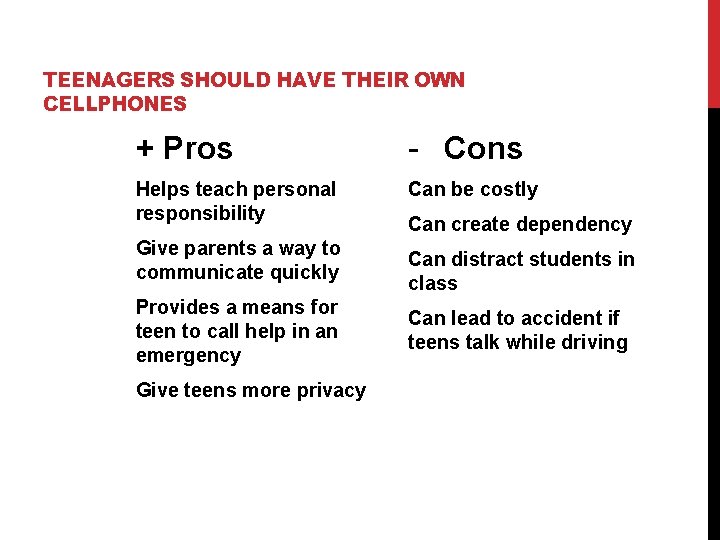
TEENAGERS SHOULD HAVE THEIR OWN CELLPHONES + Pros - Cons Helps teach personal responsibility Can be costly Give parents a way to communicate quickly Provides a means for teen to call help in an emergency Give teens more privacy Can create dependency Can distract students in class Can lead to accident if teens talk while driving
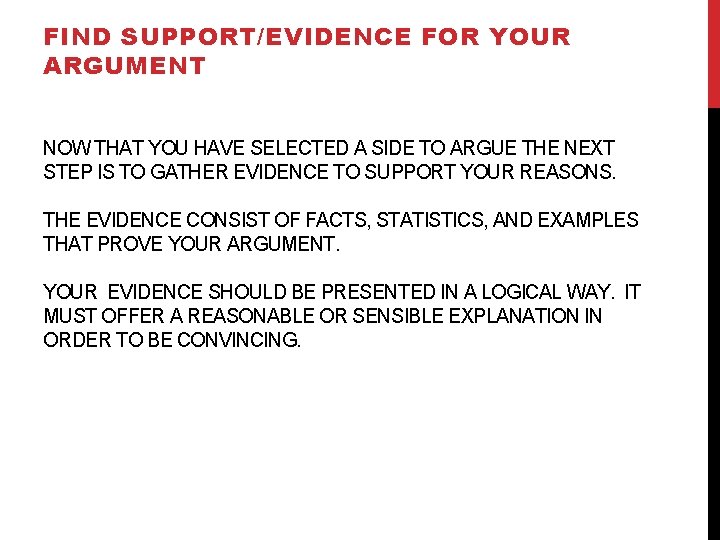
FIND SUPPORT/EVIDENCE FOR YOUR ARGUMENT NOW THAT YOU HAVE SELECTED A SIDE TO ARGUE THE NEXT STEP IS TO GATHER EVIDENCE TO SUPPORT YOUR REASONS. THE EVIDENCE CONSIST OF FACTS, STATISTICS, AND EXAMPLES THAT PROVE YOUR ARGUMENT. YOUR EVIDENCE SHOULD BE PRESENTED IN A LOGICAL WAY. IT MUST OFFER A REASONABLE OR SENSIBLE EXPLANATION IN ORDER TO BE CONVINCING.
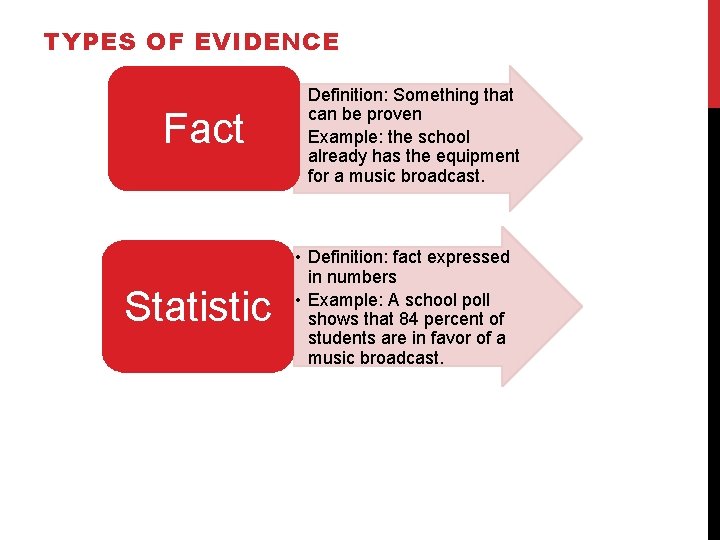
TYPES OF EVIDENCE Fact Statistic • Definition: Something that can be proven • Example: the school already has the equipment for a music broadcast. • Definition: fact expressed in numbers • Example: A school poll shows that 84 percent of students are in favor of a music broadcast.
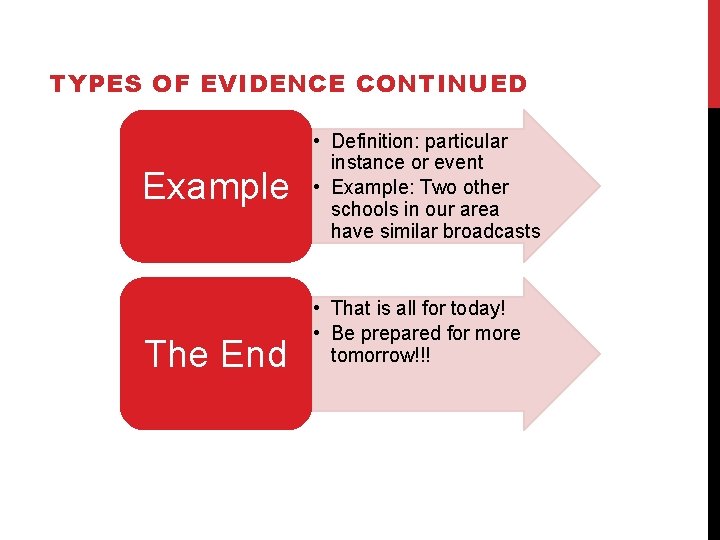
TYPES OF EVIDENCE CONTINUED Example The End • Definition: particular instance or event • Example: Two other schools in our area have similar broadcasts • That is all for today! • Be prepared for more tomorrow!!!
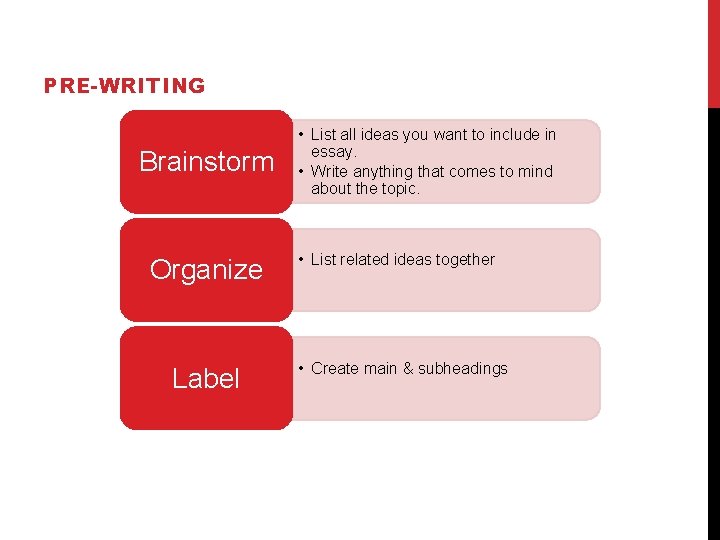
PRE-WRITING Brainstorm Organize Label • List all ideas you want to include in essay. • Write anything that comes to mind about the topic. • List related ideas together • Create main & subheadings
CREATE A FORMAL OUTLINE: WHY CREATE AN OUTLINE? THERE ARE MANY REASONS. 1. AIDS IN THE PROCESS OF WRITING 2. HELPS YOU ORGANIZE YOUR IDEAS 3. PRESENTS YOUR MATERIAL IN A LOGICAL FORM 4. SHOWS RELATIONSHIPS AMONG IDEAS IN YOUR WRITING 5. CONSTRUCTS AN ORDERED OVERVIEW OF YOUR WRITING REMEMBER CREATING AN OUTLINE BEFORE WRITING YOUR PAPER WILL MAKE ORGANIZING YOUR THOUGHTS A LOT EASIER.
GATHERING SOURCES/ EVIDENCE YOU ARE REQUIRED TO HAVE A MINIMUM OF 5 SOURCES. 2 -BOOKS, 2 - ARTICLES/JOURNALS, AND 1 INTERNET SOURCE. ALL SOURCES MUST BE RELIABLE & TRUSTWORTHY. YOU WILL HAVE 5 SOURCE SHEETS/ CARDS 20 EXAMPLES (1 ST PD), 10 EXAMPLES (3 -6 PDS. ) OF EVIDENCE/ NOTE CARDS- WHERE YOU WILL WRITE DOWN YOUR INFORMATION YOU GET FROM YOUR SOURCES. YOU WILL NEED TO PRESENT 4 ARGUMENTS-3 DEFENDING YOUR SIDE, AND 1 OPPOSING SIDE- THE ARGUMENT AGAINST YOUR TOPIC
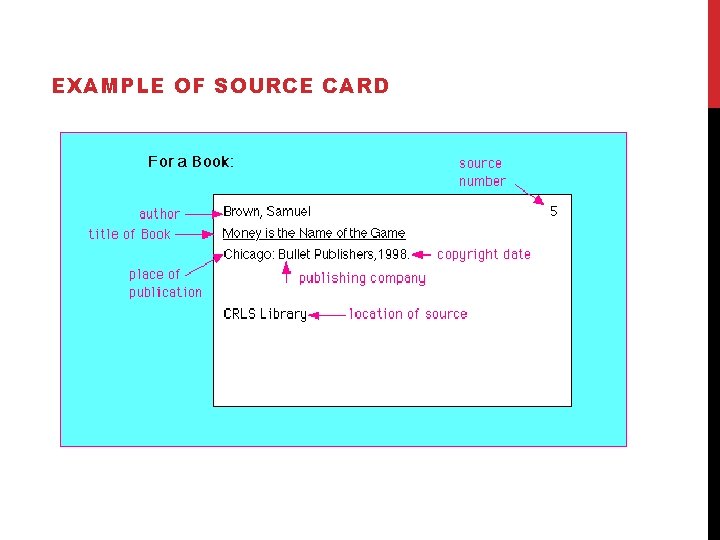
EXAMPLE OF SOURCE CARD
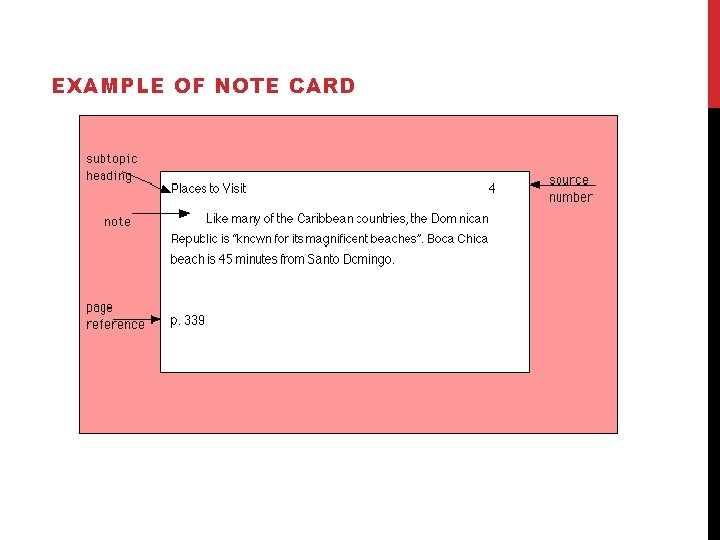
EXAMPLE OF NOTE CARD
EVALUATE YOUR SOURCE: ASK QUESTIONS ABOUT YOUR SOURCES. IS THE INFORMATION USEFUL? IS THE INFORMATION EASY TO UNDERSTAND? IS THE INFORMATION NEW ENOUGH? IS THE INFORMATION TRUSTWORTHY AND TRUE? IS THE INFORMATION BALANCED AND FAIR? MEANING IT IS NOT BIASED OR PREJUDICE.
GIVING CREDIT WHERE CREDIT IS DUE: HOW TO AVOID PLAGIARISM MERRIAM-WEBSTER’S COLLEGIATE DICTIONARY, 12 TH EDITION, DEFINES PLAGIARISM AS “TO STEAL OR PASS-OFF(IDEAS OR WORDS OF ANOTHER) AS YOUR OWN WITHOUT CREDITING THE SOURCE. ” IT IS A TYPE OF STEALING THAT APPLIES TO ALL FORMS OF WRITING AND IS A VIOLATION OF THE COPYRIGHT LAWS. WHEN YOU RESEARCH AND COPY WORD-FOR-WORD, PARAPHRASE OR SUMMARIZE SOMEONE ELSE’S WORDS OR IDEAS IN YOUR OWN PAPER YOU MUST CITE YOUR SOURCE! THE CONSEQUENCES OF PLAGIARISM ARE HARSH. PEOPLE HAVE LOST JOBS, DEGREES, CREDIT FOR CLASSES, AND SCHOLARSHIPS BECAUSE THEY “BORROWED” IDEAS FROM OTHERS WITH OUT CITING THEIR SOURCES.
ALWAYS CITE THE FOLLOWING IF YOU LOOK UP THE INFORMATION IN A SOURCE YOU MUST CITE IT IN YOUR PAPER! THIS DOES NOT WEAKEN YOUR PAPER. IT PROVIDES SUPPORT FOR YOUR WRITING AND THOUGHTS AND SHOWS THE READER HOW HARD YOU WORKED. DIRECT QUOTES OR COPY AND PASTE FROM ANOTHER SOURCE- SET ANOTHER’S WORDS OFF WITH QUOTATION MARKS. NEVER ALTER DIRECT QUOTES UNLESS YOU INDICATE YOU HAVE DONE SO. SPECIFIC IDEAS TAKEN FROM ANOTHER SOURCE- EVEN IF REWRITTEN IN YOUR WORDS, SPECIFIC IDEAS SHOULD BE CITED. OPINION OF OTHERS- WHETHER DIRECTLY QUOTED OR PARAPHRASED.
ALWAYS CITE THE FOLLOWING CONTINUED ANY SPECIFIC DISPLAYS OF FACT OR VISUALS- SUCH AS CHARTS, TABLES, DIAGRAMS OR PICTURES
EXAMPLE OF SOURCE/NOTE CARDS
THE PURPOSE OF SOURCE/NOTE CARDS IT HELPS YOU IDENTIFY THE SOURCE, WHERE YOU GOT THE INFORMATION FROM. FIND THE SOURCE AGAIN IF YOU NEED IT. HELPS YOU TO MAKE YOUR WORKS CITED PAGE(A LIST OF SOURCES USED IN YOUR ESSAY). USE THE NOTES/EVIDENCE YOU WILL USE IN YOUR PAPER. YOUR NOTE CARD SHOULD BE NEAT AND BE NUMBERED BE SURE TO INCLUDE ALL THE INFORMATION WILL NEED ON THE CARD IF POSSIBLE ONLY WRITE ON ONE SIDE OF THE CARD.
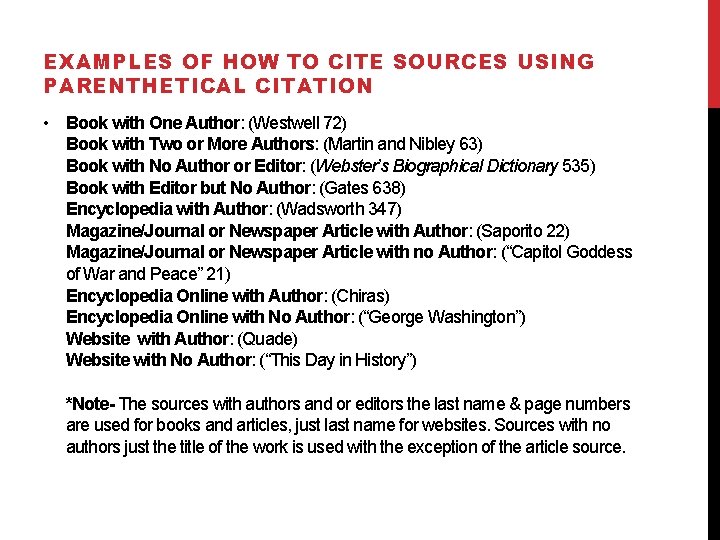
HOW TO INCLUDE SOURCES INTO YOUR PAPER USING PARENTHETICAL CITATION It is not enough just to list your sources at the end you need to show your teacher where you got your facts in the body of your paper, too. Use parenthetical citations to show credit in the body of your research paper. The citation should provide just enough information to lead the reader to the full source listing on your works cited page (bibliography page) an author’s last name and page number are usually enough. Placing a Parenthetical Reference The placement of the source information in parentheses is usually at the end of the sentence or phrase in which you’ve used someone else’s words or ideas. Place it as near to the material as possible. The parenthetical reference comes before the punctuation mark that ends the sentence, clause, or phrase containing the original material. The page number must always be in parentheses at the end of the source. It should never appear in the text always at the end. There are two ways to use parenthetical citation : Author’s Name in Text and Author’s Name in Reference.
PARENTHETICAL CITATION CONTINUED… Author’s Name in Text: Ex. Desmond Morris notes that people from the Mediterranean prefer an elbow-to- shoulder distance (131). Desmond Morris is the author of the information used and 131 is the page number where the information came from. Author’s Name in Reference: Ex. People from the Mediterranean prefer an elbowto-shoulder distance(Morris 131). The author’s name is not included in the text, just the last name is used and the page number where the information came from. Notice in both examples the citation is very close to where the information is used. Those examples are usually used for book & journal/article sources. It is the writers choice which format is used. Both formats may be used in the paper. Works With No Author: Parenthetical references for works with no author should include the title of the work and the appropriate page number. Book titles should be in italics, article titles in quotations. (“National Geographic” 132)- article, ( Animal Cloning 62) - book
EXAMPLES OF HOW TO CITE SOURCES USING PARENTHETICAL CITATION • Book with One Author: (Westwell 72) Book with Two or More Authors: (Martin and Nibley 63) Book with No Author or Editor: (Webster’s Biographical Dictionary 535) Book with Editor but No Author: (Gates 638) Encyclopedia with Author: (Wadsworth 347) Magazine/Journal or Newspaper Article with Author: (Saporito 22) Magazine/Journal or Newspaper Article with no Author: (“Capitol Goddess of War and Peace” 21) Encyclopedia Online with Author: (Chiras) Encyclopedia Online with No Author: (“George Washington”) Website with Author: (Quade) Website with No Author: (“This Day in History”) *Note- The sources with authors and or editors the last name & page numbers are used for books and articles, just last name for websites. Sources with no authors just the title of the work is used with the exception of the article source.
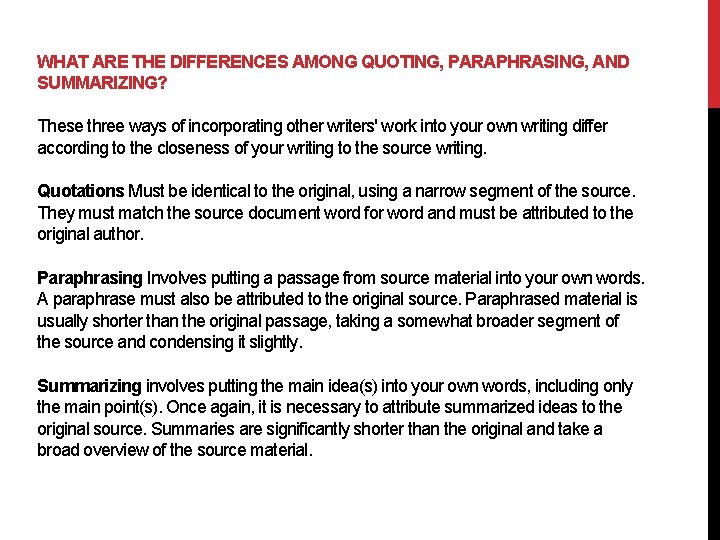
WHAT ARE THE DIFFERENCES AMONG QUOTING, PARAPHRASING, AND SUMMARIZING? These three ways of incorporating other writers' work into your own writing differ according to the closeness of your writing to the source writing. Quotations Must be identical to the original, using a narrow segment of the source. They must match the source document word for word and must be attributed to the original author. Paraphrasing Involves putting a passage from source material into your own words. A paraphrase must also be attributed to the original source. Paraphrased material is usually shorter than the original passage, taking a somewhat broader segment of the source and condensing it slightly. Summarizing involves putting the main idea(s) into your own words, including only the main point(s). Once again, it is necessary to attribute summarized ideas to the original source. Summaries are significantly shorter than the original and take a broad overview of the source material.
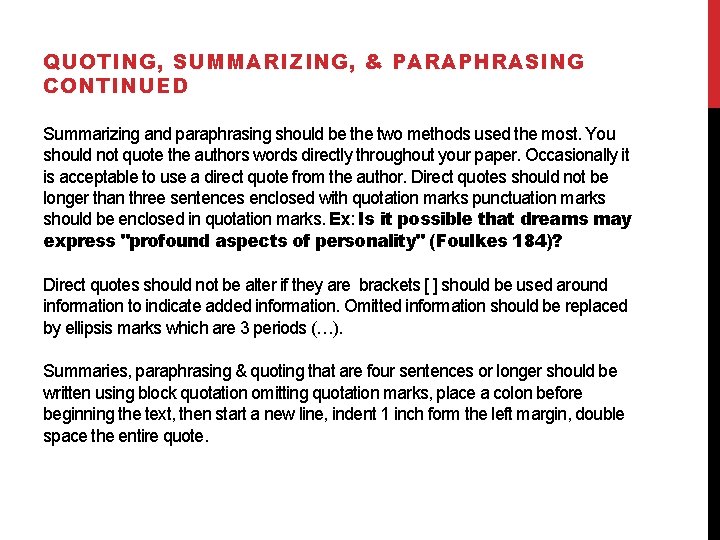
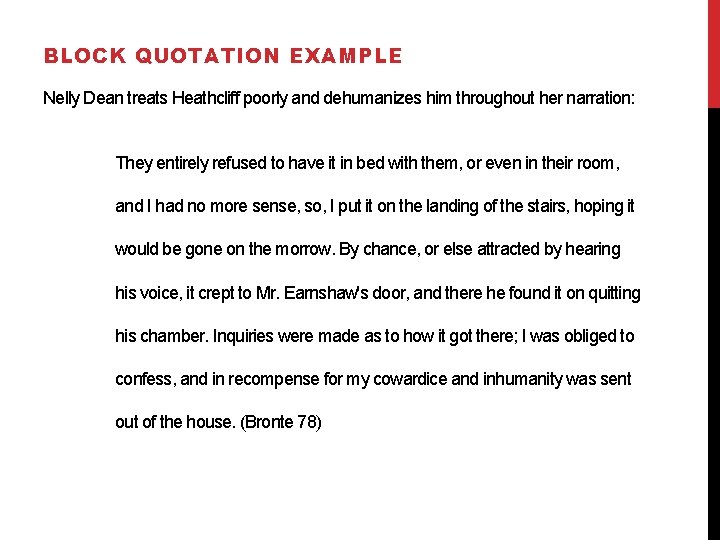
QUOTING, SUMMARIZING, & PARAPHRASING CONTINUED Summarizing and paraphrasing should be the two methods used the most. You should not quote the authors words directly throughout your paper. Occasionally it is acceptable to use a direct quote from the author. Direct quotes should not be longer than three sentences enclosed with quotation marks punctuation marks should be enclosed in quotation marks. Ex: Is it possible that dreams may express "profound aspects of personality" (Foulkes 184)? Direct quotes should not be alter if they are brackets [ ] should be used around information to indicate added information. Omitted information should be replaced by ellipsis marks which are 3 periods (…). Summaries, paraphrasing & quoting that are four sentences or longer should be written using block quotation omitting quotation marks, place a colon before beginning the text, then start a new line, indent 1 inch form the left margin, double space the entire quote.
BLOCK QUOTATION EXAMPLE Nelly Dean treats Heathcliff poorly and dehumanizes him throughout her narration: They entirely refused to have it in bed with them, or even in their room, and I had no more sense, so, I put it on the landing of the stairs, hoping it would be gone on the morrow. By chance, or else attracted by hearing his voice, it crept to Mr. Earnshaw's door, and there he found it on quitting his chamber. Inquiries were made as to how it got there; I was obliged to confess, and in recompense for my cowardice and inhumanity was sent out of the house. (Bronte 78)
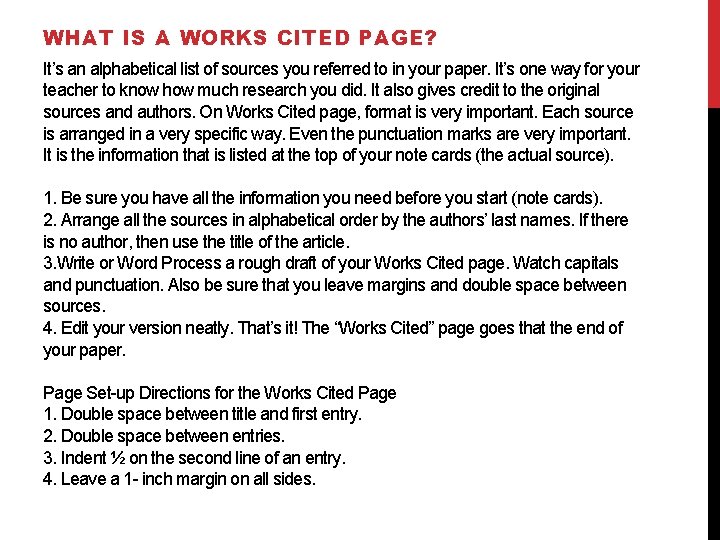
WHAT IS A WORKS CITED PAGE? It’s an alphabetical list of sources you referred to in your paper. It’s one way for your teacher to know how much research you did. It also gives credit to the original sources and authors. On Works Cited page, format is very important. Each source is arranged in a very specific way. Even the punctuation marks are very important. It is the information that is listed at the top of your note cards (the actual source). 1. Be sure you have all the information you need before you start (note cards). 2. Arrange all the sources in alphabetical order by the authors’ last names. If there is no author, then use the title of the article. 3. Write or Word Process a rough draft of your Works Cited page. Watch capitals and punctuation. Also be sure that you leave margins and double space between sources. 4. Edit your version neatly. That’s it! The “Works Cited” page goes that the end of your paper. Page Set-up Directions for the Works Cited Page 1. Double space between title and first entry. 2. Double space between entries. 3. Indent ½ on the second line of an entry. 4. Leave a 1 - inch margin on all sides.
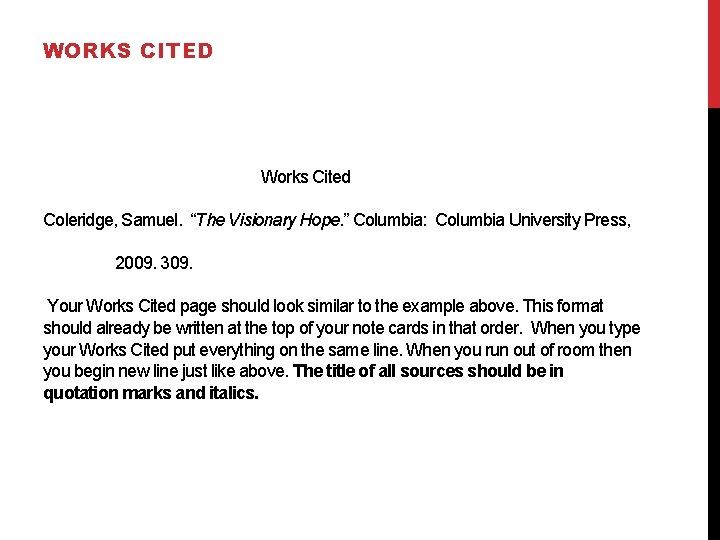
WORKS CITED Works Cited Coleridge, Samuel. “The Visionary Hope. ” Columbia: Columbia University Press, 2009. 309. Your Works Cited page should look similar to the example above. This format should already be written at the top of your note cards in that order. When you type your Works Cited put everything on the same line. When you run out of room then you begin new line just like above. The title of all sources should be in quotation marks and italics.