
Persuasive Essays Examples and Evidence Persuasive Evidence In
- Slides: 22
Persuasive Essays Examples and Evidence
Persuasive Evidence In Persuasive Essays, you must first state a claim. *This is your proposition for a change in policy *Then you must support that proposition with evidence Evidence will clarify and prove your ideas and opinions by backing them up with specific reasons In essays, you must support the main ideas behind your claim in order to obtain audience understanding and acceptance of your claim.
Verbal Support There are 4 major types of verbal support Illustration: Factual, Fictitious, and Specific Instance Testimony Comparison Statistics
Factual Illustrations Factual Illustration A factual story with a point (something that has really happened Can be serious or humorous Can be long, with lots of details (Remember if you use a long story, EACH detail must have its own signpost. Nothing should look like a paragraph.
Factual Illustration Example For an essay on the importance of making promises when you know you might not be able to keep them… Let me tell you a strange tale of a MRS. Robinson Crusoe taken from the article, “The devastation of culture by the Mexican Government” written by Stan Smith, Harvard Archeological scholar: In 1836 Captain Nidever was evacuating the island of San Nicolas upon the orders of the Mexican government. He was to take all of the Indians there to a California Mission. But just as the captain was ready to sail, one Indian woman jumped into the ocean, screaming that her child had been left behind in the confusion. The captain waited several hours, but when the woman failed to appear, he set sail, promising her friends to return for her in a short time. But that promise was broken. The ship was wrecked in a storm, and the few survivors apparently forgot all about the stranded woman. Both she and her child were never heard from again…” (Smith 9)
Fictitious Illustrations Fictitious Illustration An invented story that you ask the audience to believe in order to make a point. It is often stated as… “Let us suppose…” Can be serious or humorous Can be long, with lots of details (Remember if you use a long story, EACH detail must have its own signpost. Nothing should look like a paragraph
Fictitious Illustration Example For an essay on life saving: Let us suppose for a moment that it is summer and you are resting by yourself on a sandy beach after a brisk swim in a cold mountain lake. Suddenly you hear screams coming from the water. A young person is obviously drowning. A quick glance around indicates that you are the only one within hearing distance of the plea for help. What do you do? ? ?
Fictitious Illustrations as Parables Fictitious Illustration in Parable Form A long detailed story is told to the audience with a lesson as the end result It may be serious or humorous
Fictitious Parable For an essay on the power of fear… An Arab folk tale relates that Pestilence once met a caravan upon a desert path to Baghdad “Why, ” asked the chief of the caravan, “are you in a hurry to get to the city? ” “To take 5000 lives, ” Pestilence replied. Upon the way back from Baghdad, Pestilence met the caravan again. “You lied, ” said the Chief. “Instead of 5000 lives you took 50, 000. ” “No, ” said Pestilence. “Five Thousand not one more. It was Fear who killed the rest…”
Specific Instances Telling a very short story to make a point. Can be brief facts You will need to tell several, because they are so short and superficial, in order to make an impression on the audience.
Specific Instance Example Many Musicals are adapted from stage plays: Oklahoma! is from Rigg’s Green Grow the Lilacs My Fair Lady is from Shaw’s Pygmalion Hello Dolly is from Wilder’s The Matchmaker Oliver is from Dicken’s Oliver Twist I Do! Is from Hartog’s The Four Poster Where’s Charley? Is from Thomas’ Charley’s Aunt West Side Story is from Romeo and Juliet Kiss Me Kate is from Taming of the Shrew
Testimony Citing another person’s words to support your views The person you quote should be an AUTHORITY on the subject Make sure that your audience knows WHY they should listen to your authority; that is, why he/she is an expert on the subject by giving your audience their specific qualifications. By doing this, you are adding to your ethos!! Keep quotations BRIEF!
TESTIMONY EXAMPLE Dr. Jacobs is a cancer specialist who graduated from Harvard, and has worked for decades as a specialist for the American Cancer Research Center. She says, “…” (Jacobs 7).
Comparison This is where you will point out similarities between two ideas in order to make them vivid, clear, and interesting.
Comparison Example Reading a speech from a manuscript is like dating a girl through a high picket fence. Everything that is said can be heard, but there isn’t much contact. An essay is like a love affair. Any fool can start it, but to end it well, requires considerable skill.
Statistics These are numbers that show comparisons While they provide strong verbal support, USE THEM SPARINGLY!!
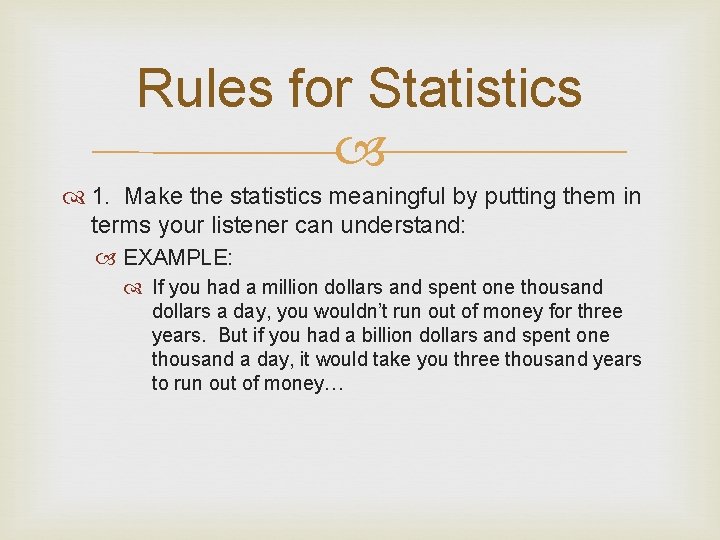
Rules for Statistics 1. Make the statistics meaningful by putting them in terms your listener can understand: EXAMPLE: If you had a million dollars and spent one thousand dollars a day, you wouldn’t run out of money for three years. But if you had a billion dollars and spent one thousand a day, it would take you three thousand years to run out of money…
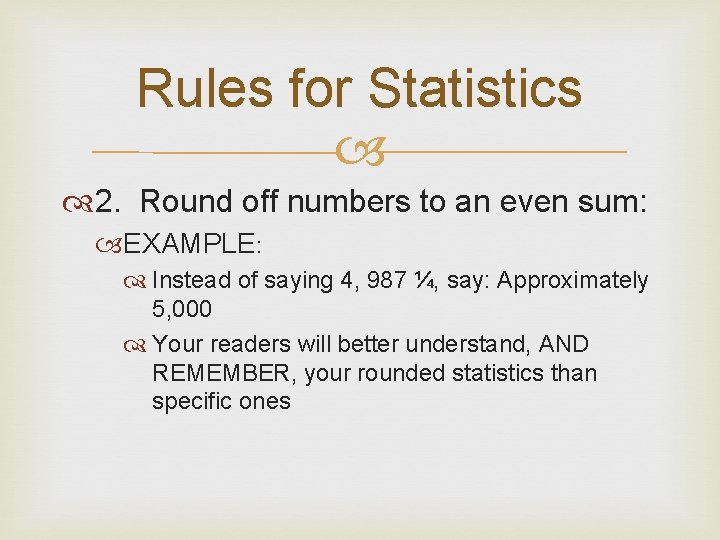
Rules for Statistics 2. Round off numbers to an even sum: EXAMPLE: Instead of saying 4, 987 ¼, say: Approximately 5, 000 Your readers will better understand, AND REMEMBER, your rounded statistics than specific ones
Rules for Statistics 3. Use statistics SPARINGLY!! Too many numbers either confuse, or bore, the reader!!
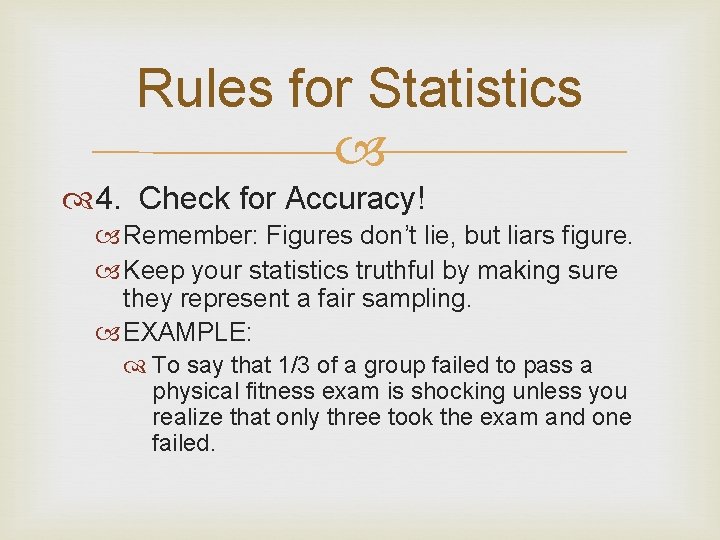
Rules for Statistics 4. Check for Accuracy! Remember: Figures don’t lie, but liars figure. Keep your statistics truthful by making sure they represent a fair sampling. EXAMPLE: To say that 1/3 of a group failed to pass a physical fitness exam is shocking unless you realize that only three took the exam and one failed.
Rules for Statistics Check for recency!! What was true ten years ago may not be correct today! Use current figures and recent copyright dates In a persuasive speech, your sources should always be within the last 2 - 5 years!!!
Works Cited Tanner, Fran. Creative Communication – 5 th Edition. Logan, IA: Perfection Learning Corporation, 2003. Print.