
Persuasion Using Rhetorical Devices Types of Speeches Political
- Slides: 14
Persuasion Using Rhetorical Devices
Types of Speeches • Political speeches: – Focuses on an issue relating to government or politics • Address: – A formal speech that is prepared for a special occasion • Sermon: – A speech that is usually based on a scriptural text and intended to provide religious instruction.
Persuasive Techniques • Persuasion: – Speech or writing that tries to get the audience to think or act a certain way. • Persuasive Techniques: – The methods that a speaker or a writer uses to sway an audience.
Types of Persuasive Techniques • Logical appeal (logos): – Builds a well-reasoned argument based on evidence such as facts, statistics, or expert testimony.
• Ethical Appeal (ethos) – Arguments are based on morals and values of a culture that ask the audience to do what is “right” according to what the culture deems correct – This appeal is linked to the audience’s perception of the trustworthiness and moral character of the speaker or writer.
• Emotional Appeal (pathos) • Attempts to arouse the audience’s feelings, often by using loaded words that convey strong connotations • The argument strives to appeal to the audience’s sense of fear, pity, needs, desires and sympathies.
How Persuasive Techniques are used: • Rhetorical Devices: – Patterns of words and ideas that create emphasis and stir the audience’s emotions.
Types of Rhetorical Devices • Repetition: –Restating an idea using the same words • Example: “The war is inevitable—and let it come! I repeat it, sir, let it come!” ~Patrick Henry
• Restatement: –Expressing the same idea using different words. • Example: “…we cannot dedicate—we cannot consecrate—we cannot hallow—this ground. ” ~Abraham Lincoln
• Parallelism: –Repeating a grammatical structure • Example: “With malice toward none; with charity for all…” ~Abraham Lincoln
• Antithesis: –Using strongly contrasting words, images, or ideas • Example: “…ask not what your country can do for you—ask what you can do for your country. ” ~John F. Kennedy
• Rhetorical Questions: –Asking questions for effect, not to get answers • Example: “From such an assembly can a perfect production be expected? ” ~Benjamin Franklin
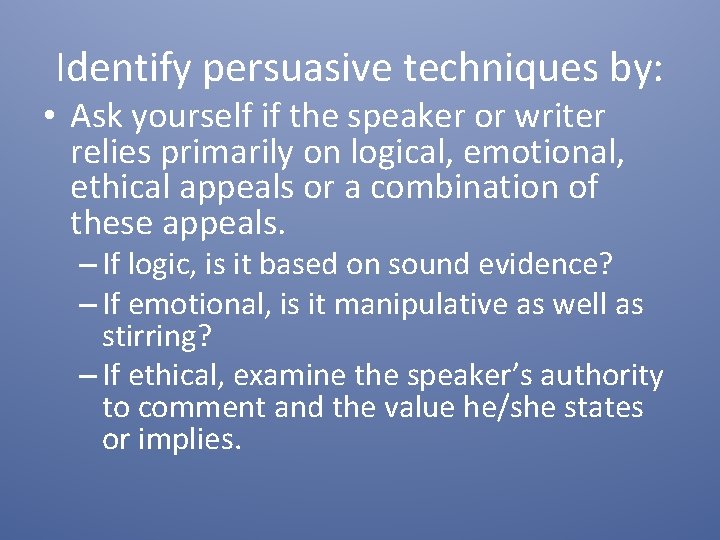
Identify persuasive techniques by: • Ask yourself if the speaker or writer relies primarily on logical, emotional, ethical appeals or a combination of these appeals. – If logic, is it based on sound evidence? – If emotional, is it manipulative as well as stirring? – If ethical, examine the speaker’s authority to comment and the value he/she states or implies.
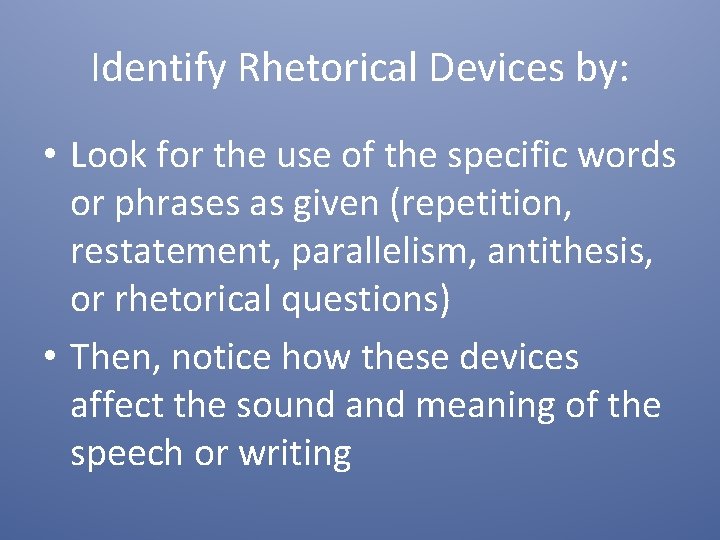
Identify Rhetorical Devices by: • Look for the use of the specific words or phrases as given (repetition, restatement, parallelism, antithesis, or rhetorical questions) • Then, notice how these devices affect the sound and meaning of the speech or writing