
PERSPECTIVES ON THE CAP THEOREM Seth Gilbert National

PERSPECTIVES ON THE CAP THEOREM Seth Gilbert, National U of Singapore Nancy A. Lynch, MIT
Paper highlights n The CAP theorem as a negative result ¨ Cannot have Consistency + Availability + Partition Tolerance n Tradeoffs between safety and liveness in unreliable systems ¨ Asynchronous systems ¨ Synchronous systems ¨ Asynchronous systems with failure detectors n Some practical compromises
Redefining the terms n Consistency ¨ Distributed system operates as if it was fully centralized ¨ One single view of the state of the system n Availability ¨ System remains able to process requests in the presence of partial failures n Partition tolerance ¨ System remains able to process requests in the presence of communication failures
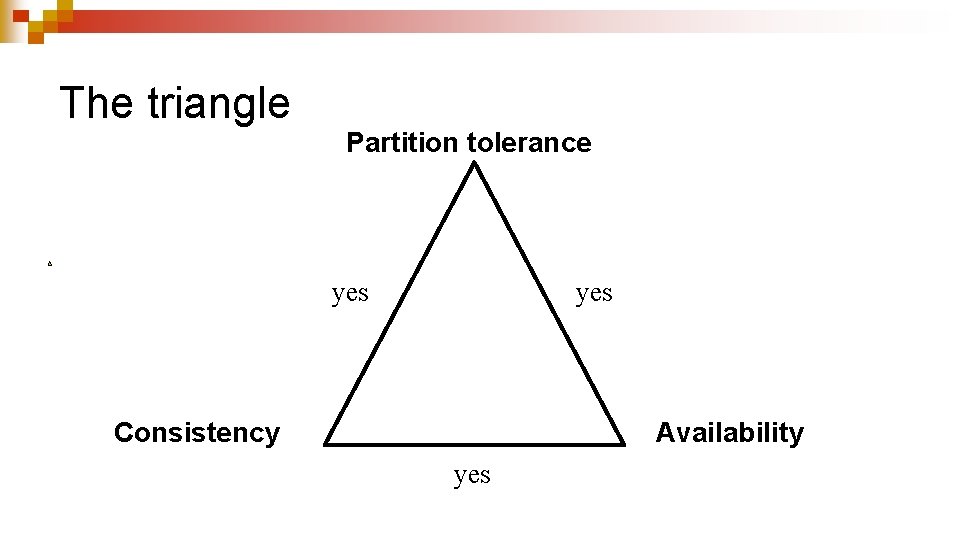
The CAP theorem n A distributed service cannot provide ¨ Consistency ¨ Availability ¨ Partition tolerance at the same time
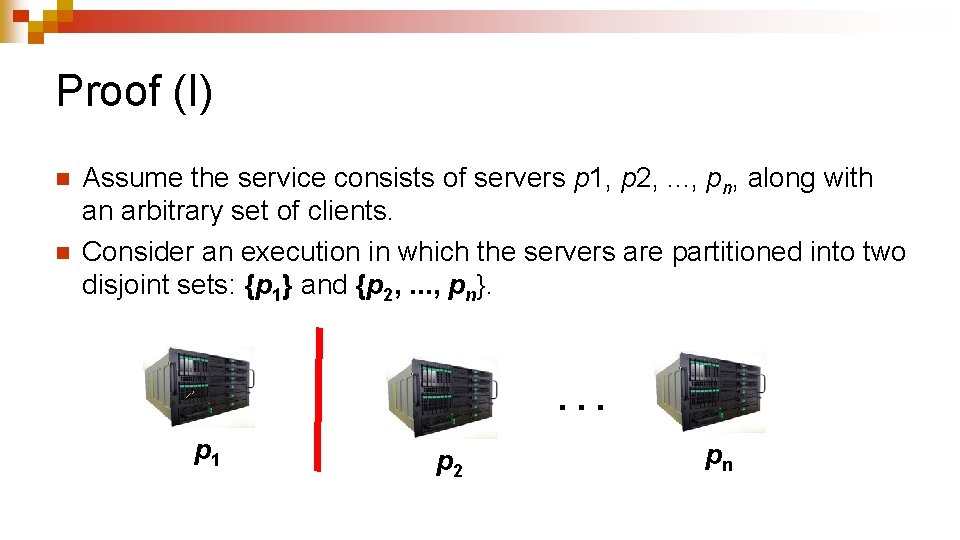
Proof (I) n n Assume the service consists of servers p 1, p 2, . . . , pn, along with an arbitrary set of clients. Consider an execution in which the servers are partitioned into two disjoint sets: {p 1} and {p 2, . . . , pn}. … p 1 p 2 pn
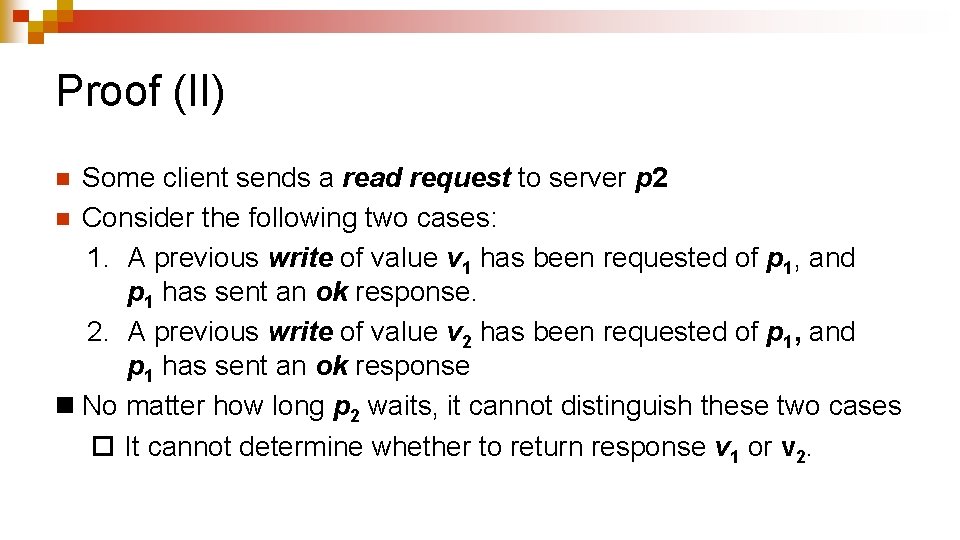
Proof (II) Some client sends a read request to server p 2 n Consider the following two cases: 1. A previous write of value v 1 has been requested of p 1, and p 1 has sent an ok response. 2. A previous write of value v 2 has been requested of p 1, and p 1 has sent an ok response n No matter how long p 2 waits, it cannot distinguish these two cases ¨ It cannot determine whether to return response v 1 or v 2. n
The triangle Partition tolerance yes Consistency Availability yes
An example n Taking reservations for a concert ¨ Distributed system ¨ Clients send to local server a reservation request ¨ Server returns the reserved seat(s).
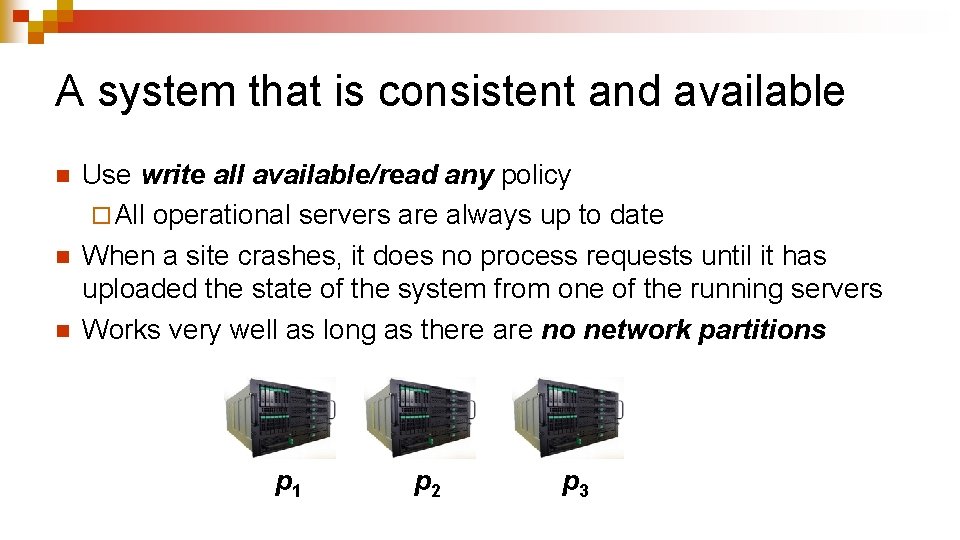
A system that is consistent and available n n n Use write all available/read any policy ¨ All operational servers are always up to date When a site crashes, it does no process requests until it has uploaded the state of the system from one of the running servers Works very well as long as there are no network partitions p 1 p 2 p 3
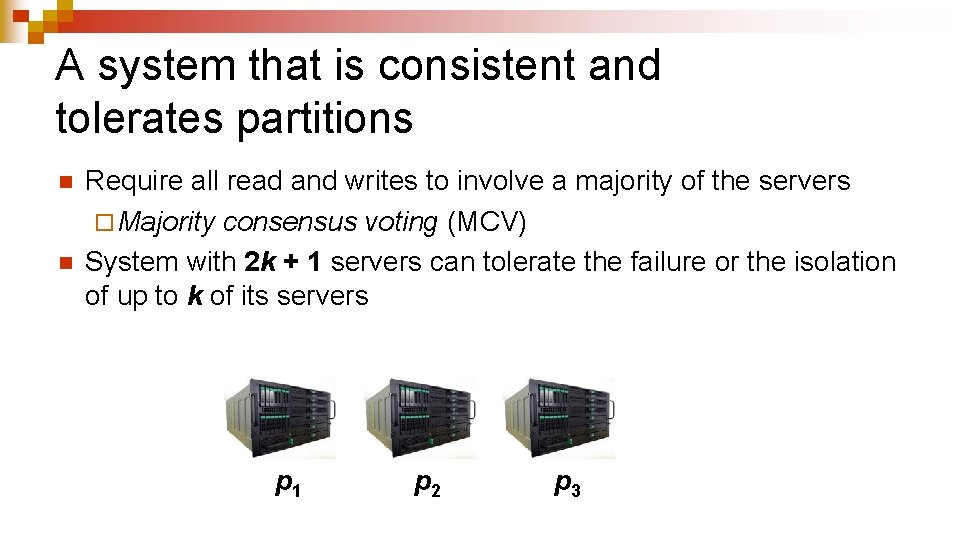
A system that is consistent and tolerates partitions n n Require all read and writes to involve a majority of the servers ¨ Majority consensus voting (MCV) System with 2 k + 1 servers can tolerate the failure or the isolation of up to k of its servers p 1 p 2 p 3
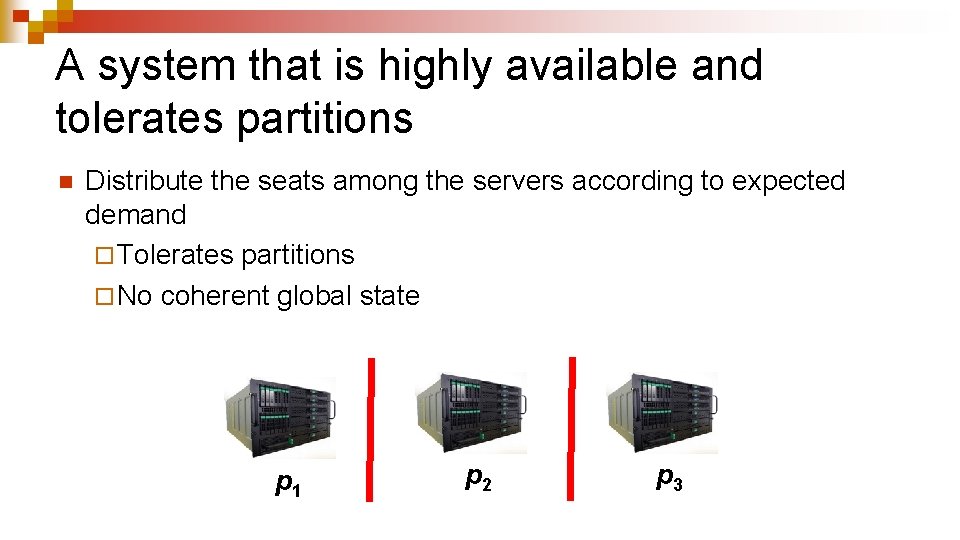
A system that is highly available and tolerates partitions n Distribute the seats among the servers according to expected demand ¨ Tolerates partitions ¨ No coherent global state p 1 p 2 p 3
Comments n The theorem states that we have to choose between consistency and availability ¨ But only in the presence of network partitions. ¨ Otherwise we can have both.
Generalization n A safety property ¨ Must always hold ¨ Such as consistency n A liveness property ¨ Means that the system will make progress n CAP theorem states we cannot guarantee both safety and liveness in the presence of network partitions.
Asynchronous systems (I) n Two main characteristics ¨ Non-blocking sends and receive ¨ Unbounded message transmission times n Define consensus as ¨ Agreement among all processes on a single output value ¨ Validity: That value must have proposed by some process ¨ Termination: That value will eventually be output by all processes
Asynchronous systems (II) n Fischer, Lynch and Paterson (1985) ¨ No consensus protocol is totally correct in spite of one fault. n There will always be circumstances under which the protocol remains forever indecisive.
Synchronous systems (I) n Three conditions ¨ Every process has a clock and all clocks are synchronized ¨ Every message is delivered within a fixed and known amount of time ¨ Every process takes steps at a fixed and known rate n Can assume that all communications proceed in rounds ¨ In each round a process may send all the messages it requires while receiving all messages that were sent to it in that round
Synchronous systems (II) n Lamport and Fischer (1984); Lynch (1996) ¨ Consensus requires f + 1 rounds, if up to f servers can crash. n Dwork, Lynch and Stockmeyer (1988) ¨ Eventual synchrony n System can experience periods of asynchrony but will eventually maintain synchrony long enough to achieve consensus ¨ Consensus requires f + 2 rounds of synchrony
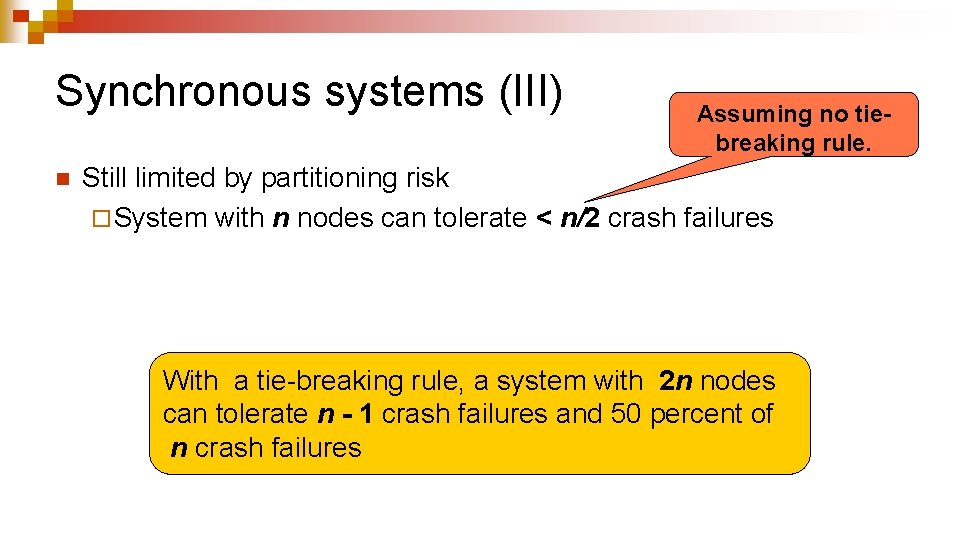
Synchronous systems (III) n Assuming no tiebreaking rule. Still limited by partitioning risk ¨ System with n nodes can tolerate < n/2 crash failures With a tie-breaking rule, a system with 2 n nodes can tolerate n - 1 crash failures and 50 percent of n crash failures
Failure detectors n Chandra et al. (1996) n Detect node failure and crashes ¨ Hello protocol, exchanging heartbeats n Allow consensus in asynchronous failure-prone systems ¨ Raft
Set agreement n Can have up to k distinct correct outputs ¨ k-set agreement n Not covered
Practical implications
Best effort availability n Put consistency ahead of availability n Chubby ¨ Distributed database with primary + backup design ¨ Based on Lamport’s Paxos protocol ¨ Provides strong consistency among the servers using a replicated state machine protocol ¨ Can operate as long as half the servers remain available and the network is reliable
Best effort consistency n Sacrifice consistency to maintain availability n Akamai ¨ System of distributed web caches n Store images and videos contained in web pages n Cache updates are not instantaneous n Service does its best to provide up-to-date contents ¨Does not guarantee all users will always get the same version of the cached data
Balancing consistency and availability n n n Put limits on how out-of-date some data may be Can make the constraint tunable TACT ¨ Yu and Vadat (2006) ¨ Airline reservation system n Can rely on slightly out-of-date data as long as there are enough empty seats n Not so true otherwise
Segmenting consistency and availability (I) n Data partitioning ¨ Some data must be kept more consistent than others ¨ In an online shopping service n User can tolerate slightly inconsistent inventory data n Not true for checkout, billing and shipping records!
Segmenting consistency and availability (II) n Operational partitioning ¨ Maintain read access while preventing updates during a network partition n Write all/read any policy
Segmenting consistency and availability (III) n Functional partitioning ¨ Have different requirements for different subservices ¨ Chubby n Strong consistency for coarse-grained locks n Weaker consistency for DNS requests
Segmenting consistency and availability (IV) n User partitioning ¨ Not covered n Hierarchical partitioning ¨ Not covered
- Slides: 28