
Perspectives on System Identification Lennart Ljung Linkping University




- Slides: 33
Perspectives on System Identification Lennart Ljung Linköping University, Sweden
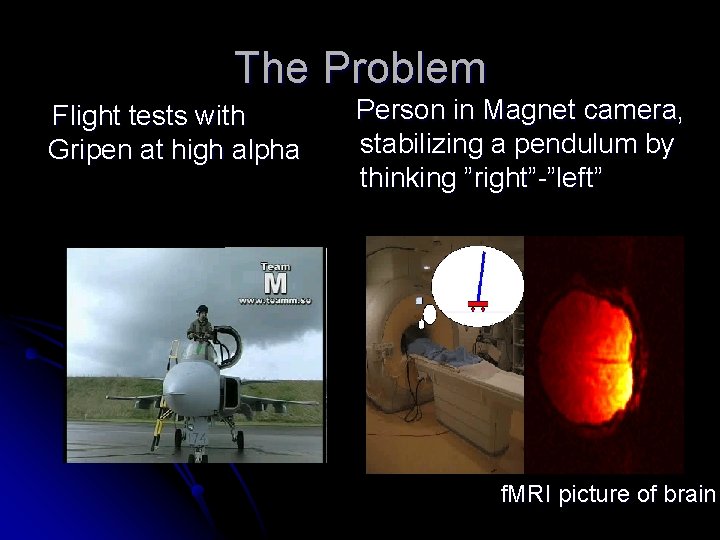
The Problem Flight tests with Gripen at high alpha Person in Magnet camera, stabilizing a pendulum by thinking ”right”-”left” f. MRI picture of brain
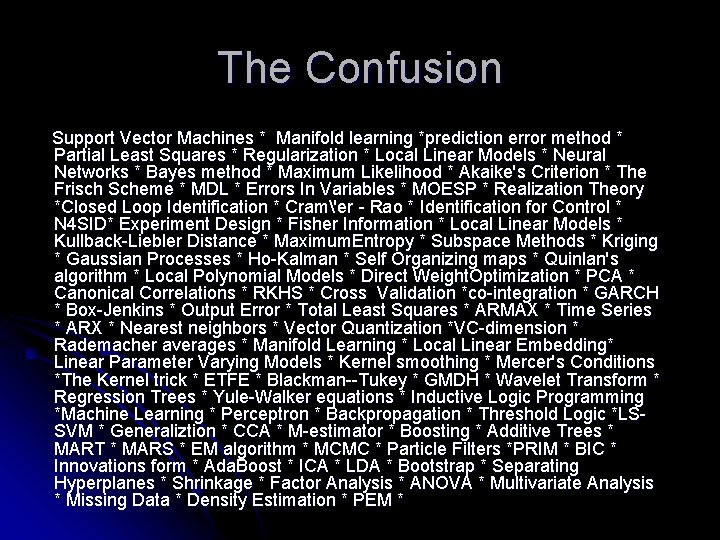
The Confusion Support Vector Machines * Manifold learning *prediction error method * Partial Least Squares * Regularization * Local Linear Models * Neural Networks * Bayes method * Maximum Likelihood * Akaike's Criterion * The Frisch Scheme * MDL * Errors In Variables * MOESP * Realization Theory *Closed Loop Identification * Cram'er - Rao * Identification for Control * N 4 SID* Experiment Design * Fisher Information * Local Linear Models * Kullback-Liebler Distance * Maximum. Entropy * Subspace Methods * Kriging * Gaussian Processes * Ho-Kalman * Self Organizing maps * Quinlan's algorithm * Local Polynomial Models * Direct Weight. Optimization * PCA * Canonical Correlations * RKHS * Cross Validation *co-integration * GARCH * Box-Jenkins * Output Error * Total Least Squares * ARMAX * Time Series * ARX * Nearest neighbors * Vector Quantization *VC-dimension * Rademacher averages * Manifold Learning * Local Linear Embedding* Linear Parameter Varying Models * Kernel smoothing * Mercer's Conditions *The Kernel trick * ETFE * Blackman--Tukey * GMDH * Wavelet Transform * Regression Trees * Yule-Walker equations * Inductive Logic Programming *Machine Learning * Perceptron * Backpropagation * Threshold Logic *LSSVM * Generaliztion * CCA * M-estimator * Boosting * Additive Trees * MART * MARS * EM algorithm * MCMC * Particle Filters *PRIM * BIC * Innovations form * Ada. Boost * ICA * LDA * Bootstrap * Separating Hyperplanes * Shrinkage * Factor Analysis * ANOVA * Multivariate Analysis * Missing Data * Density Estimation * PEM *
This Talk Two objectives: • Place System Identification on the global map. Who are our neighbours in this part of the universe? • Discuss some open areas in System Identfication.
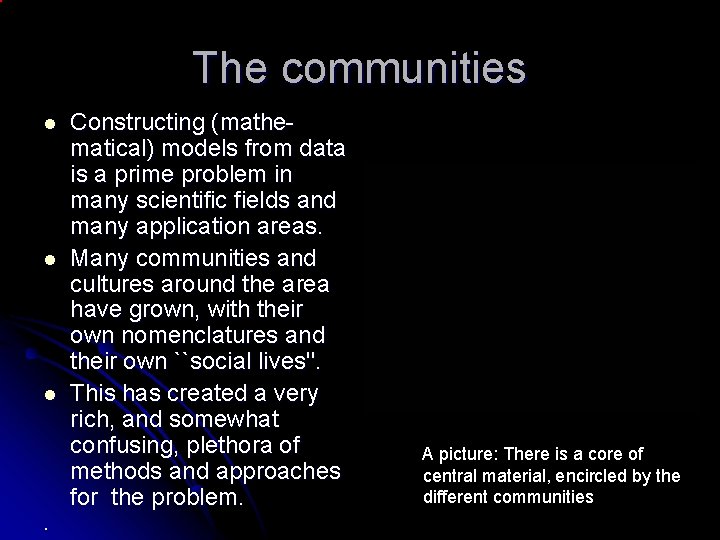
The communities l l l . Constructing (mathematical) models from data is a prime problem in many scientific fields and many application areas. Many communities and cultures around the area have grown, with their own nomenclatures and their own ``social lives''. This has created a very rich, and somewhat confusing, plethora of methods and approaches for the problem. A picture: There is a core of central material, encircled by the different communities
The core
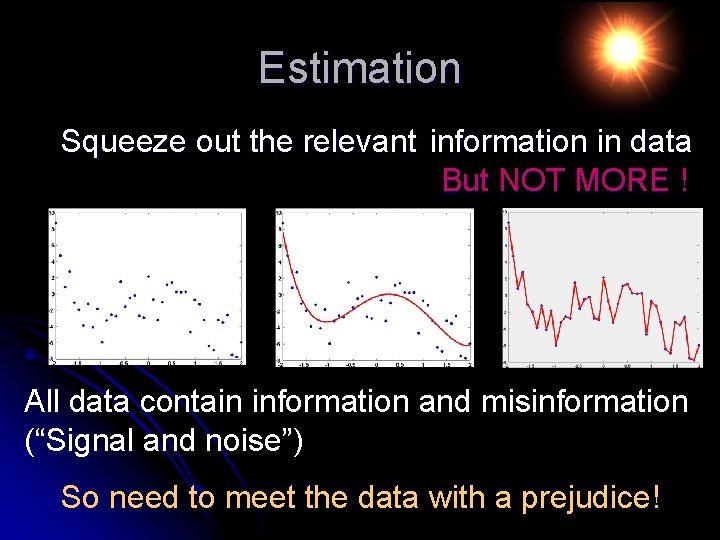
Estimation Squeeze out the relevant information in data But NOT MORE ! All data contain information and misinformation (“Signal and noise”) So need to meet the data with a prejudice!
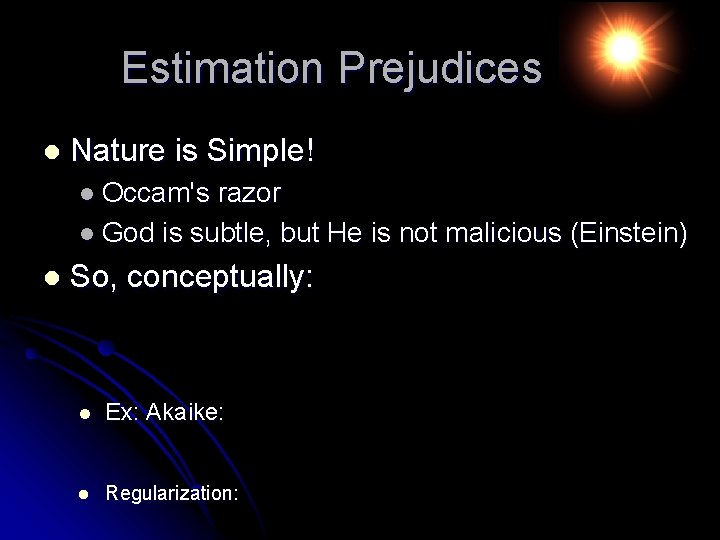
Estimation Prejudices l Nature is Simple! l Occam's razor l God is subtle, but He is not malicious (Einstein) l So, conceptually: l Ex: Akaike: l Regularization:
Estimation and Validation So don't be impressed by a good fit to data in a flexible model set!
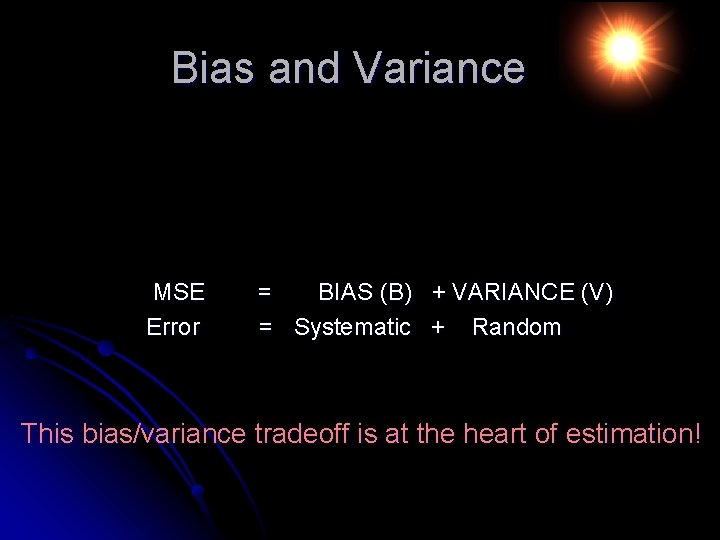
Bias and Variance MSE Error = BIAS (B) + VARIANCE (V) = Systematic + Random This bias/variance tradeoff is at the heart of estimation!
Information Contents in Data and the CR Inequality
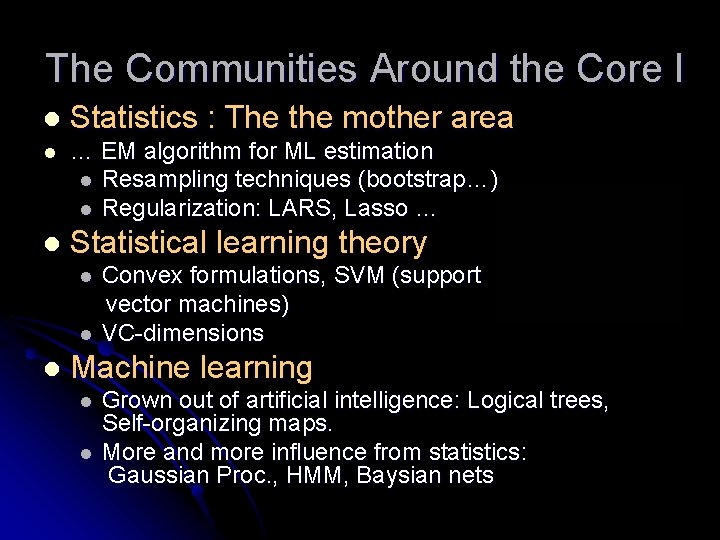
The Communities Around the Core I l Statistics : The the mother area l … EM algorithm for ML estimation l Resampling techniques (bootstrap…) l Regularization: LARS, Lasso … l Statistical learning theory l l l Convex formulations, SVM (support vector machines) VC-dimensions Machine learning l l Grown out of artificial intelligence: Logical trees, Self-organizing maps. More and more influence from statistics: Gaussian Proc. , HMM, Baysian nets
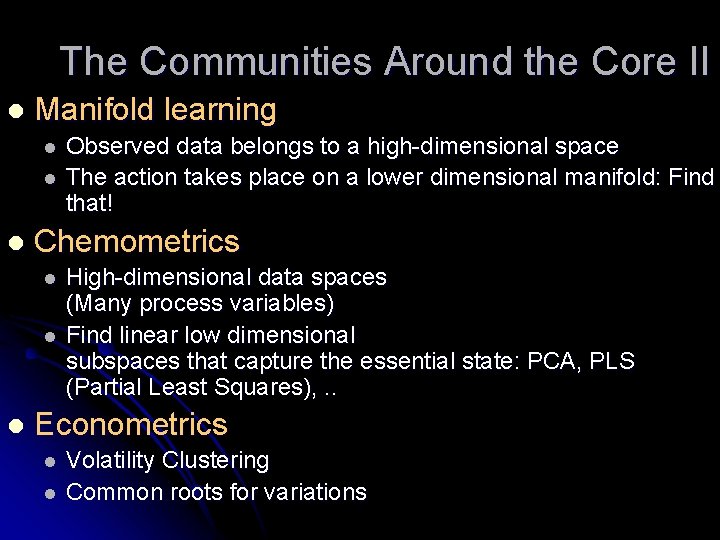
The Communities Around the Core II l Manifold learning l l l Chemometrics l l l Observed data belongs to a high-dimensional space The action takes place on a lower dimensional manifold: Find that! High-dimensional data spaces (Many process variables) Find linear low dimensional subspaces that capture the essential state: PCA, PLS (Partial Least Squares), . . Econometrics l l Volatility Clustering Common roots for variations
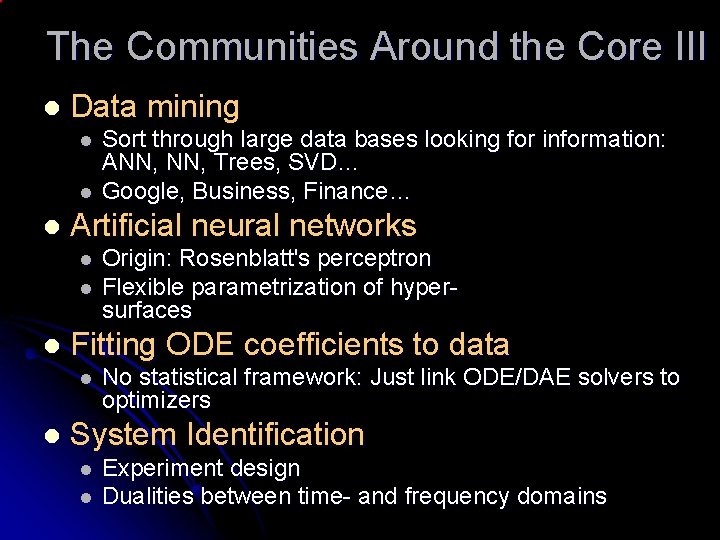
The Communities Around the Core III l Data mining l l l Artificial neural networks l l l Origin: Rosenblatt's perceptron Flexible parametrization of hypersurfaces Fitting ODE coefficients to data l l Sort through large data bases looking for information: ANN, Trees, SVD… Google, Business, Finance… No statistical framework: Just link ODE/DAE solvers to optimizers System Identification l l Experiment design Dualities between time- and frequency domains
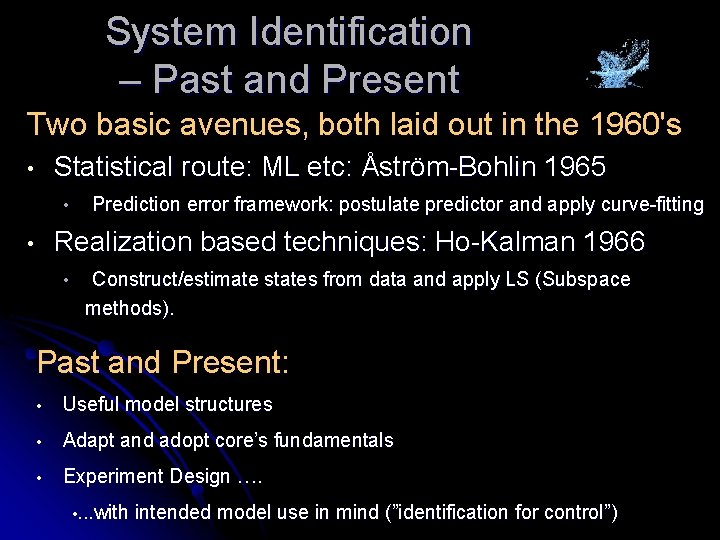
System Identification – Past and Present Two basic avenues, both laid out in the 1960's Statistical route: ML etc: Åström-Bohlin 1965 • • Prediction error framework: postulate predictor and apply curve-fitting Realization based techniques: Ho-Kalman 1966 • • Construct/estimate states from data and apply LS (Subspace methods). Past and Present: • Useful model structures • Adapt and adopt core’s fundamentals • Experiment Design …. • . . . with intended model use in mind (”identification for control”)
System Identification - Future: Open Areas l Spend more time with our neighbours! l Report from a visit later on Model reduction and system identification l Issues in identification of nonlinear systems l Meet demands from industry l Convexification l l Formulate the estimation task as a convex optimization problem
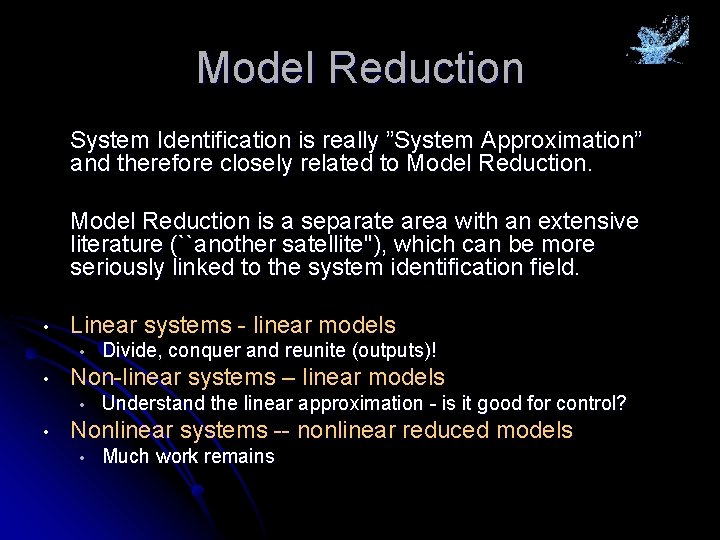
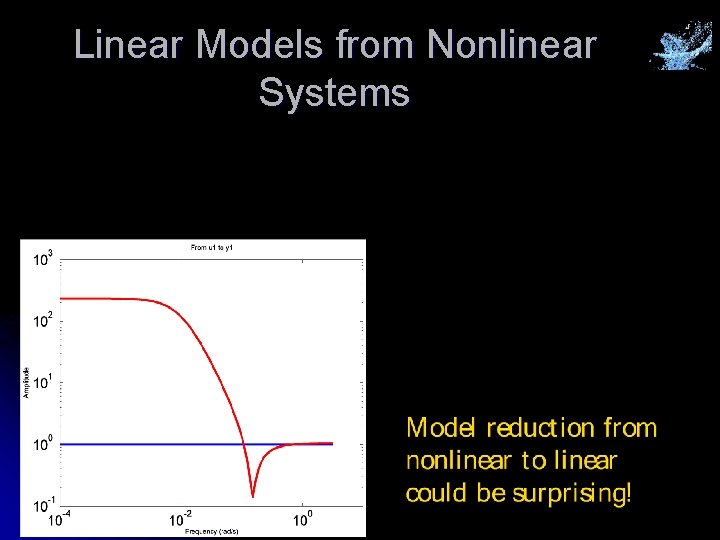
Model Reduction System Identification is really ”System Approximation” and therefore closely related to Model Reduction is a separate area with an extensive literature (``another satellite''), which can be more seriously linked to the system identification field. • Linear systems - linear models • • Non-linear systems – linear models • • Divide, conquer and reunite (outputs)! Understand the linear approximation - is it good for control? Nonlinear systems -- nonlinear reduced models • Much work remains
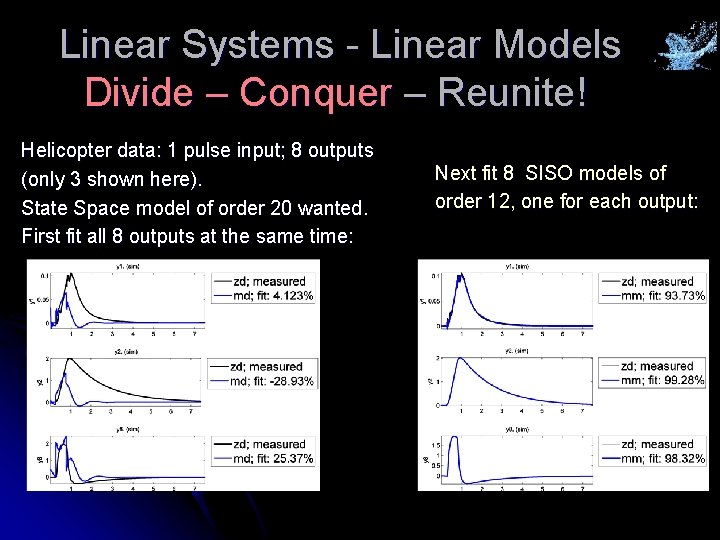
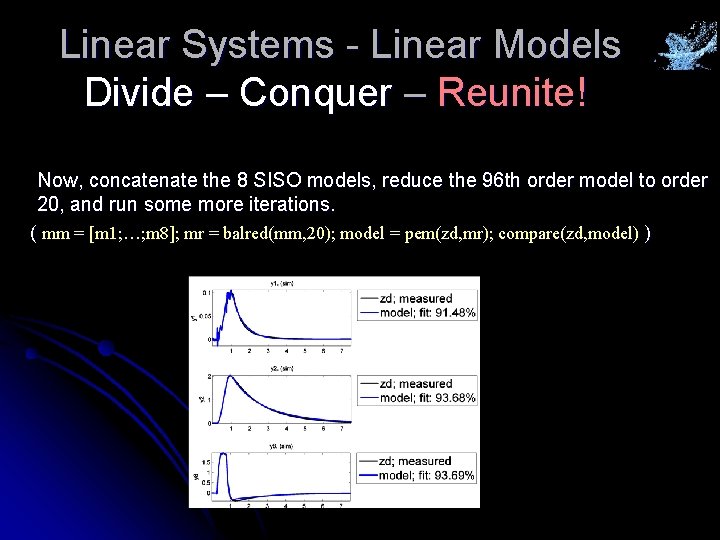
Linear Systems - Linear Models Divide – Conquer – Reunite! Helicopter data: 1 pulse input; 8 outputs (only 3 shown here). State Space model of order 20 wanted. First fit all 8 outputs at the same time: Next fit 8 SISO models of order 12, one for each output:
Linear Systems - Linear Models Divide – Conquer – Reunite! Now, concatenate the 8 SISO models, reduce the 96 th order model to order 20, and run some more iterations. ( mm = [m 1; …; m 8]; mr = balred(mm, 20); model = pem(zd, mr); compare(zd, model) )
Linear Models from Nonlinear Systems
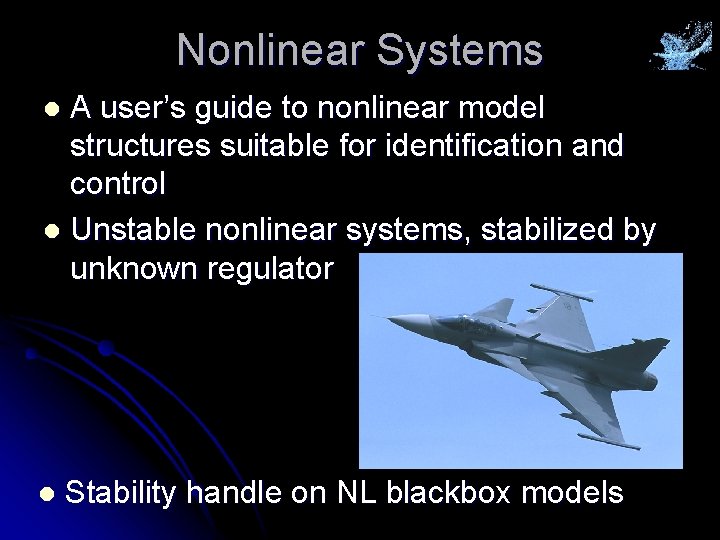
Nonlinear Systems A user’s guide to nonlinear model structures suitable for identification and control l Unstable nonlinear systems, stabilized by unknown regulator l l Stability handle on NL blackbox models
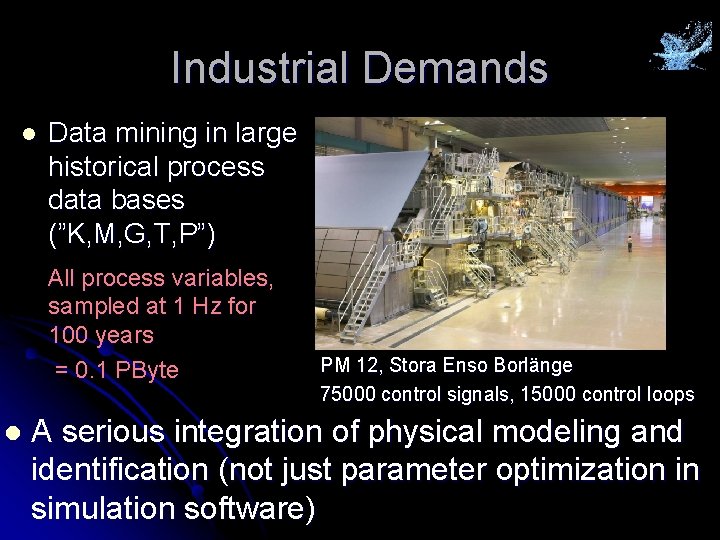
Industrial Demands l Data mining in large historical process data bases (”K, M, G, T, P”) All process variables, sampled at 1 Hz for 100 years = 0. 1 PByte l PM 12, Stora Enso Borlänge 75000 control signals, 15000 control loops A serious integration of physical modeling and identification (not just parameter optimization in simulation software)
Industrial Demands: Simple Models l l l Simple Models/Experiments for certain aspects of complex systems Use input that enhances the aspects, … … and also conceals irrelevant features l Steady state gain for arbitrary systems l l Nyquist curve at phase crossover l l Use constant input! Use relay feedback experiments But more can be done … l …Hjalmarsson et al: ”Cost of Complexity”.
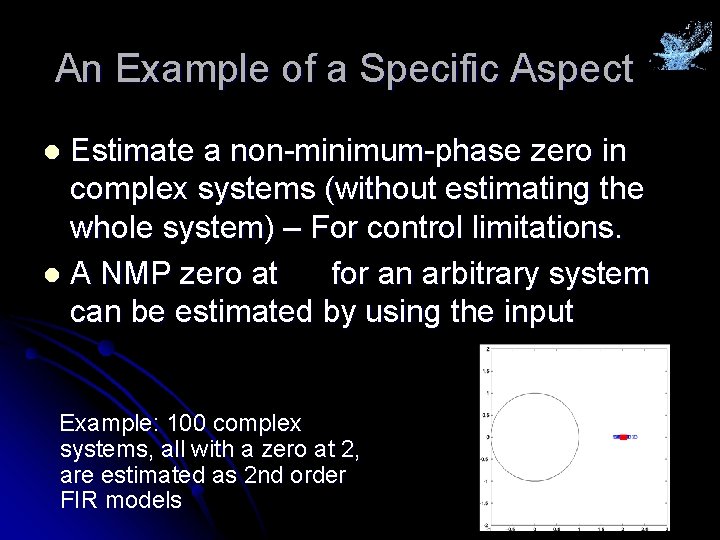
An Example of a Specific Aspect Estimate a non-minimum-phase zero in complex systems (without estimating the whole system) – For control limitations. l A NMP zero at for an arbitrary system can be estimated by using the input l Example: 100 complex systems, all with a zero at 2, are estimated as 2 nd order FIR models
System Identification - Future: Open Areas l Spend more time with our neighbours! l Report from a visit later on Model reduction and system identification l Issues in identification of nonlinear systems l Meet demands from industry l Convexification l l Formulate the estimation task as a convex optimization problem
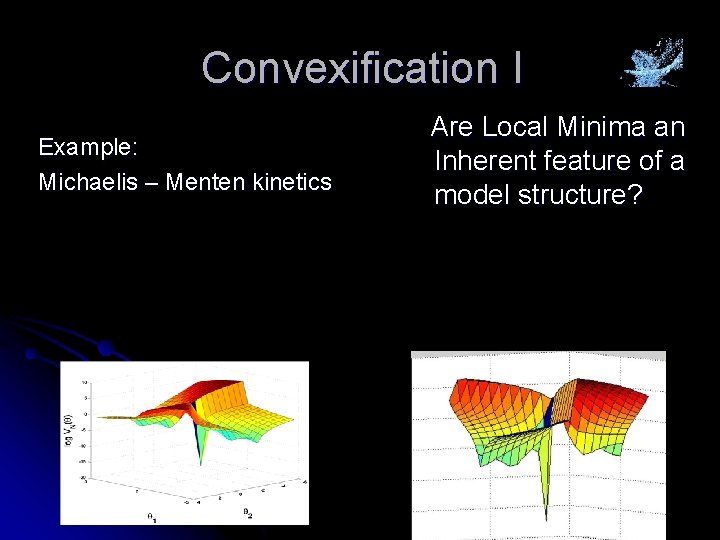
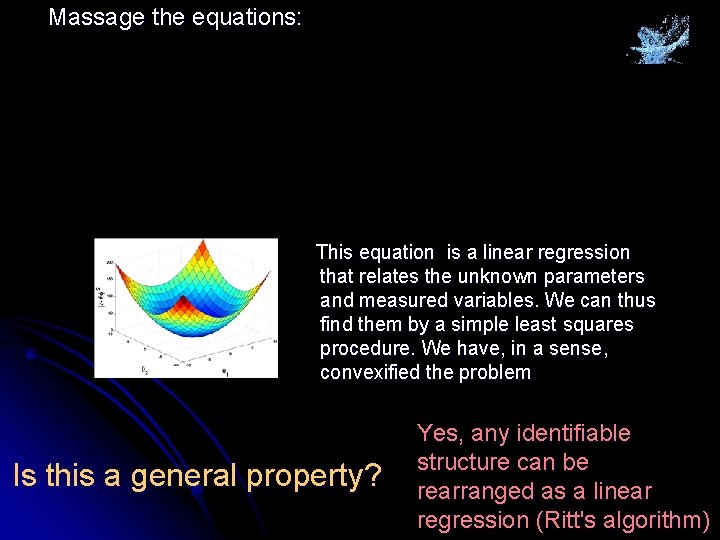
Convexification I Example: Michaelis – Menten kinetics Are Local Minima an Inherent feature of a model structure?
Massage the equations: This equation is a linear regression that relates the unknown parameters and measured variables. We can thus find them by a simple least squares procedure. We have, in a sense, convexified the problem Is this a general property? Yes, any identifiable structure can be rearranged as a linear regression (Ritt's algorithm)
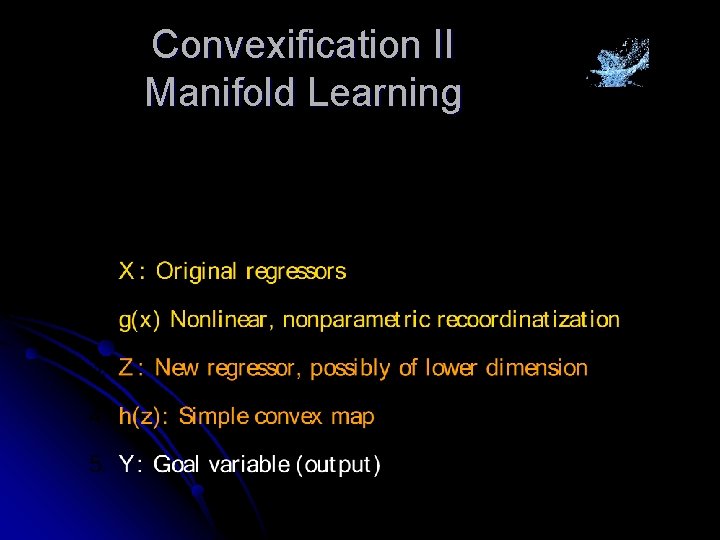
Convexification II Manifold Learning
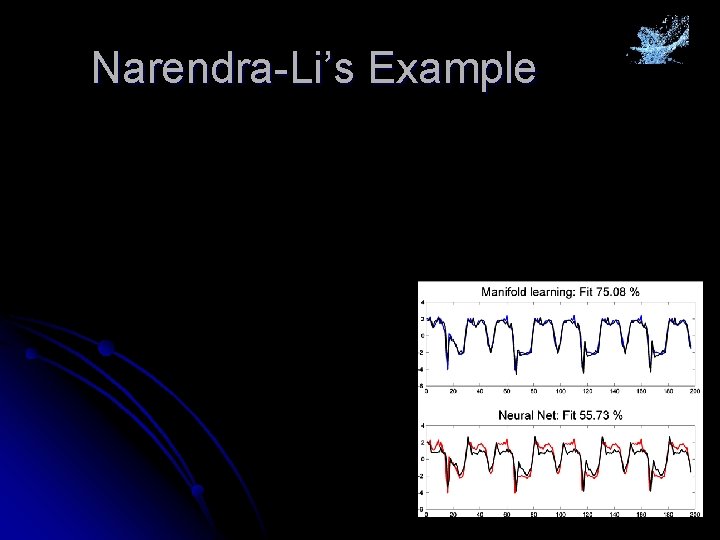
Narendra-Li’s Example
Conclusions l System identification is a mature subject. . . l same age as IFAC, with the longest running symposium series … and much progress has allowed important industrial applications … l … but it still has an exciting and bright future! l
Epilogue: The name of the game….
Thanks Research: Martin Enqvist, Torkel Glad, Håkan Hjalmarsson, Henrik Ohlsson, Jacob Roll Discussions: Bart de Moor, Johan Schoukens, Rik Pintelon, Paul van den Hof Comments on paper: Michel Gevers, Manfred Deistler, Martin Enqvist, Jacob Roll, Thomas Schön Comments on presentation: Martin Enqvist, Håkan Hjalmarsson, Kalle Johansson, Ulla Salaneck, Thomas Schön, Ann-Kristin Ljung Special effects: Effektfabriken AB, Sciss AB
Non. Linear Systems l Stability handle on NL blackbox models: