
Perspectives on NASA Mission Cost and Schedule Performance
- Slides: 31
Perspectives on NASA Mission Cost and Schedule Performance Trends Presentation at GSFC Symposium 3 June 2008 David Bearden Acknowledgments: Claude Freaner, Bob Bitten, Debra Emmons, Tom Coonce © 2008 The Aerospace Corporation 1
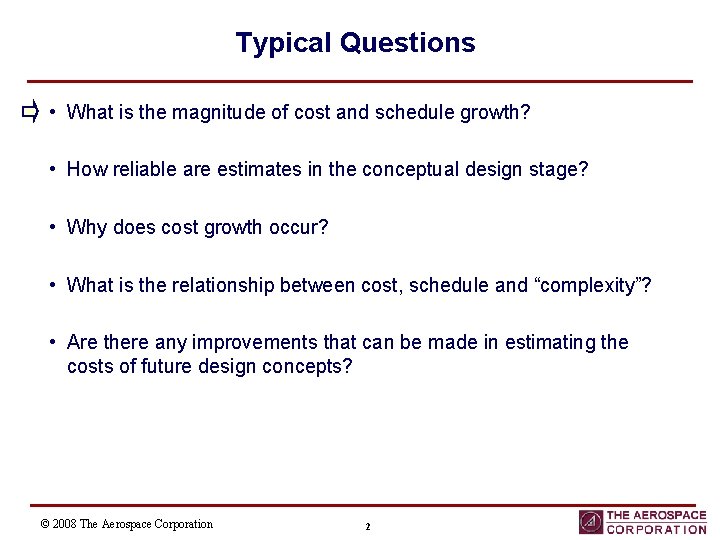
Typical Questions • What is the magnitude of cost and schedule growth? • How reliable are estimates in the conceptual design stage? • Why does cost growth occur? • What is the relationship between cost, schedule and “complexity”? • Are there any improvements that can be made in estimating the costs of future design concepts? © 2008 The Aerospace Corporation 2
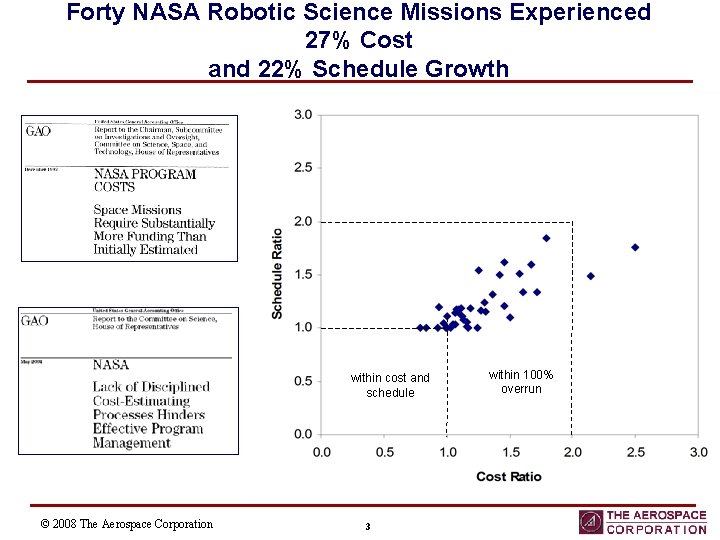
Forty NASA Robotic Science Missions Experienced 27% Cost and 22% Schedule Growth within cost and schedule © 2008 The Aerospace Corporation 3 within 100% overrun
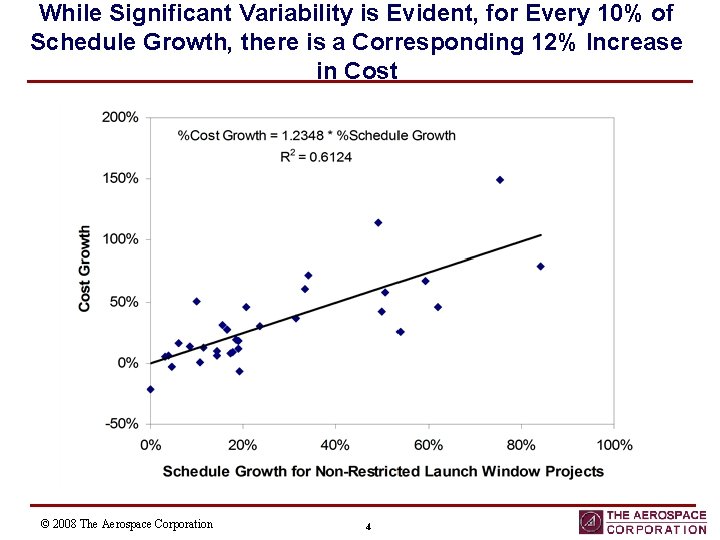
While Significant Variability is Evident, for Every 10% of Schedule Growth, there is a Corresponding 12% Increase in Cost © 2008 The Aerospace Corporation 4
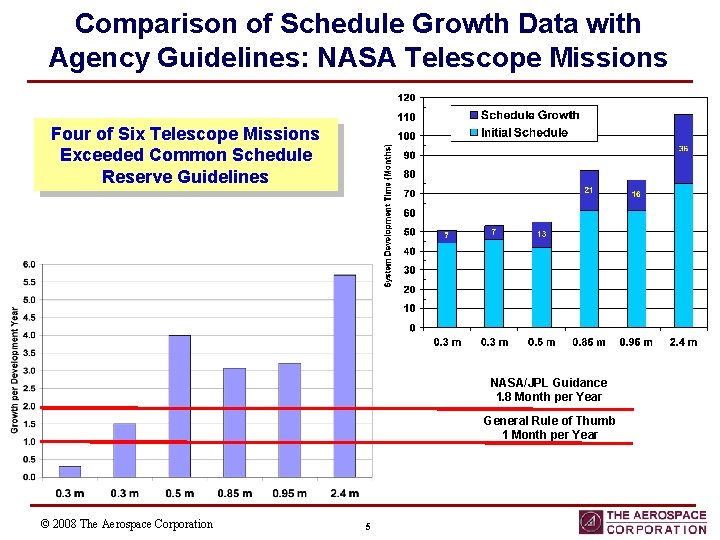
Comparison of Schedule Growth Data with Agency Guidelines: NASA Telescope Missions Four of Six Telescope Missions Exceeded Common Schedule Reserve Guidelines NASA/JPL Guidance 1. 8 Month per Year General Rule of Thumb 1 Month per Year © 2008 The Aerospace Corporation 5
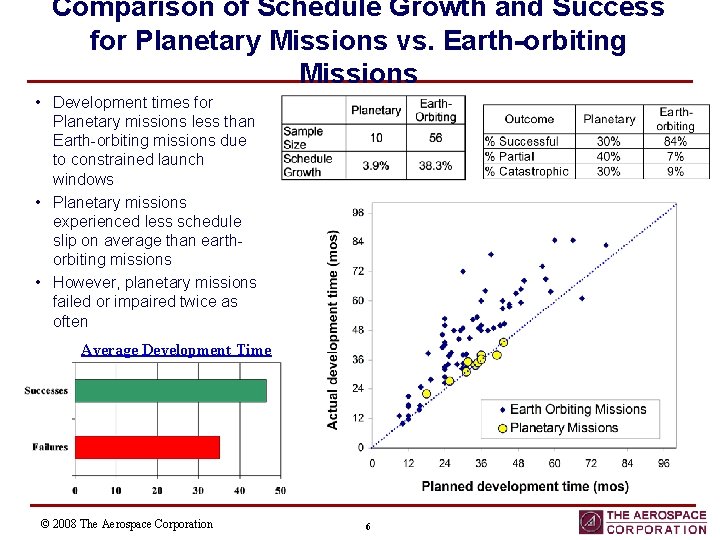
Comparison of Schedule Growth and Success for Planetary Missions vs. Earth-orbiting Missions • Development times for Planetary missions less than Earth-orbiting missions due to constrained launch windows • Planetary missions experienced less schedule slip on average than earthorbiting missions • However, planetary missions failed or impaired twice as often Average Development Time © 2008 The Aerospace Corporation 6
Typical Questions • What is the magnitude of cost and schedule growth? • How reliable are estimates in the conceptual design stage? • Why does cost growth occur? • What is the relationship between cost, schedule and “complexity”? • Are there any improvements that can be made in estimating the costs of future design concepts? © 2008 The Aerospace Corporation 7
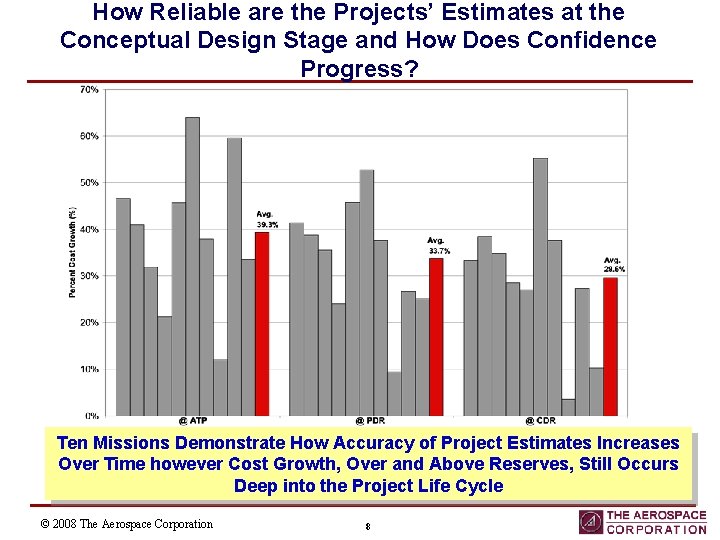
How Reliable are the Projects’ Estimates at the Conceptual Design Stage and How Does Confidence Progress? Ten Missions Demonstrate How Accuracy of Project Estimates Increases Over Time however Cost Growth, Over and Above Reserves, Still Occurs Deep into the Project Life Cycle © 2008 The Aerospace Corporation 8
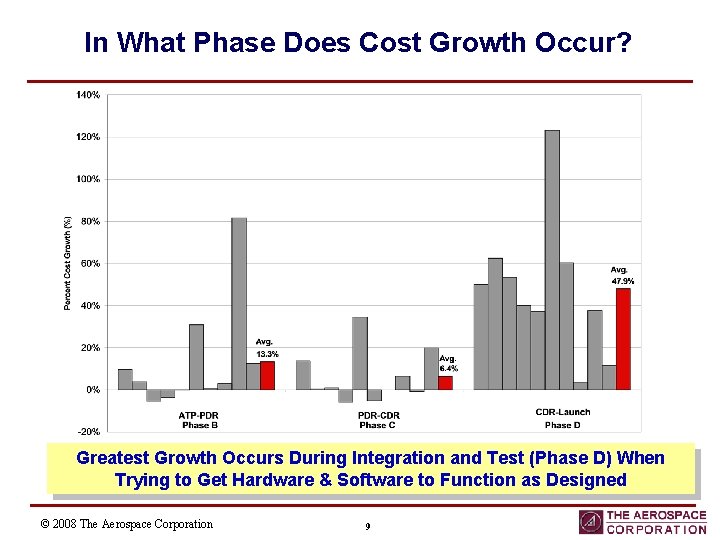
In What Phase Does Cost Growth Occur? Greatest Growth Occurs During Integration and Test (Phase D) When Trying to Get Hardware & Software to Function as Designed © 2008 The Aerospace Corporation 9
Typical Questions • What is the magnitude of cost and schedule growth? • How reliable are estimates in the conceptual design stage? • Why does cost growth occur? • What is the relationship between cost, schedule and “complexity”? • Are there any improvements that can be made in estimating the costs of future design concepts? © 2008 The Aerospace Corporation 10
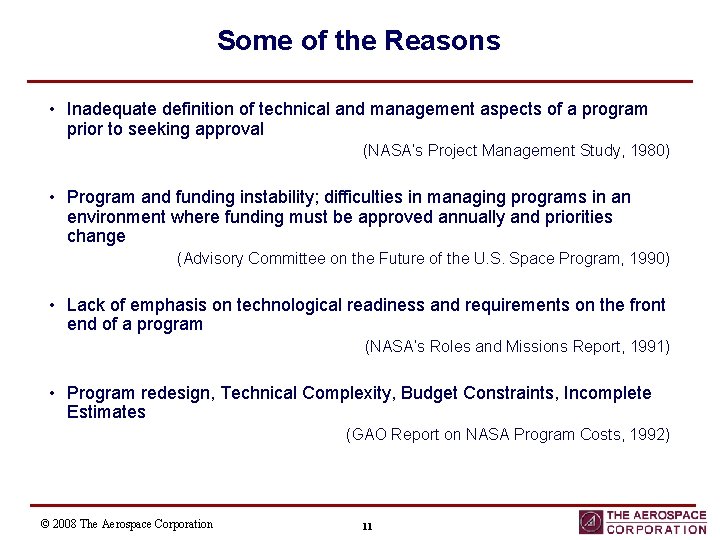
Some of the Reasons • Inadequate definition of technical and management aspects of a program prior to seeking approval (NASA’s Project Management Study, 1980) • Program and funding instability; difficulties in managing programs in an environment where funding must be approved annually and priorities change (Advisory Committee on the Future of the U. S. Space Program, 1990) • Lack of emphasis on technological readiness and requirements on the front end of a program (NASA’s Roles and Missions Report, 1991) • Program redesign, Technical Complexity, Budget Constraints, Incomplete Estimates (GAO Report on NASA Program Costs, 1992) © 2008 The Aerospace Corporation 11
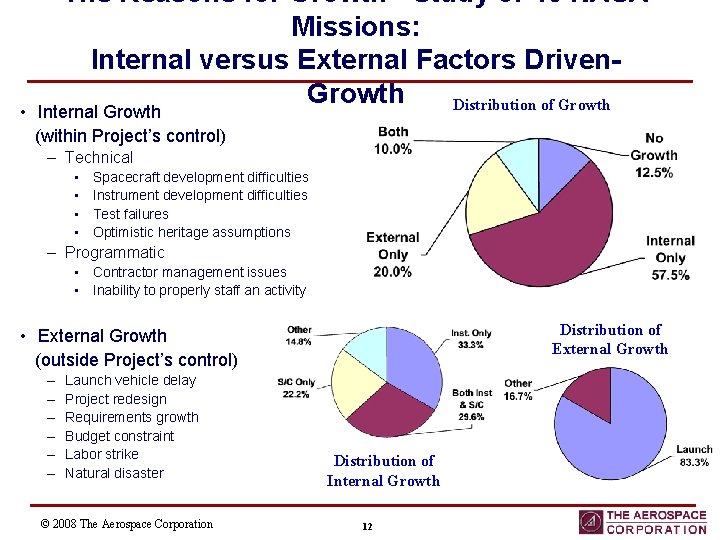
The Reasons for Growth - Study of 40 NASA Missions: Internal versus External Factors Driven. Growth Distribution of Growth • Internal Growth (within Project’s control) – Technical • • Spacecraft development difficulties Instrument development difficulties Test failures Optimistic heritage assumptions – Programmatic • Contractor management issues • Inability to properly staff an activity Distribution of External Growth • External Growth (outside Project’s control) – – – Launch vehicle delay Project redesign Requirements growth Budget constraint Labor strike Natural disaster © 2008 The Aerospace Corporation Distribution of Internal Growth 12
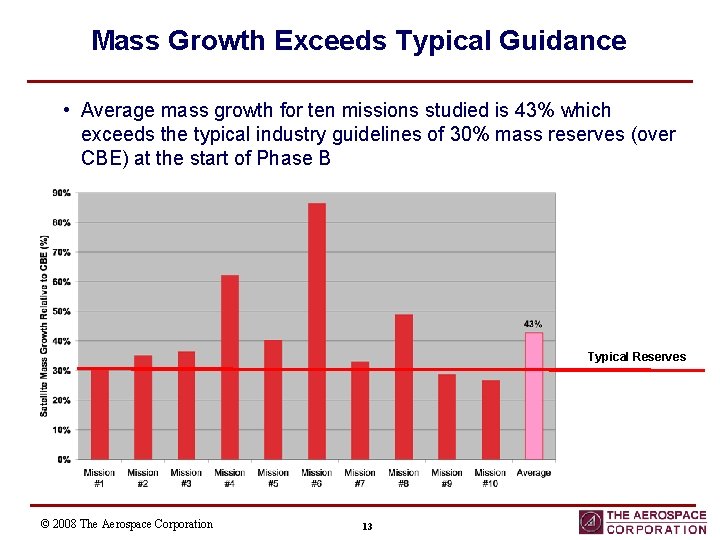
Mass Growth Exceeds Typical Guidance • Average mass growth for ten missions studied is 43% which exceeds the typical industry guidelines of 30% mass reserves (over CBE) at the start of Phase B Typical Reserves © 2008 The Aerospace Corporation 13
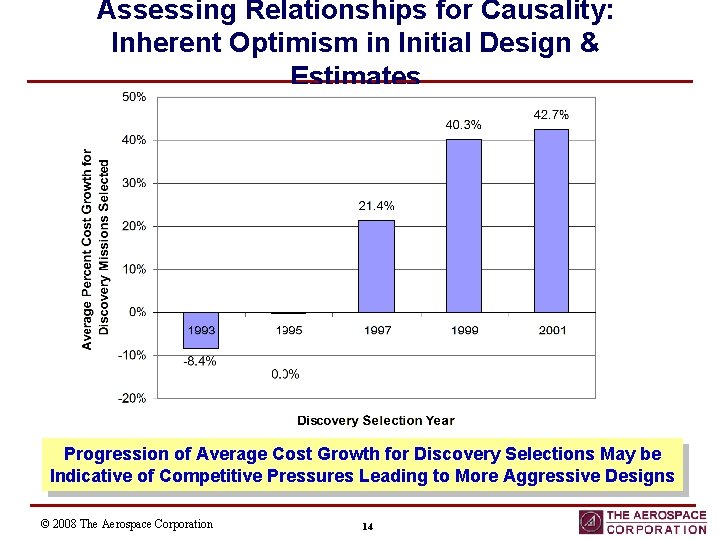
Assessing Relationships for Causality: Inherent Optimism in Initial Design & Estimates Progression of Average Cost Growth for Discovery Selections May be Indicative of Competitive Pressures Leading to More Aggressive Designs © 2008 The Aerospace Corporation 14
Typical Questions • What is the magnitude of cost and schedule growth? • How reliable are estimates in the conceptual design stage? • Why does cost growth occur? • What is the relationship between cost, schedule and “complexity”? • Are there any improvements that can be made in estimating the costs of future design concepts? © 2008 The Aerospace Corporation 15
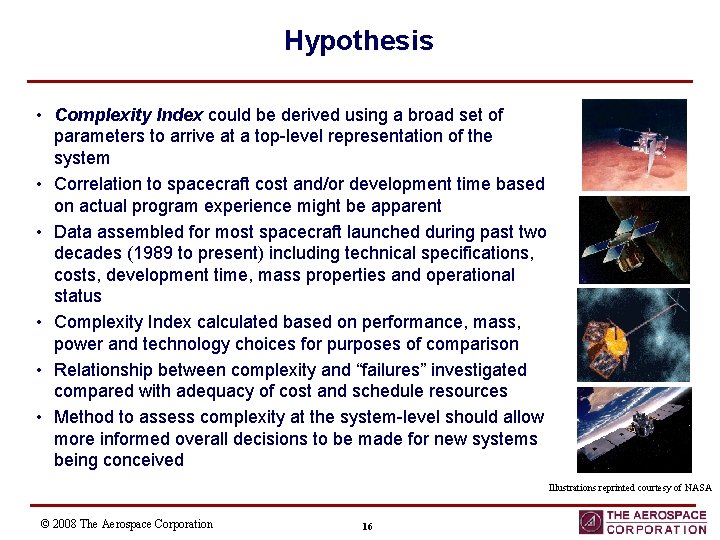
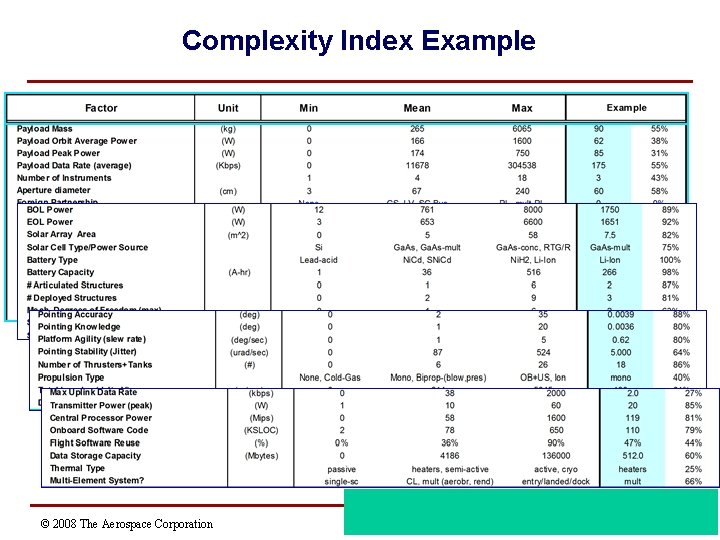
Hypothesis • Complexity Index could be derived using a broad set of parameters to arrive at a top-level representation of the system • Correlation to spacecraft cost and/or development time based on actual program experience might be apparent • Data assembled for most spacecraft launched during past two decades (1989 to present) including technical specifications, costs, development time, mass properties and operational status • Complexity Index calculated based on performance, mass, power and technology choices for purposes of comparison • Relationship between complexity and “failures” investigated compared with adequacy of cost and schedule resources • Method to assess complexity at the system-level should allow more informed overall decisions to be made for new systems being conceived Illustrations reprinted courtesy of NASA © 2008 The Aerospace Corporation 16
Complexity Index Example © 2008 The Aerospace Corporation 17
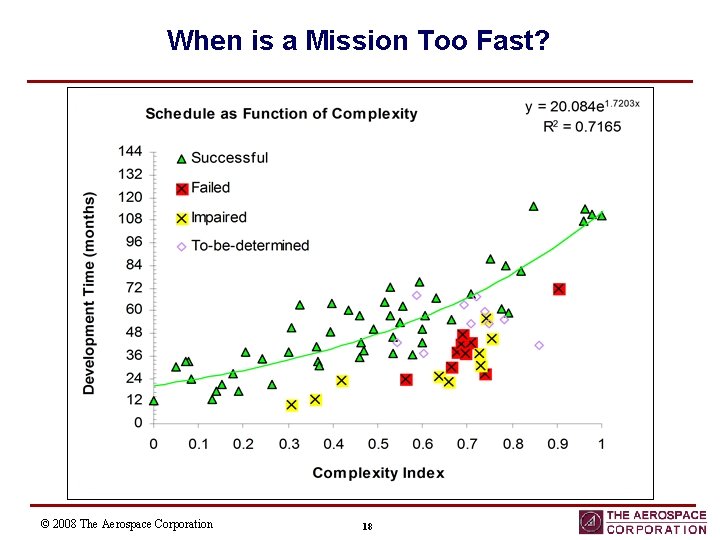
When is a Mission Too Fast? © 2008 The Aerospace Corporation 18
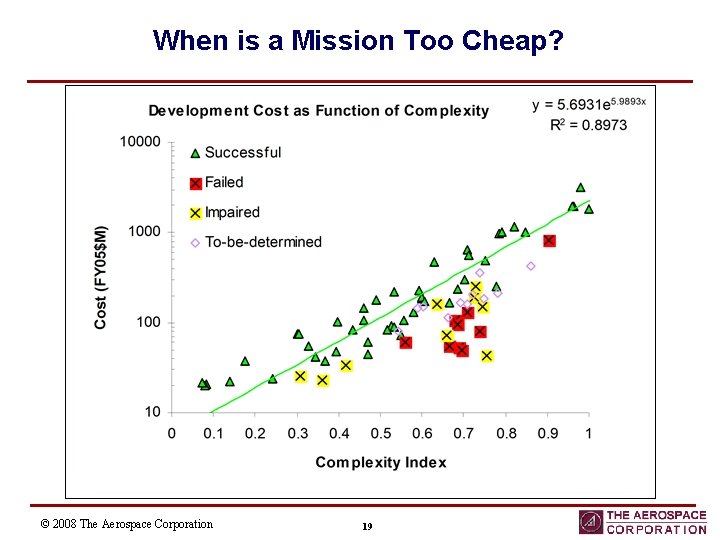
When is a Mission Too Cheap? © 2008 The Aerospace Corporation 19
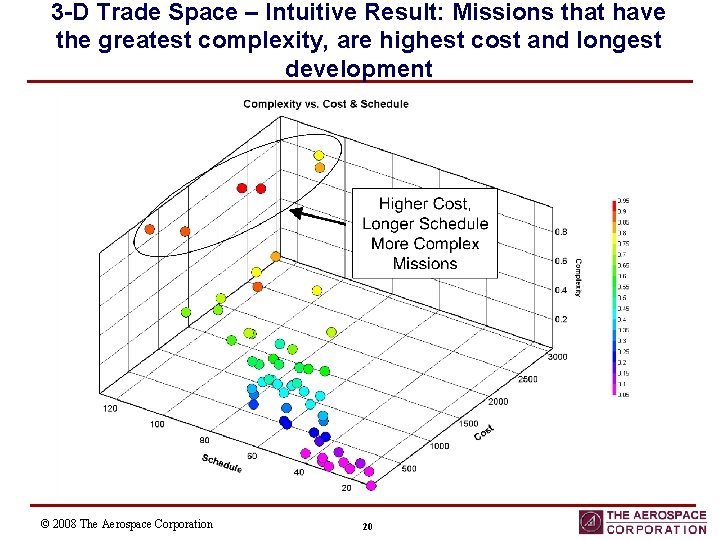
3 -D Trade Space – Intuitive Result: Missions that have the greatest complexity, are highest cost and longest development © 2008 The Aerospace Corporation 20
Complexity Bands vs. Cost and Schedule Help Proposers Define Scope of Mission to Fit Fixed Cost & Schedule 2012 2010 © 2008 The Aerospace Corporation 21
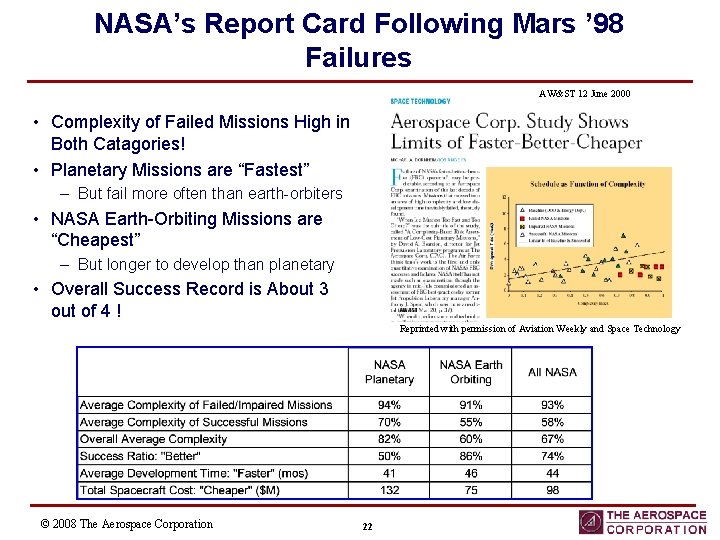
NASA’s Report Card Following Mars ’ 98 Failures AW&ST 12 June 2000 • Complexity of Failed Missions High in Both Catagories! • Planetary Missions are “Fastest” – But fail more often than earth-orbiters • NASA Earth-Orbiting Missions are “Cheapest” – But longer to develop than planetary • Overall Success Record is About 3 out of 4 ! Reprinted with permission of Aviation Weekly and Space Technology © 2008 The Aerospace Corporation 22
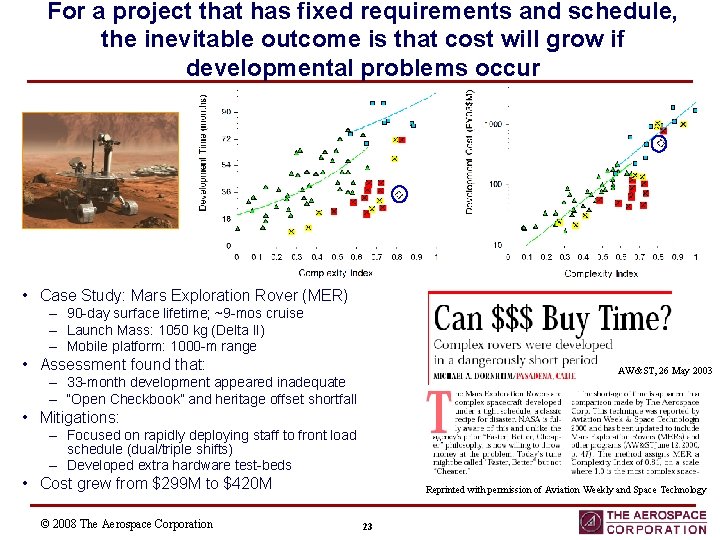
For a project that has fixed requirements and schedule, the inevitable outcome is that cost will grow if developmental problems occur • Case Study: Mars Exploration Rover (MER) – 90 -day surface lifetime; ~9 -mos cruise – Launch Mass: 1050 kg (Delta II) – Mobile platform: 1000 -m range • Assessment found that: AW&ST, 26 May 2003 – 33 -month development appeared inadequate – “Open Checkbook” and heritage offset shortfall • Mitigations: – Focused on rapidly deploying staff to front load schedule (dual/triple shifts) – Developed extra hardware test-beds • Cost grew from $299 M to $420 M © 2008 The Aerospace Corporation Reprinted with permission of Aviation Weekly and Space Technology 23
Typical Questions • What is the magnitude of cost and schedule growth? • How reliable are estimates in the conceptual design stage? • Why does cost growth occur? • What is the relationship between cost, schedule and “complexity”? • Are there any improvements that can be made in estimating the costs of future design concepts? © 2008 The Aerospace Corporation 24
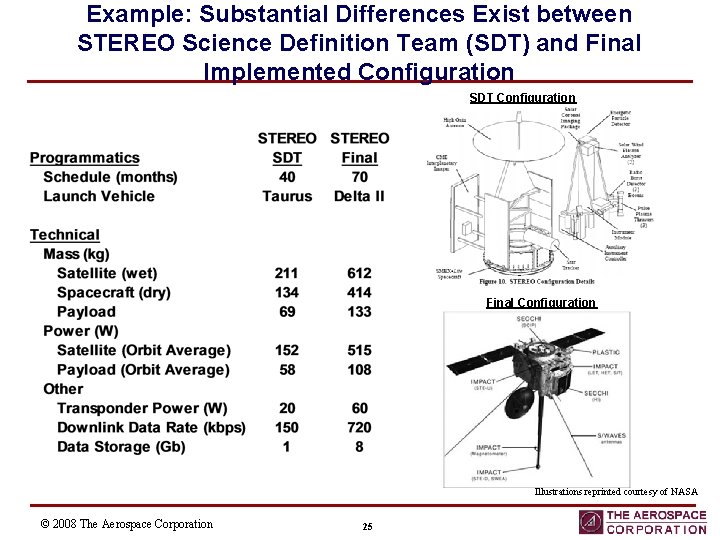
Example: Substantial Differences Exist between STEREO Science Definition Team (SDT) and Final Implemented Configuration SDT Configuration Final Configuration Illustrations reprinted courtesy of NASA © 2008 The Aerospace Corporation 25
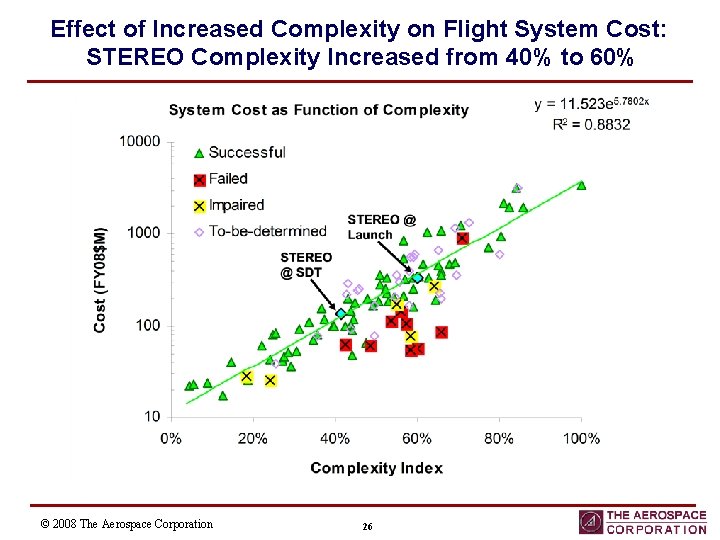
Effect of Increased Complexity on Flight System Cost: STEREO Complexity Increased from 40% to 60% © 2008 The Aerospace Corporation 26
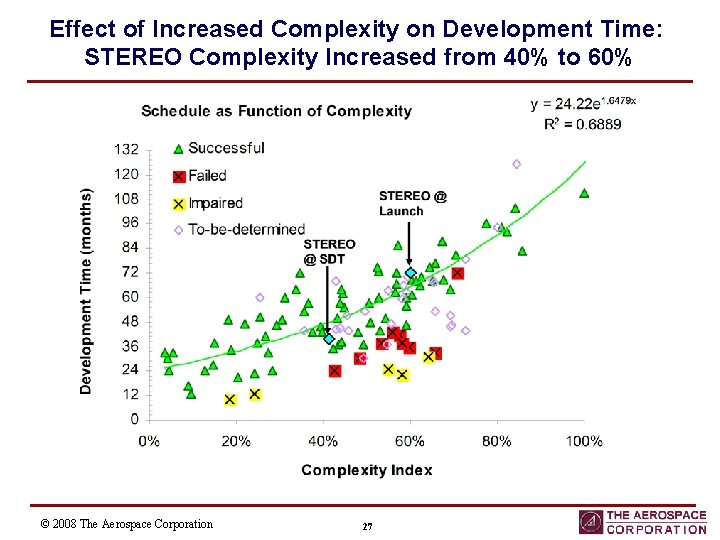
Effect of Increased Complexity on Development Time: STEREO Complexity Increased from 40% to 60% © 2008 The Aerospace Corporation 27
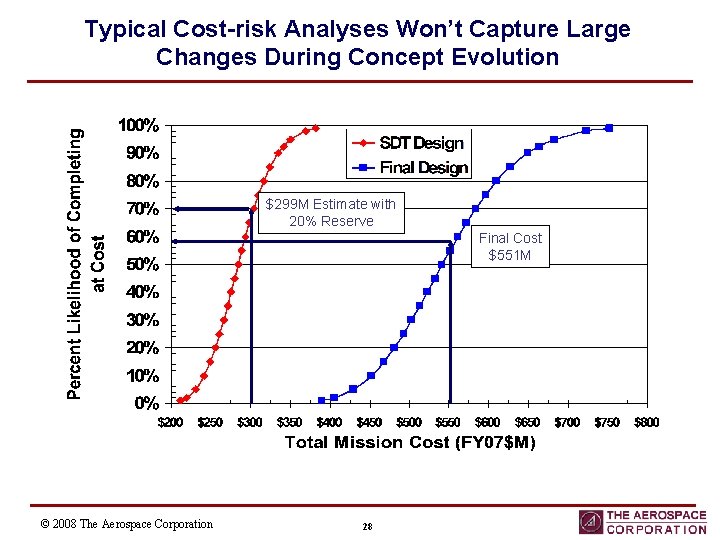
Typical Cost-risk Analyses Won’t Capture Large Changes During Concept Evolution $299 M Estimate with 20% Reserve Final Cost $551 M © 2008 The Aerospace Corporation 28
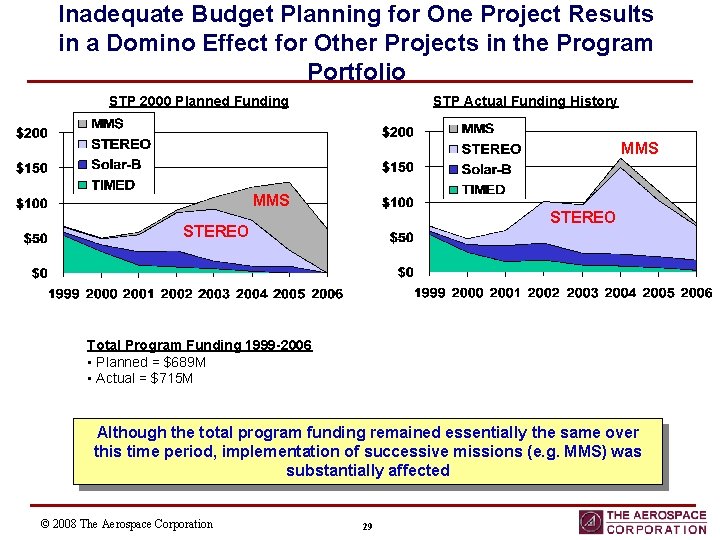
Inadequate Budget Planning for One Project Results in a Domino Effect for Other Projects in the Program Portfolio STP 2000 Planned Funding STP Actual Funding History MMS STEREO Total Program Funding 1999 -2006 • Planned = $689 M • Actual = $715 M Although the total program funding remained essentially the same over this time period, implementation of successive missions (e. g. MMS) was substantially affected © 2008 The Aerospace Corporation 29
Summary • Methods exist to estimate cost and schedule at the conceptual phase albeit with some level of uncertainty • While estimates become more accurate as project matures, the greatest growth manifests itself late in project during Integration & Test • Data highlighted that the primary reason for cost and schedule growth is internal project technical and development issues often associated with instruments • Initial project estimates may be unreliable due to design and technology immaturity and inherent optimism • Success dependence on system complexity and adequacy of resources observed with identification of a “no-fly zone” • Better technical and programmatic appraisal early in lifecycle is needed along with independent assessment of design and programmatic assumptions © 2008 The Aerospace Corporation 30
References and Further Reading 1) Bearden, David A. , “A Complexity-based Risk Assessment of Low-Cost Planetary Missions: When is a Mission Too Fast and Too Cheap? ”, Fourth IAA International Conference on Low-Cost Planetary Missions, JHU/APL, Laurel, MD, 2 -5 May, 2000. 2) Dornheim, Michael, "Aerospace Corp. Study Shows Limits of Faster-Better-Cheaper", Aviation Week and Space Technology, 12 June 2000. 3) Bearden, David A. , "Small Satellite Costs", Crosslink Magazine, The Aerospace Corporation, Winter 2000 -2001. 4) Dornheim, Michael, “Can $$$ Buy Time? ", Aviation Week and Space Technology, 26 May 2003. 5) Bitten R. E. , Bearden D. A. , Lao N. Y. and Park, T. H. , “The Effect of Schedule Constraints on the Success of Planetary Missions”, Fifth IAA International Conference on Low-Cost Planetary Missions, 24 September 2003. 6) Bearden, D. A. , “Perspectives on NASA Robotic Mission Success with a Cost and Schedule-constrained Environment”, Aerospace Risk Symposium, Manhattan Beach, CA, August 2005 7) Bitten R. E. , Bearden D. A. , Emmons D. L. , “A Quantitative Assessment of Complexity, Cost, And Schedule: Achieving A Balanced Approach For Program Success”, 6 th IAA International Low Cost Planetary Conference, Japan, 11 -13 October 2005. 8) Bitten R. E. , “Determining When A Mission Is "Outside The Box": Guidelines For A Cost- Constrained Environment”, 6 th IAA International Low Cost Planetary Conference, October 11 -13, 2005. 9) Bitten R. , Emmons D. , Freaner C. , “Using Historical NASA Cost and Schedule Growth to Set Future Program and Project Reserve Guidelines”, IEEE Aerospace Conference, Big Sky, Montana, March 3 -10, 2007. 10) Emmons D. , “A Quantitative Approach to Independent Schedule Estimates of Planetary & Earth-orbiting Missions”, 2008 ISPA-SCEA Joint International Conference, Netherlands, 12 -14 May 2008. 11) Freaner C. , Bitten R. , Bearden D. , and Emmons D. , “An Assessment of the Inherent Optimism in Early Conceptual Designs and its Effect on Cost and Schedule Growth”, 2008 SSCAG/SCAF/EACE Joint International Conference, Noordwijk, The Netherlands, 15 -16 May 2008. © 2008 The Aerospace Corporation 31