
Perspectives on Game Science by Ehud Kalai Northwestern
Perspectives on Game Science by Ehud Kalai Northwestern University The Luce and Raiffa conference U. C. Irvine January 2007 Apology: Much of what I have to say • • • is not new, was learned from people in this room, may be controversial. Still, it offers overall perspectives. 1
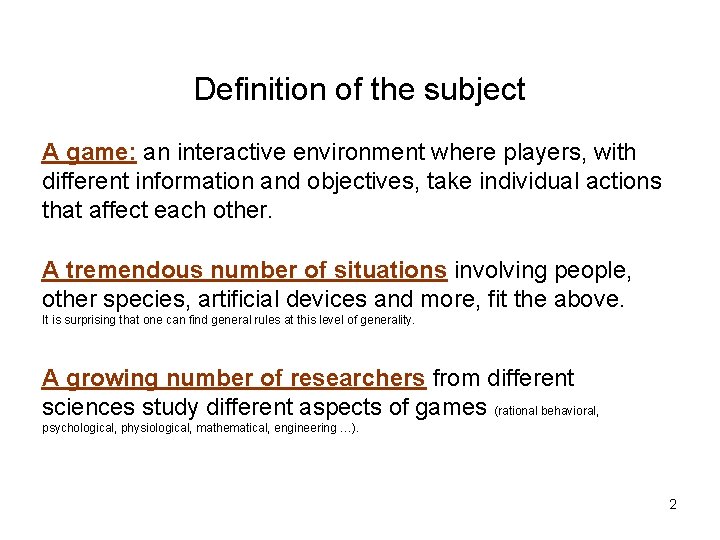
Definition of the subject A game: an interactive environment where players, with different information and objectives, take individual actions that affect each other. A tremendous number of situations involving people, other species, artificial devices and more, fit the above. It is surprising that one can find general rules at this level of generality. A growing number of researchers from different sciences study different aspects of games (rational behavioral, psychological, physiological, mathematical, engineering …). 2
Will refer to the study of games as game science, and to the people involved in it as game scientists. So all game theorists are game scientists, but there is a growing number of game scientists who are not game theorists. 3
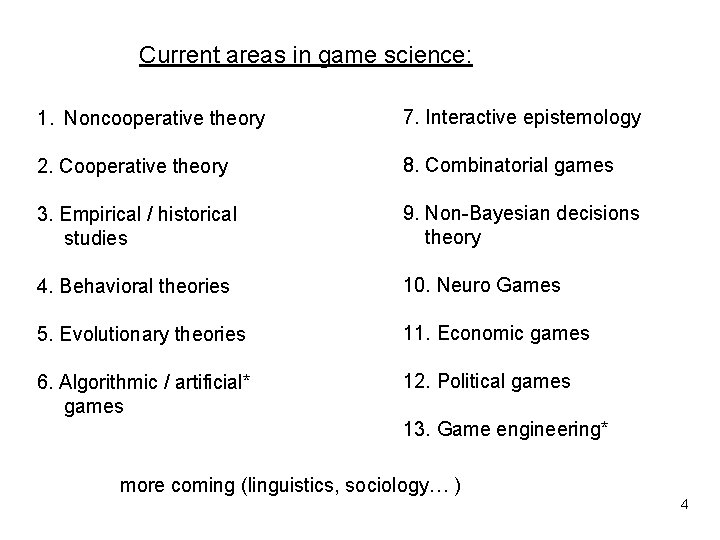
Current areas in game science: 1. Noncooperative theory 7. Interactive epistemology 2. Cooperative theory 8. Combinatorial games 3. Empirical / historical studies 9. Non-Bayesian decisions theory 4. Behavioral theories 10. Neuro Games 5. Evolutionary theories 11. Economic games 6. Algorithmic / artificial* games 12. Political games 13. Game engineering* more coming (linguistics, sociology… ) 4
Are we going through a Disintegration or a Healthy Expansion? From the Luce and Raiffa book I learned two models of rational players: cooperative and strategic. Similarly, in the first conference I attended in Bielefeld, (organized by the young Reinhard Selten in 1973), almost everybody discussed the non-cooperative or cooperative models. It is very different today. 5
Specialization is unavoidable 6
Horizontal specialization: economic games, political games, biological games, etc. We are all used to it. Vertical specialization is more controversial in game theory, but is unavoidable as can be seen from older fields. Examples: Probability and statistics. Physics and engineering. 7
Example: airplane design and operation Physicists developed theory of aerodynamics. Engineers design airplanes using: • aerodynamic theory, • knowledge of previously designed planes • experimentation in wind tunnels. Pilots fly the planes. • Different skills. • Knowledge of each other is valuable. • But it is impractical to combine three specialties into one.
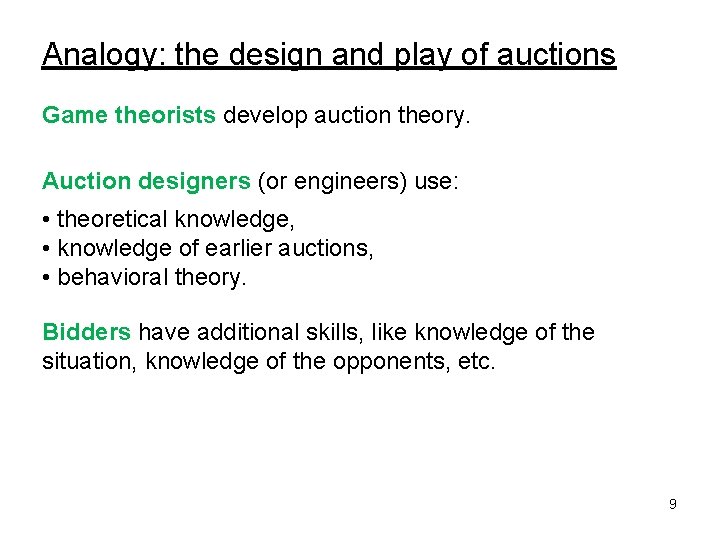
Analogy: the design and play of auctions Game theorists develop auction theory. Auction designers (or engineers) use: • theoretical knowledge, • knowledge of earlier auctions, • behavioral theory. Bidders have additional skills, like knowledge of the situation, knowledge of the opponents, etc. 9
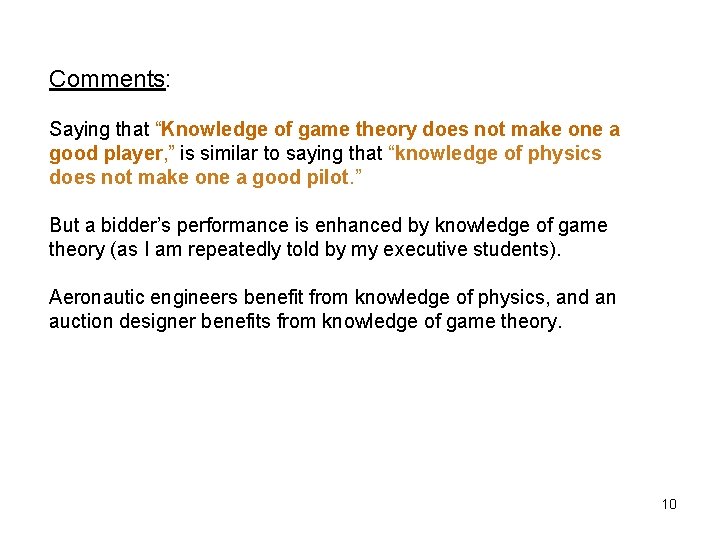
Comments: Saying that “Knowledge of game theory does not make one a good player, ” is similar to saying that “knowledge of physics does not make one a good pilot. ” But a bidder’s performance is enhanced by knowledge of game theory (as I am repeatedly told by my executive students). Aeronautic engineers benefit from knowledge of physics, and an auction designer benefits from knowledge of game theory. 10

Past and current applications 11
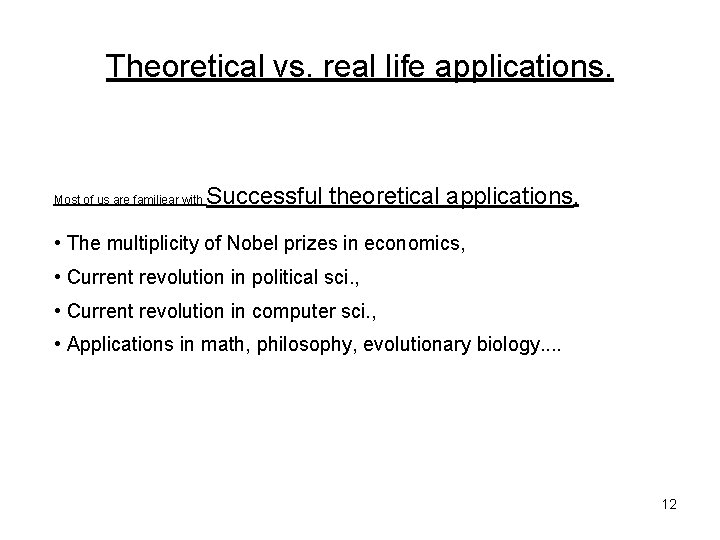
Theoretical vs. real life applications. Most of us are familiear with Successful theoretical applications. • The multiplicity of Nobel prizes in economics, • Current revolution in political sci. , • Current revolution in computer sci. , • Applications in math, philosophy, evolutionary biology. . 12
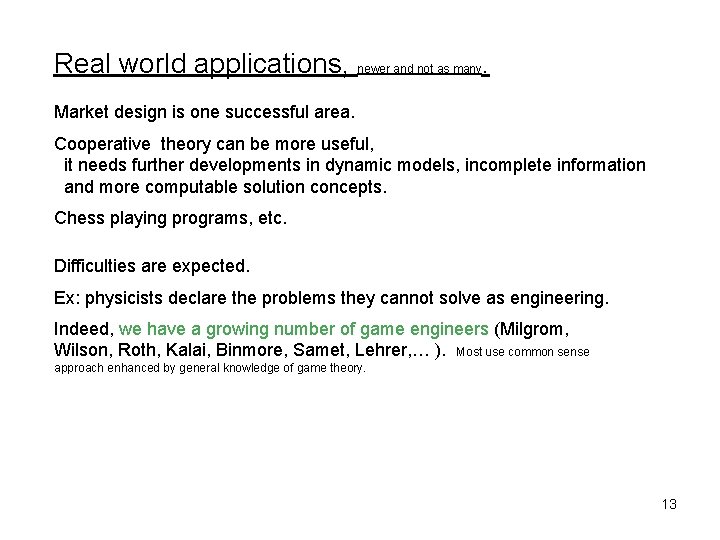
Real world applications, newer and not as many. Market design is one successful area. Cooperative theory can be more useful, it needs further developments in dynamic models, incomplete information and more computable solution concepts. Chess playing programs, etc. Difficulties are expected. Ex: physicists declare the problems they cannot solve as engineering. Indeed, we have a growing number of game engineers (Milgrom, Wilson, Roth, Kalai, Binmore, Samet, Lehrer, … ). Most use common sense approach enhanced by general knowledge of game theory. 13
We have some basic engineering tools (e. g. , game and strategy trees, tree trimming as in Chess, game modifications ) , but we don’t have a workhorse tool (like regression in probability theory) that fits well theory and the applications. We need to remove theoretical barriers. We need engineering tools that are grounded in theory. For this reason theory needs some substantial breakthroughs. 14
Some comments on Rational Players with Bounded Ability One of the most important issues in game theory today, see Game Theory 5 questions. 15
Bounded rationality is a dangerous term. It invites models with “highly specific stupid behavior. ” At what micro (vs macro) level should games be modeled? Several difficulties: 1. Optimization may be more difficult under constraints (Selten & Papadimitriou) 2. When do you stop computing? 3. Hierarchies of knowledge about knowledge make the modeling of computational limitations difficult, unlike in physics. 16
Probability Theory: an illustration of Rational Players with Bounded Ability. Coin Example: bet H or T on a coin flip? Compare: 1. the approach of a physicist, in a world where probability theory does not exist, who plans to solve the relevant differential equations, with 2. the approach taken by a probabilist. 17
Micro vs. Macro models: The macro level of the probabilist seems more appropriate for the gambling problem, at least the casinos think so. Game theorists bring in probabilities into our models. But often at unrealistic micro level. For example: Assign prior probabilities to all unknown parameters: How strong would the coin be flipped, the wind velocity in the room, hardness of the table on which the coin falls…. Then compute the H or T outcome for each vector of parameter values. Predict the outcome of the coin according to the probabilities of the computed outcomes. The choice of micro level may be difficult. For example, in a gentle flip you may want to go with the physicist. When do we switch the models? 18
Ability Bounds that are common knowledge are less problematic. Similar to Harsanyi where common knowledge of the parameters of uncertainty simplifies the informational issues. Example: limiting the complexity of strategies in a repeated game. Example: Bounded Payoff Perception: Numbers used in payoff tables have finite descriptions. For example, assume that players are unable to differentiate payoffs beyond the 16 th decimal. 19
Bounded payoff perception overcomes two impossibility theorems: Do we learn to play Nash equilibrium in a Bayesian Repeated Game? § D. P. Foster and H. P. Young’s “On the impossibility of predicting the behavior of rational agents, ” Proc. of the National Academy of Sciences (2001), illustrates impossibility by an example. § But under bounded payoff perception, E. Kalai and E. Lehrer’s “Rational learning leads to Nash equilibrium, ” Econometrica (1993), illustrates a general positive result. 20
Are there uncoupled learning algorithms that lead to Nash equilibrium in a repeated play of a normal form game? • S. Hart and A. Mas Colell’s “Uncoupled Dynamics Do Not Lead to Nash Equilibrium, ” American Economic Review (2003), illustrates an impossibility result. • But under bounded payoff perception, using E. Kalai and E. Lehrer’s , “Rational learning leads to Nash equilibrium, ” Econometrica (1993), it is easy to construct uncoupled dynamics that lead to Nash equilibrium in any repeated normal form game. 21
So, are we in a process of disintegration or healthy expansion? I would love to hear peoples’ opinions on this! Thank you! 22
- Slides: 22