
Perspectives on carcass pricing for the Irish beef

Perspectives on carcass pricing for the Irish beef sector Paul Crosson and Laurence Shalloo Beef Task Force Tuesday, 9 March 2021
Irish Beef Sector Agreement • Teagasc would scope out … in depth study to look at a revised system (of beef pricing). (Beef Task Force, 9 January 2020) Presentation outline Ø Review of current pricing model Ø Review of meat processing technologies Ø Overview of ‘cuts-based’ pricing concept
Current Pricing Model 3 Teagasc Presentation Footer
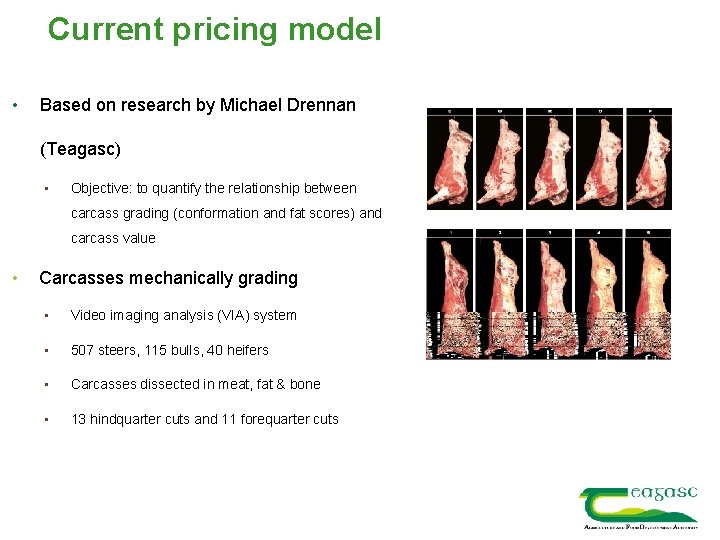
Current pricing model • Based on research by Michael Drennan (Teagasc) • Objective: to quantify the relationship between carcass grading (conformation and fat scores) and carcass value • Carcasses mechanically grading • Video imaging analysis (VIA) system • 507 steers, 115 bulls, 40 heifers • Carcasses dissected in meat, fat & bone • 13 hindquarter cuts and 11 forequarter cuts
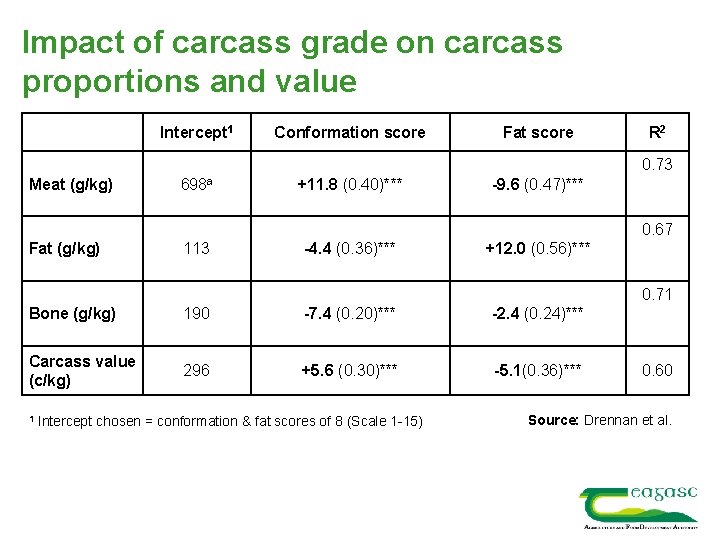
Impact of carcass grade on carcass proportions and value Intercept 1 Conformation score Fat score R 2 0. 73 Meat (g/kg) 698 a +11. 8 (0. 40)*** -9. 6 (0. 47)*** 0. 67 Fat (g/kg) 113 -4. 4 (0. 36)*** +12. 0 (0. 56)*** 0. 71 Bone (g/kg) 190 -7. 4 (0. 20)*** -2. 4 (0. 24)*** Carcass value (c/kg) 296 +5. 6 (0. 30)*** -5. 1(0. 36)*** 1 Intercept chosen = conformation & fat scores of 8 (Scale 1 -15) 0. 60 Source: Drennan et al.
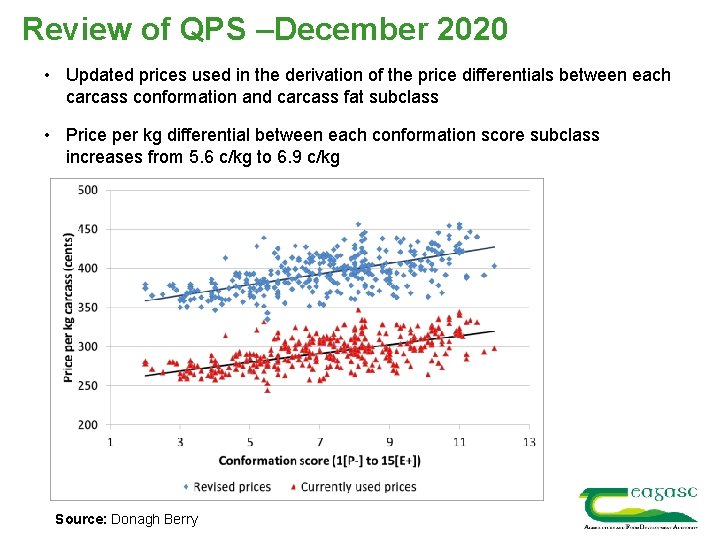
Review of QPS –December 2020 • Updated prices used in the derivation of the price differentials between each carcass conformation and carcass fat subclass • Price per kg differential between each conformation score subclass increases from 5. 6 c/kg to 6. 9 c/kg Source: Donagh Berry
Recent technological innovations & implications for beef pricing 7 Teagasc Presentation Footer
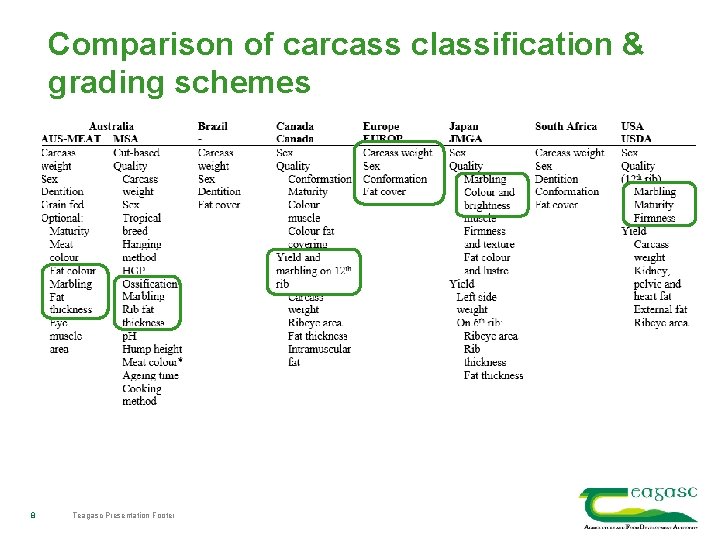
Comparison of carcass classification & grading schemes 8 Teagasc Presentation Footer
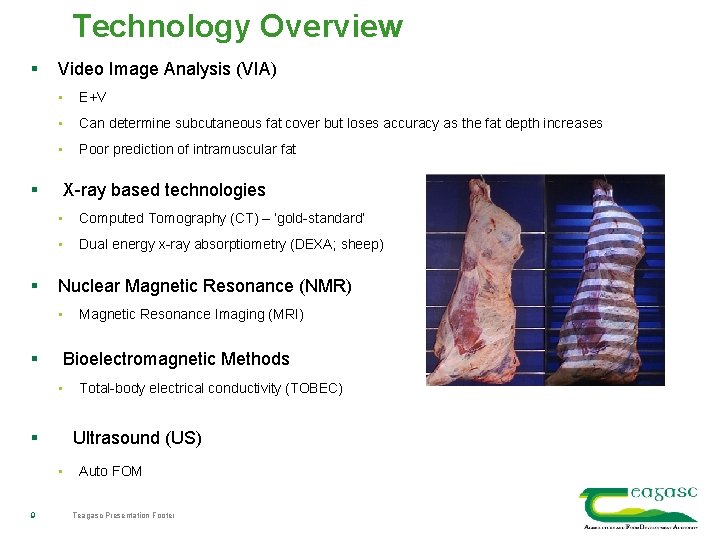
Technology Overview § § § Video Image Analysis (VIA) • E+V • Can determine subcutaneous fat cover but loses accuracy as the fat depth increases • Poor prediction of intramuscular fat X-ray based technologies • Computed Tomography (CT) – ‘gold-standard’ • Dual energy x-ray absorptiometry (DEXA; sheep) Nuclear Magnetic Resonance (NMR) • § Bioelectromagnetic Methods • § Total-body electrical conductivity (TOBEC) Ultrasound (US) • 9 Magnetic Resonance Imaging (MRI) Auto FOM Teagasc Presentation Footer
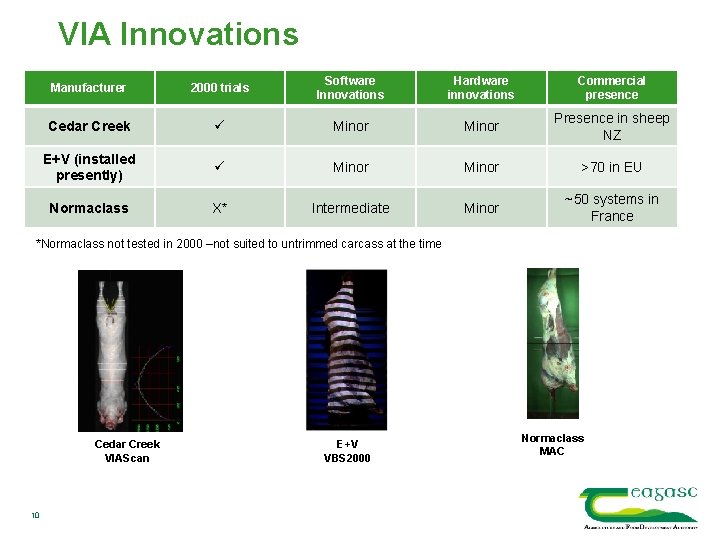
VIA Innovations Manufacturer 2000 trials Software Innovations Hardware innovations Commercial presence Cedar Creek Minor Presence in sheep NZ E+V (installed presently) Minor >70 in EU Normaclass X* Intermediate Minor ~50 systems in France *Normaclass not tested in 2000 –not suited to untrimmed carcass at the time Cedar Creek VIAScan 10 E+V VBS 2000 Normaclass MAC
Findings from a recent French study (Monteils et al. , 2017) • The EUROP grid is well adapted to estimate yield but it does not reflect marbling (e. g. explains 21% of variance in marbling score for steers). • A set of 5 indicators was proposed: hindquarter weight, meat colour, retailcut yield, rib-eye area and marbling score. • This set of indicators is the first step in developing a new way to assess the overall quality of beef carcasses in Europe. • Will take further research and investment at industry level – long term project • In the short term yield of meat will remain paramount 11 Teagasc Presentation Footer
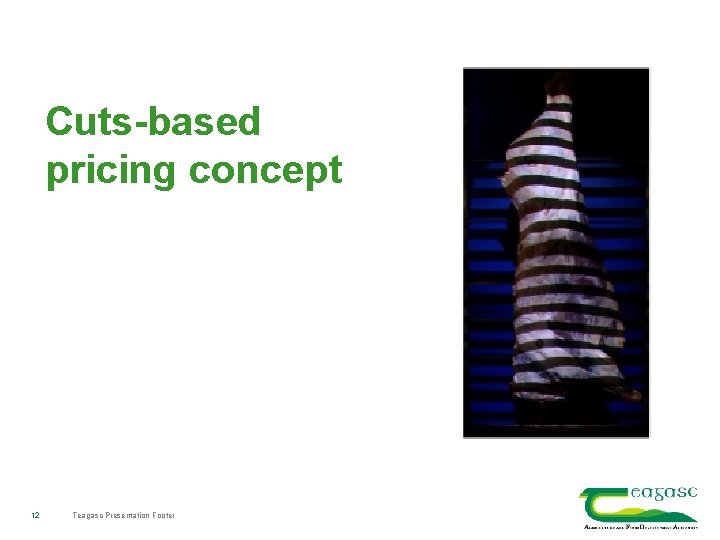
Cuts-based pricing concept 12 Teagasc Presentation Footer
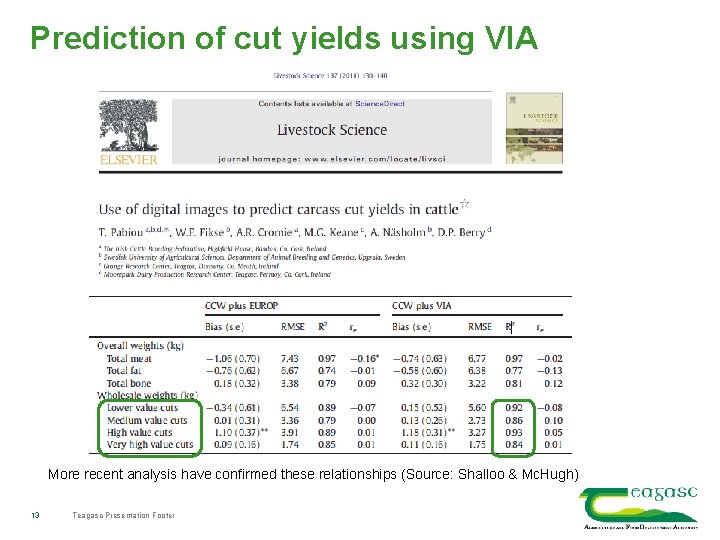
Prediction of cut yields using VIA More recent analysis have confirmed these relationships (Source: Shalloo & Mc. Hugh) 13 Teagasc Presentation Footer
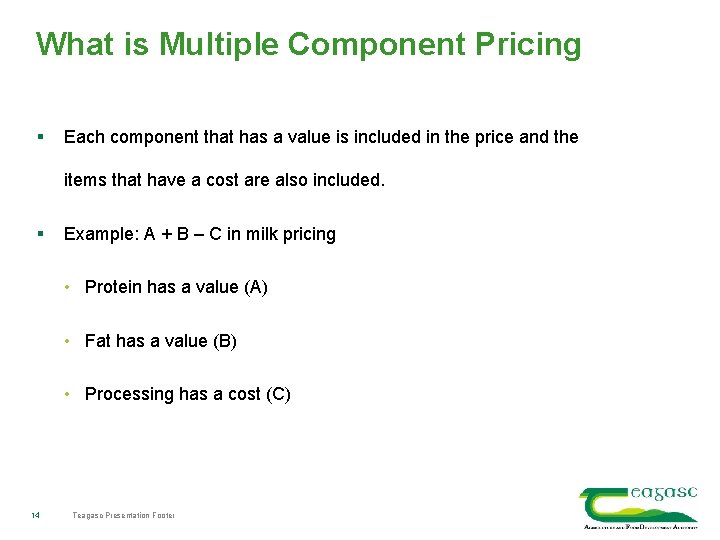
What is Multiple Component Pricing § Each component that has a value is included in the price and the items that have a cost are also included. § Example: A + B – C in milk pricing • Protein has a value (A) • Fat has a value (B) • Processing has a cost (C) 14 Teagasc Presentation Footer
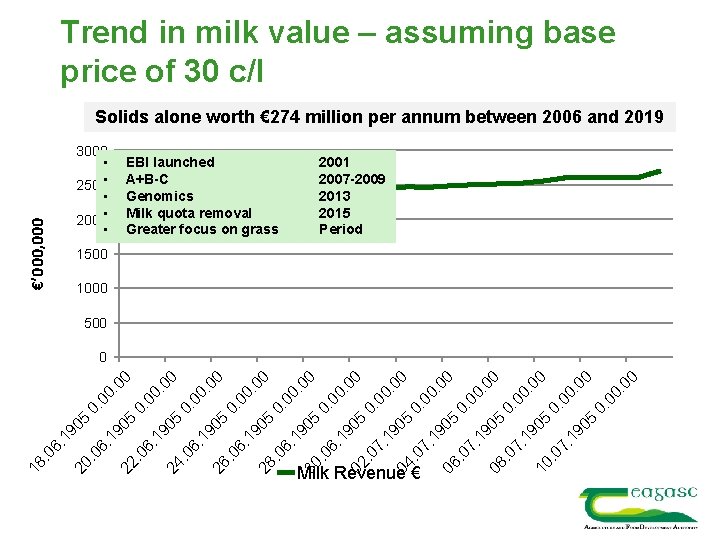
Trend in milk value – assuming base price of 30 c/l Solids alone worth € 274 million per annum between 2006 and 2019 €’ 000, 000 3000 • 2500 • • 2000 • • EBI launched A+B-C Genomics Milk quota removal Greater focus on grass 2001 2007 -2009 2013 2015 Period 1500 1000 5 0: 06 00. 1 : 0 90 0 26 5. 0 0: 6. 00 19 : 0 05 0 28. 0 0: 6. 00 19 : 0 05 0 30. 0 0: 6. 00 19 : 0 05 0 02. 0 0: 7. 00 19 : 0 05 0 04. 0 0: 7. 00 19 : 0 05 0 06. 0 0: 7. 00 19 : 0 05 0 08. 0 0: 7. 00 19 : 0 05 0 10. 0 0: 7. 00 19 : 0 05 0 0: 00 : 0 0 00 19 0 0: 24. 22. 0 6. 5 19 0 6. 20. 0 18. 0 6. 19 0 5 0: 00 : 0 0 0 Milk Revenue €
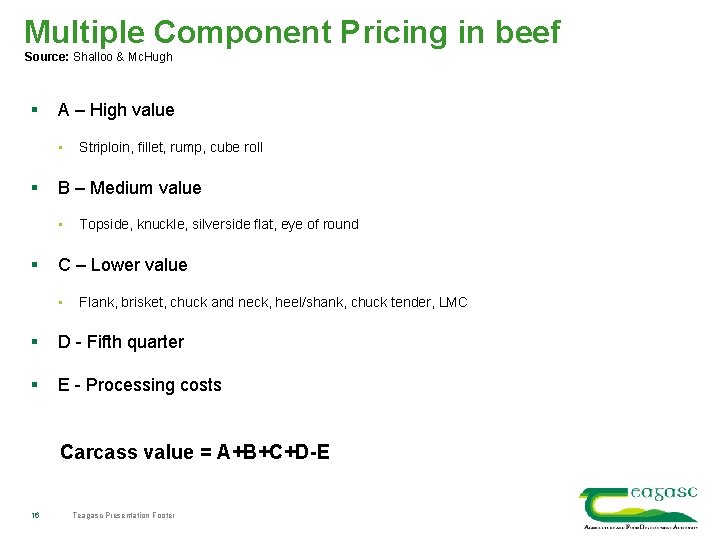
Multiple Component Pricing in beef Source: Shalloo & Mc. Hugh § A – High value • § B – Medium value • § Striploin, fillet, rump, cube roll Topside, knuckle, silverside flat, eye of round C – Lower value • Flank, brisket, chuck and neck, heel/shank, chuck tender, LMC § D - Fifth quarter § E - Processing costs Carcass value = A+B+C+D-E 16 Teagasc Presentation Footer
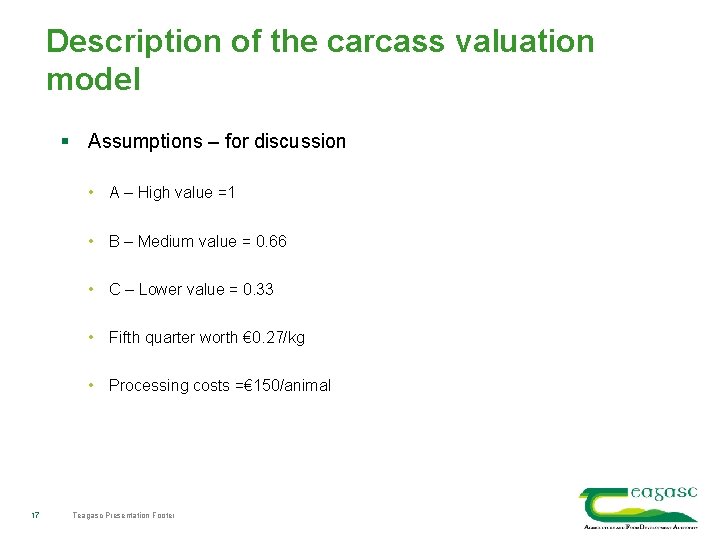
Description of the carcass valuation model § Assumptions – for discussion • A – High value =1 • B – Medium value = 0. 66 • C – Lower value = 0. 33 • Fifth quarter worth € 0. 27/kg • Processing costs =€ 150/animal 17 Teagasc Presentation Footer
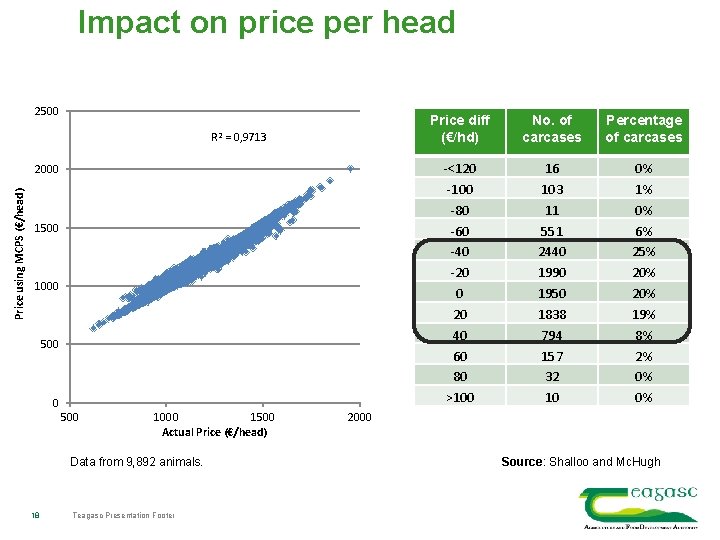
Impact on price per head 2500 R 2 = 0, 9713 Price using MCPS (€/head) 2000 1500 1000 1500 Actual Price (€/head) Data from 9, 892 animals. 18 Teagasc Presentation Footer Price diff (€/hd) No. of carcases Percentage of carcases -<120 -100 -80 -60 -40 -20 0 20 40 60 80 >100 16 103 11 551 2440 1990 1950 1838 794 157 32 10 0% 1% 0% 6% 25% 20% 19% 8% 2% 0% 0% 2000 Source: Shalloo and Mc. Hugh
Summary of Multiple Component Pricing in beef • Provides more detailed signals for producers to breed animals with attributes that are desired by consumers § Reflects cut returns and market preferences § Allows cut off based on size of cuts rather than size of animal § Allows additional components to be included in pricing § Marbling for certain cuts § 19 Currently a concept that requires feedback and further research Teagasc Presentation Footer
Summary • Historically, Ireland have been innovators in carcass grading systems • Pre-automation: manual classification by >65 DAFM staff • First to adopt automated grading by VIA in 2004 (following review of systems by Teagasc and application to EU by DAFM) • ‘Drennan’ model of carcass payment adopted in 2009/2010 • Current VIA technology could be developed to facilitate ‘cuts-based’ payment • Can be aligned to the beef breeding programme to increase genetic gain • Research on grading and valuing carcass quality ongoing 20 Teagasc Presentation Footer
- Slides: 20