
PERSPECTIVES ON AUTOMATED METHODS FOR PHARMACOVIGILANCE SIGNAL DETECTION
- Slides: 26
PERSPECTIVES ON AUTOMATED METHODS FOR PHARMACOVIGILANCE SIGNAL DETECTION A. Lawrence Gould, Ph. D Peter K Honig, MD, MPH Merck Research Laboratories FDA/Industry Statistics Workshop Bethesda MD, September 19, 2003
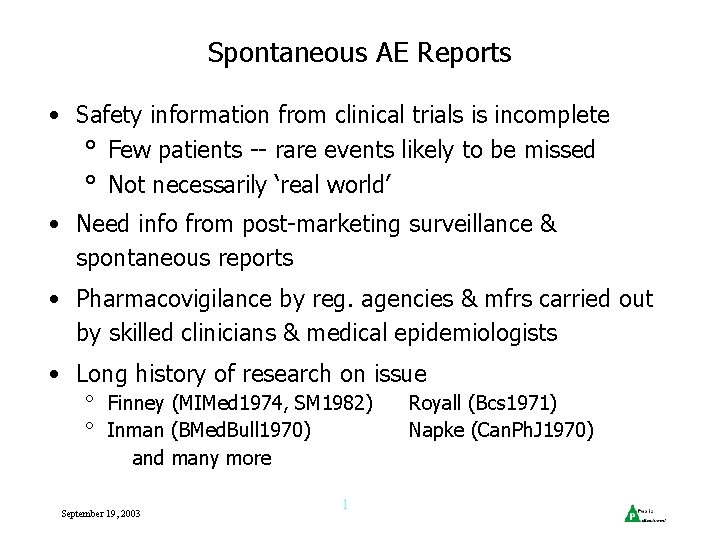
Spontaneous AE Reports • Safety information from clinical trials is incomplete ° Few patients -- rare events likely to be missed ° Not necessarily ‘real world’ • Need info from post-marketing surveillance & spontaneous reports • Pharmacovigilance by reg. agencies & mfrs carried out by skilled clinicians & medical epidemiologists • Long history of research on issue ° Finney (MIMed 1974, SM 1982) ° Inman (BMed. Bull 1970) and many more September 19, 2003 1 Royall (Bcs 1971) Napke (Can. Ph. J 1970)
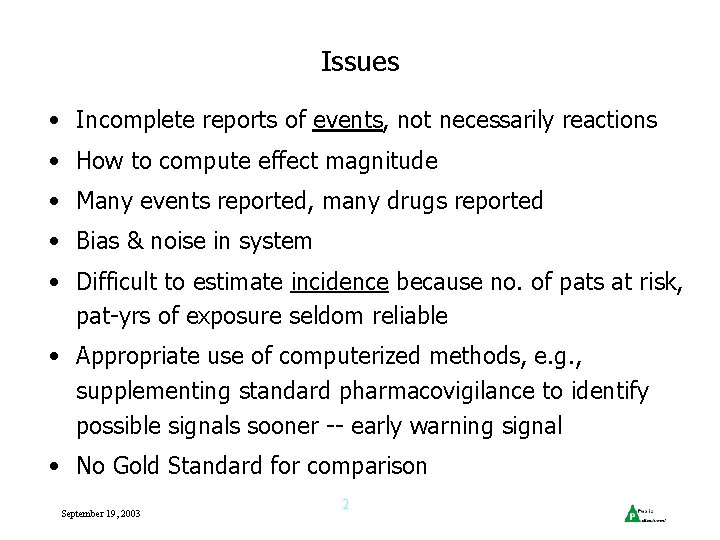
Issues • Incomplete reports of events, not necessarily reactions • How to compute effect magnitude • Many events reported, many drugs reported • Bias & noise in system • Difficult to estimate incidence because no. of pats at risk, pat-yrs of exposure seldom reliable • Appropriate use of computerized methods, e. g. , supplementing standard pharmacovigilance to identify possible signals sooner -- early warning signal • No Gold Standard for comparison September 19, 2003 2
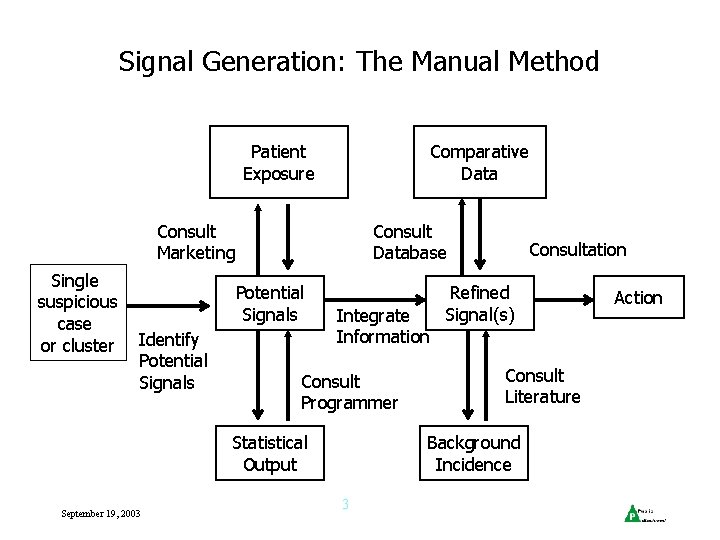
Signal Generation: The Manual Method Patient Exposure Comparative Data Consult Marketing Single suspicious case or cluster Consult Database Potential Signals Identify Potential Signals Integrate Information Consult Programmer Statistical Output September 19, 2003 Consultation Refined Signal(s) Consult Literature Background Incidence 3 Action
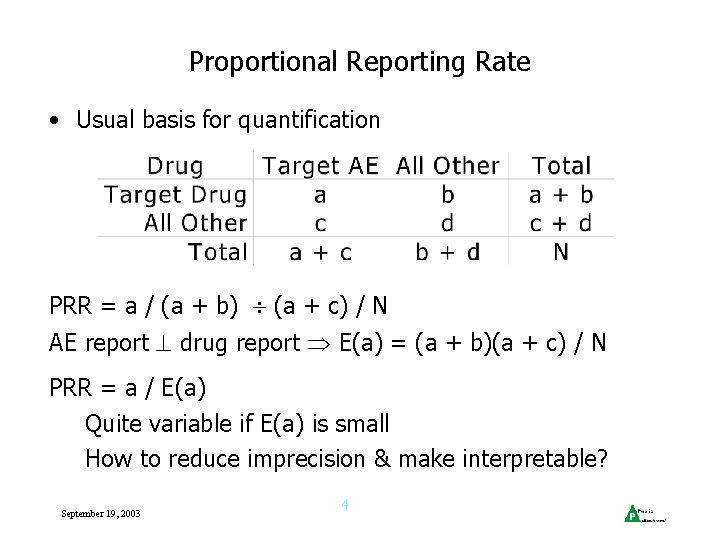
Proportional Reporting Rate • Usual basis for quantification PRR = a / (a + b) (a + c) / N AE report drug report E(a) = (a + b)(a + c) / N PRR = a / E(a) Quite variable if E(a) is small How to reduce imprecision & make interpretable? September 19, 2003 4
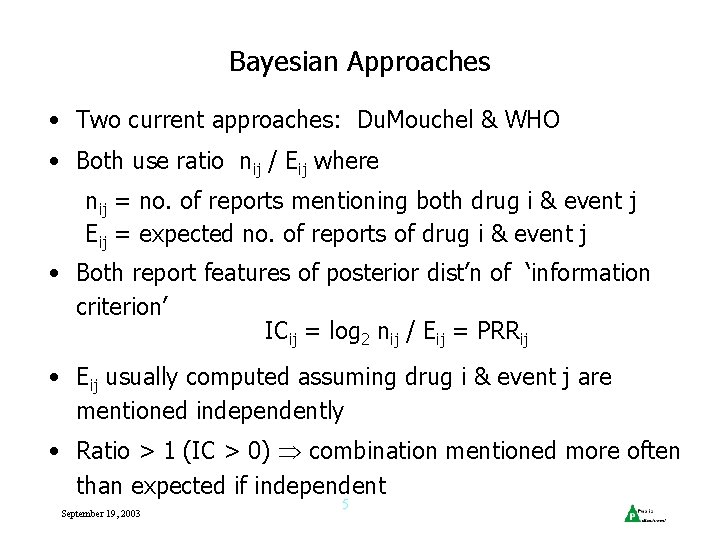
Bayesian Approaches • Two current approaches: Du. Mouchel & WHO • Both use ratio nij / Eij where nij = no. of reports mentioning both drug i & event j Eij = expected no. of reports of drug i & event j • Both report features of posterior dist’n of ‘information criterion’ ICij = log 2 nij / Eij = PRRij • Eij usually computed assuming drug i & event j are mentioned independently • Ratio > 1 (IC > 0) combination mentioned more often than expected if independent September 19, 2003 5
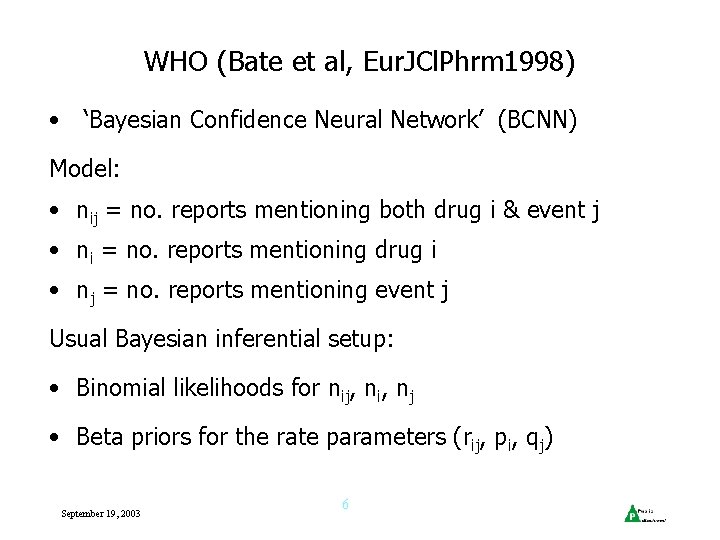
WHO (Bate et al, Eur. JCl. Phrm 1998) • ‘Bayesian Confidence Neural Network’ (BCNN) Model: • nij = no. reports mentioning both drug i & event j • ni = no. reports mentioning drug i • nj = no. reports mentioning event j Usual Bayesian inferential setup: • Binomial likelihoods for nij, ni, nj • Beta priors for the rate parameters (rij, pi, qj) September 19, 2003 6
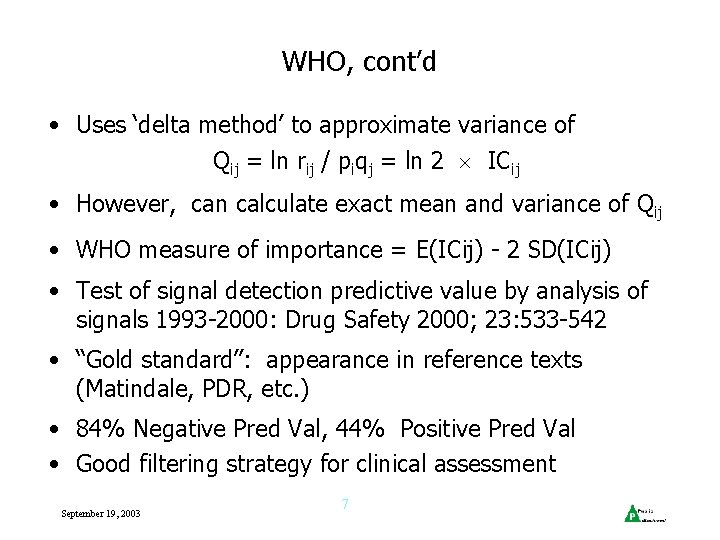
WHO, cont’d • Uses ‘delta method’ to approximate variance of Qij = ln rij / piqj = ln 2 ICij • However, can calculate exact mean and variance of Qij • WHO measure of importance = E(ICij) - 2 SD(ICij) • Test of signal detection predictive value by analysis of signals 1993 -2000: Drug Safety 2000; 23: 533 -542 • “Gold standard”: appearance in reference texts (Matindale, PDR, etc. ) • 84% Negative Pred Val, 44% Positive Pred Val • Good filtering strategy for clinical assessment September 19, 2003 7
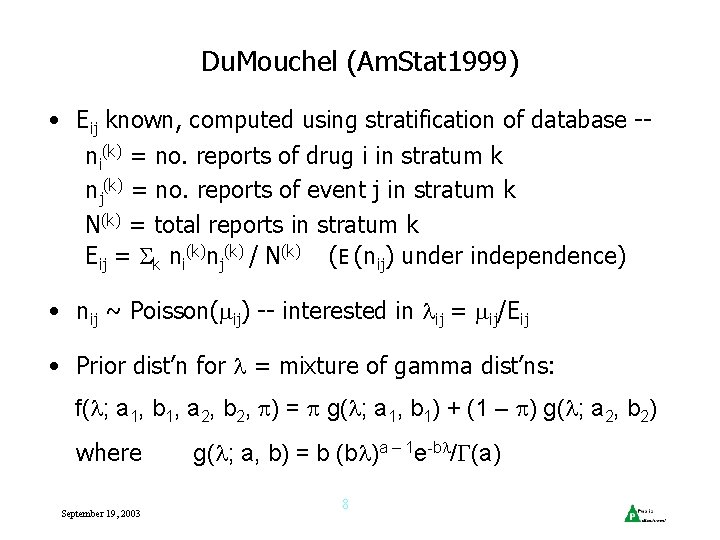
Du. Mouchel (Am. Stat 1999) • Eij known, computed using stratification of database -ni(k) = no. reports of drug i in stratum k nj(k) = no. reports of event j in stratum k N(k) = total reports in stratum k Eij = k ni(k)nj(k) / N(k) (E (nij) under independence) • nij ~ Poisson( ij) -- interested in ij = ij/Eij • Prior dist’n for = mixture of gamma dist’ns: f( ; a 1, b 1, a 2, b 2, ) = g( ; a 1, b 1) + (1 – ) g( ; a 2, b 2) where September 19, 2003 g( ; a, b) = b (b )a – 1 e-b / (a) 8
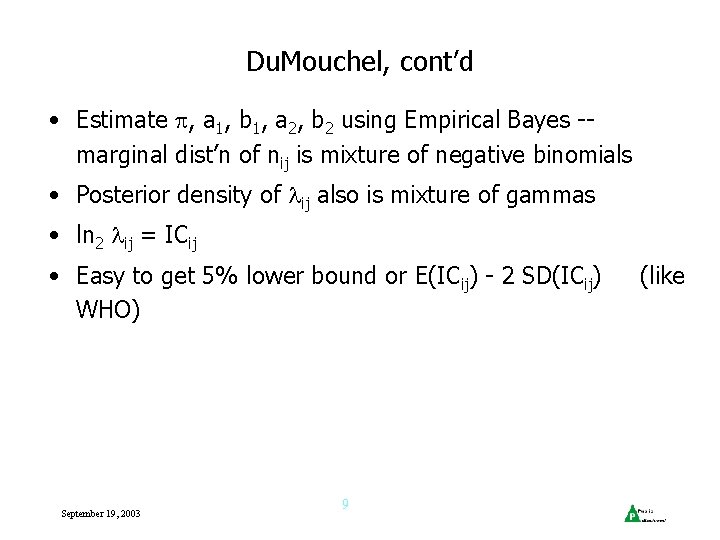
Du. Mouchel, cont’d • Estimate , a 1, b 1, a 2, b 2 using Empirical Bayes -marginal dist’n of nij is mixture of negative binomials • Posterior density of ij also is mixture of gammas • ln 2 ij = ICij • Easy to get 5% lower bound or E(ICij) - 2 SD(ICij) WHO) September 19, 2003 9 (like
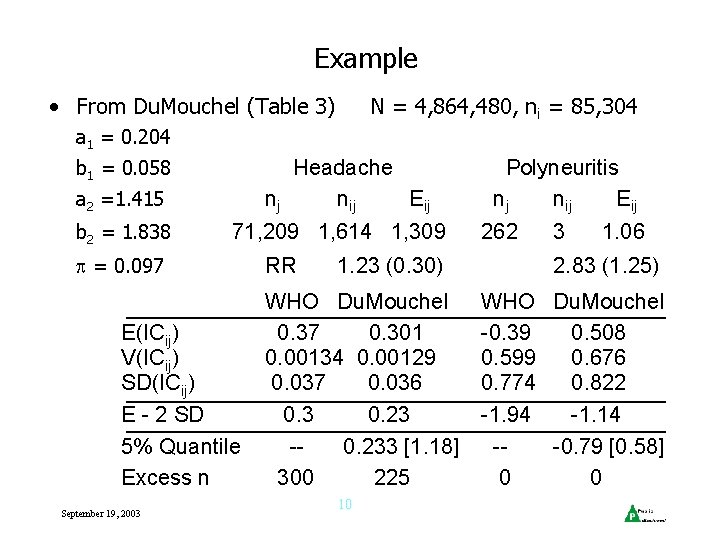
Example • From Du. Mouchel (Table 3) N = 4, 864, 480, ni = 85, 304 a 1 = 0. 204 b 1 = 0. 058 Headache nj nij Eij a 2 =1. 415 b 2 = 1. 838 71, 209 1, 614 1, 309 = 0. 097 E(ICij) V(ICij) SD(ICij) E - 2 SD 5% Quantile Excess n September 19, 2003 RR 1. 23 (0. 30) WHO Du. Mouchel 0. 37 0. 301 0. 00134 0. 00129 0. 037 0. 036 0. 3 0. 23 -0. 233 [1. 18] 300 225 10 Polyneuritis nj nij Eij 262 3 1. 06 2. 83 (1. 25) WHO Du. Mouchel -0. 39 0. 508 0. 599 0. 676 0. 774 0. 822 -1. 94 -1. 14 --0. 79 [0. 58] 0 0
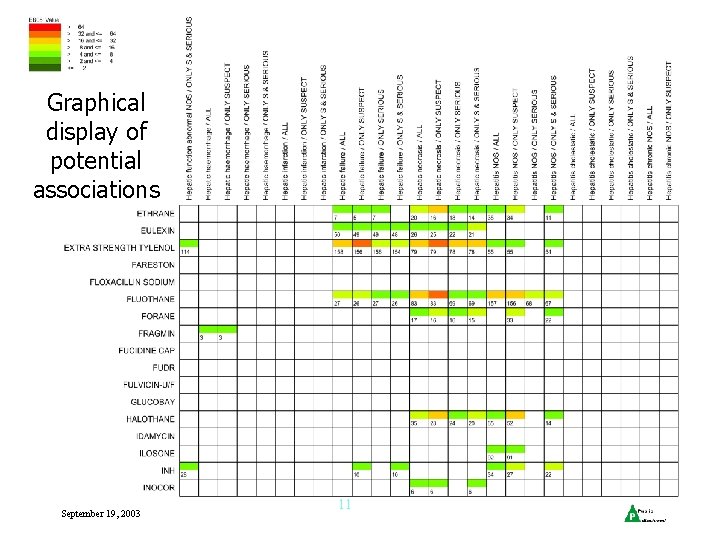
Graphical display of potential associations September 19, 2003 11
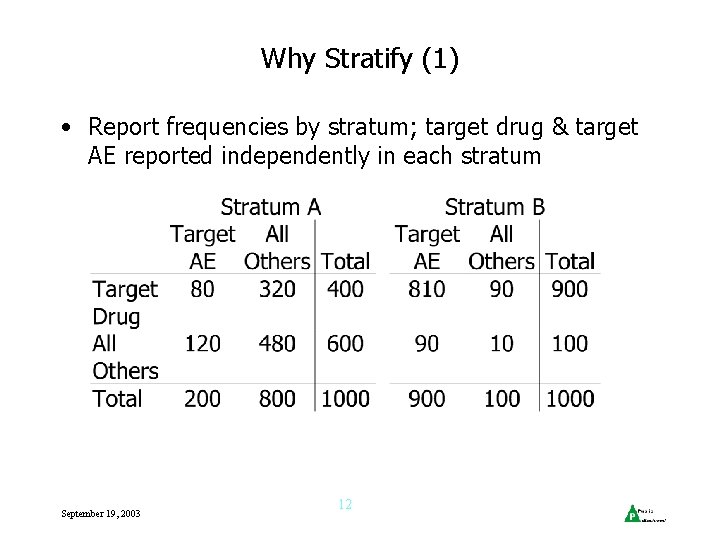
Why Stratify (1) • Report frequencies by stratum; target drug & target AE reported independently in each stratum September 19, 2003 12
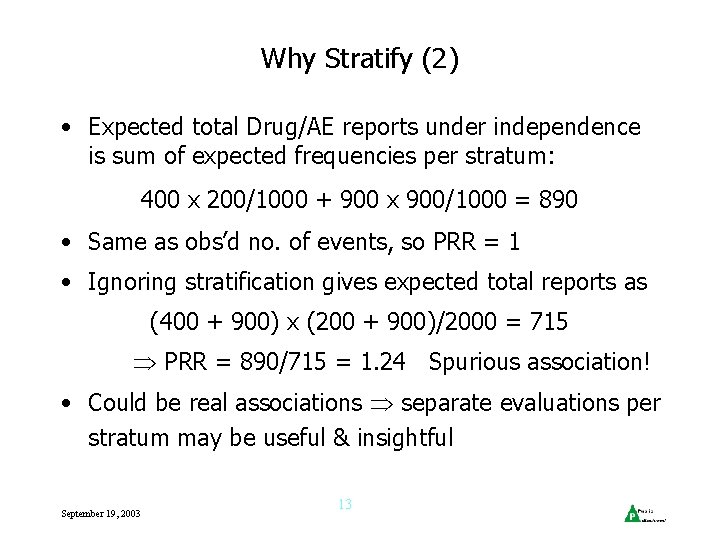
Why Stratify (2) • Expected total Drug/AE reports under independence is sum of expected frequencies per stratum: 400 x 200/1000 + 900 x 900/1000 = 890 • Same as obs’d no. of events, so PRR = 1 • Ignoring stratification gives expected total reports as (400 + 900) x (200 + 900)/2000 = 715 PRR = 890/715 = 1. 24 Spurious association! • Could be real associations separate evaluations per stratum may be useful & insightful September 19, 2003 13
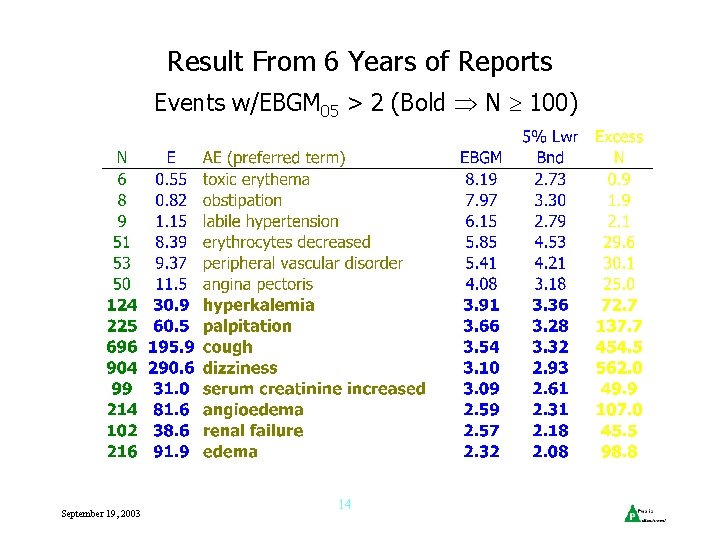
Result From 6 Years of Reports Events w/EBGM 05 > 2 (Bold N 100) September 19, 2003 14
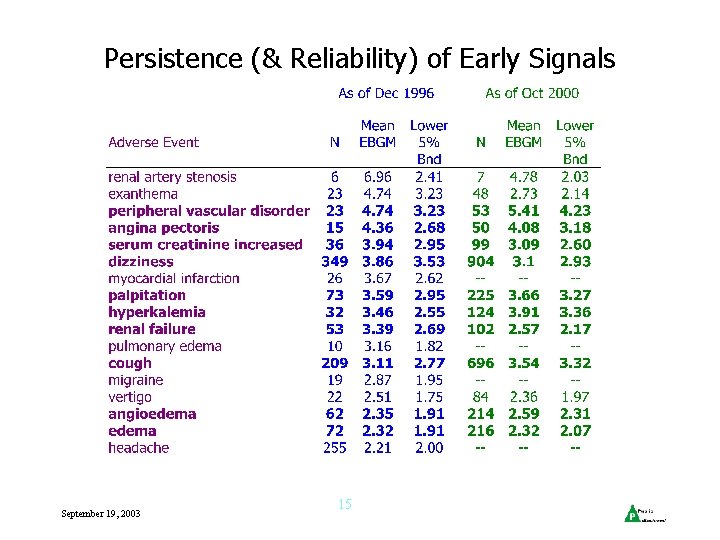
Persistence (& Reliability) of Early Signals September 19, 2003 15
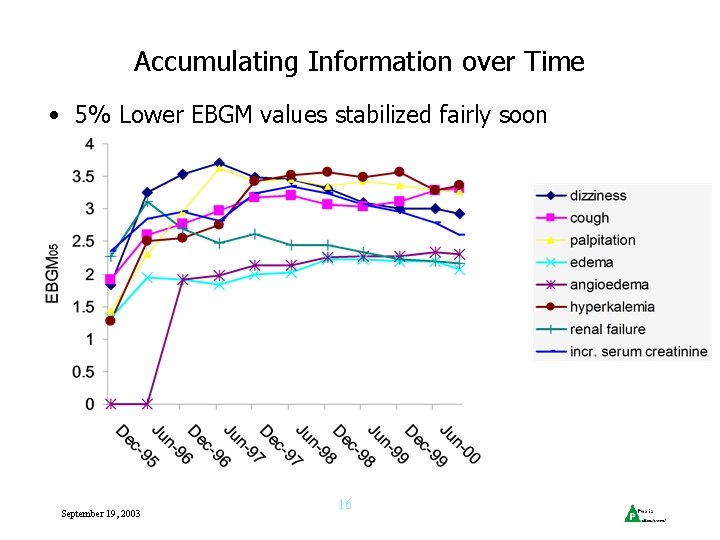
Accumulating Information over Time • 5% Lower EBGM values stabilized fairly soon September 19, 2003 16
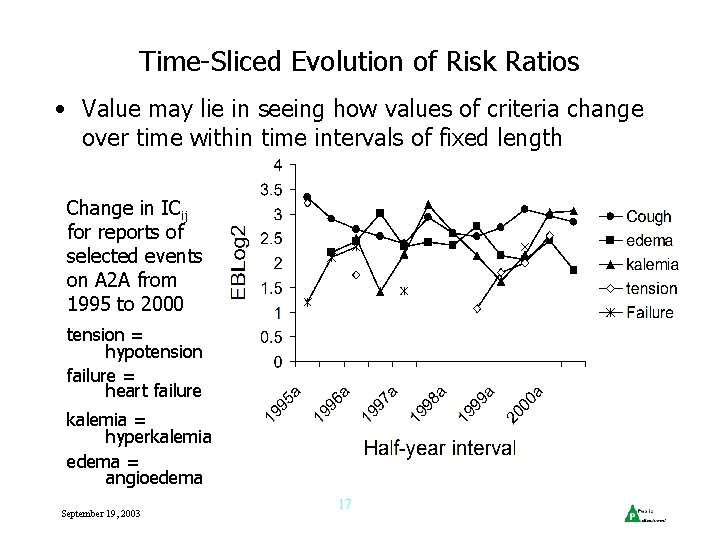
Time-Sliced Evolution of Risk Ratios • Value may lie in seeing how values of criteria change over time within time intervals of fixed length Change in ICij for reports of selected events on A 2 A from 1995 to 2000 tension = hypotension failure = heart failure kalemia = hyperkalemia edema = angioedema September 19, 2003 17
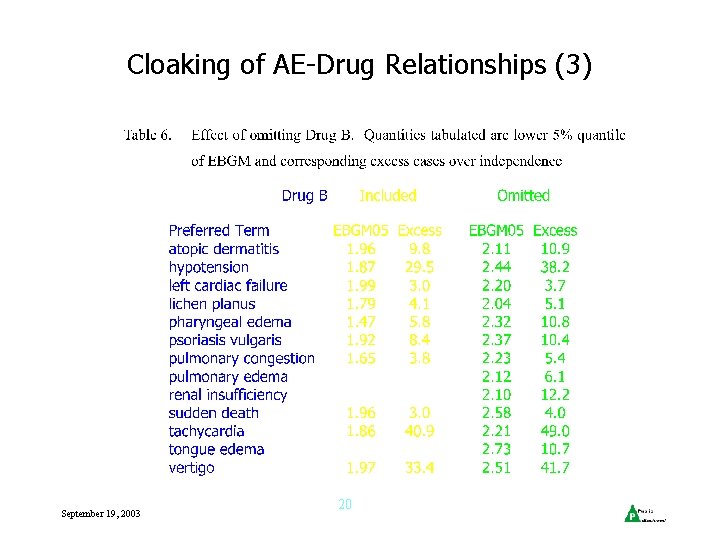
Cloaking of AE-Drug Relationships (1) • Company databases smaller than regulatory db, more loaded with ‘similar’ drugs • eg, Drug A is 2 nd generation version of Drug B, similar mechanism of action, many reports with B • Effect of B could mask effect of A • May be useful to provide results when reports mentioning Drug B are omitted September 19, 2003 18
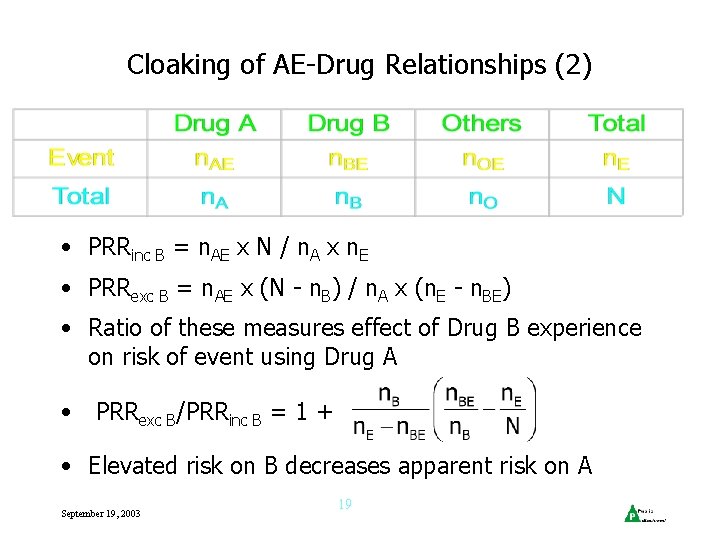
Cloaking of AE-Drug Relationships (2) • PRRinc B = n. AE x N / n. A x n. E • PRRexc B = n. AE x (N - n. B) / n. A x (n. E - n. BE) • Ratio of these measures effect of Drug B experience on risk of event using Drug A • PRRexc B/PRRinc B = 1 + • Elevated risk on B decreases apparent risk on A September 19, 2003 19
Cloaking of AE-Drug Relationships (3) • Examples September 19, 2003 20
Effect of Combinations of Drugs or Vaccines • GPS gives effect of individual drugs ignoring what else patient was taking • But combinations of drugs may increase risk more than just effects of individual drugs • FDA recognizes problem; multi-item version of GPS will be available soon (can purchase now) September 19, 2003 21
Discussion • Bayesian approaches useful for detecting possible emerging signals, espcially with few events, especially with precision is considered • MCA (UK) currently uses PRR for monitoring emergence of drug-event associations • Signal detection = a combination of numerical data screening and clinical judgement September 19, 2003 22
Discussion • Most apparent associations represent known problems • Some reflect disease or patient population • ~ 25% may represent signals about previously unknown associations • Statistical involvement in implementation & interpretation is important • The actual false positive rate is unknown as are the legal and resource implications September 19, 2003 23
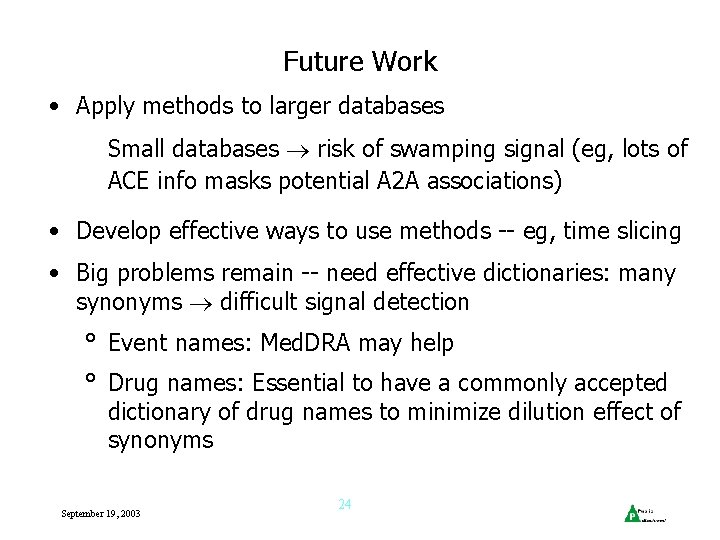
Future Work • Apply methods to larger databases Small databases risk of swamping signal (eg, lots of ACE info masks potential A 2 A associations) • Develop effective ways to use methods -- eg, time slicing • Big problems remain -- need effective dictionaries: many synonyms difficult signal detection ° Event names: Med. DRA may help ° Drug names: Essential to have a commonly accepted dictionary of drug names to minimize dilution effect of synonyms September 19, 2003 24
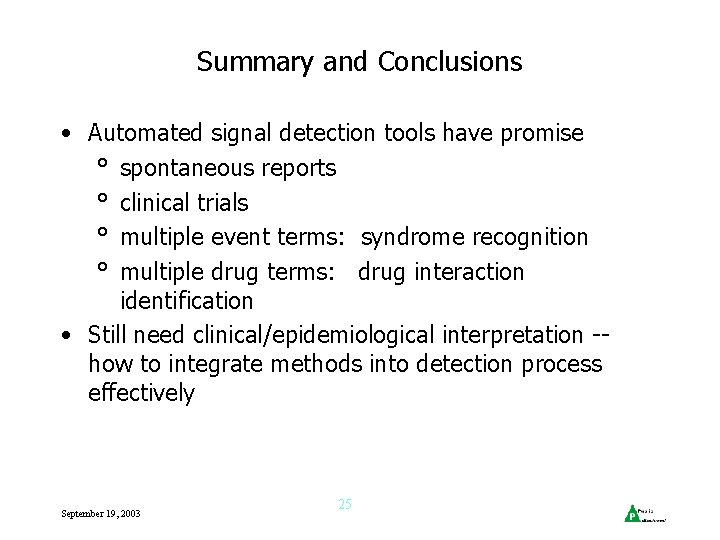
Summary and Conclusions • Automated signal detection tools have promise ° spontaneous reports ° clinical trials ° multiple event terms: syndrome recognition ° multiple drug terms: drug interaction identification • Still need clinical/epidemiological interpretation -how to integrate methods into detection process effectively September 19, 2003 25