
Perspective Structure from Motion Orthographic Perspective Last time


![Shape from Shading Results [Trucco & Verri]](https://slidetodoc.com/presentation_image_h2/43695d0bb0dd71b7e204f4c41814e83c/image-15.jpg "Shape from Shading Results [Trucco & Verri]")
![Photometric Stereo Setup [Rushmeier et al. , 1997]](https://slidetodoc.com/presentation_image_h2/43695d0bb0dd71b7e204f4c41814e83c/image-18.jpg "Photometric Stereo Setup [Rushmeier et al. , 1997]")

![Shape from Texture Results [Forsyth]](https://slidetodoc.com/presentation_image_h2/43695d0bb0dd71b7e204f4c41814e83c/image-24.jpg "Shape from Texture Results [Forsyth]")
- Slides: 24
Perspective Structure from Motion
Orthographic Perspective • Last time, considered weak perspective • With full perspective, can recover more information (translation along optical axis) • Result: can recover geometry and full motion up to global scale factor
Perspective SFM Methods • Bundle adjustment (full nonlinear minimization) • Methods based on factorization • Methods based on fundamental matrices • Methods based on vanishing points
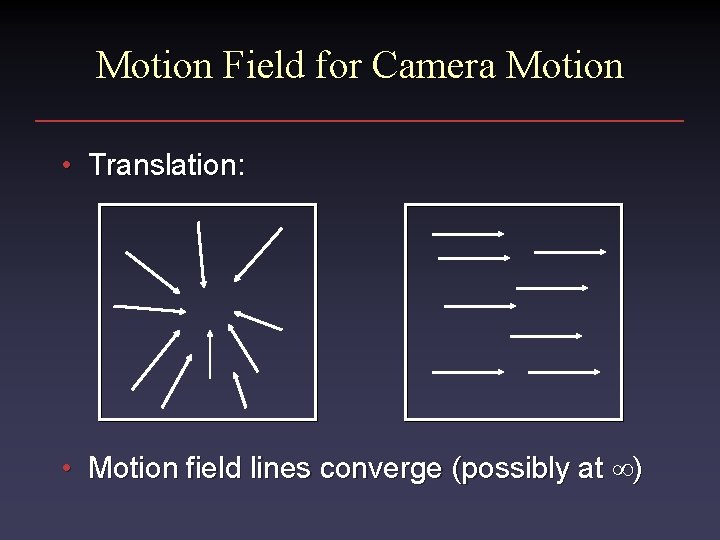
Motion Field for Camera Motion • Translation: • Motion field lines converge (possibly at )
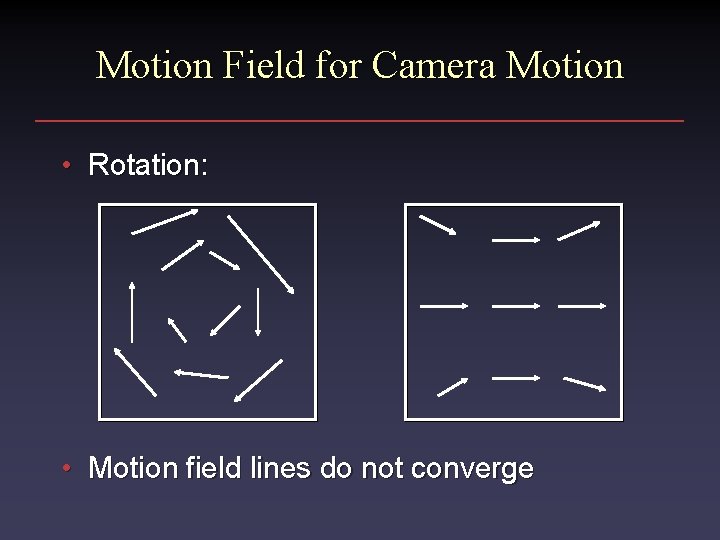
Motion Field for Camera Motion • Rotation: • Motion field lines do not converge
Motion Field for Camera Motion • Combined rotation and translation: motion field lines have component that converges, and component that does not • Algorithms can look for vanishing point, then determine component of motion around this point • “Focus of expansion / contraction” • “Instantaneous epipole”
SFM Algorithm • Compute optical flow • Find vanishing point (least squares solution) • Find direction of translation from epipole • Find perpendicular component of motion • Find velocity, axis of rotation • Find depths of points (up to global scale)
Shape from Shading and Texture
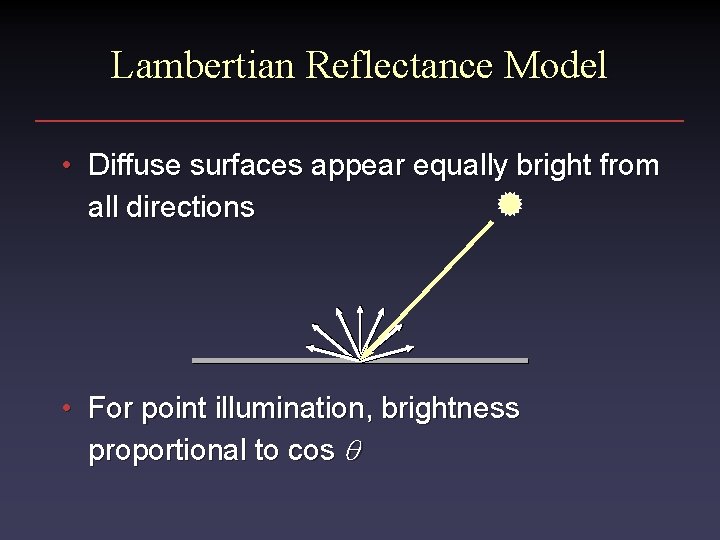
Lambertian Reflectance Model • Diffuse surfaces appear equally bright from all directions • For point illumination, brightness proportional to cos q
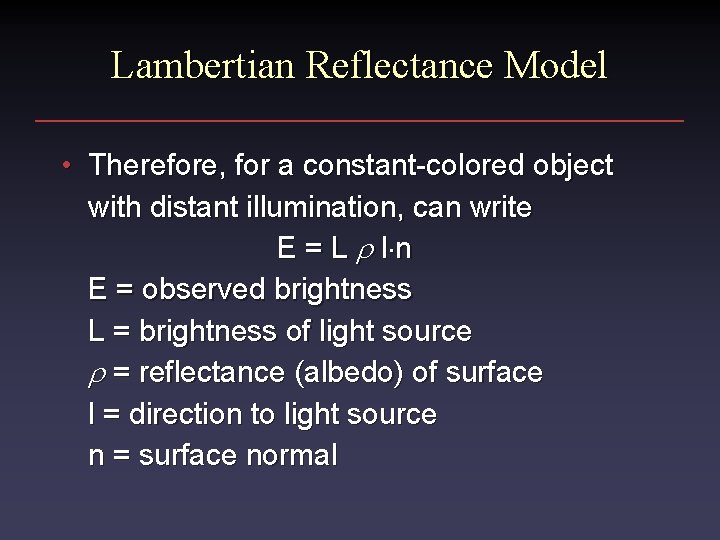
Lambertian Reflectance Model • Therefore, for a constant-colored object with distant illumination, can write E = L r l n E = observed brightness L = brightness of light source r = reflectance (albedo) of surface l = direction to light source n = surface normal
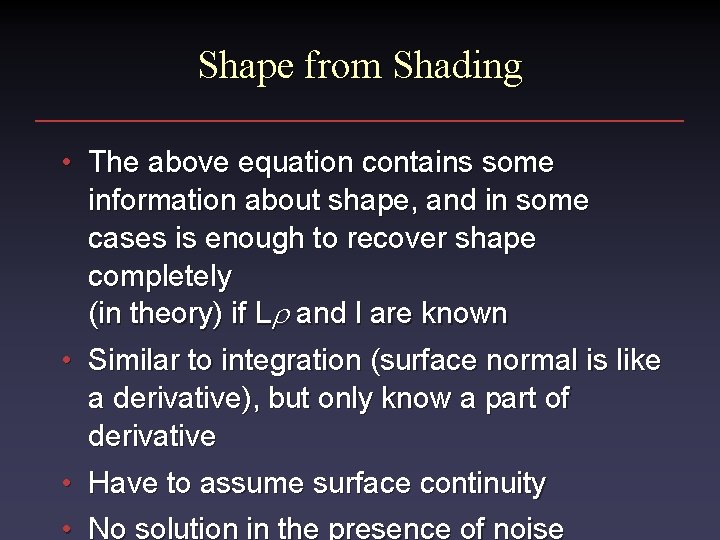
Shape from Shading • The above equation contains some information about shape, and in some cases is enough to recover shape completely (in theory) if Lr and l are known • Similar to integration (surface normal is like a derivative), but only know a part of derivative • Have to assume surface continuity • No solution in the presence of noise
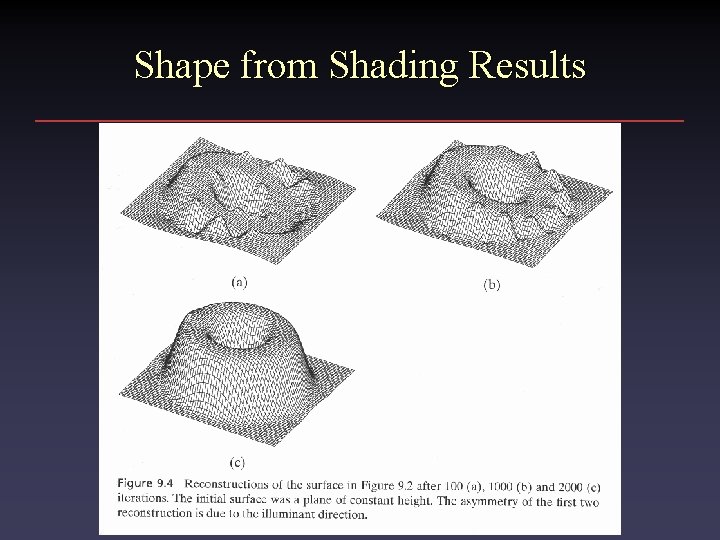
Variational Shape from Shading • Approach: energy minimization • Given observed E(x, y), find shape z(x, y) that minimizes energy where
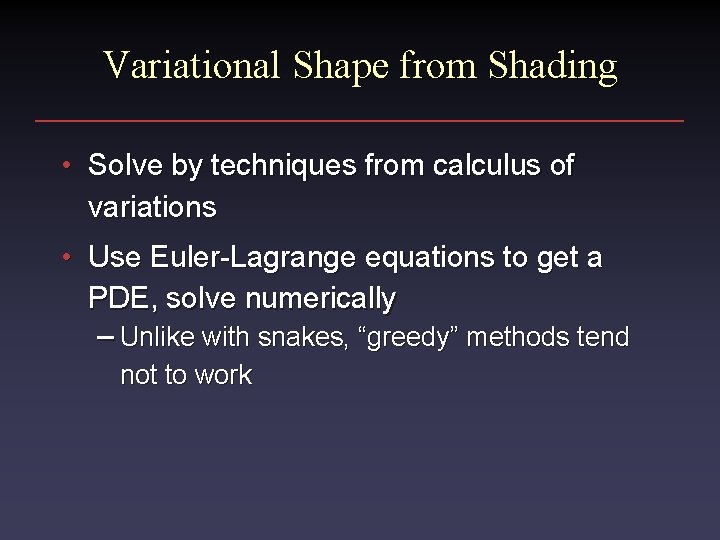
Variational Shape from Shading • Solve by techniques from calculus of variations • Use Euler-Lagrange equations to get a PDE, solve numerically – Unlike with snakes, “greedy” methods tend not to work
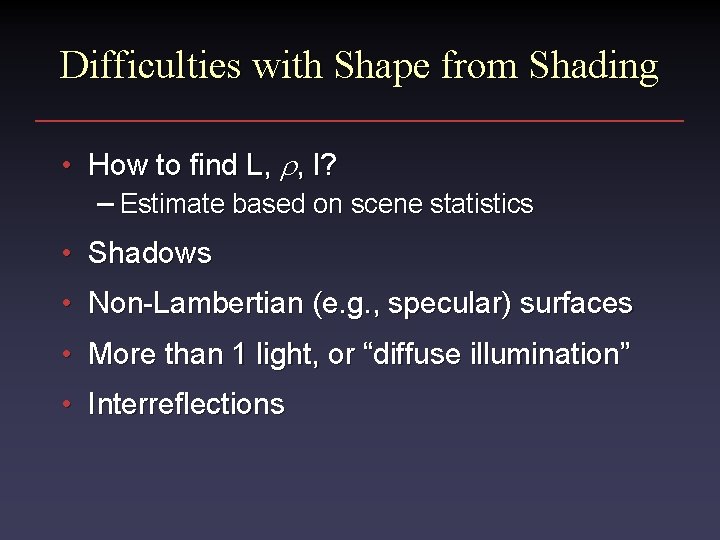
Difficulties with Shape from Shading • How to find L, r, l? – Estimate based on scene statistics • Shadows • Non-Lambertian (e. g. , specular) surfaces • More than 1 light, or “diffuse illumination” • Interreflections
Shape from Shading Results [Trucco & Verri]
Shape from Shading Results
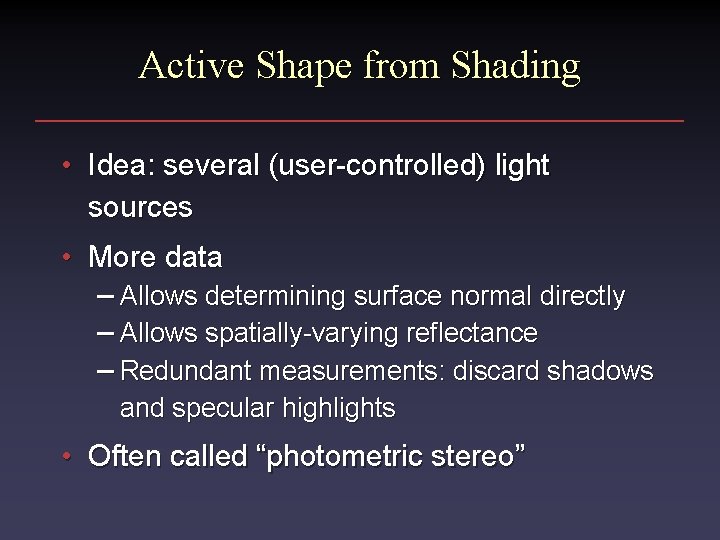
Active Shape from Shading • Idea: several (user-controlled) light sources • More data – Allows determining surface normal directly – Allows spatially-varying reflectance – Redundant measurements: discard shadows and specular highlights • Often called “photometric stereo”
Photometric Stereo Setup [Rushmeier et al. , 1997]
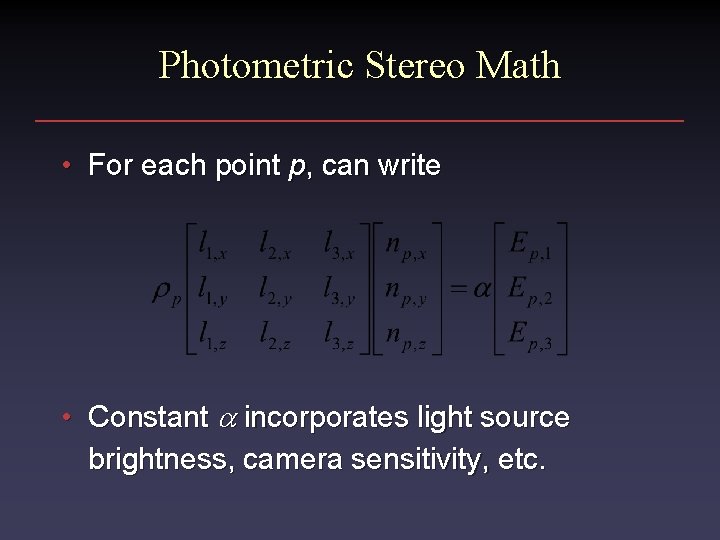
Photometric Stereo Math • For each point p, can write • Constant a incorporates light source brightness, camera sensitivity, etc.
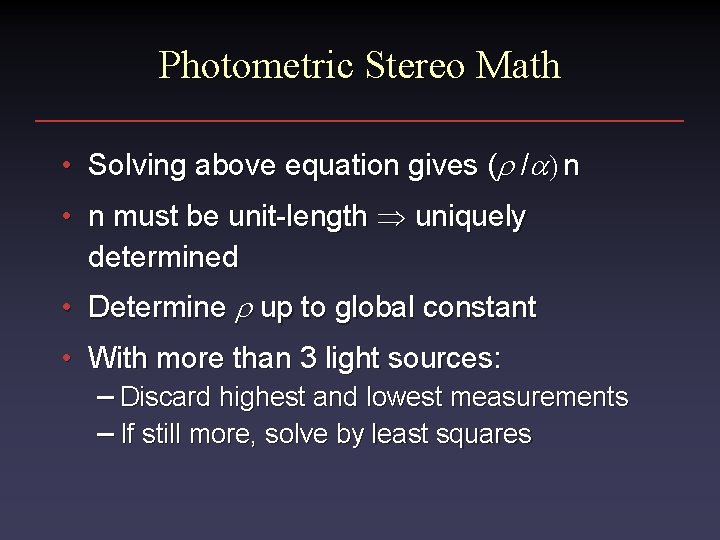
Photometric Stereo Math • Solving above equation gives (r /a) n • n must be unit-length uniquely determined • Determine r up to global constant • With more than 3 light sources: – Discard highest and lowest measurements – If still more, solve by least squares
Photometric Stereo Results Recovered normals (re-lit) Input images Recovered color [Rushmeier et al. , 1997]
Texture • Texture: repeated pattern on a surface • Elements (“textons”) either identical or come from some statistical distribution • Shape from texture comes from looking at deformation of individual textons or from distribution of textons on a surface
Shape from Texture • Much the same as shape from shading, but have more information – Foreshortening: gives surface normal (not just one component, as in shape from shading) – Perspective distortion: gives information about depth directly • Sparse depth information (only at textons) – About the same as shape from shading, because of smoothness term in energy eqn.
Shape from Texture Results [Forsyth]