
Perspective of Learners in ODL Problems and Prospective

Perspective of Learners’ in ODL: Problems and Prospective PRESENTER/AUTHOR: SIDRA IFTIKHAR (sidraiftikharaiou@gmail. com) CO/AUTHOR: DR. FARKHUNDA RASHEED CH. (farkhunda. rasheed@aiou. edu. pk) SCIENCE EDUCATION DEPARTMENT, ALLAMA IQBAL OPEN UNIVERSITY, ISLAMABAD
Introduction In recent times, ODL system is providing opportunities to more and more people to pursue higher education. The ODL system is now emerging as the imperative learning need because it bears the potential to supplement educational demands of the fast changing technological era. Open distance learning can be conceived by different words such as correspondence education, home study, independent study, external studies, continuing education, distance teaching, selfinstruction, adult education, technology-based or mediated education, learner-centered education, open learning, open access, flexible learning, and distributed learning.
Current Scenario of Open Distance Learning in Pakistan In the educational context of Pakistan, there are mainly two prominent ODL institutes namely Allama Iqbal Open University and Virtual University. The main functionality of ODL system is the delivery of education anywhere. ODL system of AIOU in Pakistan is combining ICT-based programs that comprises internet based programs along with face-to-face teaching (Bughio, Abro, & Rashdi, 2014) and LMS to reach massive quantity of learners. Virtual university provides education to far enough places without any boundary constraint. Literature shows that the ODL system particularly AIOU assumed greater prominence for improving literacy rate, minimizing dropouts due to whatever reasons, and poverty elimination in rural areas of Pakistan.
Statement of the Problem Open distance learning has been emerging as a crucial need of this era. It became very important in the scenario when ODL is going to transform the educational scenario of this technological era to seriously review the perspectives of ODL from the end users. It is very important step to improve the quality of ODL system. Open and distance universities are serving as the practical and applicable platforms with wide variation of end users’ capabilities. Therefore, ODL is not free from problems. This study has been carried out to sought for the problems and the possible prospective to improve the quality of education through distance learning.
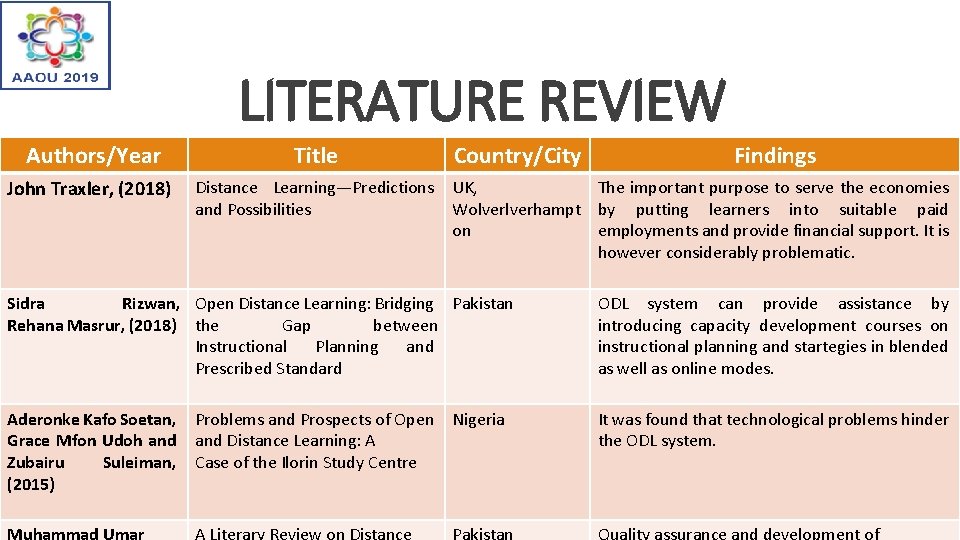
LITERATURE REVIEW Authors/Year Title John Traxler, (2018) Distance Learning—Predictions and Possibilities Country/City Findings UK, The important purpose to serve the economies Wolverhampt by putting learners into suitable paid on employments and provide financial support. It is however considerably problematic. Sidra Rizwan, Open Distance Learning: Bridging Pakistan Rehana Masrur, (2018) the Gap between Instructional Planning and Prescribed Standard ODL system can provide assistance by introducing capacity development courses on instructional planning and startegies in blended as well as online modes. Aderonke Kafo Soetan, Grace Mfon Udoh and Zubairu Suleiman, (2015) It was found that technological problems hinder the ODL system. Problems and Prospects of Open and Distance Learning: A Case of the Ilorin Study Centre Nigeria
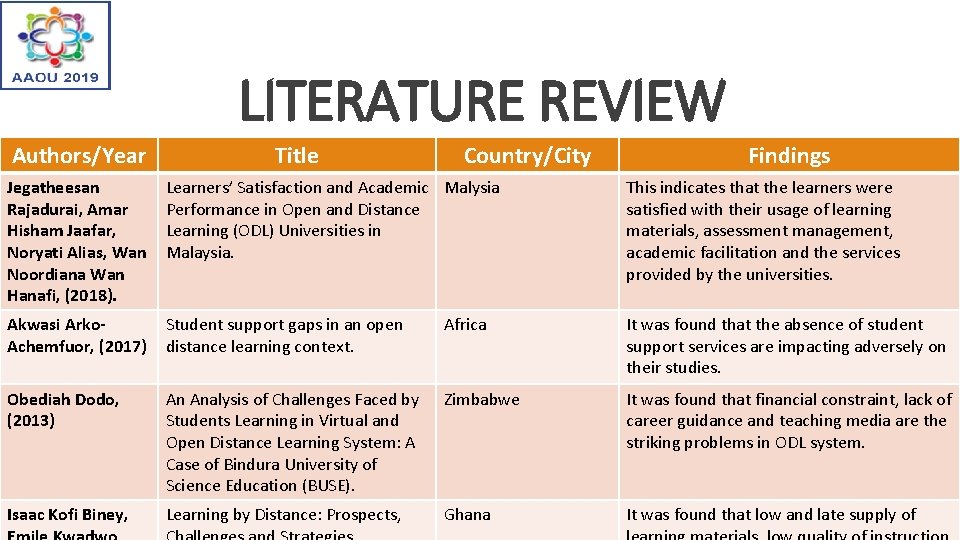
LITERATURE REVIEW Authors/Year Title Country/City Findings Jegatheesan Rajadurai, Amar Hisham Jaafar, Noryati Alias, Wan Noordiana Wan Hanafi, (2018). Learners’ Satisfaction and Academic Malysia Performance in Open and Distance Learning (ODL) Universities in Malaysia. This indicates that the learners were satisfied with their usage of learning materials, assessment management, academic facilitation and the services provided by the universities. Akwasi Arko. Achemfuor, (2017) Student support gaps in an open distance learning context. Africa It was found that the absence of student support services are impacting adversely on their studies. Obediah Dodo, (2013) An Analysis of Challenges Faced by Students Learning in Virtual and Open Distance Learning System: A Case of Bindura University of Science Education (BUSE). Zimbabwe It was found that financial constraint, lack of career guidance and teaching media are the striking problems in ODL system. Isaac Kofi Biney, Learning by Distance: Prospects, Ghana It was found that low and late supply of
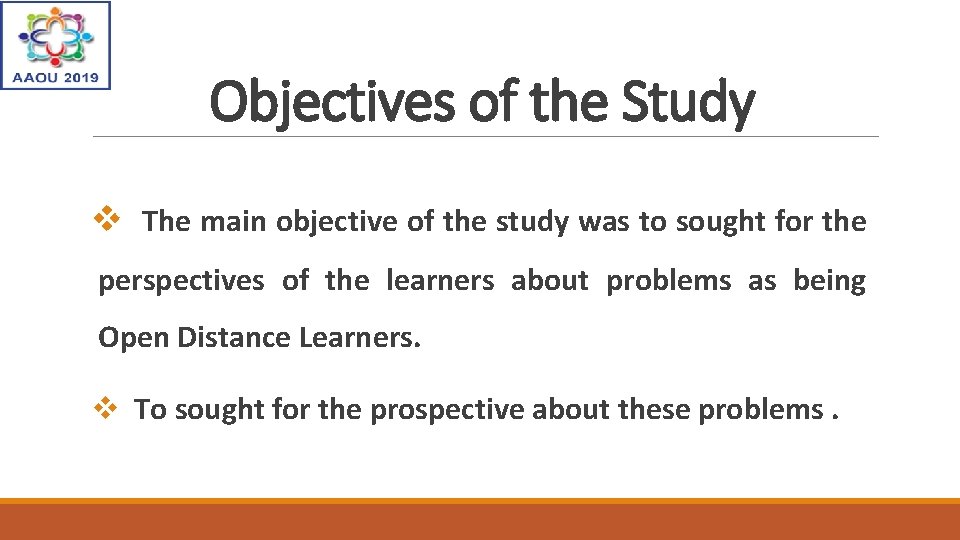
Objectives of the Study v The main objective of the study was to sought for the perspectives of the learners about problems as being Open Distance Learners. v To sought for the prospective about these problems.
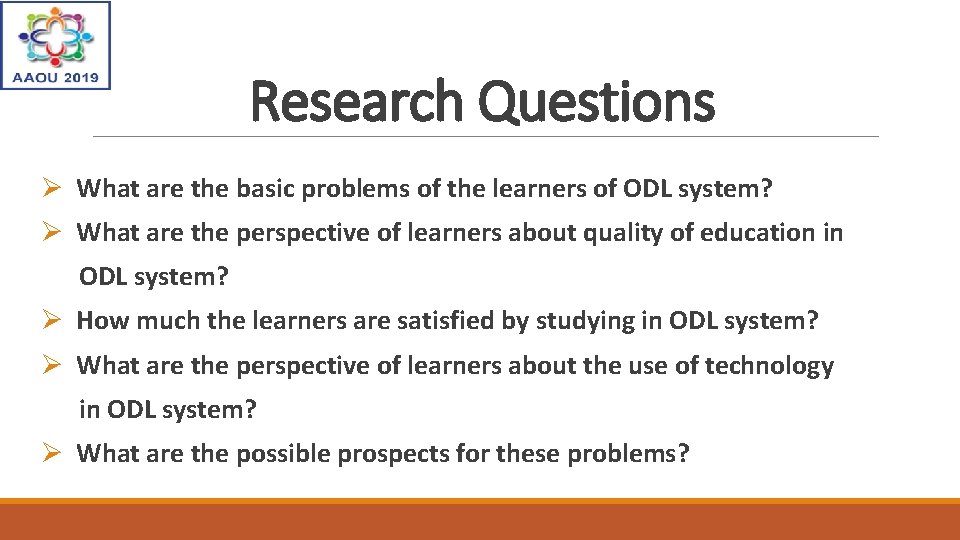
Research Questions Ø What are the basic problems of the learners of ODL system? Ø What are the perspective of learners about quality of education in ODL system? Ø How much the learners are satisfied by studying in ODL system? Ø What are the perspective of learners about the use of technology in ODL system? Ø What are the possible prospects for these problems?
Limitations of the Study By safekeeping the time and resources, the extension of the proposed study is restricted in some domains that can be explained as following. • The study has been restrained to Islamabad city only. • The study has been executed to the ODL learners of Allama Iqbal Open University. • The post graduate students were participated in the study.
Research Methodology ØResearch Design Mixed Method Research design was used. ØPopulation Students enrolled in Post graduate courses of all semesters in Allama Iqbal Open University of Islamabad city comprises the population of the study. ØSample and Sampling Technique 70 students of post graduate courses were the sample for the study that were conveniently selected. The students were asked to participate in this research. The students who are willing to fill the questionnaire was served as the sample of the study.
Research Instrument Ø A research questionnaire was served as the instrument of the research that was distributed to the participants online. The questionnaire was created by using Google forms and the link of this questionnaire was sent to the participants. Ø Validity Content and Face validity was ensured by scrutinizing the initial drafts of the questionnaire by from experts. Ø Reliability The overall reliability of the tool was 0. 755 and 30 participants were participated to collect the responses that were further requested to not participate in the final data collection.
Detail of Instrument q The instrument has two sections. q First section comprises of closed ended statements with 30 items based on certain constructs to sought the perspective of learners about problems of ODL system. The 5 -point Likert Scale was used to code the items. q The second section comprises of open ended questions with 3 items to sought for the possible prospective from the learners for these constructs.
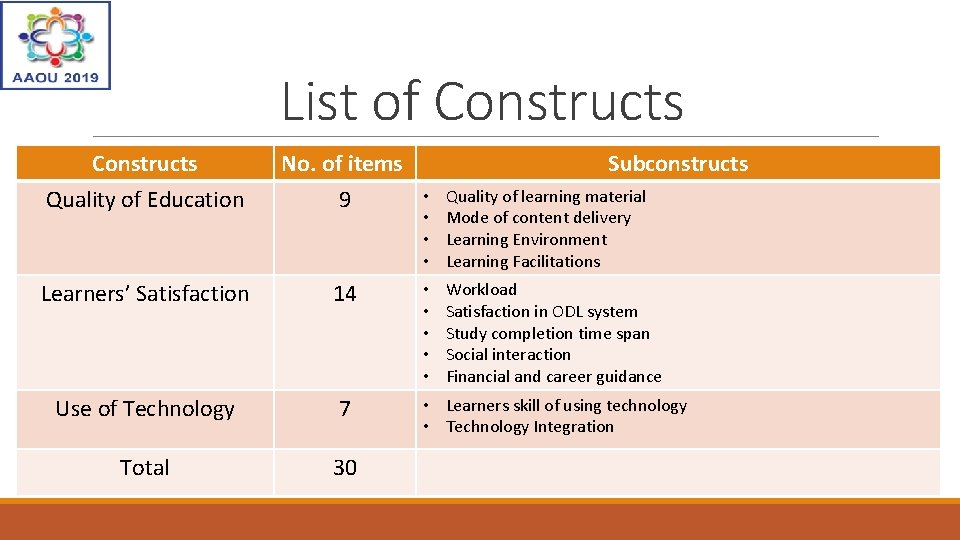
List of Constructs § Constructs Quality of Education No. of items 9 Learners’ Satisfaction 14 Use of Technology 7 Total 30 Subconstructs • • Quality of learning material Mode of content delivery Learning Environment Learning Facilitations • • • Workload Satisfaction in ODL system Study completion time span Social interaction Financial and career guidance • Learners skill of using technology • Technology Integration
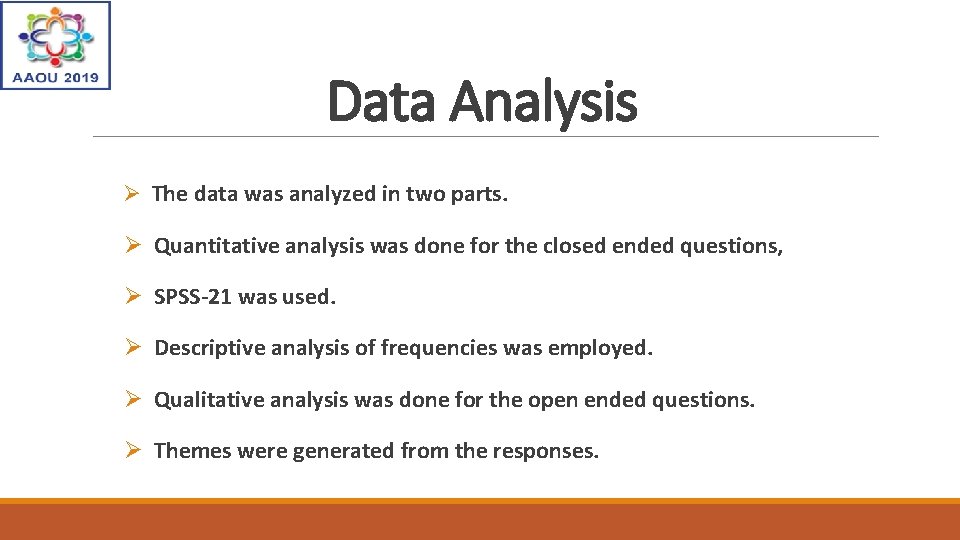
Data Analysis Ø The data was analyzed in two parts. Ø Quantitative analysis was done for the closed ended questions, Ø SPSS-21 was used. Ø Descriptive analysis of frequencies was employed. Ø Qualitative analysis was done for the open ended questions. Ø Themes were generated from the responses.
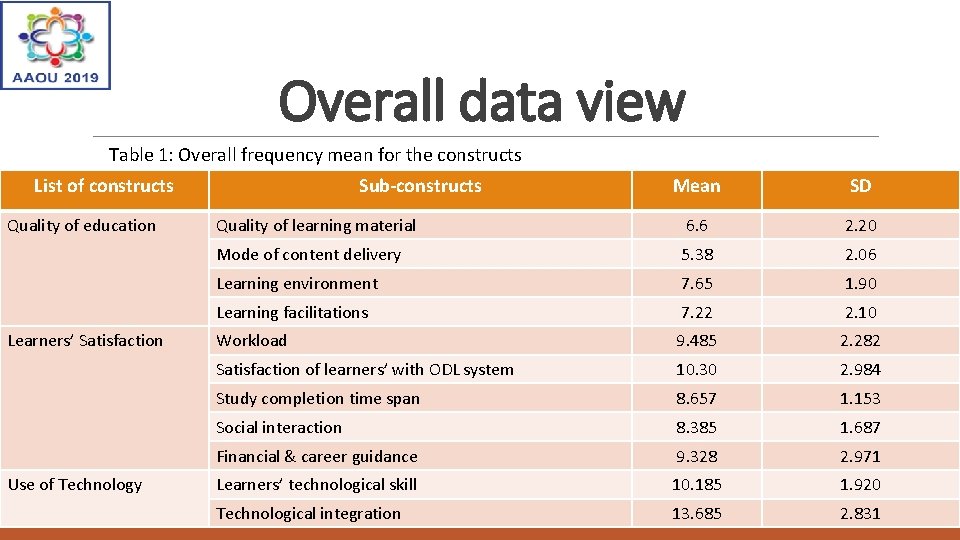
Overall data view Table 1: Overall frequency mean for the constructs List of constructs Quality of education Learners’ Satisfaction Use of Technology Sub-constructs Mean SD Quality of learning material 6. 6 2. 20 Mode of content delivery 5. 38 2. 06 Learning environment 7. 65 1. 90 Learning facilitations 7. 22 2. 10 Workload 9. 485 2. 282 Satisfaction of learners’ with ODL system 10. 30 2. 984 Study completion time span 8. 657 1. 153 Social interaction 8. 385 1. 687 Financial & career guidance 9. 328 2. 971 Learners’ technological skill 10. 185 1. 920 Technological integration 13. 685 2. 831
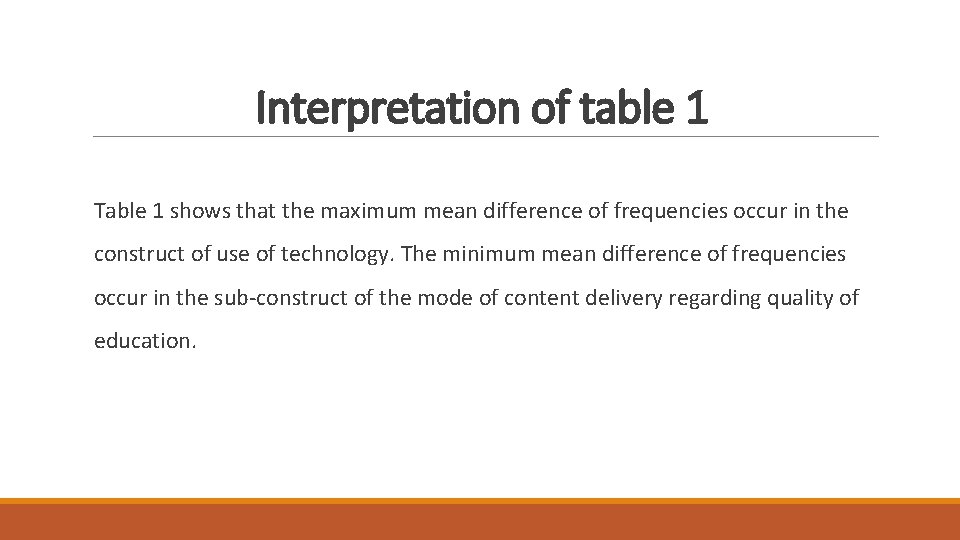
Interpretation of table 1 Table 1 shows that the maximum mean difference of frequencies occur in the construct of use of technology. The minimum mean difference of frequencies occur in the sub-construct of the mode of content delivery regarding quality of education.
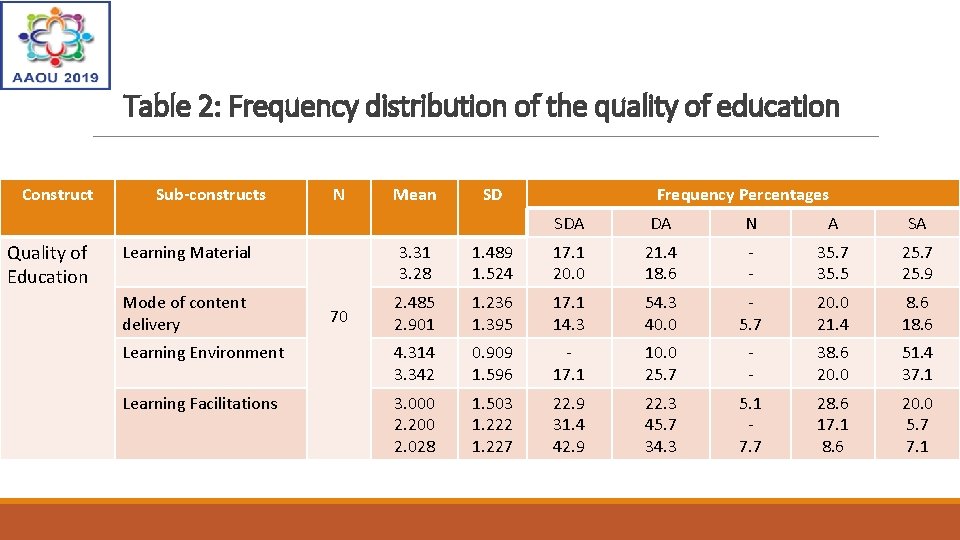
Table 2: Frequency distribution of the quality of education Construct Quality of Education Sub-constructs N Mean SD Frequency Percentages SDA DA N A SA Learning Material 3. 31 3. 28 1. 489 1. 524 17. 1 20. 0 21. 4 18. 6 - 35. 7 35. 5 25. 7 25. 9 Mode of content delivery 2. 485 2. 901 1. 236 1. 395 17. 1 14. 3 54. 3 40. 0 5. 7 20. 0 21. 4 8. 6 18. 6 Learning Environment 4. 314 3. 342 0. 909 1. 596 17. 1 10. 0 25. 7 - 38. 6 20. 0 51. 4 37. 1 Learning Facilitations 3. 000 2. 200 2. 028 1. 503 1. 222 1. 227 22. 9 31. 4 42. 9 22. 3 45. 7 34. 3 5. 1 7. 7 28. 6 17. 1 8. 6 20. 0 5. 7 7. 1 70
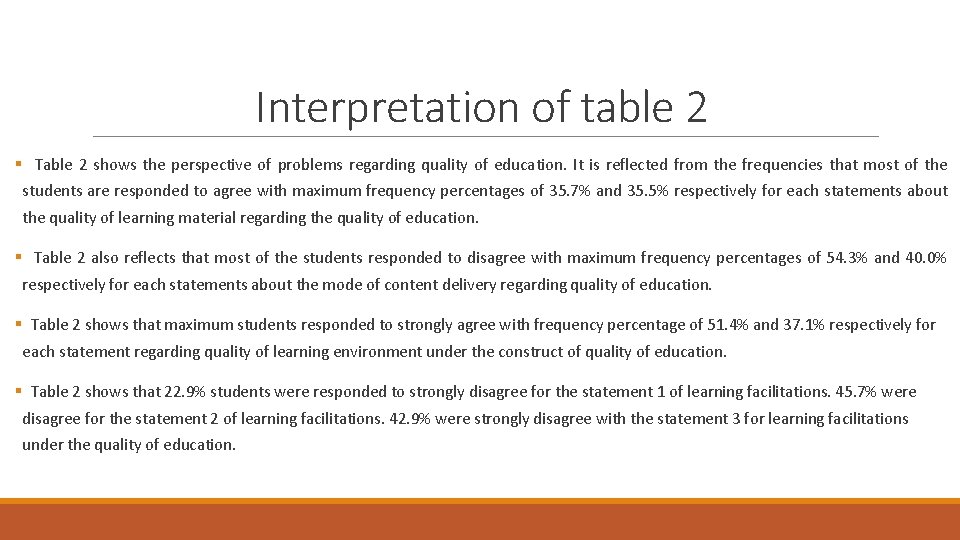
Interpretation of table 2 § Table 2 shows the perspective of problems regarding quality of education. It is reflected from the frequencies that most of the students are responded to agree with maximum frequency percentages of 35. 7% and 35. 5% respectively for each statements about the quality of learning material regarding the quality of education. § Table 2 also reflects that most of the students responded to disagree with maximum frequency percentages of 54. 3% and 40. 0% respectively for each statements about the mode of content delivery regarding quality of education. § Table 2 shows that maximum students responded to strongly agree with frequency percentage of 51. 4% and 37. 1% respectively for each statement regarding quality of learning environment under the construct of quality of education. § Table 2 shows that 22. 9% students were responded to strongly disagree for the statement 1 of learning facilitations. 45. 7% were disagree for the statement 2 of learning facilitations. 42. 9% were strongly disagree with the statement 3 for learning facilitations under the quality of education.
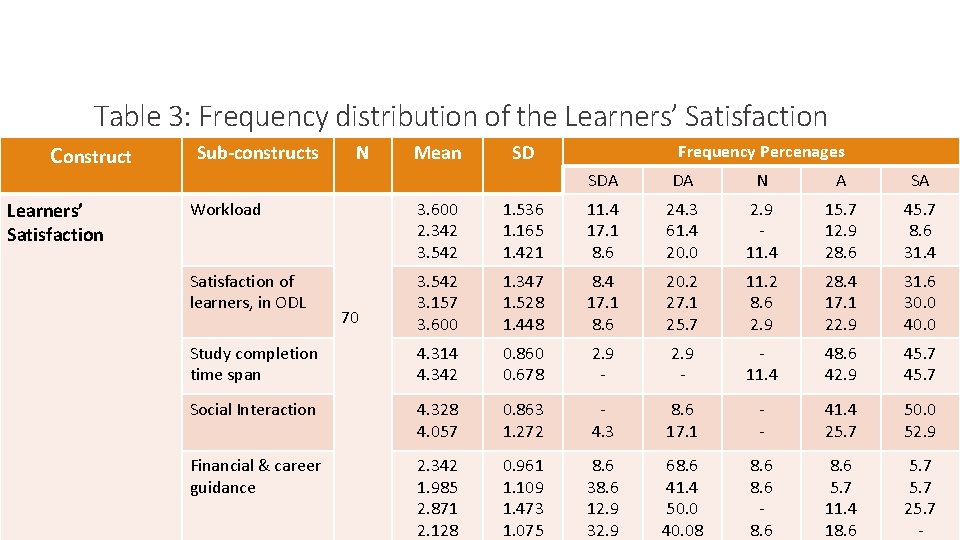
Table 3: Frequency distribution of the Learners’ Satisfaction Construct Learners’ Satisfaction Sub-constructs N Mean SD Frequency Percenages SDA DA N A SA Workload 3. 600 2. 342 3. 542 1. 536 1. 165 1. 421 11. 4 17. 1 8. 6 24. 3 61. 4 20. 0 2. 9 11. 4 15. 7 12. 9 28. 6 45. 7 8. 6 31. 4 Satisfaction of learners, in ODL 3. 542 3. 157 3. 600 1. 347 1. 528 1. 448 8. 4 17. 1 8. 6 20. 2 27. 1 25. 7 11. 2 8. 6 2. 9 28. 4 17. 1 22. 9 31. 6 30. 0 40. 0 Study completion time span 4. 314 4. 342 0. 860 0. 678 2. 9 - 11. 4 48. 6 42. 9 45. 7 Social Interaction 4. 328 4. 057 0. 863 1. 272 4. 3 8. 6 17. 1 - 41. 4 25. 7 50. 0 52. 9 Financial & career guidance 2. 342 1. 985 2. 871 2. 128 0. 961 1. 109 1. 473 1. 075 8. 6 38. 6 12. 9 32. 9 68. 6 41. 4 50. 0 40. 08 8. 6 5. 7 11. 4 18. 6 5. 7 25. 7 - 70
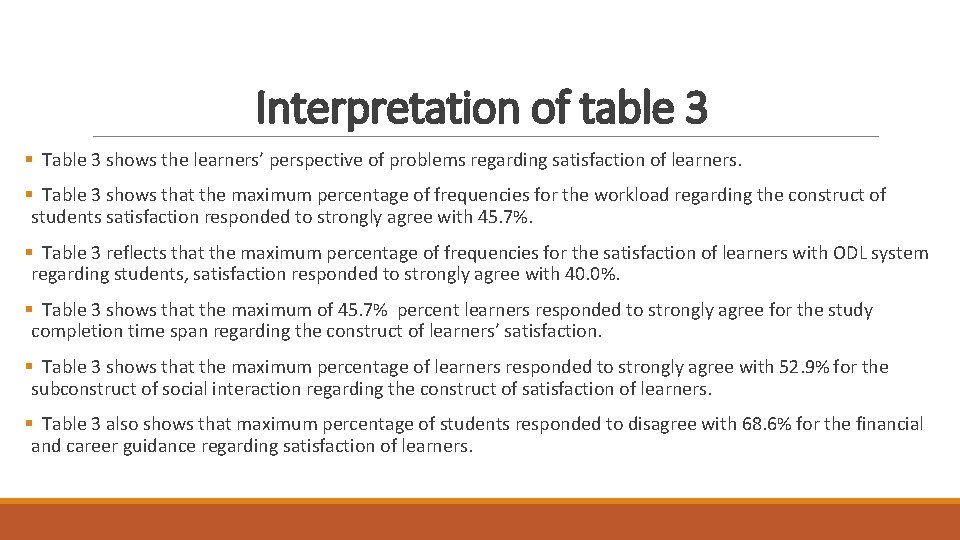
Interpretation of table 3 § Table 3 shows the learners’ perspective of problems regarding satisfaction of learners. § Table 3 shows that the maximum percentage of frequencies for the workload regarding the construct of students satisfaction responded to strongly agree with 45. 7%. § Table 3 reflects that the maximum percentage of frequencies for the satisfaction of learners with ODL system regarding students, satisfaction responded to strongly agree with 40. 0%. § Table 3 shows that the maximum of 45. 7% percent learners responded to strongly agree for the study completion time span regarding the construct of learners’ satisfaction. § Table 3 shows that the maximum percentage of learners responded to strongly agree with 52. 9% for the subconstruct of social interaction regarding the construct of satisfaction of learners. § Table 3 also shows that maximum percentage of students responded to disagree with 68. 6% for the financial and career guidance regarding satisfaction of learners.
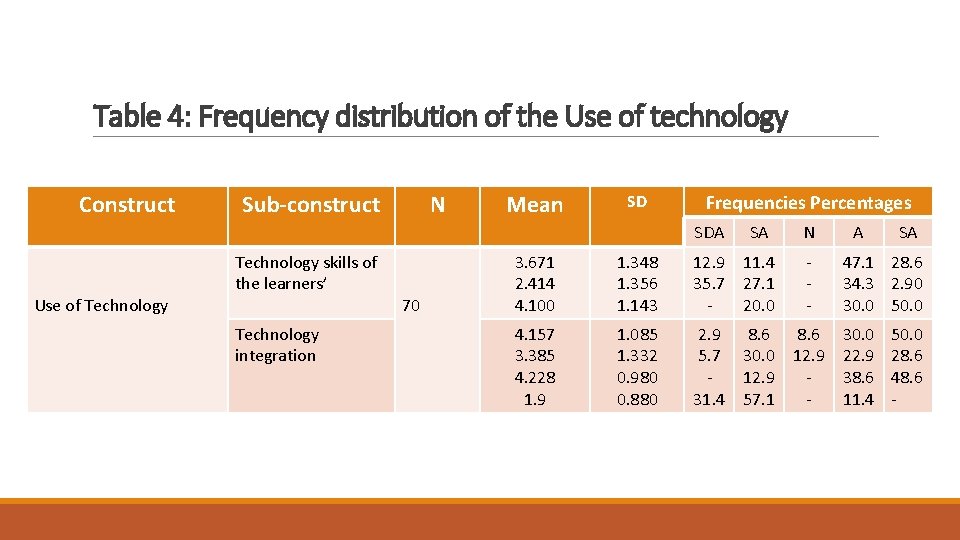
Table 4: Frequency distribution of the Use of technology Construct Sub-construct N Mean SD Frequencies Percentages SDA Use of Technology skills of the learners’ Technology integration 70 SA N - A SA 3. 671 2. 414 4. 100 1. 348 1. 356 1. 143 12. 9 11. 4 35. 7 27. 1 20. 0 47. 1 28. 6 34. 3 2. 90 30. 0 50. 0 4. 157 3. 385 4. 228 1. 9 1. 085 1. 332 0. 980 0. 880 2. 9 8. 6 30. 0 5. 7 30. 0 12. 9 28. 6 12. 9 38. 6 48. 6 31. 4 57. 1 11. 4 -
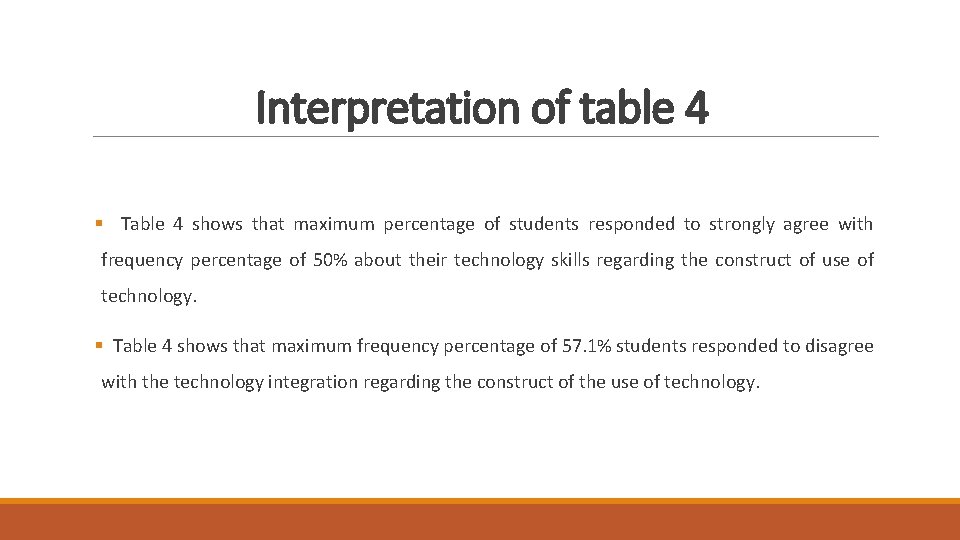
Interpretation of table 4 § Table 4 shows that maximum percentage of students responded to strongly agree with frequency percentage of 50% about their technology skills regarding the construct of use of technology. § Table 4 shows that maximum frequency percentage of 57. 1% students responded to disagree with the technology integration regarding the construct of the use of technology.
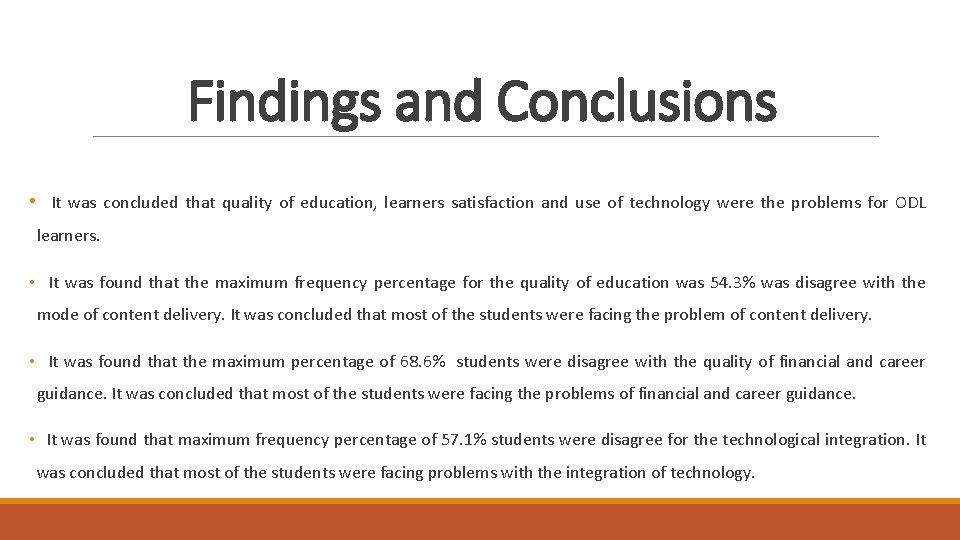
Findings and Conclusions • It was concluded that quality of education, learners satisfaction and use of technology were the problems for ODL learners. • It was found that the maximum frequency percentage for the quality of education was 54. 3% was disagree with the mode of content delivery. It was concluded that most of the students were facing the problem of content delivery. • It was found that the maximum percentage of 68. 6% students were disagree with the quality of financial and career guidance. It was concluded that most of the students were facing the problems of financial and career guidance. • It was found that maximum frequency percentage of 57. 1% students were disagree for the technological integration. It was concluded that most of the students were facing problems with the integration of technology.
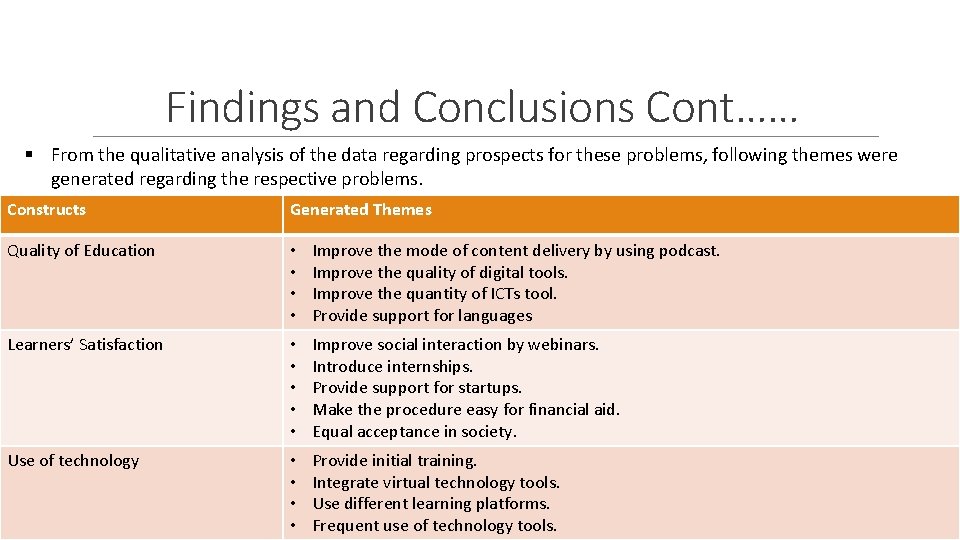
Findings and Conclusions Cont…… § From the qualitative analysis of the data regarding prospects for these problems, following themes were generated regarding the respective problems. Constructs Generated Themes Quality of Education • • Improve the mode of content delivery by using podcast. Improve the quality of digital tools. Improve the quantity of ICTs tool. Provide support for languages Learners’ Satisfaction • • • Improve social interaction by webinars. Introduce internships. Provide support for startups. Make the procedure easy for financial aid. Equal acceptance in society. Use of technology • • Provide initial training. Integrate virtual technology tools. Use different learning platforms. Frequent use of technology tools.

Thank you
- Slides: 26