
Persons with Developmental Disabilities Program PDD Abuse Prevention
Persons with Developmental Disabilities Program (PDD) Abuse Prevention and Response Protocol (APRP) Agency & FMS Staff Training 2016
Learning Objectives • To understand the purpose of Abuse Prevention and Response Protocol • To explain the scope of abuse situations • To understand the legislations associated with abuse situations (e. g. duty to report) • To identify when an abuse has occurred • To know how to respond when abuse is disclosed or suspected • To know how to report when abuse is suspected or has occurred 2
Overview of Changes Abuse Prevention and Response Protocol • • Enhancements to Prevention Clarity of Reporting Requirements Guidelines for Conducting Reviews Role of PDD Region - Response, follow-up and monitoring 3
APRP - Purpose • PDD stakeholders have a duty to ensure the safety of individuals they support • The Abuse Prevention and Response Protocol (APRP) provides information for PDD stakeholders to help them meet this duty • The Protocol outlines strategies for preventing abuse in addition to reporting, reviewing, and follow up requirements following allegation of abuse of individuals receiving PDD supports 4
Objectives of the Protocol Ensure accountability through a provincial approach to abuse response Ensure that all stakeholders are aware of their responsibilities in preventing abuse from occurring, and responding appropriately when there is incidence of abuse Promote a collaborative, community-based approach to addressing all aspects of abuse Ensure that clear accountability measures are in place 5
Responsibilities of Key Stakeholders • Ensure that Criminal Records Checks/Vulnerable Sector Checks for employees and contract workers who provide services to individuals is conducted • Ensure that individuals are safe and protected from abuse by staff 6

Responsibilities of Key Stakeholders Cont’d • Take action when abuse is reported, to ensure immediate safety, security, and wellbeing of the individual and any other person that may be at risk of being abused • Take appropriate actions to prevent future occurrences of abuse • Make available and/or participate in APRP training 7
How is Abuse Defined? Under the Abuse Prevention and Response Protocol, abuse occurs when a staff person, volunteer, contractor, or agent misuses their authority by acting in a way that causes harm or could potentially cause harm to an individual receiving PDD funded supports. 8
Categories of Abuse • • • Physical abuse Sexual abuse Emotional abuse Negligence Exploitation Inappropriate use of restrictive procedures 9
Critical Incidents • There abuse situations that are considered critical incidents • According to Critical Incident Reporting policy, physical and sexual abuse are critical incidents • Critical incident reporting is a Ministry process with steps to follow • Critical incidents that are also considered abuse must also be reported to the Region as part of the APRP process 10
Applying the Principles for Determining individual Support Needs Foundation Principle— individuals, with the assistance of their families and friends, are the primary source for identifying what is best for themselves and what kinds of support they require Supplementary Principle— Recognizing that many adults with developmental disabilities require the assistance of paid supports to live, work and participate in the community, supplementary principles have been identified to guide supports funded by PDD 11
Principles for Determining individual Support Needs Ø Supports assist individuals to be fully included and live meaningful lives in the community Ø Supports are adequate, flexible and individualized, while being responsive to personal and family changes, as well as community dynamics Ø Supports assist individuals to maintain and build their connections and relationships with family, friends and other community members and should not define all aspects of the person’s life 12
Principles for Determining individual Support Needs, Contd. Ø Supports recognize the potential of individuals and provide them with opportunities for continuing growth, personal development and life-long learning Ø Supports respond to the direction determined by individuals, their families and guardians, being careful to follow their lead, rather than taking control 13
Abuse Prevention • “Prevention” is a critical element in addressing the issue of abuse • Under the Protocol PDD key stakeholders should: – Promote prevention measures and inclusion – Promote sense of belonging and acceptance – Should reduce isolation and increase natural supports 14
Abuse Prevention Cont’d. – See gifts, capabilities and contributions of vulnerable populations – Tap into community capacity – Be aware that burnout, frustration and stress of your employees – Pay attention to your staff needs, workload, caregiver challenges, and personal issues that may affect their behaviours 15
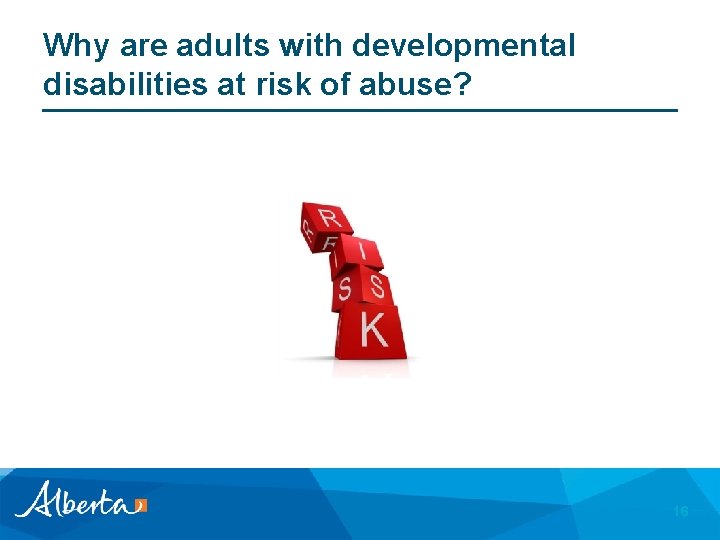
Why are adults with developmental disabilities at risk of abuse? 16
Understanding Vulnerabilities • • • Authority and Power imbalances Negative attitudes Learning to be compliant Isolation and protection Lack of knowledge about relationships and sexuality 17
How to Reduce Vulnerabilities Seeing people from a positive perspective of capacities and gifts, not deficits and needs Striving for a quality life, which is defined by the person based on interests, dreams and desires Being involved in the community, where people can get to know the person Supporting the individual to lead, with the support of families and having paid staff play a support role to the extent necessary Assisting individuals with developmental disabilities to understand their right to be treated with dignity and respect, how to recognize abuse and know what action to take 18
Prevention Expectations of Key Stakeholders Everyone has a role in the implementation of the Protocol: • • Regional staff Service Provider Organizations FMS Administrators Direct operations staff and staff hired to provide supports 19
How to Reduce Risks: Promote Inclusion & Natural Supports Knowledge and Information Promoting Inclusion Strengthening Natural Supports individuals and staff need to be educated and informed on prevention – – – Knowledge is power Social and Sexual Behavior How to say “No” Opportunity for healthy relationships Opportunity for meaningful inclusion Focus on citizenship Focus on strengths and abilities 20
When abuse is disclosed or suspected • Take immediate action: o Ensure safety of individual; develop a safety plan o If required, call for medical assistance o Contact guardian/family o Assess the individual’s risk for further abuse o If appropriate, consider a different placement for the individual (temporarily move person) o Provide additional community resources for support (help lines, victim services, health professionals, counselors) o Report situation 21
When abuse is disclosed or suspected Cont’d • Remain calm • Find a private place to talk • Encourage individual to speak in own words and freely (e. g. can you say more about that? ) • Listen carefully • Make careful records of what was said using individual’s words and what was observed (individual’s behaviors) 22
When abuse is disclosed or suspected Cont’d • Thank individual for being honest and acknowledge their courage for talking about something difficult • Be supportive, tell individual you believe what he/she is saying and thank him/her for helping you understand • Reassure individual that he/she did the right thing by telling you and it is not his/her fault 23
When abuse is disclosed or suspected Cont’d • Do not: o Express shock, panic or disbelief o Directly question the individual or suggest words for him/her o Make promises you cannot keep (e. g. not telling someone else) o Contact the person who is responsible/accused 24
How to Report Abuse? Obligation to Report • In all circumstances, the Region must be notified of a reported incident • When Albertans believe serious abuse has occurred, they should contact a Protection of Persons in Care Complaints Officer through the Safeguards for Vulnerable Adults Reporting Line at 1 -888 -357 -9339 and press option #1 25
Reporting Abuse – General Guidelines • It is mandatory to report any incident of suspected abuse immediately • If an individual’s safety or well-being is in immediate danger take action, which may include contacting the police • Service Providers or FMS Administrators are required to complete the Preliminary Report form and send it to the Region within one working day of becoming aware of the incident • All incidents of abuse must also be reported to the Region 26
Reporting Abuse to PDD • All incidents of abuse must be reported to the Region using the Preliminary Report form • The Preliminary Report is sent to the Region within one working day of becoming aware of the incident After the internal review is completed, a written Final Report must be submitted to the Region o This final report must be submitted within 30 days of the allegation being reported o However, where the final report cannot be produced within 30 days, an interim report should be submitted every 30 days until a final report is completed 27
Reporting Abuse to PDD cont’d • After the internal review is completed, a written Final Report must be submitted to the Region o This final report must be submitted within 30 days of the allegation being reported o However, where the final report cannot be produced within 30 days, an interim report should be submitted every 30 days until a final report is completed o When interim report is received, Regional staff will consider the circumstances reported as to the reason for not being able to complete the review and will confirm that the individual is still safe 28
Confidentiality and Privacy • individual’s privacy and confidentiality should be respected • In situations of suspected abuse, individual’s personal information can and should be disclosed to third parties (e. g. parties other than Regional staff or PDD funded service provider agencies/ Family Managed Agreements) • Generally, if the disclosure is done with the individual's best interests in mind and strictly for the purpose of reporting suspected abuse to the appropriate external body or to the regional staff; it will be permitted by the FOIP Act 29
General Guidelines/Considerations for Conducting Reviews Develop a plan for how to conduct the review that outlines all steps to be followed (including where to go, with whom to speak, reviewing of documentation and other information etc. ) The reviewer should notify the following persons that he/she is conducting a review: The reporter The individual who is alleged to have been abused, and/or their legal representative o The service provider and/or FMS Administrator o Any other person the reviewer considers appropriate o o 30
General Guidelines/Considerations for Conducting Reviews cont. • Obtain guardian consent and ask the individual if they wish to contact any co-decision-makers or supporters before interviewing individual unless there are extenuating circumstances • Interview relevant people who can shed light on what led up to the incident and what happened • When interviewing, be sensitive to how this is conducted • Keep a detailed written record of all interviews conducted on file 31
General Guidelines/Considerations for Conducting Reviews cont. Before entering a private dwelling or part of the premises, a reviewer should obtain the consent of the occupant or the legal representative of the occupant of the private dwelling Obtain physical information pertinent to the allegation. This could include such things as documentation, records, articles of clothing, faulty equipment, etc. Take photographs if necessary Consider the relevance of secondary documentation. This may include files, policies and procedures, training procedures, and orientation practices 32
General Guidelines/Considerations for Conducting Reviews cont. If any items, documentation or records are removed from a private dwelling or taken from an individual, the reviewer should make a detailed record of what was taken and locate a secure place where such items may be stored until such time as the review is completed and the matter is closed. The items should be returned to the owner(s) If at any time allegations are found to be potentially criminal in context contact the police immediately. Service providers or FMS Administrator must still ensure the safety of individuals and manage employee relations issues even in the event of a criminal investigation 33
Follow-up After A Review • Upon completion of a review and final report for FMS, PDD staff will: Call/meet with the FMS administrator to discuss the final report from the review. o As applicable, follow-up with the individual and/or their guardian to ensure there are no outstanding concerns or issues and to ensure they have obtained any necessary supports o As appropriate, support the FMS Administrator in implementing the recommendations and action plan, for example provide information on available staff training opportunities o Monitor the implementation of the action plan o 34
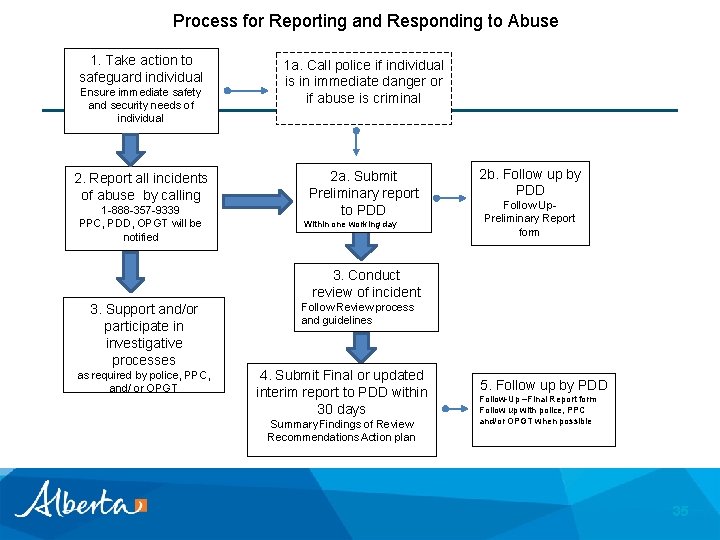
Process for Reporting and Responding to Abuse 1. Take action to safeguard individual Ensure immediate safety and security needs of individual 2. Report all incidents of abuse by calling 1 -888 -357 -9339 PPC, PDD, OPGT will be notified 1 a. Call police if individual is in immediate danger or if abuse is criminal 2 a. Submit Preliminary report to PDD Within one working day 2 b. Follow up by PDD Follow Up. Preliminary Report form 3. Conduct review of incident 3. Support and/or participate in investigative processes as required by police, PPC, and/ or OPGT Follow Review process and guidelines 4. Submit Final or updated interim report to PDD within 30 days Summary Findings of Review Recommendations Action plan 5. Follow up by PDD Follow-Up –Final Report form Follow up with police, PPC and/or OPGT when possible 35
Legislation and Policy • Criminal Code • Protection for Persons in Care Act (PPCA) • Adult Guardian and Trusteeship Act (AGTA) • PDD POLICY 6. 1 Safeguards and Standards 35
SCENARIOS 37
QUESTIONS AND REACTIONS 39
Some Useful Resources • Link to the APRP Webcast: https: //www. youtube. com/watch? v=18 E 1 lg. A 53 Mc&feature=yout u. be • Link to Abuse Prevention and Response Protocol (APRP): https: //hs. alberta. ca/pdd-online/documents/abuse-prevention-andresponse-Protocol. pdf 39
- Slides: 39