
Personas Making the user real Lecture slide deck
- Slides: 43
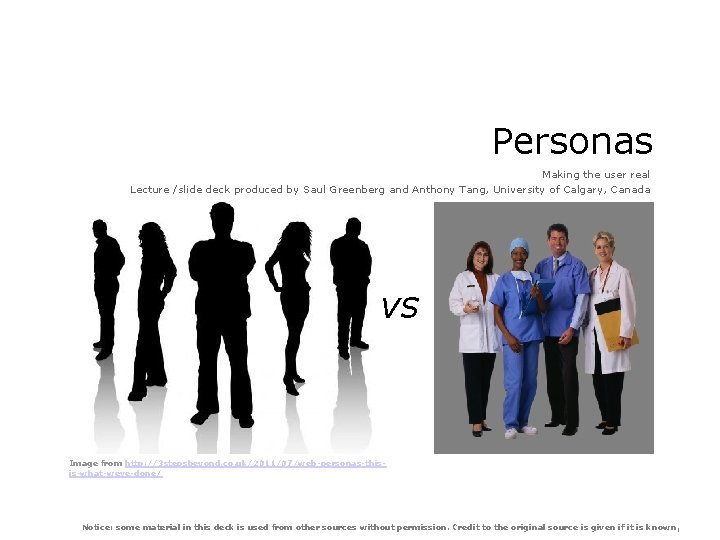
Personas Making the user real Lecture /slide deck produced by Saul Greenberg and Anthony Tang, University of Calgary, Canada vs Image from http: //3 stepsbeyond. co. uk/2011/07/web-personas-thisis-what-weve-done/ Notice: some material in this deck is used from other sources without permission. Credit to the original source is given if it is known,
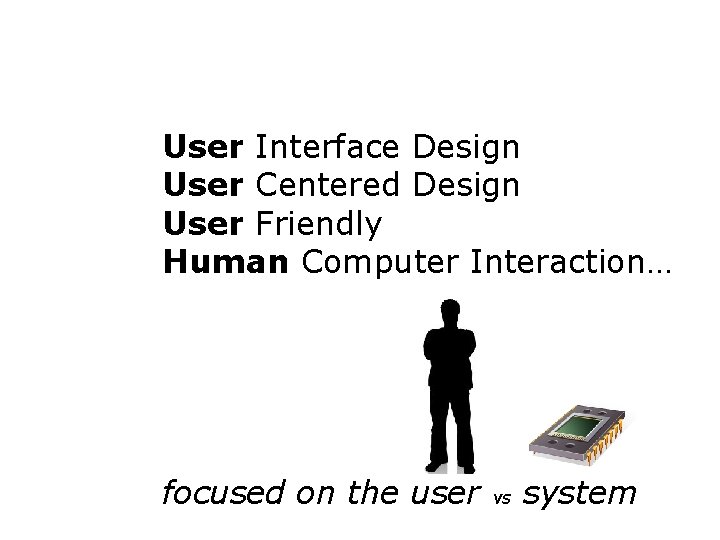
User Interface Design User Centered Design User Friendly Human Computer Interaction… focused on the user vs system
But who, exactly, is this user? Image from http: //3 stepsbeyond. co. uk/2011/07/web-personas-this-is-what-weve-done/
Agenda Challenge of Design w/ Engineers Who is the user? The Elastic user Self-referential User What are Personas? Why Personas? What constitutes a good persona?
Design a car Imagine you are designing an automobile to please a wide spectrum of people. You can easily identify at least three subgroups: the soccer mom, the carpenter, and the junior executive. Take one minute with a partner to articulate: - What is it that each subgroup wants? - How is this best achieved with a vehicle?
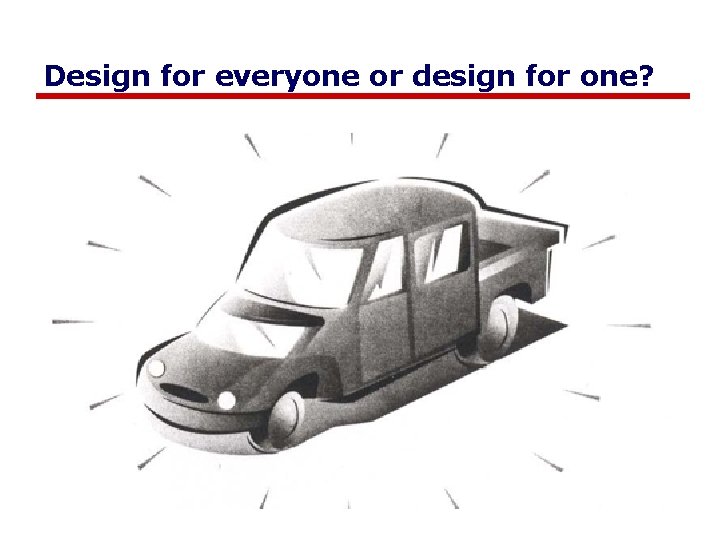
Design for everyone or design for one?
Challenge of design with engineers What is the nature of skill? power users – computer-literate users – naïve users insufficiently nuanced Rupak, network installer Shannon, accountant Dexter, VP of business development Roberto, telemarketing rep
Challenges of design with engineers Feature debates “What if the user wants to print this out? ” Programmers live and die by edge cases Design is about the “center case” Average person in Calgary has 2. 3 kids Who is the average?
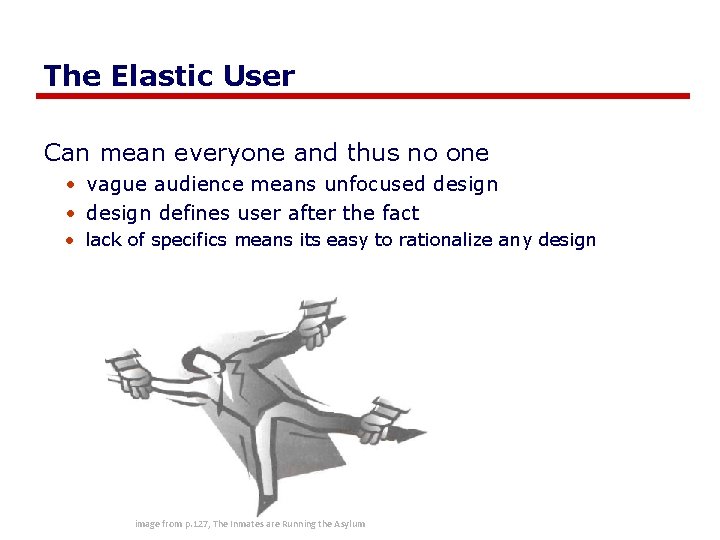
The Elastic User Can mean everyone and thus no one • vague audience means unfocused design • design defines user after the fact • lack of specifics means its easy to rationalize any design image from p. 127, The Inmates are Running the Asylum
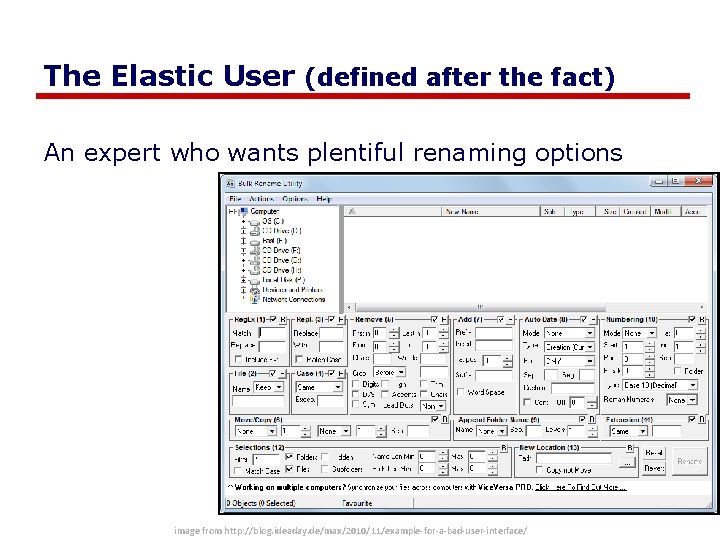
The Elastic User (defined after the fact) An expert who wants plentiful renaming options image from http: //blog. ideaday. de/max/2010/11/example-for-a-bad-user-interface/
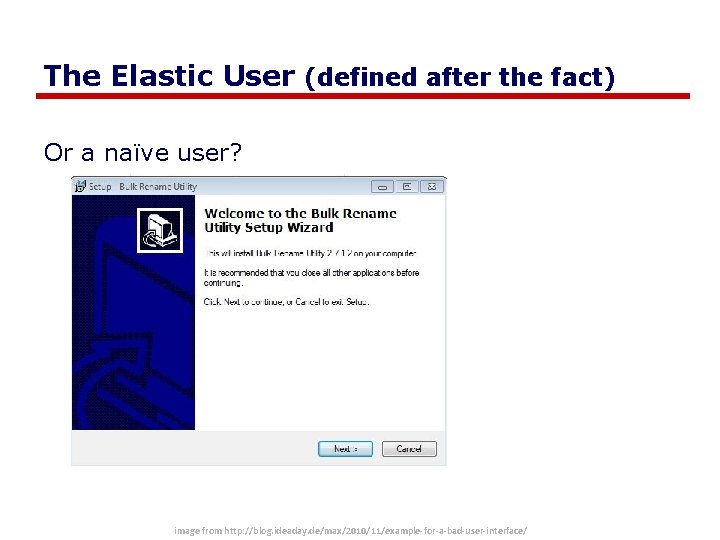
The Elastic User (defined after the fact) Or a naïve user? image from http: //blog. ideaday. de/max/2010/11/example-for-a-bad-user-interface/
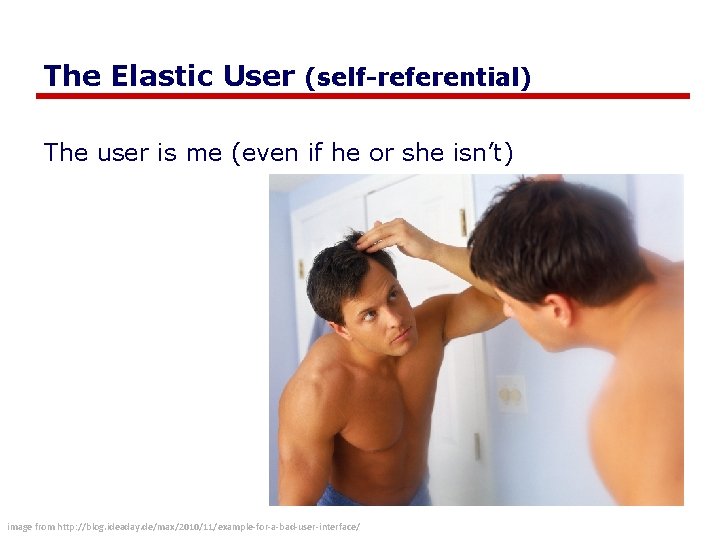
The Elastic User (self-referential) The user is me (even if he or she isn’t) image from http: //blog. ideaday. de/max/2010/11/example-for-a-bad-user-interface/
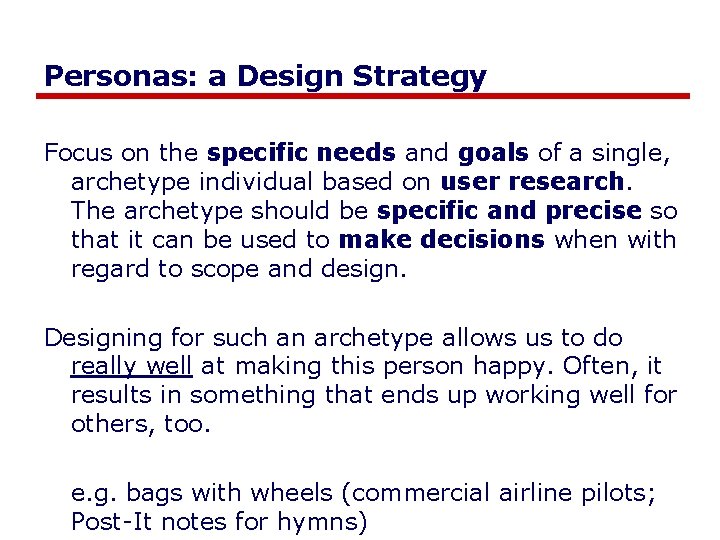
Personas: a Design Strategy Focus on the specific needs and goals of a single, archetype individual based on user research. The archetype should be specific and precise so that it can be used to make decisions when with regard to scope and design. Designing for such an archetype allows us to do really well at making this person happy. Often, it results in something that ends up working well for others, too. e. g. bags with wheels (commercial airline pilots; Post-It notes for hymns)
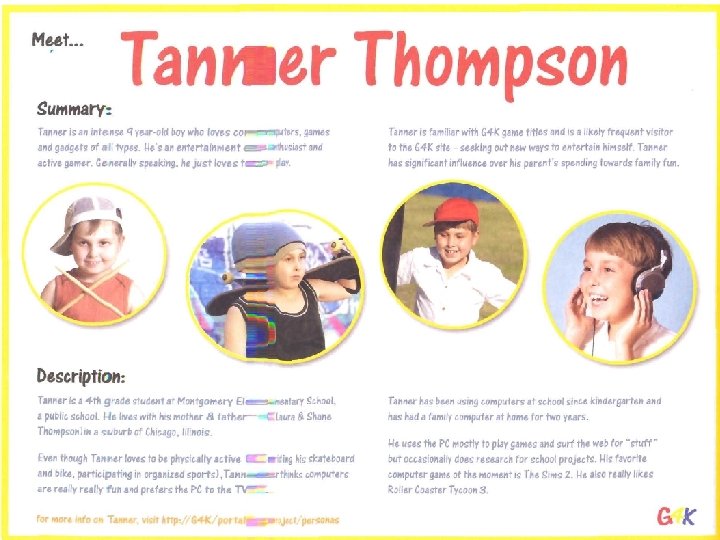
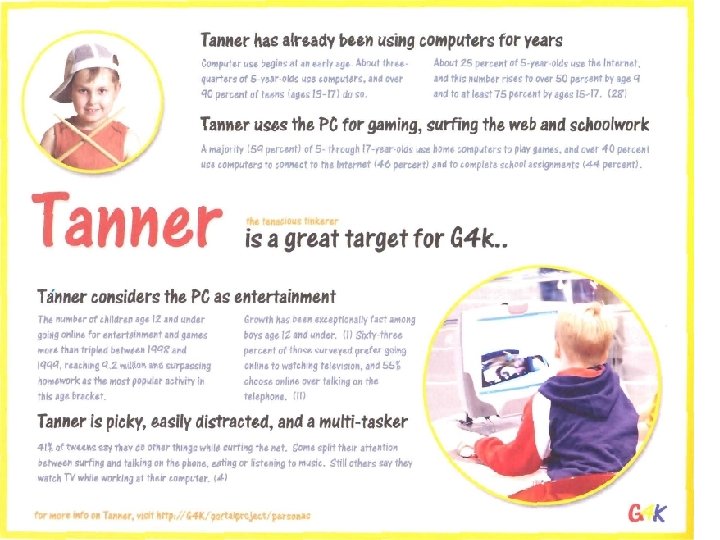
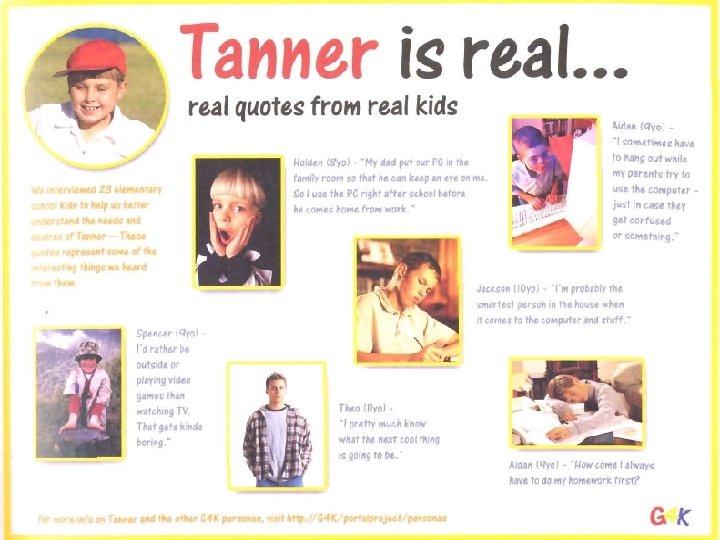
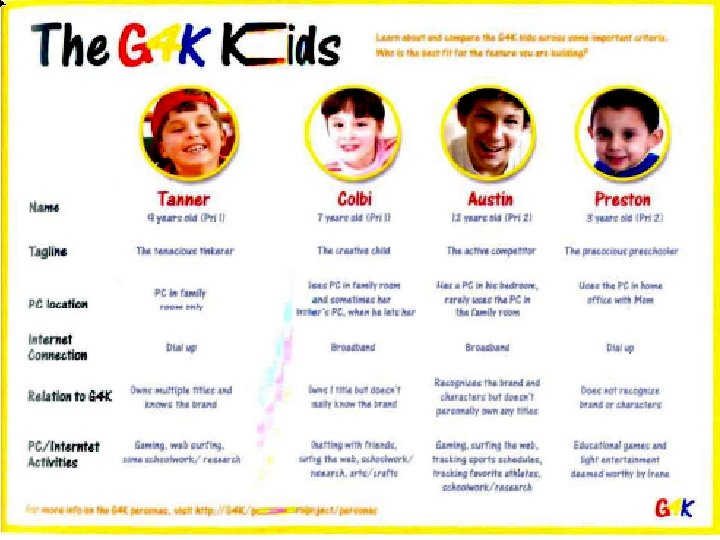
Example G 4 K Company • Produces children’s educational and game software • Goal: make a corporate destination site for kids • child-oriented entertainment • news • merchandise related to G 4 K software This example and the following images are from: The Persona Lifecycle. John Pruitt and Tamara Adlin. Morgan Kaufmann (Elsevier), 2006
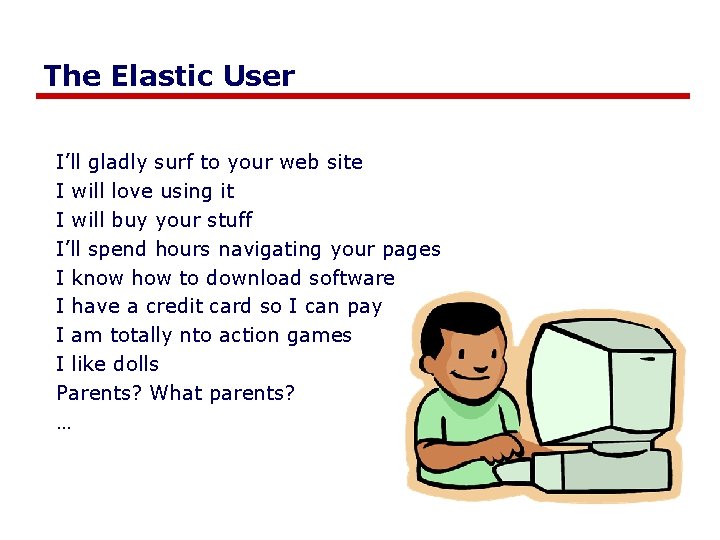
The Elastic User I’ll gladly surf to your web site I will love using it I will buy your stuff I’ll spend hours navigating your pages I know how to download software I have a credit card so I can pay I am totally nto action games I like dolls Parents? What parents? …
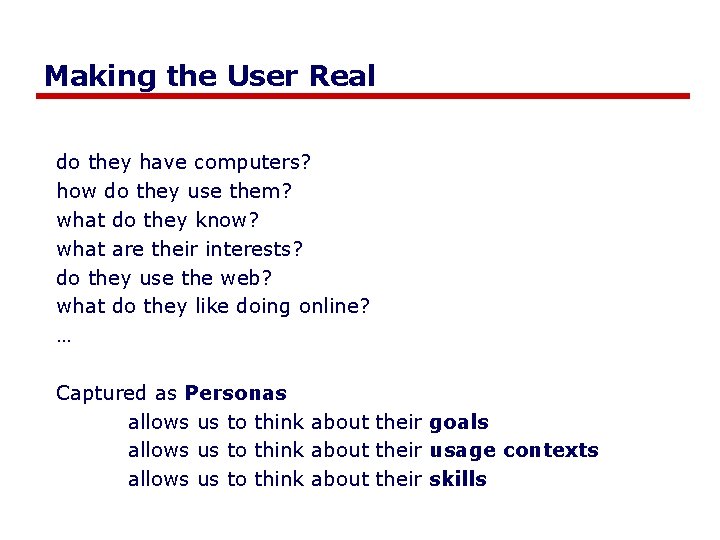
Making the User Real do they have computers? how do they use them? what do they know? what are their interests? do they use the web? what do they like doing online? … Captured as Personas allows us to think about their goals allows us to think about their usage contexts allows us to think about their skills
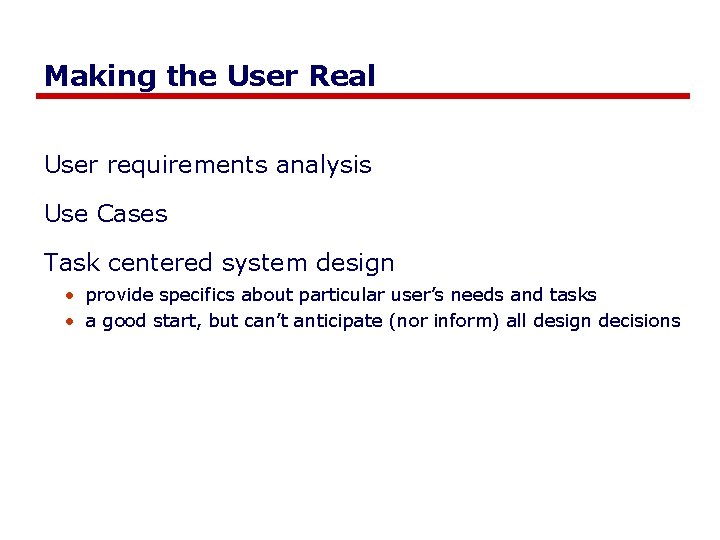
Making the User Real User requirements analysis Use Cases Task centered system design • provide specifics about particular user’s needs and tasks • a good start, but can’t anticipate (nor inform) all design decisions
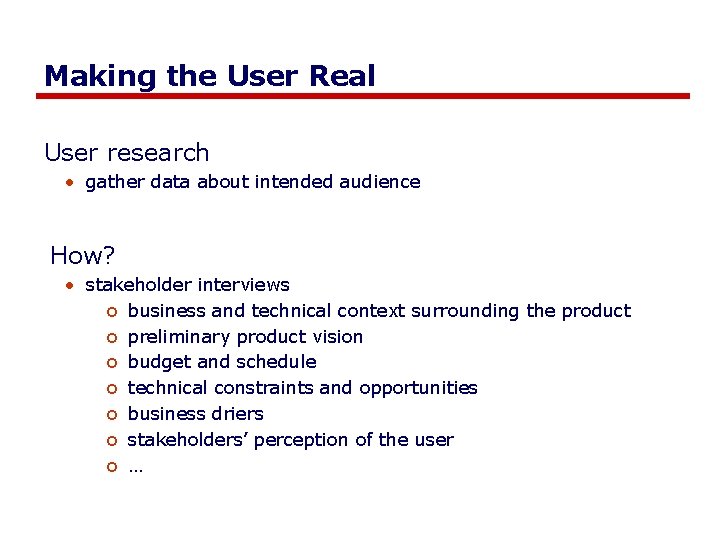
Making the User Real User research • gather data about intended audience How? • stakeholder interviews o business and technical context surrounding the product o preliminary product vision o budget and schedule o technical constraints and opportunities o business driers o stakeholders’ perception of the user o …
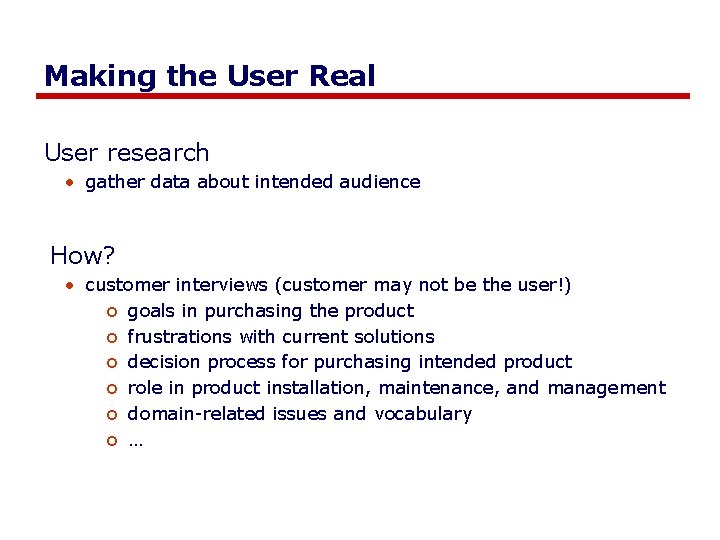
Making the User Real User research • gather data about intended audience How? • customer interviews (customer may not be the user!) o goals in purchasing the product o frustrations with current solutions o decision process for purchasing intended product o role in product installation, maintenance, and management o domain-related issues and vocabulary o …
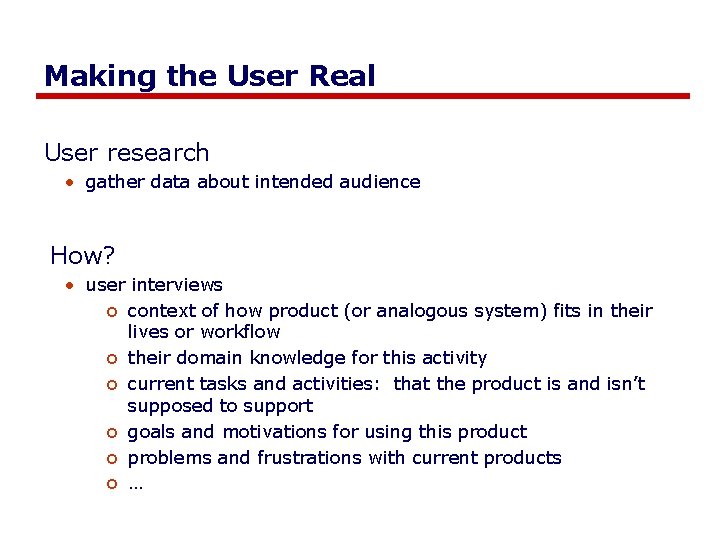
Making the User Real User research • gather data about intended audience How? • user interviews o context of how product (or analogous system) fits in their lives or workflow o their domain knowledge for this activity o current tasks and activities: that the product is and isn’t supposed to support o goals and motivations for using this product o problems and frustrations with current products o …
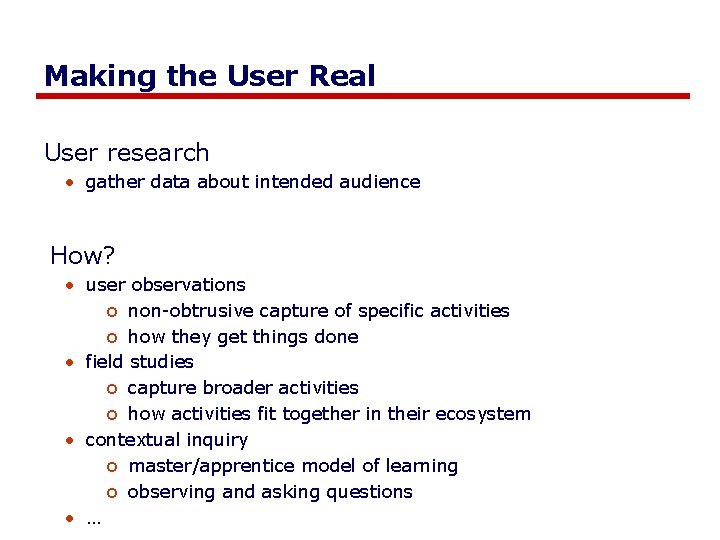
Making the User Real User research • gather data about intended audience How? • user observations o non-obtrusive capture of specific activities o how they get things done • field studies o capture broader activities o how activities fit together in their ecosystem • contextual inquiry o master/apprentice model of learning o observing and asking questions • …
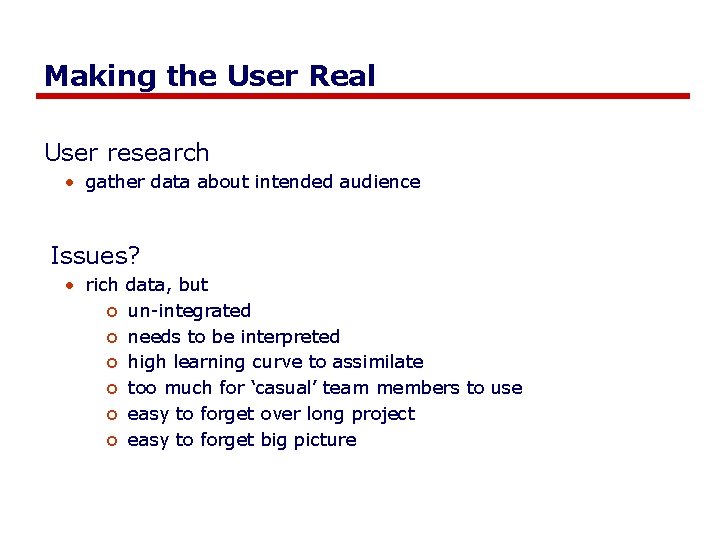
Making the User Real User research • gather data about intended audience Issues? • rich data, but o un-integrated o needs to be interpreted o high learning curve to assimilate o too much for ‘casual’ team members to use o easy to forget over long project o easy to forget big picture
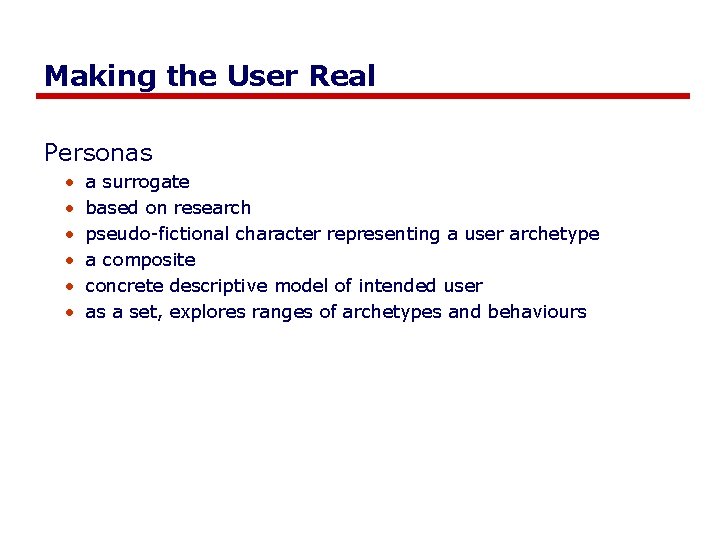
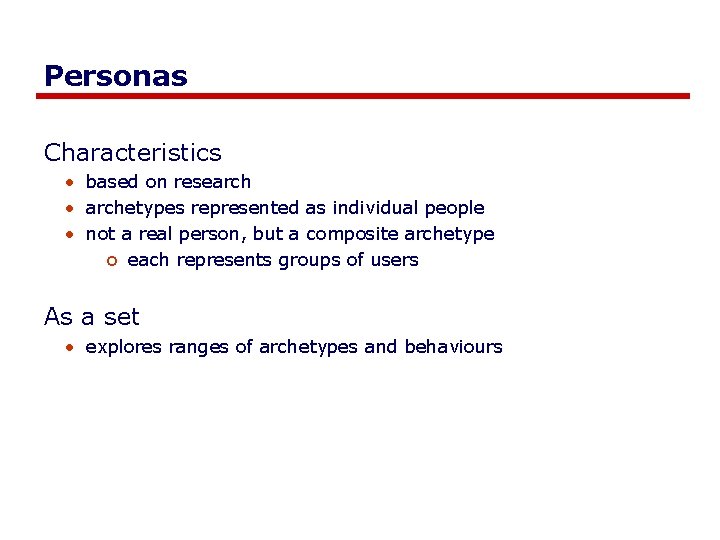
Making the User Real Personas • • • a surrogate based on research pseudo-fictional character representing a user archetype a composite concrete descriptive model of intended user as a set, explores ranges of archetypes and behaviours
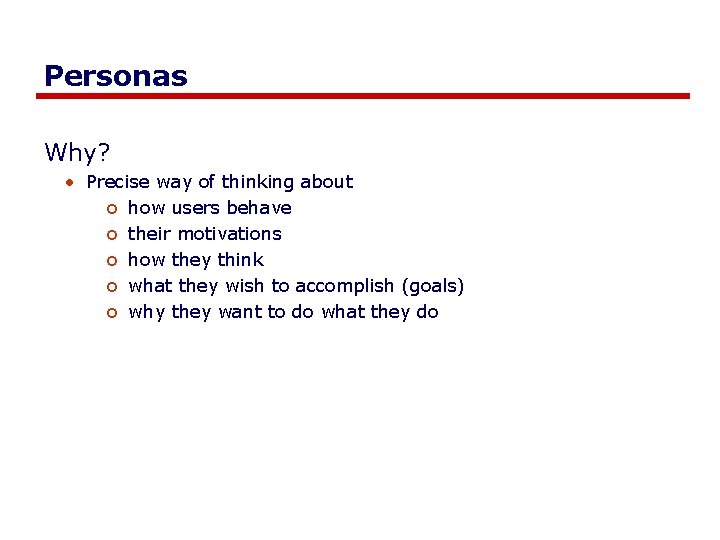
Personas Why? • Precise way of thinking about o how users behave o their motivations o how they think o what they wish to accomplish (goals) o why they want to do what they do
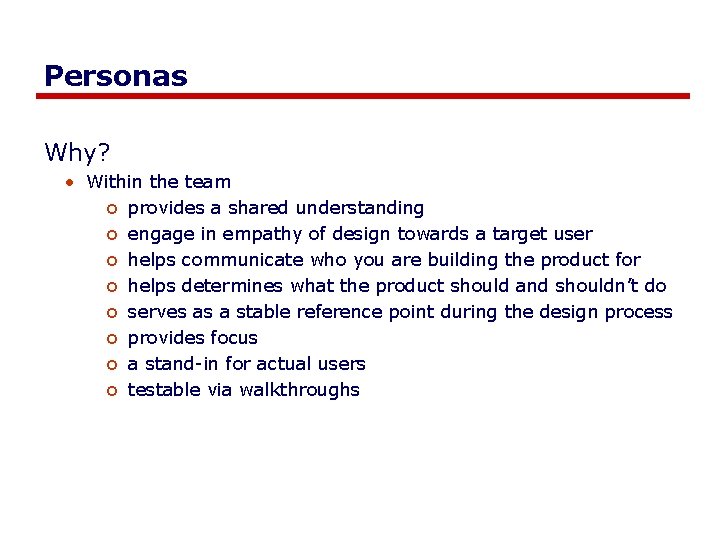
Personas Why? • Within the team o provides a shared understanding o engage in empathy of design towards a target user o helps communicate who you are building the product for o helps determines what the product should and shouldn’t do o serves as a stable reference point during the design process o provides focus o a stand-in for actual users o testable via walkthroughs
Personas Characteristics • based on research • archetypes represented as individual people • not a real person, but a composite archetype o each represents groups of users As a set • explores ranges of archetypes and behaviours
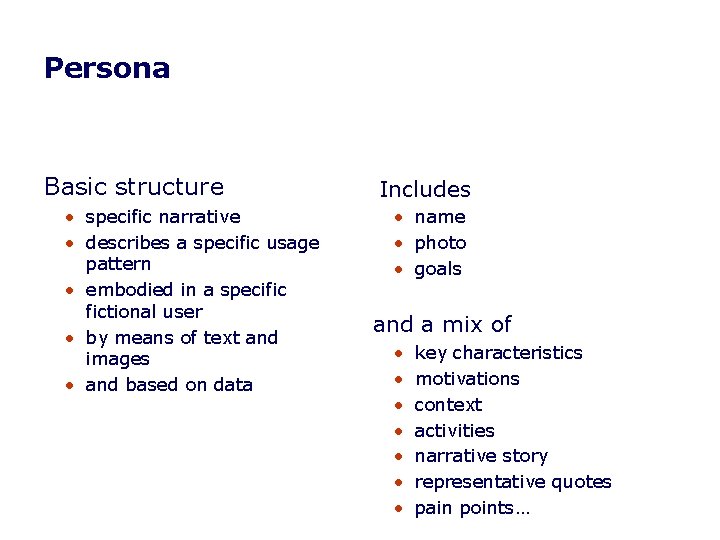
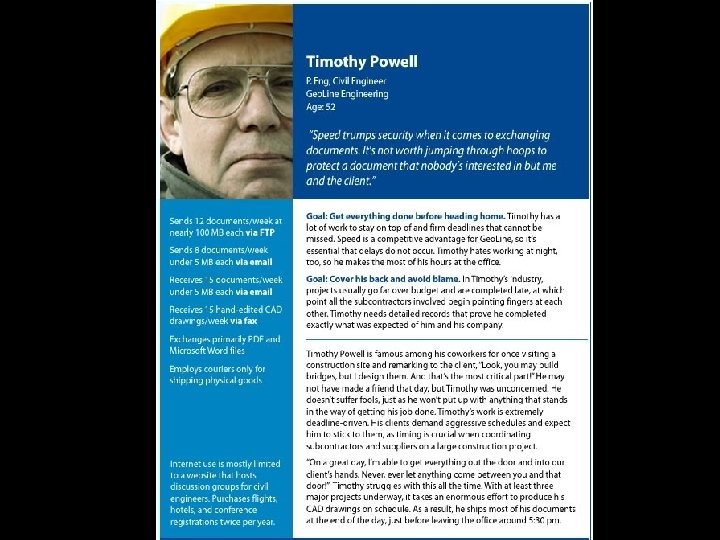
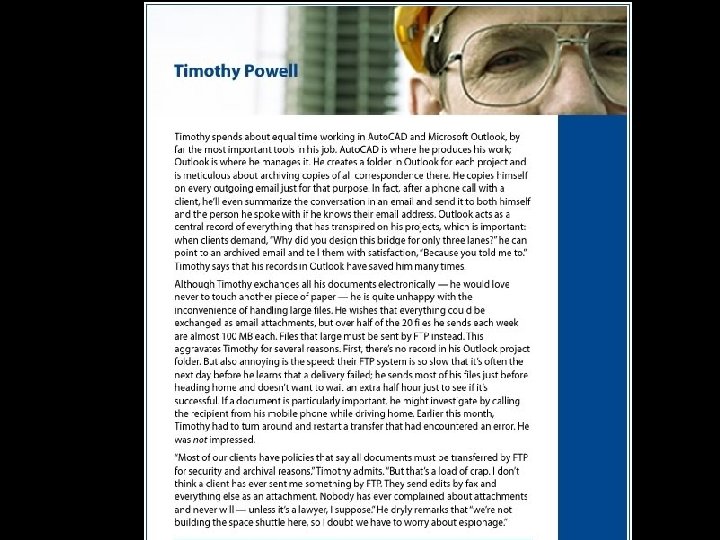
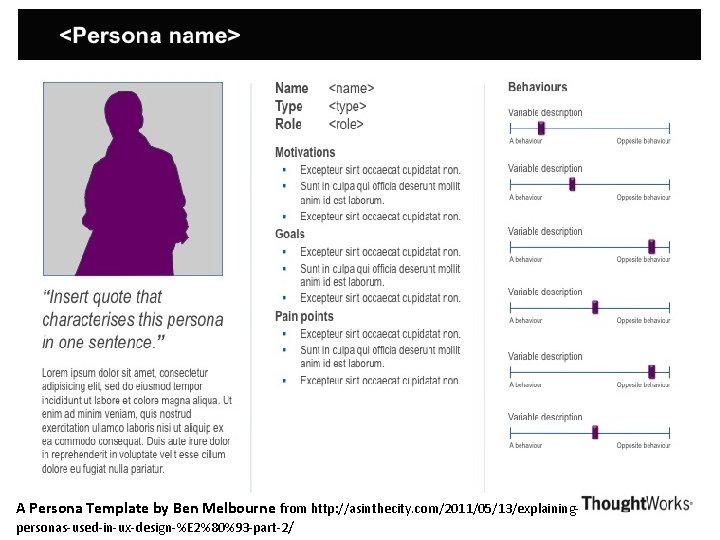
Persona Basic structure • specific narrative • describes a specific usage pattern • embodied in a specific fictional user • by means of text and images • and based on data Includes • name • photo • goals and a mix of • • key characteristics motivations context activities narrative story representative quotes pain points…
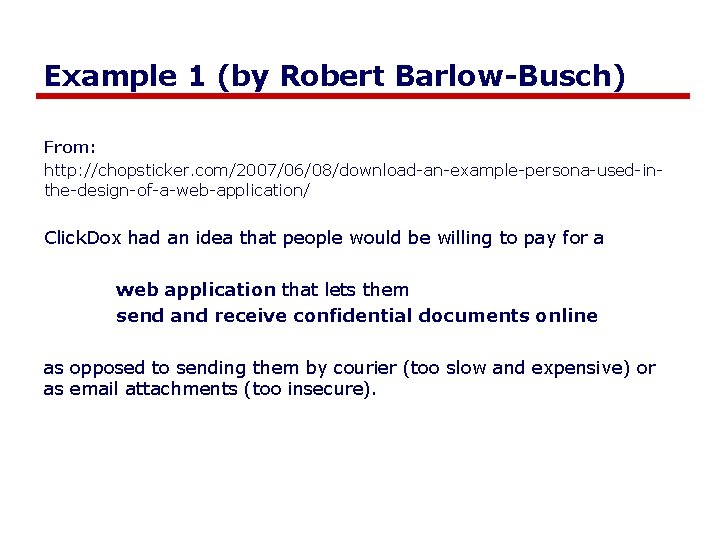
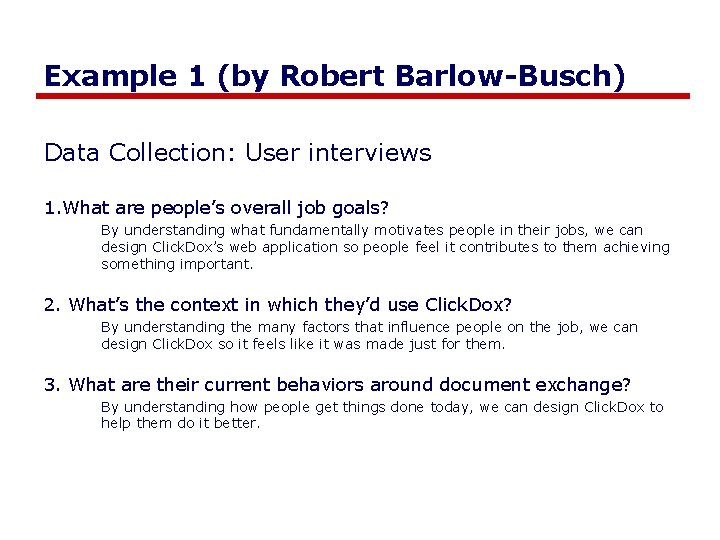
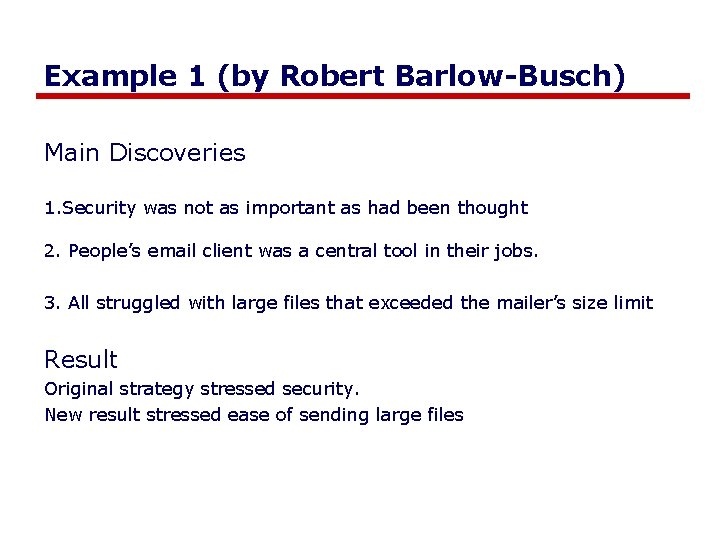
Example 1 (by Robert Barlow-Busch) From: http: //chopsticker. com/2007/06/08/download-an-example-persona-used-inthe-design-of-a-web-application/ Click. Dox had an idea that people would be willing to pay for a web application that lets them send and receive confidential documents online as opposed to sending them by courier (too slow and expensive) or as email attachments (too insecure).
Example 1 (by Robert Barlow-Busch) Data Collection: User interviews 1. What are people’s overall job goals? By understanding what fundamentally motivates people in their jobs, we can design Click. Dox’s web application so people feel it contributes to them achieving something important. 2. What’s the context in which they’d use Click. Dox? By understanding the many factors that influence people on the job, we can design Click. Dox so it feels like it was made just for them. 3. What are their current behaviors around document exchange? By understanding how people get things done today, we can design Click. Dox to help them do it better.
Example 1 (by Robert Barlow-Busch) Main Discoveries 1. Security was not as important as had been thought 2. People’s email client was a central tool in their jobs. 3. All struggled with large files that exceeded the mailer’s size limit Result Original strategy stressed security. New result stressed ease of sending large files
A Persona Template by Ben Melbourne from http: //asinthecity. com/2011/05/13/explainingpersonas-used-in-ux-design-%E 2%80%93 -part-2/
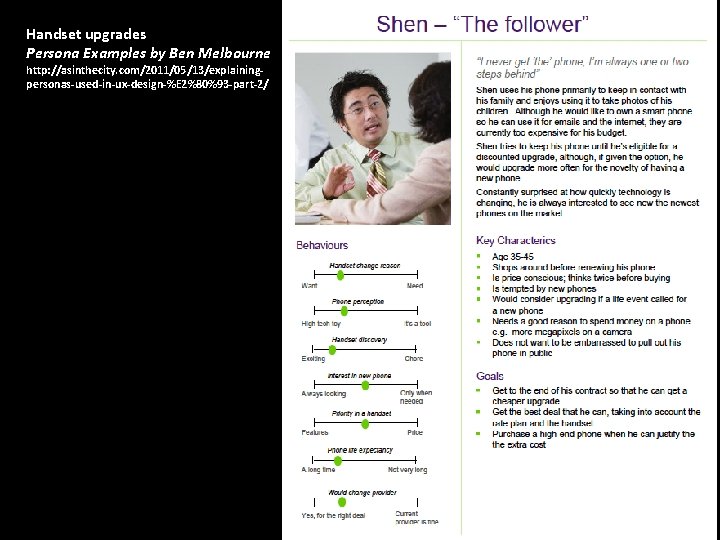
Handset upgrades Persona Examples by Ben Melbourne http: //asinthecity. com/2011/05/13/explainingpersonas-used-in-ux-design-%E 2%80%93 -part-2/
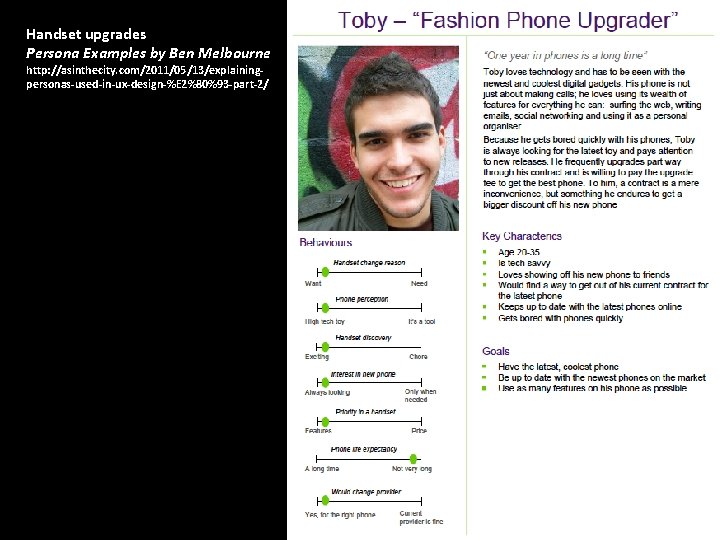
Handset upgrades Persona Examples by Ben Melbourne http: //asinthecity. com/2011/05/13/explainingpersonas-used-in-ux-design-%E 2%80%93 -part-2/
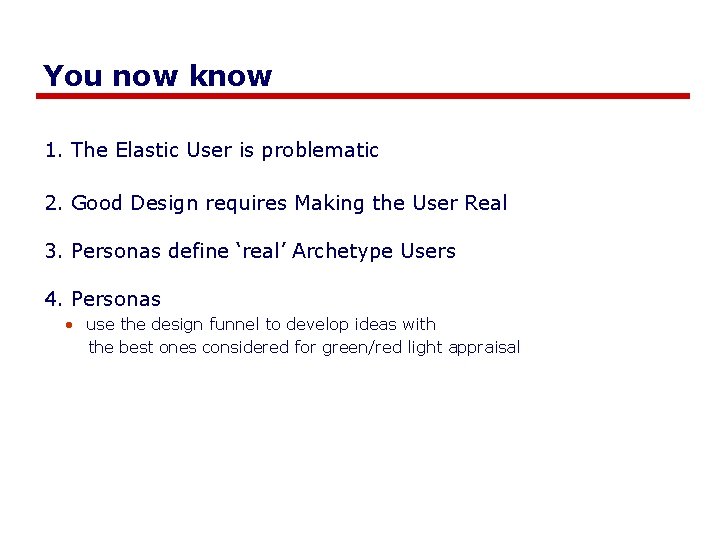
You now know 1. The Elastic User is problematic 2. Good Design requires Making the User Real 3. Personas define ‘real’ Archetype Users 4. Personas • use the design funnel to develop ideas with the best ones considered for green/red light appraisal
Sources and Further References The Inmates are Running the Asylum. Alan Cooper. Sams, 1999 (Chapter 9) About Face 3. Alan Cooper, Robert Reimann & David Cronin. Wiley Publishing, 2007 (Chapters 4 & 5) The Persona Lifecycle. John Pruitt and Tamara Adlin. Morgan Kaufmann (Elsevier), 2006 Using Personas. Slide deck by Andrea Resmini: http: //www. slideshare. net/resmini/personas-5431493? from=share_email
Assignment (in relation to P 2) Create three personas: 2 persona that represents each of the individuals 1 “persona” that represents the relationship For Wednesday, be prepared to present these personas as a small powerpoint deck (employ visuals, look at samples – see website). Based on this feedback, iterate on both your personas, and your P 2 sketches.
Permissions You are free: • to Share — to copy, distribute and transmit the work • to Remix — to adapt the work Under the following conditions: Attribution — You must attribute the work in the manner specified by the author (but not in any way that suggests that they endorse you or your use of the work) by citing: “Lecture materials by Saul Greenberg, University of Calgary, AB, Canada. http: //saul. cpsc. ucalgary. ca/saul/pmwiki. php/HCIResources/HCILectures” Noncommercial — You may not use this work for commercial purposes, except to assist one’s own teaching and training within commercial organizations. Share Alike — If you alter, transform, or build upon this work, you may distribute the resulting work only under the same or similar license to this one. With the understanding that: Not all material have transferable rights — materials from other sources which are included here are cited Waiver — Any of the above conditions can be waived if you get permission from the copyright holder. Public Domain — Where the work or any of its elements is in the public domain under applicable law, that status is in no way affected by the license. Other Rights — In no way are any of the following rights affected by the license: • Your fair dealing or fair use rights, or other applicable copyright exceptions and limitations; • The author's moral rights; • Rights other persons may have either in the work itself or in how the work is used, such as publicity or privacy rights. Notice — For any reuse or distribution, you must make clear to others the license terms of this work. The best way to do this is with a link to this web page.