
Personalization in elearning systems prof dr Mirjana Ivanovi

- Slides: 39
Personalization in e-learning systems prof. dr Mirjana Ivanović dr Aleksandra Klašnja-Milićević Department of Mathematics and Informatics Faculty of Sciences, Novi Sad Workshop 2014, Sinaia, Romania
Outline 1 Introduction 2 Recommender Systems, Collaborative tagging, Tag-based Personalized RS 3 Recommender Systems in E-learning Environments 4 Design, Architecture and Interface of Protus System 5 Evaluation and Discussion 6 Conclusions Workshop 2014, Sinaia, Romania 2
Personalization in e-learning systems • Personalization is becoming an important feature in e-learning systems due to the: – huge information, the strong interactivity, the great coverage and no space-time restrictions, – differences in background, goals, capabilities and personalities of the large numbers of learners, the main users of such systems. • Personalization can be achieved using: – pre-defined rules that sequentially propose learning objects in a specified learning path, – heuristic rules, – user models and – recommendation techniques. Workshop 2014, Sinaia, Romania 3
Outline ✓ 1 Introduction 2 Recommender Systems, Collaborative tagging, Tag-based Personalized RS 3 Recommender Systems in E-learning Environments 4 Design, Architecture and Interface of Protus System 5 Evaluation and Discussion 6 Conclusions Workshop 2014, Sinaia, Romania 4
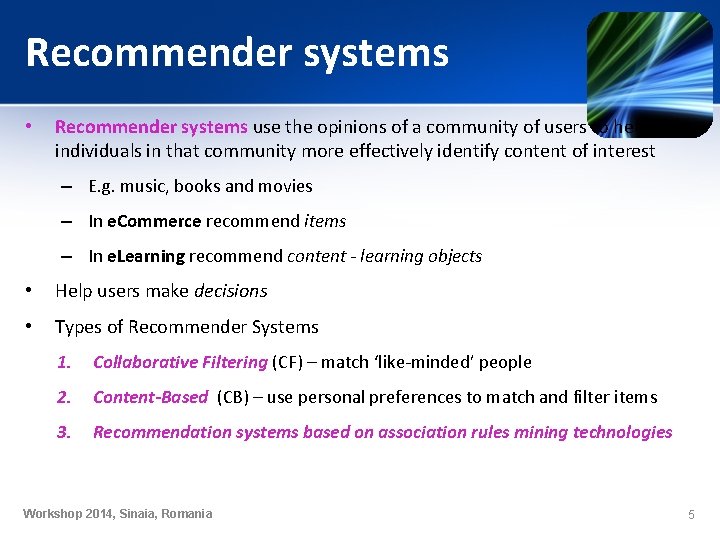
Recommender systems • Recommender systems use the opinions of a community of users to help individuals in that community more effectively identify content of interest – E. g. music, books and movies – In e. Commerce recommend items – In e. Learning recommend content - learning objects • Help users make decisions • Types of Recommender Systems 1. Collaborative Filtering (CF) – match ‘like-minded’ people 2. Content-Based (CB) – use personal preferences to match and filter items 3. Recommendation systems based on association rules mining technologies Workshop 2014, Sinaia, Romania 5
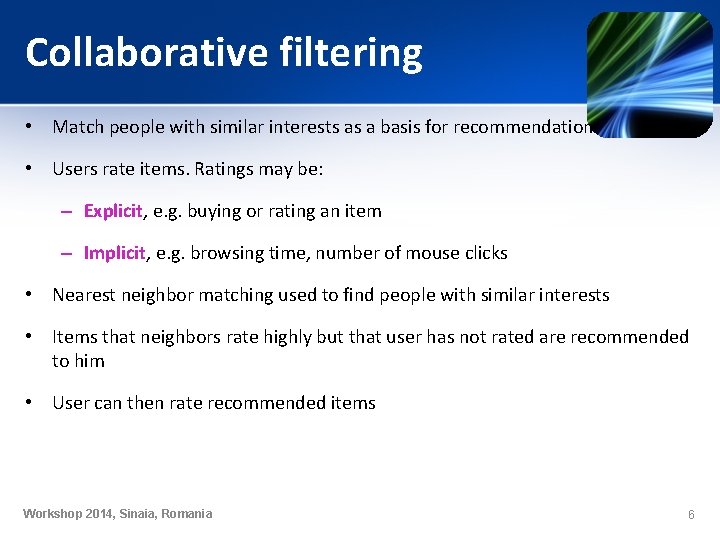
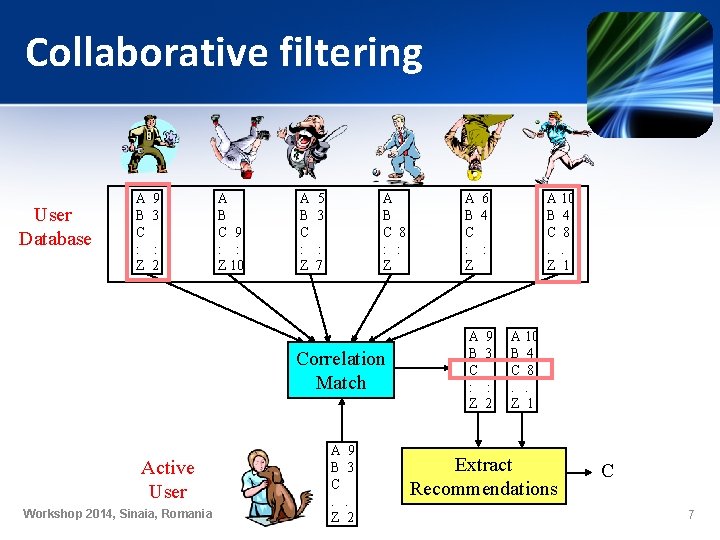
Collaborative filtering • Match people with similar interests as a basis for recommendation • Users rate items. Ratings may be: – Explicit, e. g. buying or rating an item – Implicit, e. g. browsing time, number of mouse clicks • Nearest neighbor matching used to find people with similar interests • Items that neighbors rate highly but that user has not rated are recommended to him • User can then rate recommended items Workshop 2014, Sinaia, Romania 6
Collaborative filtering User Database A B C : Z 9 3 : 2 A B C 9 : : Z 10 A B C : Z 5 3 A B C 8 : : Z : 7 Correlation Match Active User Workshop 2014, Sinaia, Romania A 9 B 3 C. . Z 2 A 6 B 4 C : : Z A B C : Z 9 3 : 2 A 10 B 4 C 8. . Z 1 Extract Recommendations C 7
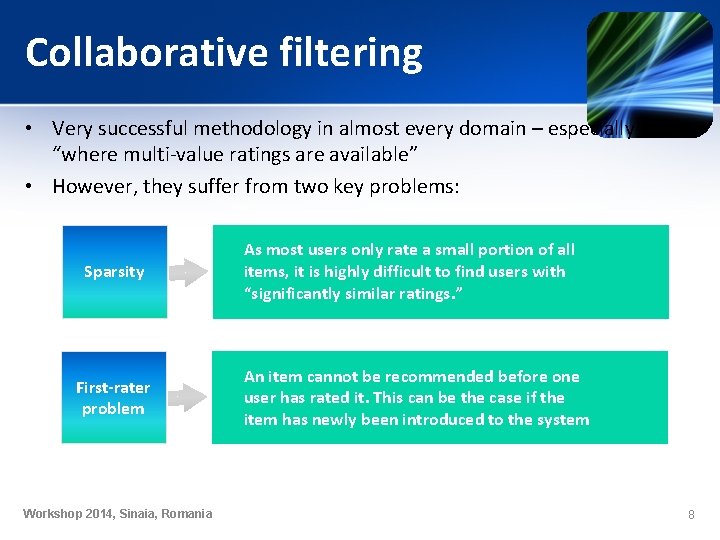
Collaborative filtering • Very successful methodology in almost every domain – especially “where multi-value ratings are available” • However, they suffer from two key problems: Sparsity First-rater problem Workshop 2014, Sinaia, Romania As most users only rate a small portion of all items, it is highly difficult to find users with “significantly similar ratings. ” An item cannot be recommended before one user has rated it. This can be the case if the item has newly been introduced to the system 8
Collaborative tagging • To improve recommendation quality, metadata such as content information of items - additional knowledge • Collaborative tagging is the practice of allowing users to freely attach keywords or tags to content • The systems can be distinguished - kind of resources are supported. – Flickr - allows the sharing of photos, – del. icio. us - allows the sharing of bookmarks, – Cite. ULike and Connotea - allows the sharing of bibliographic references, and • These systems are all very similar. • Once a user is logged in, he can add a resource to the system, and assign arbitrary tags to it. Workshop 2014, Sinaia, Romania 9
Tag-Based Recommender Systems • Tag - a user’s personal opinion expression, while • Tagging - implicit rating or voting on the tagged information resources or items. • Thus, the tagging information can be used to make recommendations • In tag recommender systems the recommendations are: – for a given user and a given resource , a set of tags – In many cases, is computed by first generating a ranking on the set of tags according to some quality or relevance criterion, from which then the top n elements are selected Workshop 2014, Sinaia, Romania 10
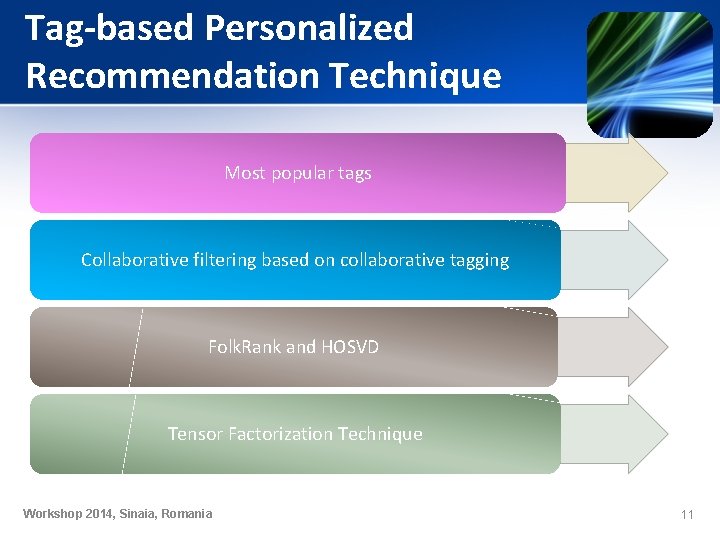
Tag-based Personalized Recommendation Technique Most popular tags Collaborative filtering based on collaborative tagging Folk. Rank and HOSVD Tensor Factorization Technique Workshop 2014, Sinaia, Romania 11
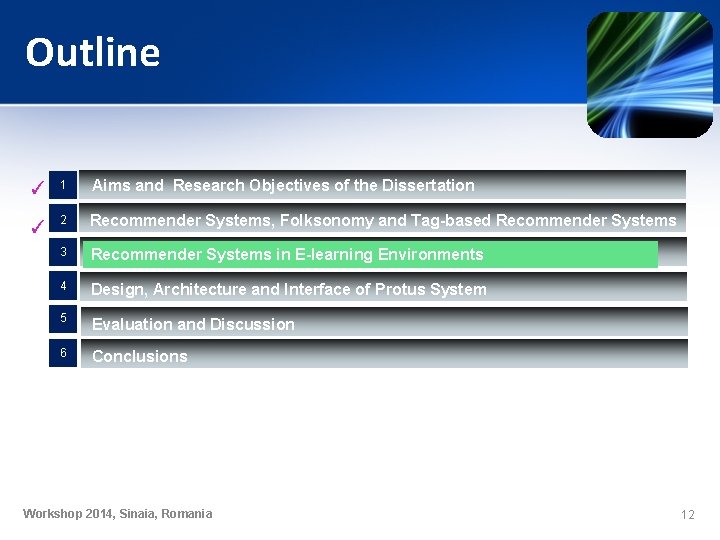
Outline ✓ 1 Aims and Research Objectives of the Dissertation ✓ 2 Recommender Systems, Folksonomy and Tag-based Recommender Systems 3 Recommender Systems in E-learning Environments 4 Design, Architecture and Interface of Protus System 5 Evaluation and Discussion 6 Conclusions Workshop 2014, Sinaia, Romania 12
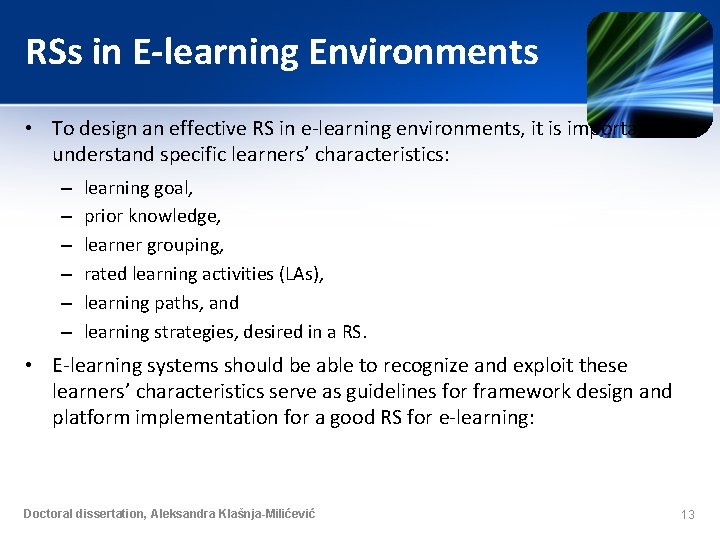
RSs in E-learning Environments • To design an effective RS in e-learning environments, it is important to understand specific learners’ characteristics: – – – learning goal, prior knowledge, learner grouping, rated learning activities (LAs), learning paths, and learning strategies, desired in a RS. • E-learning systems should be able to recognize and exploit these learners’ characteristics serve as guidelines for framework design and platform implementation for a good RS for e-learning: Doctoral dissertation, Aleksandra Klašnja-Milićević 13
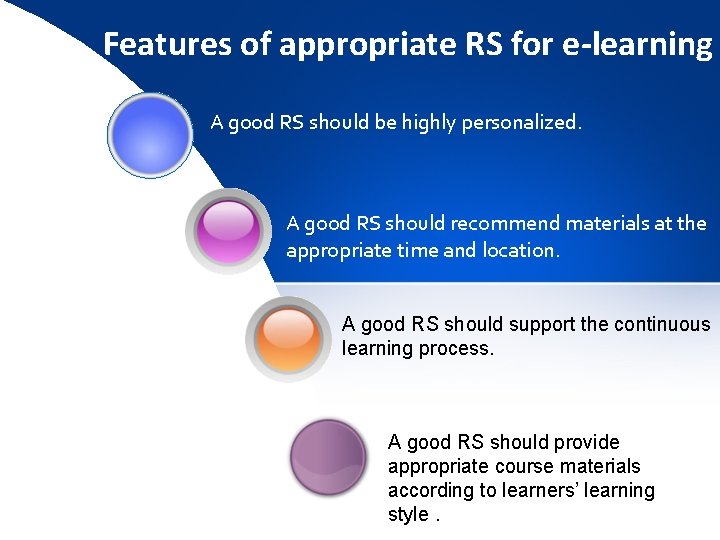
Features of appropriate RS for e-learning A good RS should be highly personalized. A good RS should recommend materials at the appropriate time and location. A good RS should support the continuous learning process. A good RS should provide appropriate course materials according to learners’ learning style.
Applying Tag-Based RSs to E-learning Environments Learners could benefit from writing tags: 1. Tagging involves learners in active learning and engages them with more effectively in the learning process 2. Tags could help learners to remember better by highlighting the most significant part of a text, could encourage learners to think when they add more ideas to what they are reading, supporting a learner in finding the exact point of interest within the page. 3. Tagging provides possible solutions for learners’ engagement in a number of different annotation activities – add comments, – corrections, – links, or shared discussion. Workshop 2014, Sinaia, Romania 15
Applying Tag-Based RSs to E-learning Environments 3. Learners’ tags - important trail for other learners 4. In e-learning there is a lack of the social cues that inform instructors about the understanding of new concepts by their learners. • Collaborative tags, created by learners to categorize learning contents, would allow instructors to reflect at different levels on their learners’ progress. • Tags could be examined at the individual level to observe the understanding of a learner (e. g. tags that are out of context could represent a misconception), while tags studied at the group level could identify the overall progress of the class. • Working with instructors of online courses employing tagging would help shed light on the perceived benefits of reflection based on tags. Workshop 2014, Sinaia, Romania 16
Outline ✓ 1 Aims and Research Objectives of the Dissertation ✓ 2 Recommender Systems, Folksonomy and Tag-based Recommender Systems ✓ 3 Recommender Systems in E-learning Environments 4 Design, Architecture and Interface of Protus System 5 Evaluation and Discussion 6 Conclusions Workshop 2014, Sinaia, Romania 17
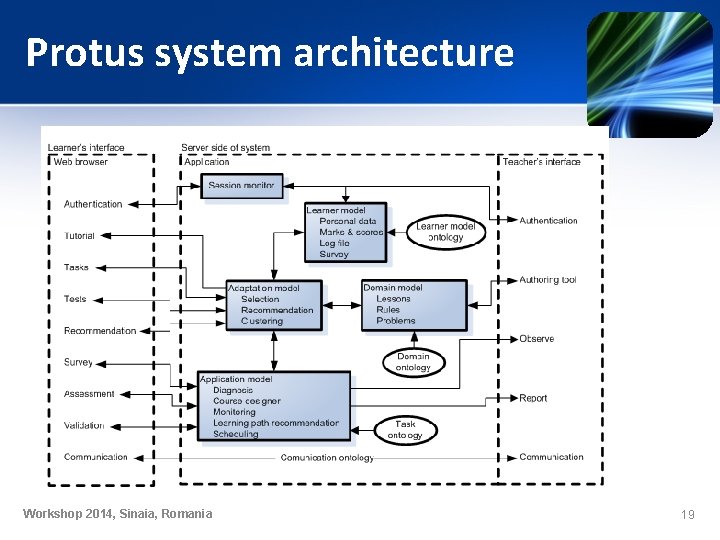
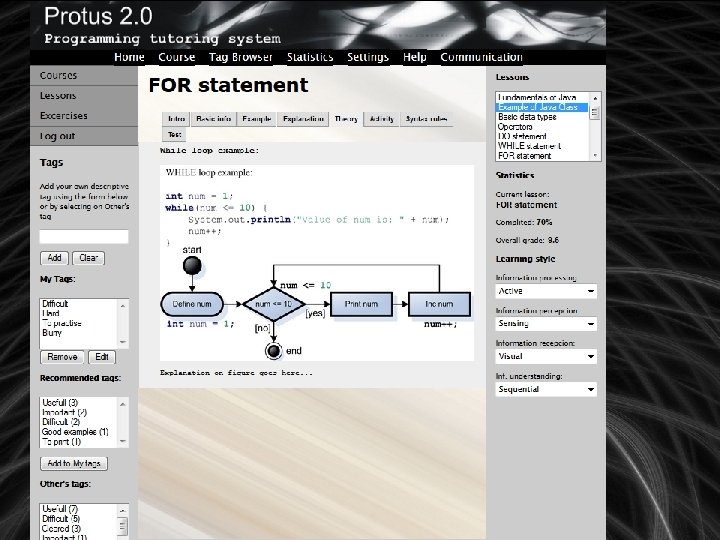
Protus system architecture • Recommender system for an adaptive and intelligent web-based programming tutoring system – Protus (PRogramming TUtoring System) • Protus is a tutoring system designed to help learners in learning essentials of programming languages. • In spite of the fact that this system is designed and implemented as a general tutoring system for different programming languages, the first completely implemented and tested version was for an introductory Java programming course • The environment - for learners with no programming experience. • An interactive system that allows learners to use the teaching material prepared within appropriate course. It also includes a part for testing the acquired knowledge. Workshop 2014, Sinaia, Romania 18
Protus system architecture Workshop 2014, Sinaia, Romania 19
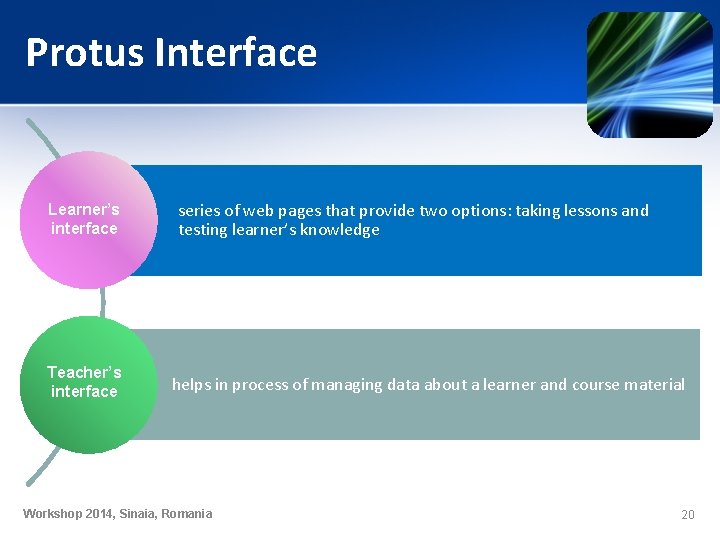
Protus Interface Learner’s interface Teacher’s interface series of web pages that provide two options: taking lessons and testing learner’s knowledge helps in process of managing data about a learner and course material Workshop 2014, Sinaia, Romania 20
Doctoral dissertation, Aleksandra Klašnja-Milićević 21
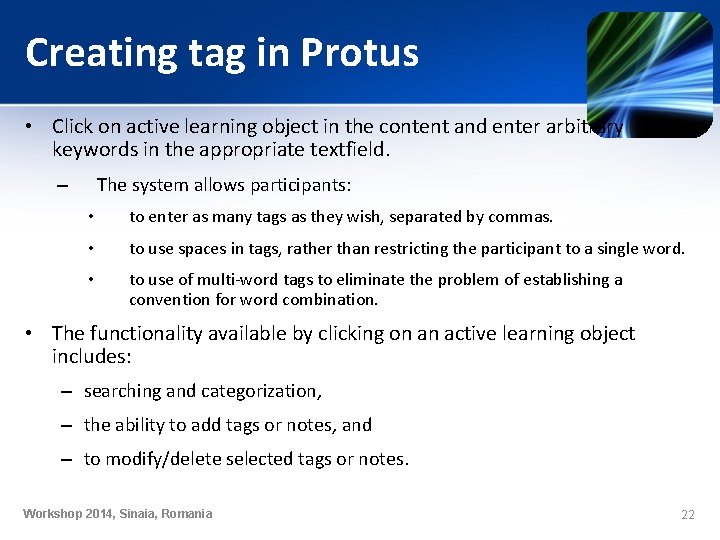
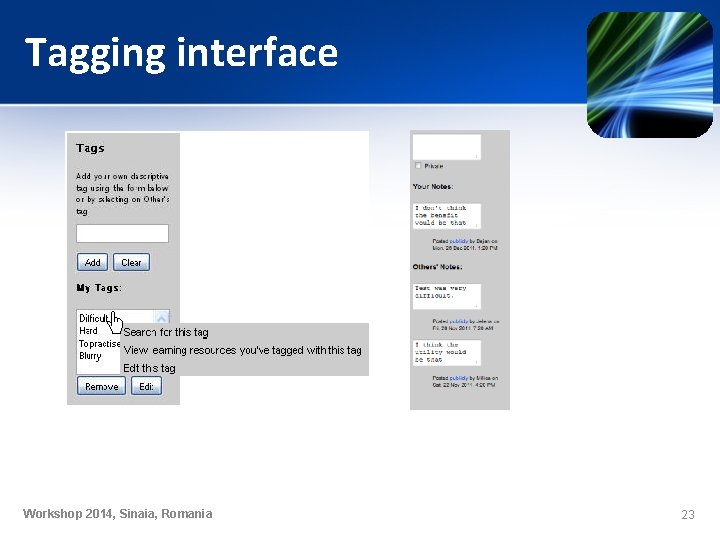
Creating tag in Protus • Click on active learning object in the content and enter arbitrary keywords in the appropriate textfield. The system allows participants: – • to enter as many tags as they wish, separated by commas. • to use spaces in tags, rather than restricting the participant to a single word. • to use of multi-word tags to eliminate the problem of establishing a convention for word combination. • The functionality available by clicking on an active learning object includes: – searching and categorization, – the ability to add tags or notes, and – to modify/delete selected tags or notes. Workshop 2014, Sinaia, Romania 22
Tagging interface Workshop 2014, Sinaia, Romania 23
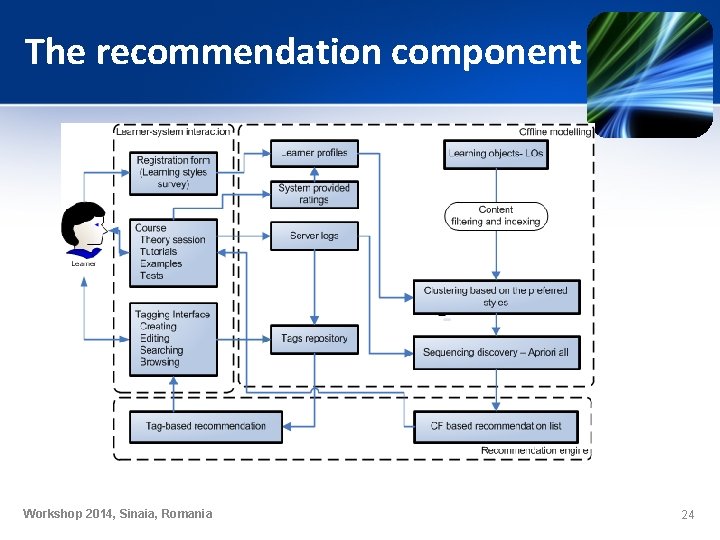
The recommendation component Workshop 2014, Sinaia, Romania 24
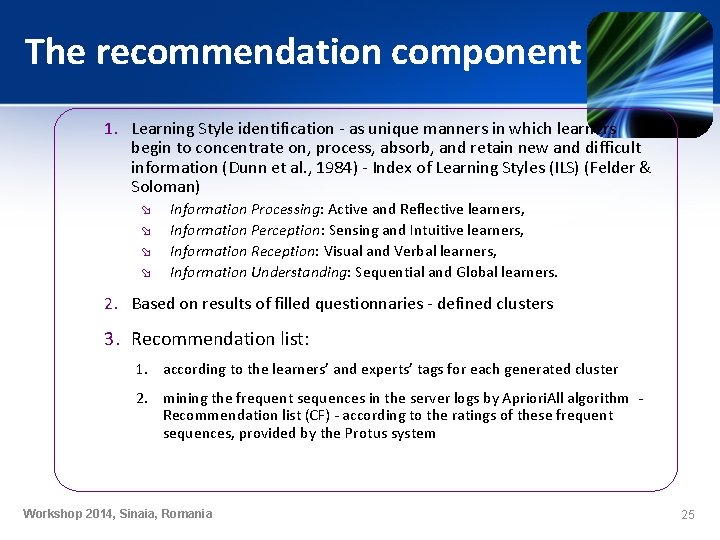
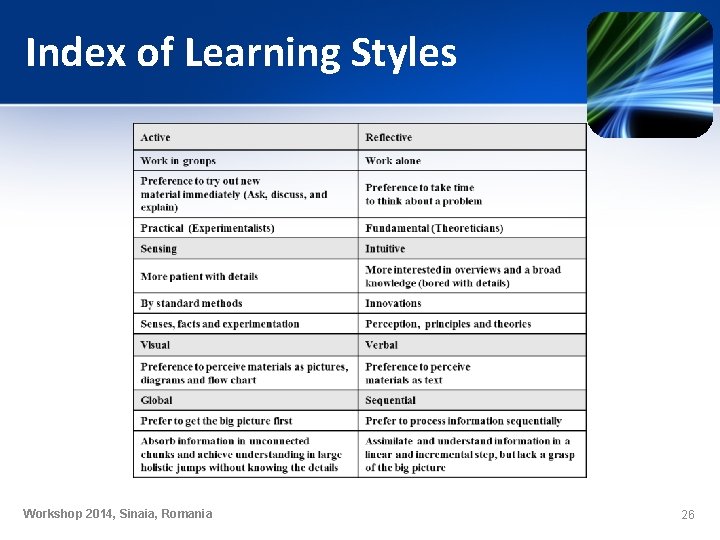
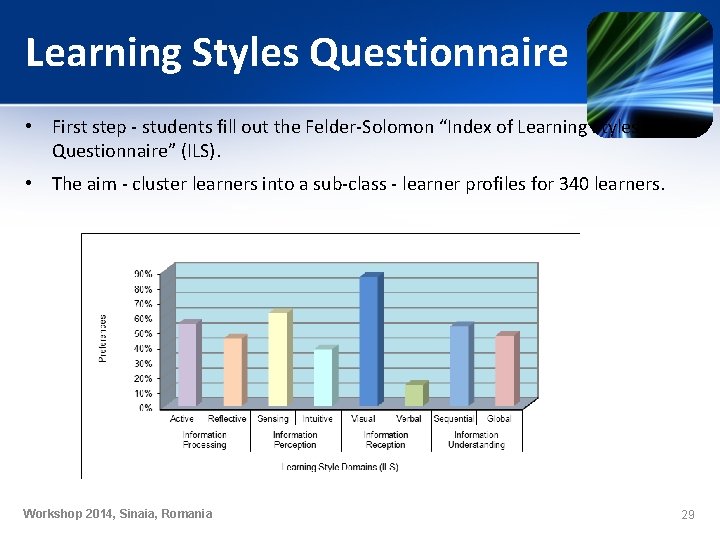
The recommendation component 1. Learning Style identification - as unique manners in which learners begin to concentrate on, process, absorb, and retain new and difficult information (Dunn et al. , 1984) - Index of Learning Styles (ILS) (Felder & Soloman) ø ø Information Processing: Active and Reflective learners, Information Perception: Sensing and Intuitive learners, Information Reception: Visual and Verbal learners, Information Understanding: Sequential and Global learners. 2. Based on results of filled questionnaries - defined clusters 3. Recommendation list: 1. according to the learners’ and experts’ tags for each generated cluster 2. mining the frequent sequences in the server logs by Apriori. All algorithm Recommendation list (CF) - according to the ratings of these frequent sequences, provided by the Protus system Workshop 2014, Sinaia, Romania 25
Index of Learning Styles Workshop 2014, Sinaia, Romania 26
Outline ✓ 1 Aims and Research Objectives of the Dissertation ✓ 2 Recommender Systems, Folksonomy and Tag-based Recommender Systems ✓ 3 Recommender Systems in E-learning Environments ✓ 4 Design, Architecture and Interface of Protus System 5 Evaluation and Discussion 6 Conclusions Workshop 2014, Sinaia, Romania 27
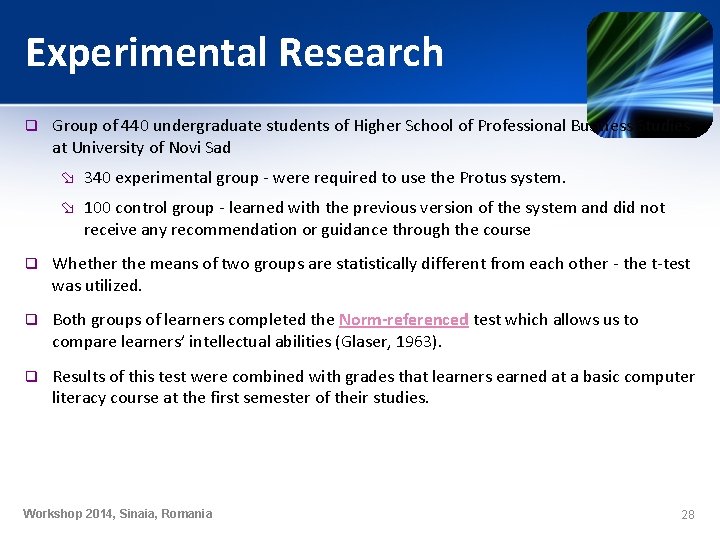
Experimental Research q Group of 440 undergraduate students of Higher School of Professional Business Studies at University of Novi Sad ø 340 experimental group - were required to use the Protus system. ø 100 control group - learned with the previous version of the system and did not receive any recommendation or guidance through the course q Whether the means of two groups are statistically different from each other - the t-test was utilized. q Both groups of learners completed the Norm-referenced test which allows us to compare learners’ intellectual abilities (Glaser, 1963). q Results of this test were combined with grades that learners earned at a basic computer literacy course at the first semester of their studies. Workshop 2014, Sinaia, Romania 28
Learning Styles Questionnaire • First step - students fill out the Felder-Solomon “Index of Learning Styles Questionnaire” (ILS). • The aim - cluster learners into a sub-class - learner profiles for 340 learners. Workshop 2014, Sinaia, Romania 29
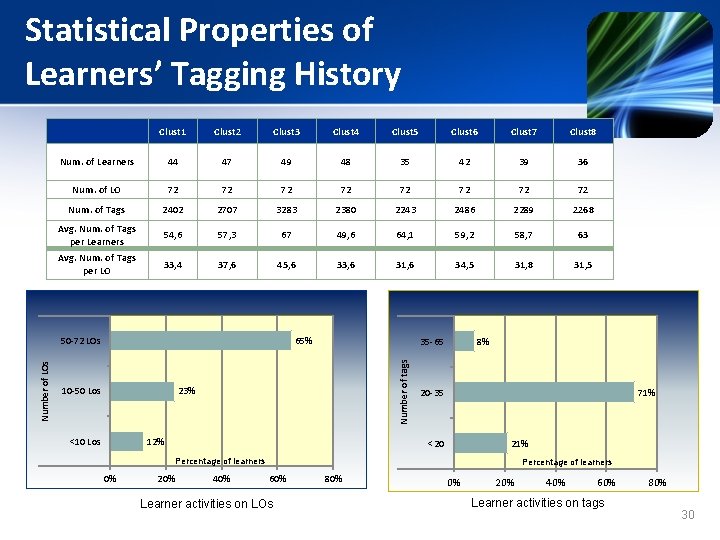
Statistical Properties of Learners’ Tagging History Clust 1 Clust 2 Clust 3 Clust 4 Clust 5 Clust 6 Clust 7 Clust 8 Num. of Learners 44 47 49 48 35 42 39 36 Num. of LO 72 72 Num. of Tags 2402 2707 3283 2380 2243 2486 2289 2268 Avg. Num. of Tags per Learners 54, 6 57, 3 67 49, 6 64, 1 59, 2 58, 7 63 Avg. Num. of Tags per LO 33, 4 37, 6 45, 6 33, 6 31, 6 34, 5 31, 8 31, 5 10 -50 Los Number of tags Number of LOs 35 -65 65% 50 -72 LOs 23% <10 Los 12% 8% 20 -35 71% <20 21% Percentage of learners 0% 20% 40% Percentage of learners 60% Learner activities on LOs 80% 0% 20% 40% 60% Learner activities on tags 80% 30
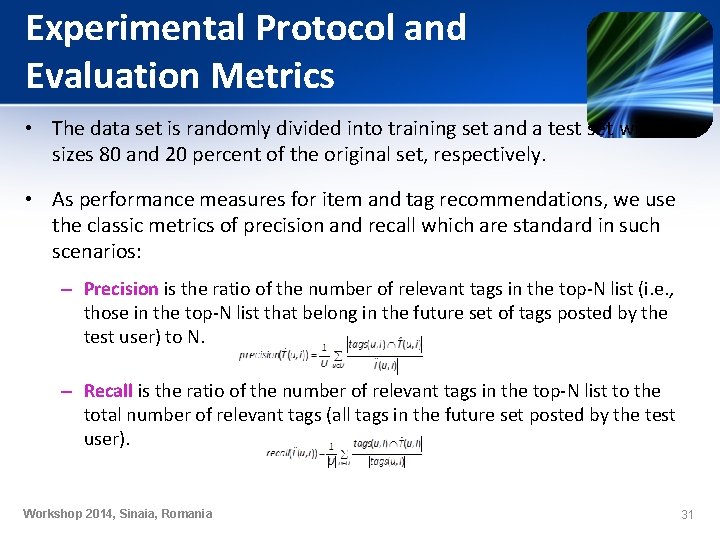
Experimental Protocol and Evaluation Metrics • The data set is randomly divided into training set and a test set with sizes 80 and 20 percent of the original set, respectively. • As performance measures for item and tag recommendations, we use the classic metrics of precision and recall which are standard in such scenarios: – Precision is the ratio of the number of relevant tags in the top-N list (i. e. , those in the top-N list that belong in the future set of tags posted by the test user) to N. – Recall is the ratio of the number of relevant tags in the top-N list to the total number of relevant tags (all tags in the future set posted by the test user). Workshop 2014, Sinaia, Romania 31
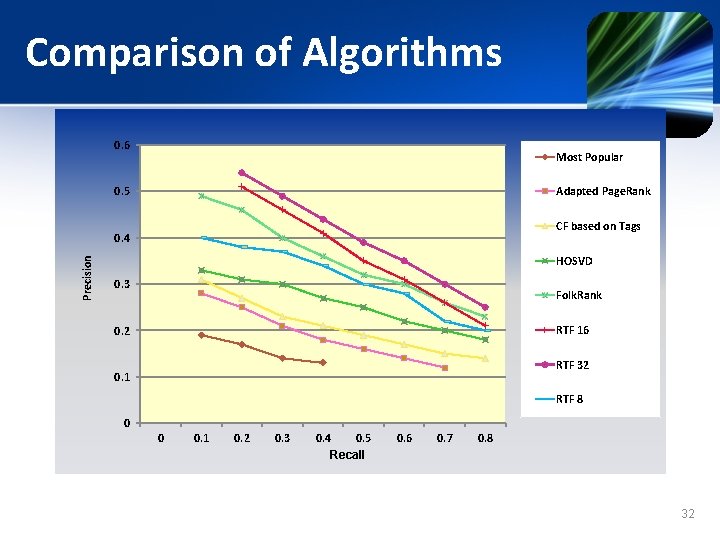
Comparison of Algorithms 0. 6 Most Popular Adapted Page. Rank 0. 5 Precision 0. 4 CF based on Tags 0. 4 HOSVD 0. 3 0. 2 0. 1 CF based on Tags Folk. Rank RTF 16 RTF 32 0. 1 RTF 8 0 1 0 0 2 0. 1 3 0. 2 4 0. 3 5 6 0. 4 Recall 0. 5 Recall 7 0. 6 8 9 0. 7 0. 8 32
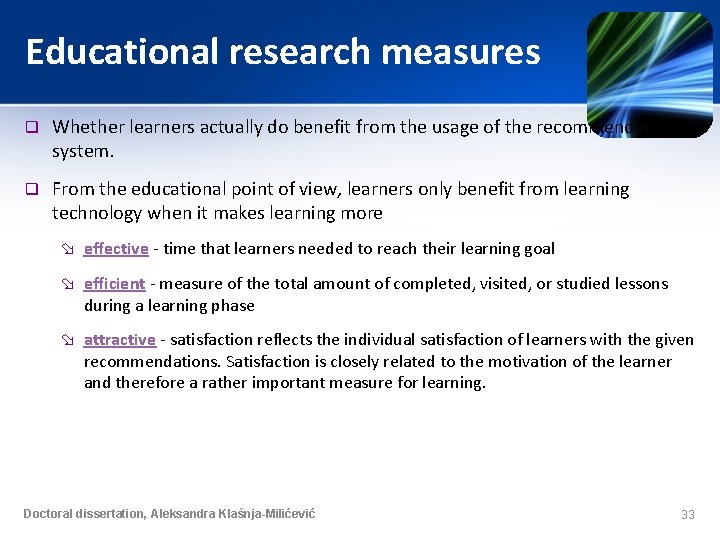
Educational research measures q Whether learners actually do benefit from the usage of the recommender system. q From the educational point of view, learners only benefit from learning technology when it makes learning more ø effective - time that learners needed to reach their learning goal ø efficient - measure of the total amount of completed, visited, or studied lessons during a learning phase ø attractive - satisfaction reflects the individual satisfaction of learners with the given recommendations. Satisfaction is closely related to the motivation of the learner and therefore a rather important measure for learning. Doctoral dissertation, Aleksandra Klašnja-Milićević 33
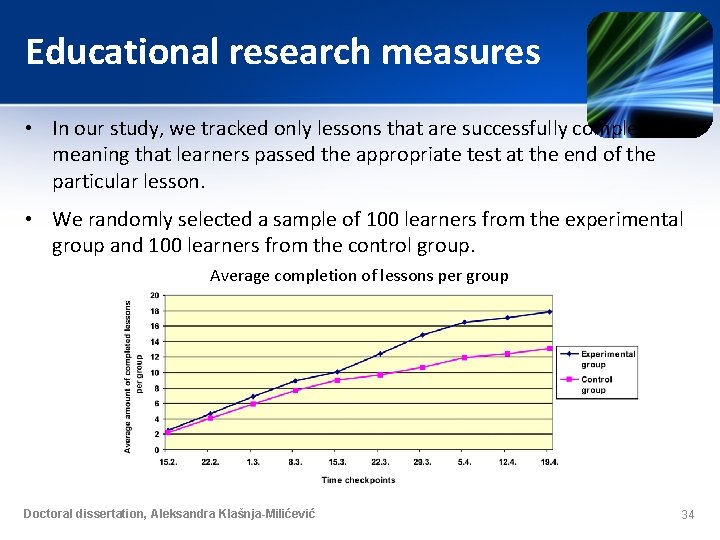
Educational research measures • In our study, we tracked only lessons that are successfully completed, meaning that learners passed the appropriate test at the end of the particular lesson. • We randomly selected a sample of 100 learners from the experimental group and 100 learners from the control group. Average completion of lessons per group Doctoral dissertation, Aleksandra Klašnja-Milićević 34
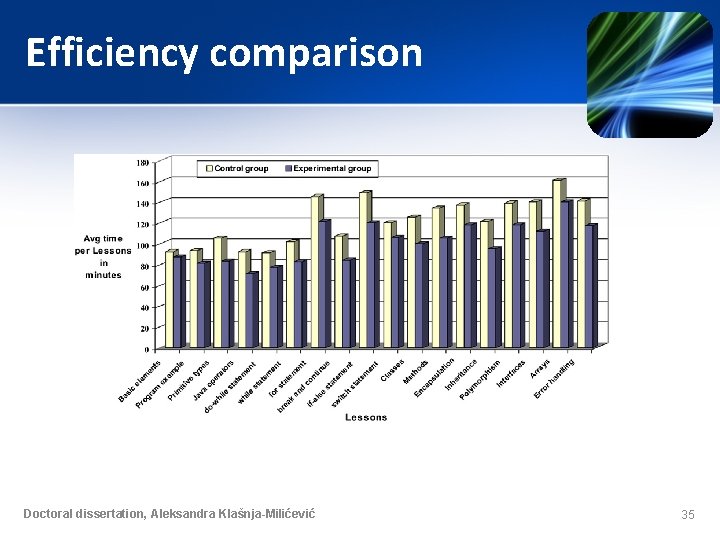
Efficiency comparison Doctoral dissertation, Aleksandra Klašnja-Milićević 35
Subjective evaluation • At the end of the course a non-mandatory questionnaire that collected learners’ (from the experimental group) opinions about the main features of the system. • Out of 100 learners, 75 filled in the questionnaire.
Outline ✓ 1 Aims and Research Objectives of the Dissertation ✓ 2 Recommender Systems, Folksonomy and Tag-based Recommender Systems ✓ 3 Recommender Systems in E-learning Environments ✓ 4 Design, Architecture and Interface of Protus System ✓ 5 Evaluation and Discussion 6 Conclusions Workshop 2014, Sinaia, Romania 37
Conclusions • Learners can learn more conveniently than before - system meets their need and interest • Including learner’s learning style - better interpretation of the learner cluster • The best method is RTF (Ranking with Tensor Factorization), followed by Folk. Rank and HOSVD • The tag collection - identify learner’s interests, judgment, comprehension and knowledge level in different topics • The learners have gained more knowledge in less time • Appropriate selection of collaborative tagging techniques - lead to applying the best results in terms of: – increasing motivation in learning process and – understanding of the learning content. Workshop 2014, Sinaia, Romania 38
Personalization in e-learning systems prof. dr Mirjana Ivanović dr Aleksandra Klašnja-Milićević Department of Mathematics and Informatics Faculty of Sciences, Novi Sad Workshop 2014, Sinaia, Romania