
Personality Psychology Erikson History Erikson l Born Frankfurt

Personality Psychology Erikson
History Erikson l Born: Frankfurt, Germany, on June 15, 1902. l Died May 12, 1994 in Harwich, MA l Family: His biological father was an unnamed Danish man who abandoned Erik's mother before he was born. His mother, Karla Abrahamsen, was a young Jewish woman who raised him alone for the first three years of his life. She then married Dr. Theodor Homberger, who was Erik's pediatrician, and moved to Karlsruhe in southern Germany. l He married Joan Serson, a Canadian dance teacher and had three children. l .
History Career l He studied art and a variety of languages during his school years, rather than science courses such as biology and chemistry. He did not prefer the atmosphere that formal schooling produced, so instead of going to college he traveled around Europe, keeping a diary of his experiences. After a year of doing this, he returned to Germany and enrolled in art school. l Erikson started off being an art teacher and earned Montessori education certificate. He taught children of Americans who had come to Vienna for Freudian training. He was then admitted into the Vienna Psychoanalytic Institute. He graduated from the Vienna Psychoanalytic Institute in 1933. Also that year, he settled in Boston and began work in private practice and at Harvard. It was at this time in his life that he was psychoanalyzed by Anna Freud herself.
Concepts l l l Epigenetic Principle Psychosocial Crises Timing Virtues Maladaptations/Malignancies
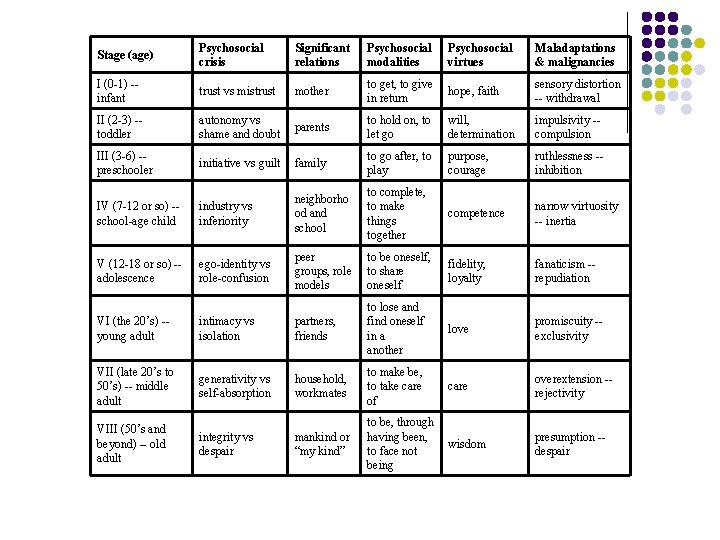
Stage (age) Psychosocial crisis Significant relations Psychosocial modalities Psychosocial virtues Maladaptations & malignancies I (0 -1) -infant trust vs mistrust mother to get, to give in return hope, faith sensory distortion -- withdrawal II (2 -3) -toddler autonomy vs shame and doubt parents to hold on, to let go will, determination impulsivity -compulsion III (3 -6) -preschooler initiative vs guilt family to go after, to play purpose, courage ruthlessness -inhibition IV (7 -12 or so) -school-age child industry vs inferiority neighborho od and school to complete, to make things together competence narrow virtuosity -- inertia V (12 -18 or so) -adolescence ego-identity vs role-confusion peer groups, role models to be oneself, to share oneself fidelity, loyalty fanaticism -repudiation love promiscuity -exclusivity VI (the 20’s) -young adult intimacy vs isolation partners, friends to lose and find oneself in a another VII (late 20’s to 50’s) -- middle adult generativity vs self-absorption household, workmates to make be, to take care of care overextension -rejectivity mankind or “my kind” to be, through having been, to face not being wisdom presumption -despair VIII (50’s and beyond) -- old adult integrity vs despair
- Slides: 5