
Personality Notes Part II Assessing the Unconscious Projective
- Slides: 23
Personality Notes Part II
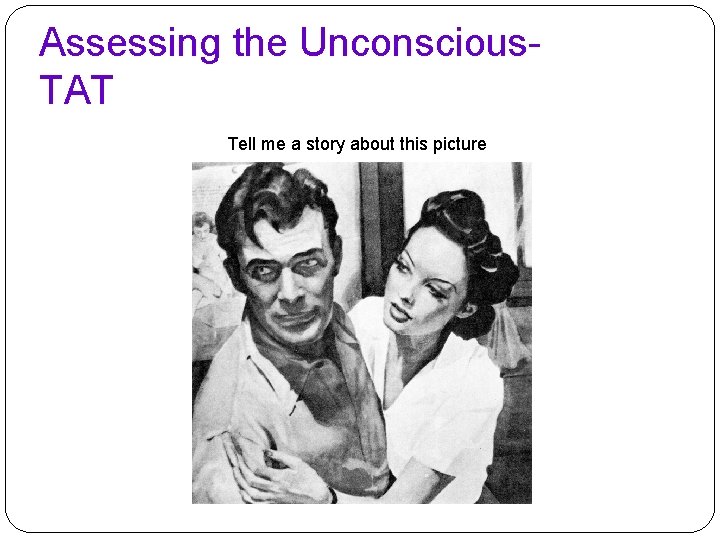
Assessing the Unconscious �Projective Test �a personality test, such as the Rorschach or TAT, that provides ambiguous stimuli designed to trigger projection of one’s inner dynamics �Thematic Apperception Test (TAT) �a projective test in which people express their inner feelings and interests through the stories they make up about ambiguous scenes
Assessing the Unconscious. TAT Tell me a story about this picture
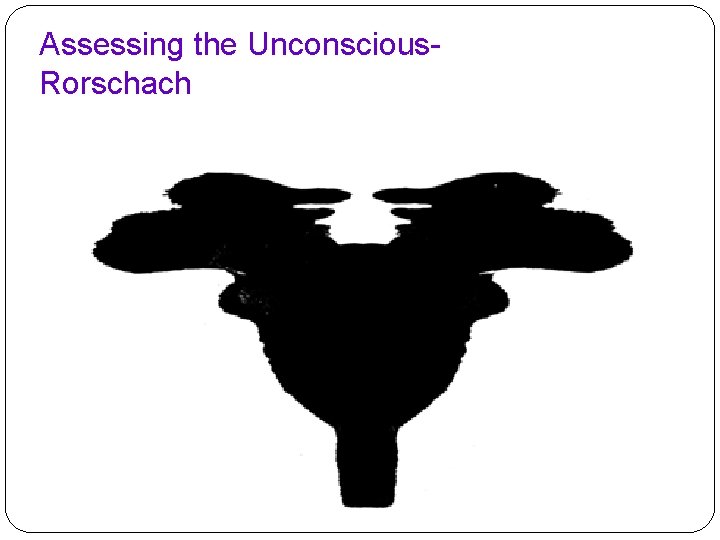
Assessing the Unconscious �Rorschach Inkblot Test �the most widely used projective test �a set of 10 inkblots designed by Hermann Rorschach �seeks to identify people’s inner feelings by analyzing their interpretations of the blots
Assessing the Unconscious. Rorschach
The Trait Perspective �Trait �a characteristic pattern of behavior �a disposition to feel and act, as assessed by self-report inventories and peer reports �Personality Inventory �a questionnaire (often with true-false or agree-disagree items) on which people respond to items designed to gauge a wide range of feelings and behaviors �used to assess selected personality traits
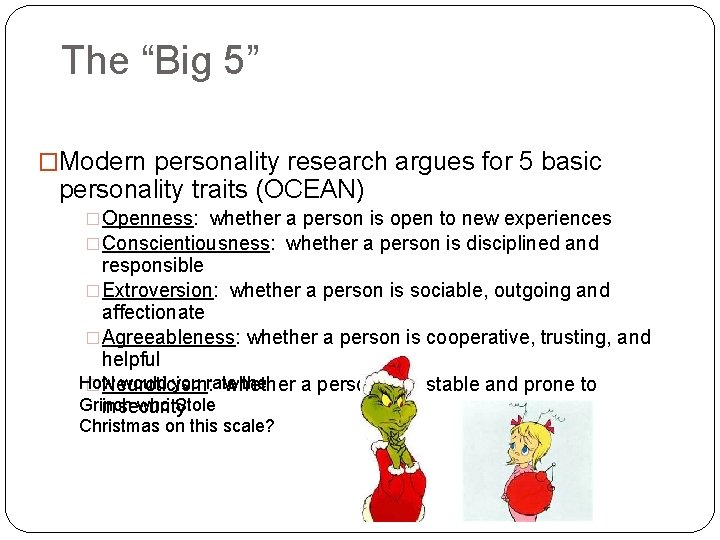
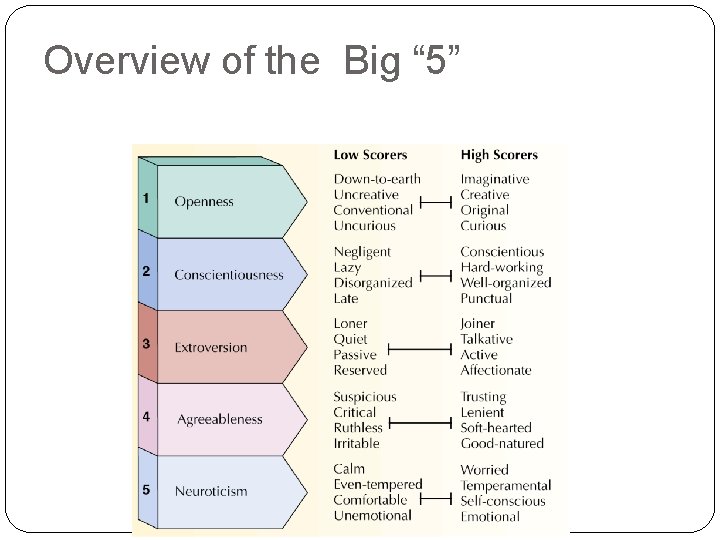
The “Big 5” �Modern personality research argues for 5 basic personality traits (OCEAN) �Openness: whether a person is open to new experiences �Conscientiousness: whether a person is disciplined and responsible �Extroversion: whether a person is sociable, outgoing and affectionate �Agreeableness: whether a person is cooperative, trusting, and helpful How would you rate the �Neuroticism: whether a person is unstable and prone to Grinch who Stole insecurity Christmas on this scale?
Overview of the Big “ 5”
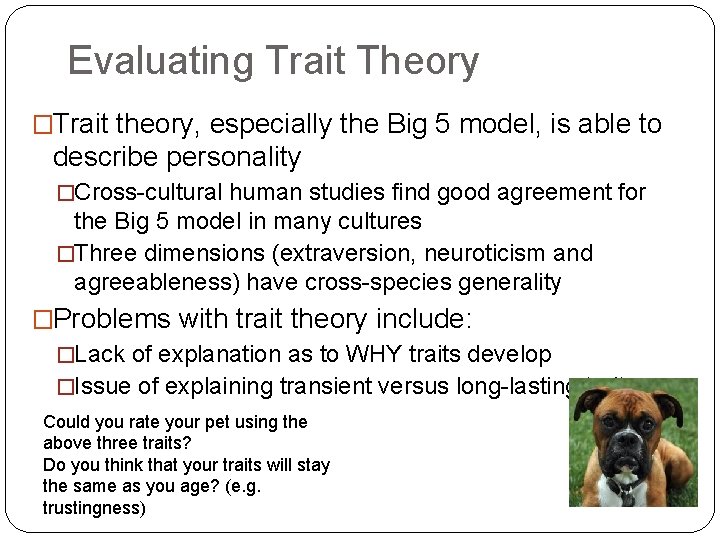
Evaluating Trait Theory �Trait theory, especially the Big 5 model, is able to describe personality �Cross-cultural human studies find good agreement for the Big 5 model in many cultures �Three dimensions (extraversion, neuroticism and agreeableness) have cross-species generality �Problems with trait theory include: �Lack of explanation as to WHY traits develop �Issue of explaining transient versus long-lasting traits Could you rate your pet using the above three traits? Do you think that your traits will stay the same as you age? (e. g. trustingness)
Evaluating the Trait Perspective �Situational influences on behavior are important to consider �People can fake desirable responses on self-report measures of personality �Averaging behavior across situations seems to indicate that people do have distinct personality How might someone with Antisocial Personality traits Disorder fake caring about other people? What kind of jobs might they end up in?
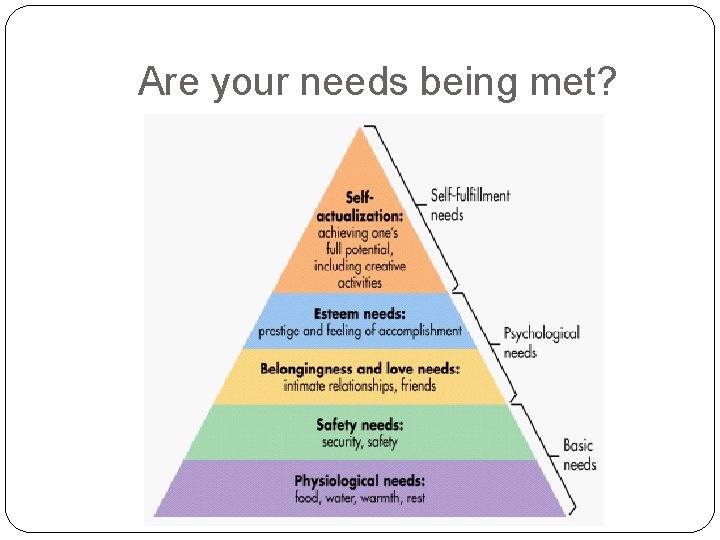
Humanistic Perspective �Abraham Maslow (1908 -1970) �studied self-actualization processes of productive and healthy people (e. g. , Lincoln) �Self-Actualization �the ultimate psychological need that arises after basic physical and psychological needs are met and selfesteem is achieved �the motivation to fulfill one’s potential
Are your needs being met?
Humanistic Perspective �Carl Rogers (1902 -1987) �focused on growth and fulfillment of individuals �requires three conditions: � genuineness � acceptance - unconditional positive regard � empathy �Unconditional Positive Regard �an attitude of total acceptance toward another person How is this a positive form of psychology? How is psychodynamics a negative view of psychology?
Humanistic Perspective � Self-Concept �all our thoughts and feelings about ourselves, in an answer to the question, “Who am I? ’ � Self-Esteem �one’s feelings of high or low self-worth � Self-Serving Bias �a readiness to perceive oneself favorably What do you think are the consequences of having a negative self-concept and low self-esteem?
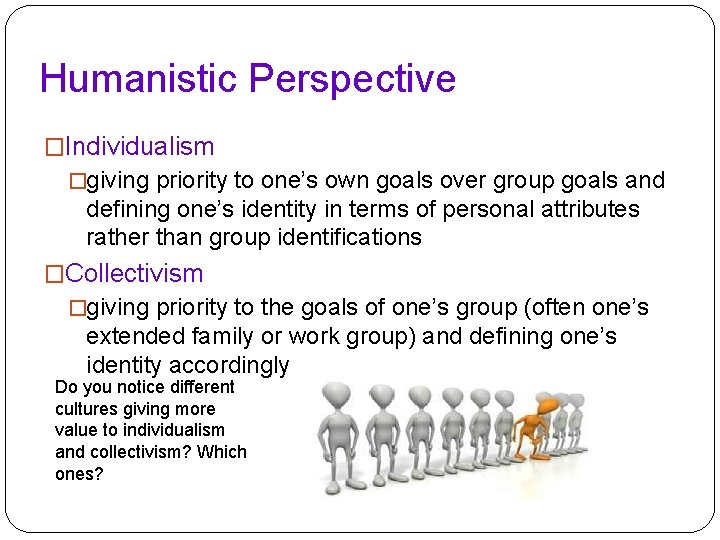
Humanistic Perspective �Individualism �giving priority to one’s own goals over group goals and defining one’s identity in terms of personal attributes rather than group identifications �Collectivism �giving priority to the goals of one’s group (often one’s extended family or work group) and defining one’s identity accordingly Do you notice different cultures giving more value to individualism and collectivism? Which ones?
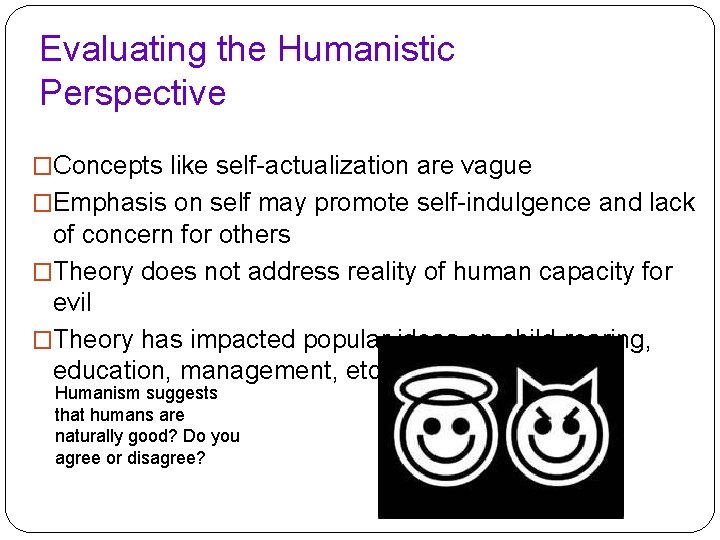
Evaluating the Humanistic Perspective �Concepts like self-actualization are vague �Emphasis on self may promote self-indulgence and lack of concern for others �Theory does not address reality of human capacity for evil �Theory has impacted popular ideas on child-rearing, education, management, etc. Humanism suggests that humans are naturally good? Do you agree or disagree?
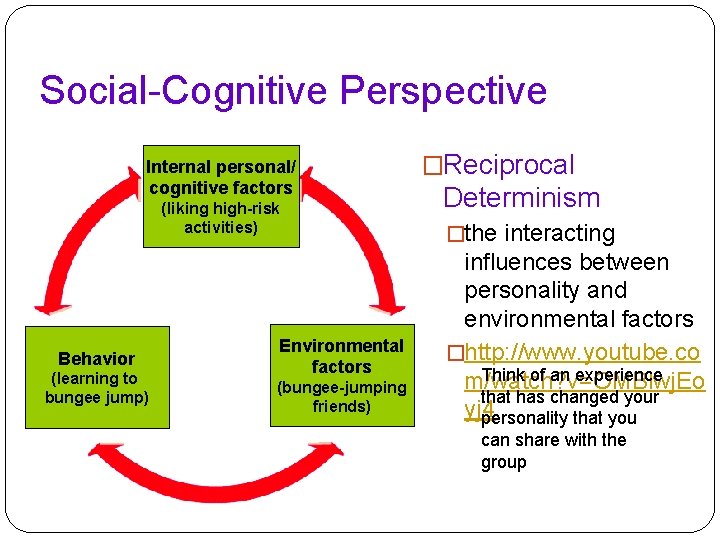
Social-Cognitive Perspective Internal personal/ cognitive factors (liking high-risk activities) Behavior (learning to bungee jump) Environmental factors (bungee-jumping friends) �Reciprocal Determinism �the interacting influences between personality and environmental factors �http: //www. youtube. co Think of an experience m/watch? v=OMBlwj. Eo that has changed your yj 4 personality that you can share with the group
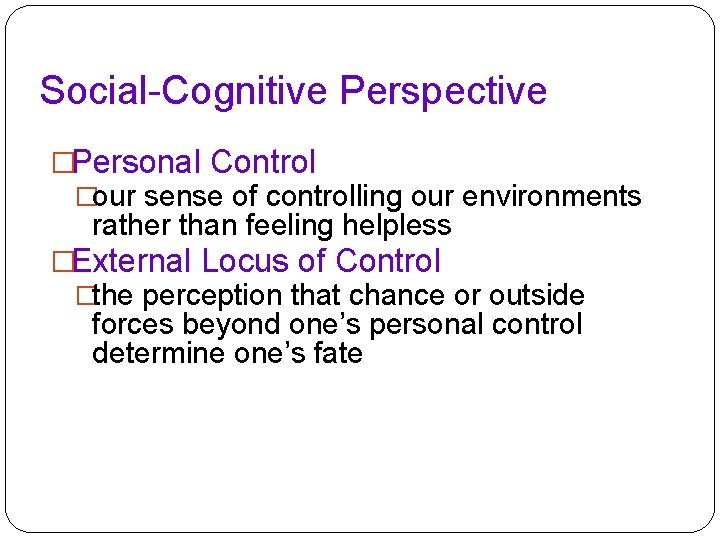
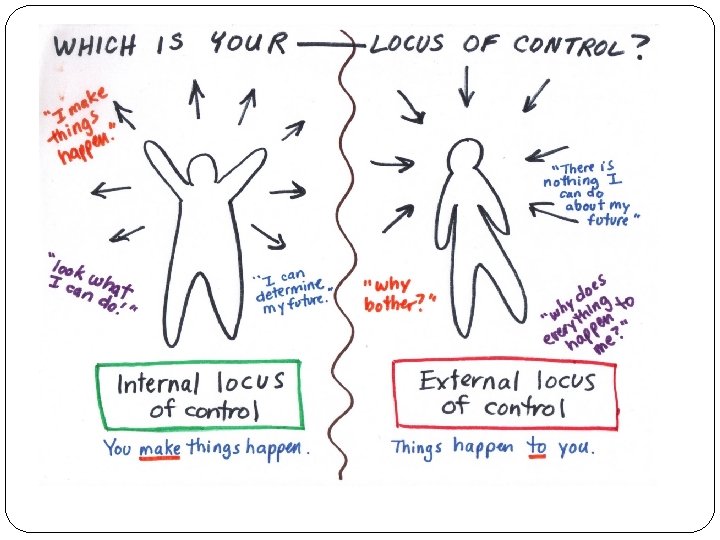
Social-Cognitive Perspective �Personal Control �our sense of controlling our environments rather than feeling helpless �External Locus of Control �the perception that chance or outside forces beyond one’s personal control determine one’s fate
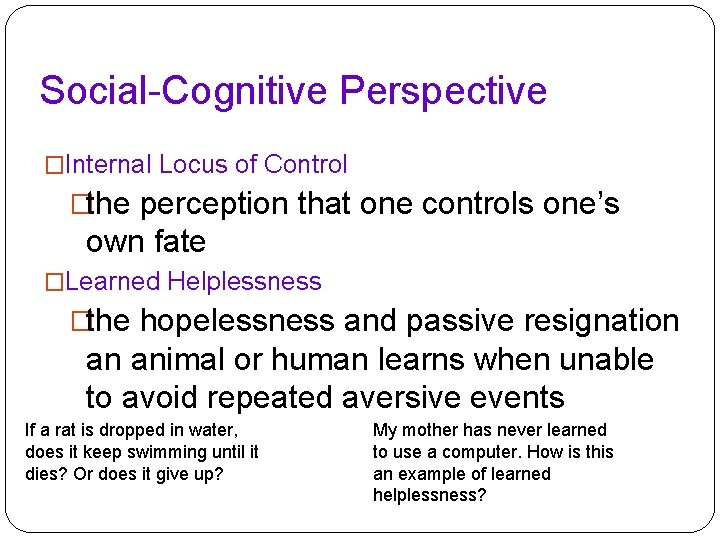
Social-Cognitive Perspective �Internal Locus of Control �the perception that one controls one’s own fate �Learned Helplessness �the hopelessness and passive resignation an animal or human learns when unable to avoid repeated aversive events If a rat is dropped in water, does it keep swimming until it dies? Or does it give up? My mother has never learned to use a computer. How is this an example of learned helplessness?
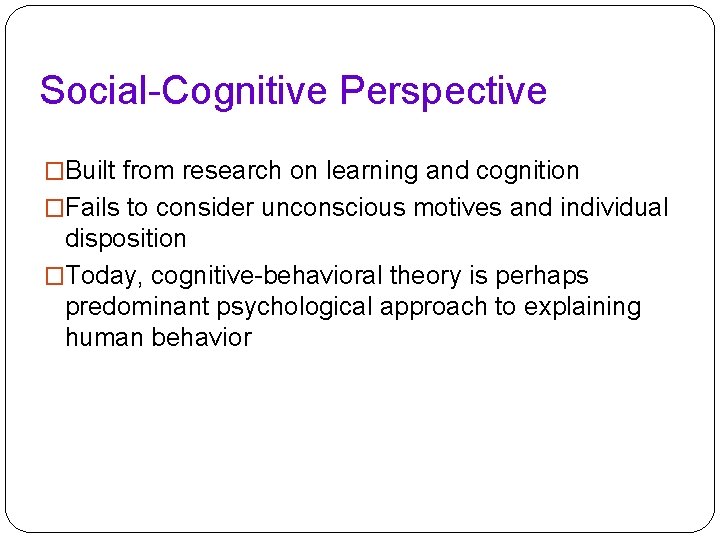
Social-Cognitive Perspective �Built from research on learning and cognition �Fails to consider unconscious motives and individual disposition �Today, cognitive-behavioral theory is perhaps predominant psychological approach to explaining human behavior
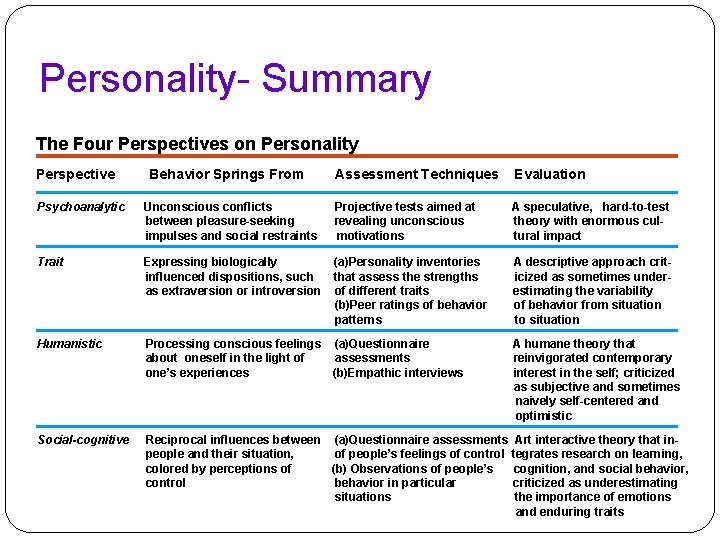
Personality- Summary The Four Perspectives on Personality Perspective Behavior Springs From Assessment Techniques Evaluation Psychoanalytic Unconscious conflicts between pleasure-seeking impulses and social restraints Projective tests aimed at revealing unconscious motivations A speculative, hard-to-test theory with enormous cultural impact Trait Expressing biologically influenced dispositions, such as extraversion or introversion (a)Personality inventories that assess the strengths of different traits (b)Peer ratings of behavior patterns A descriptive approach criticized as sometimes underestimating the variability of behavior from situation to situation Humanistic Processing conscious feelings (a)Questionnaire about oneself in the light of assessments one’s experiences (b)Empathic interviews Social-cognitive Reciprocal influences between (a)Questionnaire assessments Art interactive theory that inpeople and their situation, of people’s feelings of control tegrates research on learning, colored by perceptions of (b) Observations of people’s cognition, and social behavior, control behavior in particular criticized as underestimating situations the importance of emotions and enduring traits A humane theory that reinvigorated contemporary interest in the self; criticized as subjective and sometimes naively self-centered and optimistic
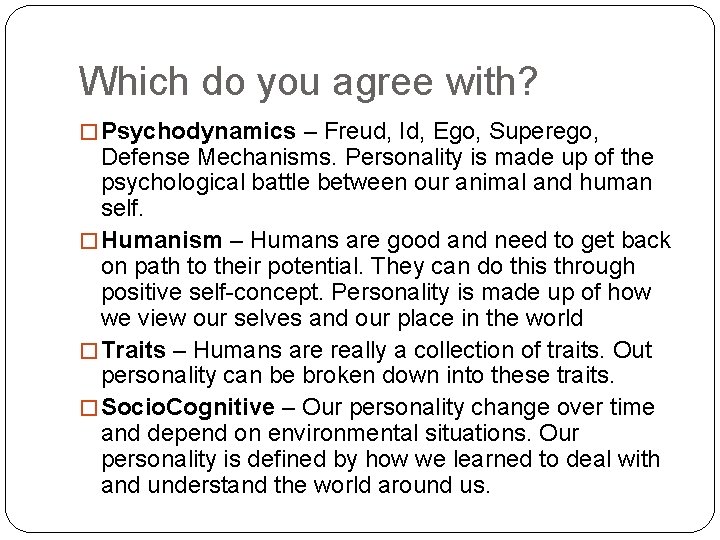
Which do you agree with? � Psychodynamics – Freud, Id, Ego, Superego, Defense Mechanisms. Personality is made up of the psychological battle between our animal and human self. � Humanism – Humans are good and need to get back on path to their potential. They can do this through positive self-concept. Personality is made up of how we view our selves and our place in the world � Traits – Humans are really a collection of traits. Out personality can be broken down into these traits. � Socio. Cognitive – Our personality change over time and depend on environmental situations. Our personality is defined by how we learned to deal with and understand the world around us.