
Personality Four Main Theories Psychoanalytic Theory Humanistic Theory
- Slides: 14
Personality Four Main Theories: • Psychoanalytic Theory • Humanistic Theory • Social-Cognitive Theory • Trait Theory A person’s pattern of thinking, feeling and acting.
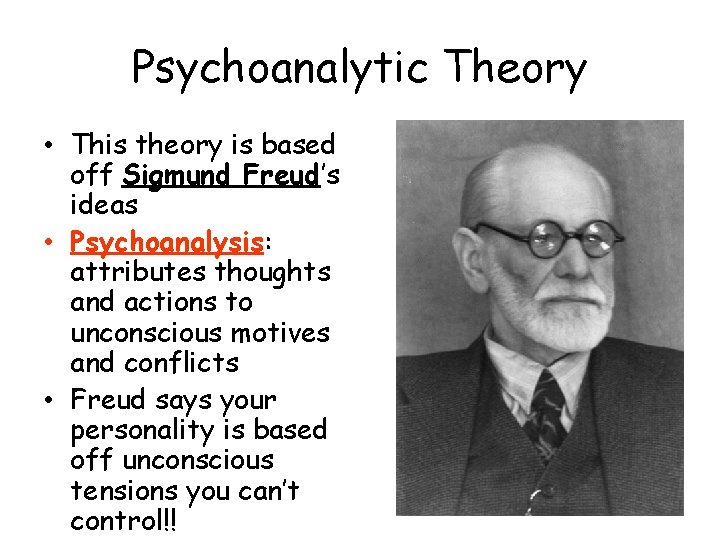
Psychoanalytic Theory • This theory is based off Sigmund Freud’s ideas • Psychoanalysis: attributes thoughts and actions to unconscious motives and conflicts • Freud says your personality is based off unconscious tensions you can’t control!!
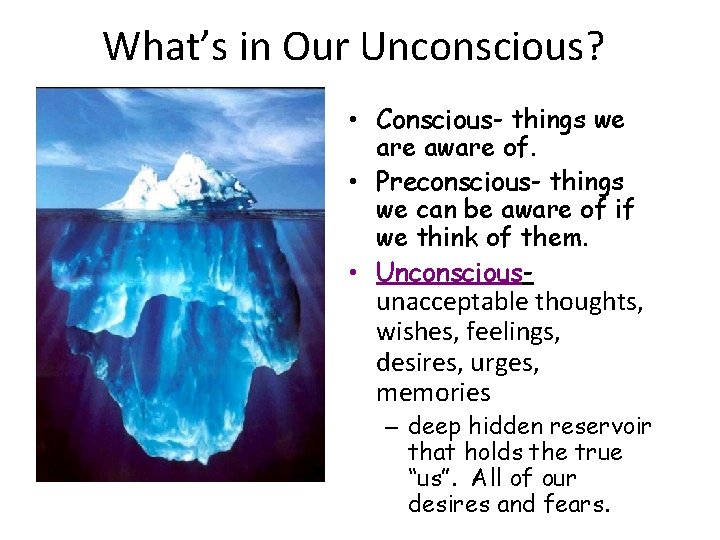
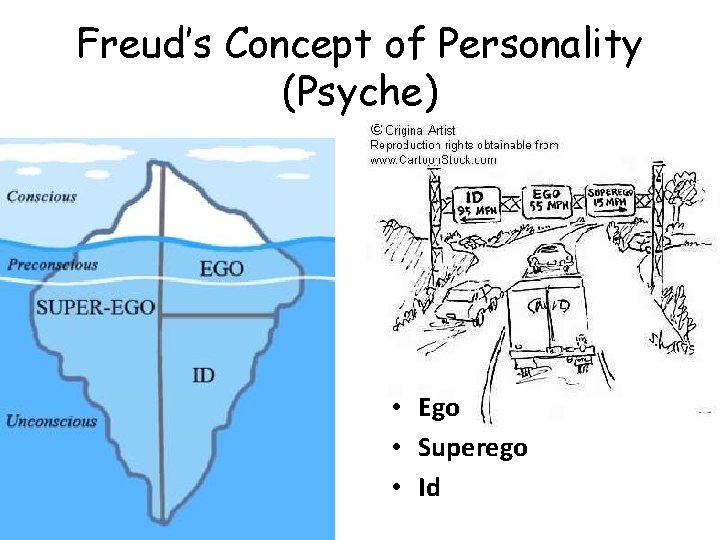
What’s in Our Unconscious? • Conscious- things we are aware of. • Preconscious- things we can be aware of if we think of them. • Unconscious- unacceptable thoughts, wishes, feelings, desires, urges, memories – deep hidden reservoir that holds the true “us”. All of our desires and fears.
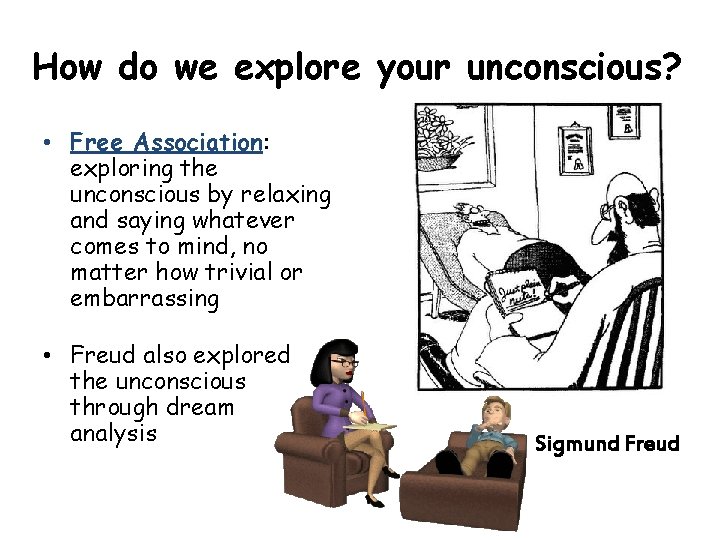
How do we explore your unconscious? • Free Association: exploring the unconscious by relaxing and saying whatever comes to mind, no matter how trivial or embarrassing • Freud also explored the unconscious through dream analysis Sigmund Freud
Freud’s Concept of Personality (Psyche) • Ego • Superego • Id
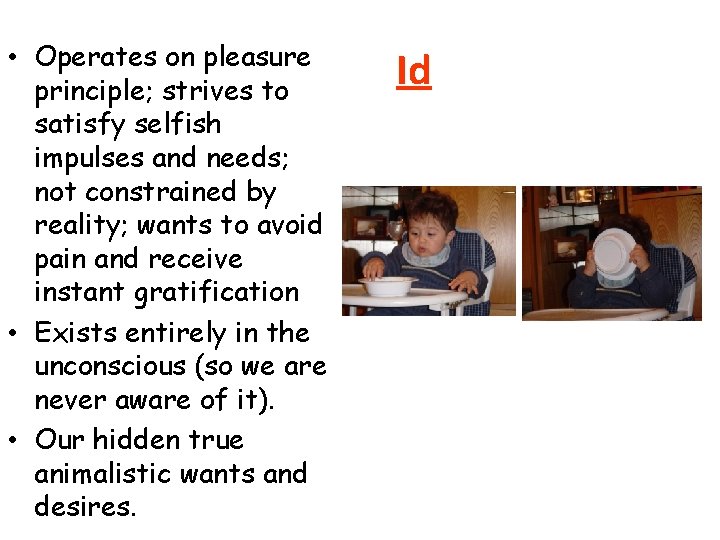
• Operates on pleasure principle; strives to satisfy selfish impulses and needs; not constrained by reality; wants to avoid pain and receive instant gratification • Exists entirely in the unconscious (so we are never aware of it). • Our hidden true animalistic wants and desires. Id
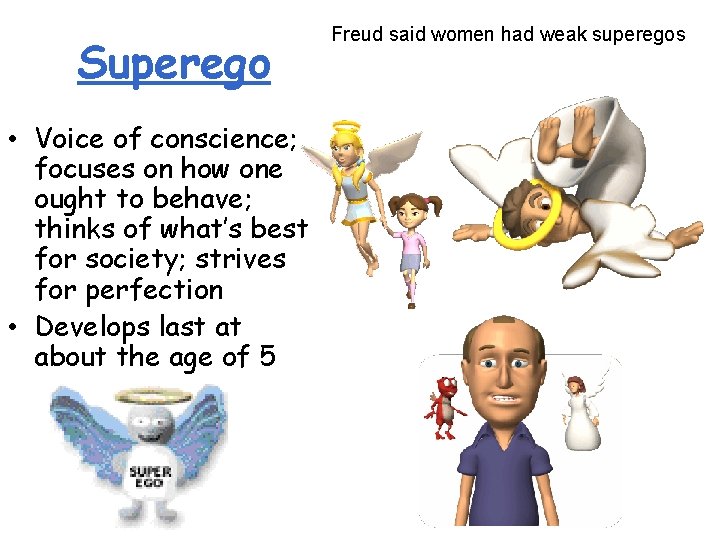
Superego • Voice of conscience; focuses on how one ought to behave; thinks of what’s best for society; strives for perfection • Develops last at about the age of 5 Freud said women had weak superegos
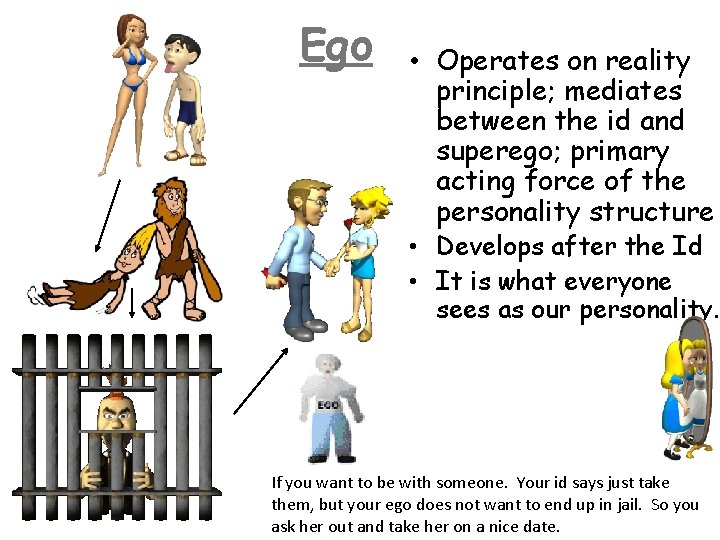
Ego • Operates on reality principle; mediates between the id and superego; primary acting force of the personality structure • Develops after the Id • It is what everyone sees as our personality. If you want to be with someone. Your id says just take them, but your ego does not want to end up in jail. So you ask her out and take her on a nice date.
Psychosexual Stages of Development • Children encounter conflicts during each of these five stages. • If the conflicts are not resolved, the child might become “fixated, ” or stuck at an early stage of development. The child would then carry that stage’s traits into adulthood. • Thus, Freud believed that an adult’s psychological problems might actually stem from unresolved childhood conflicts. • • • Oral Stage (0 -18 months) Anal Stage (18 -36 months) Phallic Stage (3 -6 years) Latency Stage (6 to puberty) Genital Stage (puberty on)
Oral Stage • 0 -18 months • Pleasure centers on mouth – Sucking, biting, chewing • If you don’t successfully pass through this stage as an infant, you might develop an oral fixation as an adult!
Anal Stage • 18 -36 months • Pleasure focuses on bladder and bowel elimination • If you don’t pass through this stage as a child, you might develop a demand for control as an adult – being “anal”!
Phallic Stage • 3 -6 years • Pleasure zone is the genitals • Freud claimed the Oedipus and Electra Complexes occurred in this stage – Wanted to kill your same sex parent and sleep with your opposite sex parent! • Eventually, identification with same sex parent occurs
Latency Stage • 6 -puberty • Dormant sexual feelings • Nothing going on here!
Genital Stage • Puberty on • Maturation of sexual interests • Start becoming interested in other people