
Personality Disorders DSM 5 Personality What is personality

- Slides: 42
Personality Disorders DSM 5
Personality · What is personality? · Personality is a unique and long-term pattern of inner experience and outward behavior · Tends to be consistent and is often described in terms of “traits” ( )ﺳﻤﺔ · Also flexible, allowing us to learn and adapt to new environments 2
Personality Traits • Personality Traits are enduring ( )ﺩﺍﺋﻤﺔ patterns of perceiving, relating to, and thinking about the environment and oneself that are exhibited in a wide range of context.
Personality Disorders • People with personality disorders experience an enduring, rigid pattern of inner experience and outward behavior that impairs sense of self, emotional experience, goals, and capacity for empathy and/or intimacy • The rigid traits of people with personality disorders often lead to psychological pain for the individual or others 4
Personality Disorders · A personality disorder typically becomes recognizable in adolescence or early adulthood and symptoms last for years · Among the most difficult psychological disorders to treat · Many sufferers are not even aware of their personality disorder · Estimated that 9% to 13% of all adults may have a personality disorder 5
Personality Disorders • Personality Disorders are often co-morbid with another Personality Disorder and with Mood. Ø Depression Ø Anxiety Ø And Substance use Disorders. Ø The diagnosis of a Personality Disorder requires and evaluation of the person’s longterm patterns of functioning.
General personality disorder • A. An enduring pattern of inner experience and behavior that deviates markedly from the expectations of the individual’s culture This pattern is manifested in two (or more) of the following areas: • 1. Cognition (i. e. , ways of perceiving and interpreting self, other people, and events). • 2. Affectivity (i. e. , the range, intensity, lability, and appropriateness of emotional response). • 3. Interpersonal functioning • 4. Impulse control
General personality disorder • B. The enduring pattern is inflexible and pervasive across a broad range of personal and social situations. • C. The enduring pattern leads to clinically significant distress or impairment in social, occupational, or other important areas of functioning. • D. The pattern is stable and of long duration, duration and Its onset can be traced back at least to adolescence or early adulthood • E. The enduring pattern is not better explained as a manifestation or consequence of another mental disorder. • F. The enduring pattern is not attributable to the physiological effects of a substance (e. g. , a drug of abuse, a medication) or another medical condition (e. g. , head trauma).
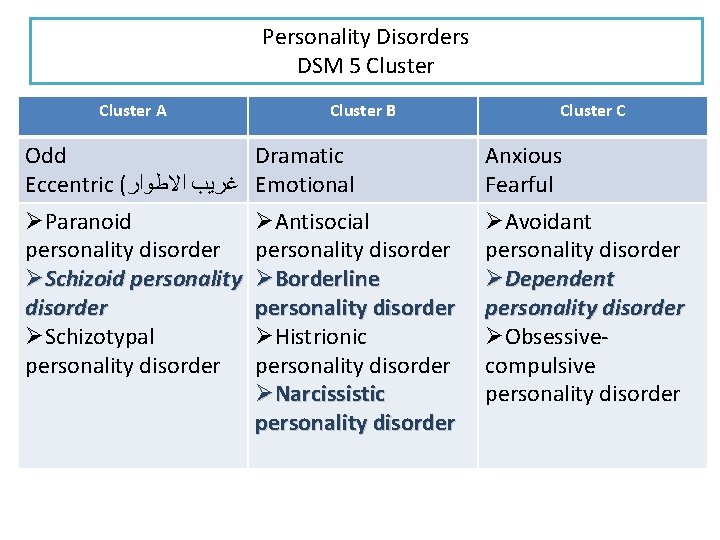
Personality Disorders DSM 5 Cluster A Cluster B Cluster C Odd Dramatic Eccentric ( ﻏﺮﻳﺐ ﺍﻻﻃﻮﺍﺭ Emotional Anxious Fearful ØParanoid personality disorder ØSchizotypal personality disorder ØAvoidant personality disorder ØDependent personality disorder ØObsessivecompulsive personality disorder ØAntisocial personality disorder ØBorderline personality disorder ØHistrionic personality disorder ØNarcissistic personality disorder
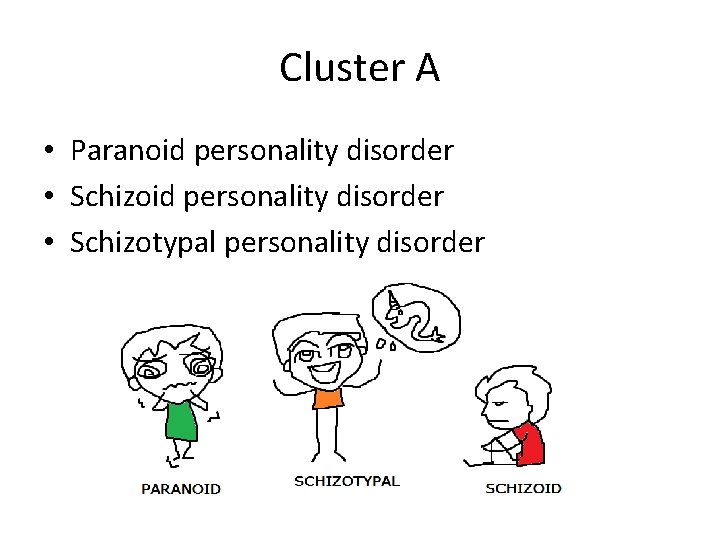
Cluster A • Paranoid personality disorder • Schizotypal personality disorder
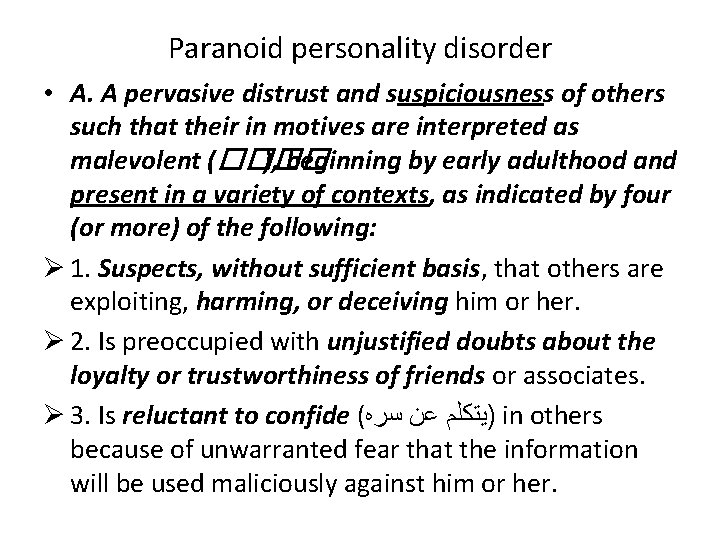
Paranoid personality disorder • A. A pervasive distrust and suspiciousness of others such that their in motives are interpreted as malevolent (���� ), beginning by early adulthood and present in a variety of contexts, as indicated by four (or more) of the following: Ø 1. Suspects, without sufficient basis, that others are exploiting, harming, or deceiving him or her. Ø 2. Is preoccupied with unjustified doubts about the loyalty or trustworthiness of friends or associates. Ø 3. Is reluctant to confide ( )ﻳﺘﻜﻠﻢ ﻋﻦ ﺳﺮﻩ in others because of unwarranted fear that the information will be used maliciously against him or her.
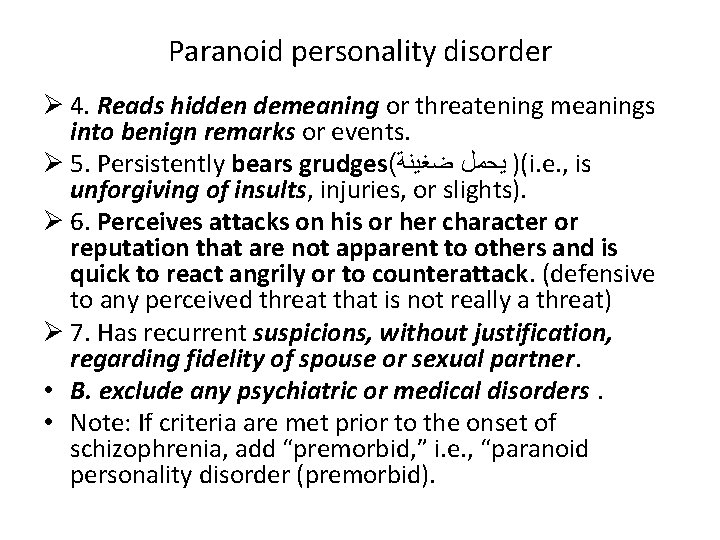
Paranoid personality disorder Ø 4. Reads hidden demeaning or threatening meanings into benign remarks or events. Ø 5. Persistently bears grudges( () ﻳﺤﻤﻞ ﺿﻐﻴﻨﺔ i. e. , is unforgiving of insults, injuries, or slights). Ø 6. Perceives attacks on his or her character or reputation that are not apparent to others and is quick to react angrily or to counterattack. (defensive to any perceived threat that is not really a threat) Ø 7. Has recurrent suspicions, without justification, regarding fidelity of spouse or sexual partner. • B. exclude any psychiatric or medical disorders. • Note: If criteria are met prior to the onset of schizophrenia, add “premorbid, ” i. e. , “paranoid personality disorder (premorbid).
Treatments for Paranoid Personality Disorder · People with paranoid personality disorder do not typically see themselves as needing help · Few come to treatment willingly · Those who are in treatment often distrust and rebel against their therapists · As a result, therapy for this disorder, as for most of the other personality disorders, has limited effect and moves slowly 13
Schizotypal • A. A pervasive pattern of social and interpersonal deficits marked by acute discomfort with, and reduced capacity for, close relationships as well as by cognitive or perceptual distortions and eccentricities of behavior, beginning by early adulthood and present in a variety of contexts, as indicated by five (or more) more of the following: • 1. Ideas of reference (excluding delusions of reference). • 2. Odd beliefs or magical thinking that influences behavior and is inconsistent with Sub-cultural norms (e. g. , superstitious, belief in clairvoyance ( )ﺍﺳﺘﺒﺼﺎﺭ , telepathy, or “sixth sense
Schizotypal • 3. Unusual perceptual experiences, including bodily illusions. • 4. Odd thinking and speech (e. g. , vague, circumstantial, metaphorical, over elaborate, or stereotyped). • 5. Suspiciousness or paranoid ideation. • 6. Inappropriate or constricted affect. • 7. Behavior or appearance that is odd, eccentric, or peculiar.
Schizotypal • 8. Lack of close friends or confidants other than first-degree relatives. • 9. Excessive social anxiety that does not diminish with familiarity and tends to be associated with paranoid fears rather than negative judgments about self. • B. Does not occur exclusively during the course of schizophrenia, a bipolar disorder or depressive disorder with psychotic features, another psychotic disorder, or autism spectrum disorder.
Treatments for Schizotypal Personality Disorder · Cognitive-behavioral therapists further try to teach clients to objectively evaluate their thoughts and perceptions and provide speech lessons and social skills training · Antipsychotic drugs appear to be somewhat helpful in reducing certain thought problems 17
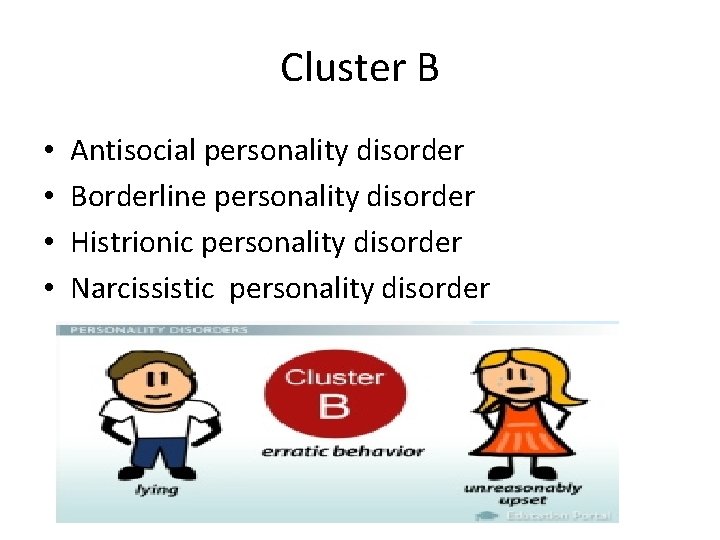
Cluster B • • Antisocial personality disorder Borderline personality disorder Histrionic personality disorder Narcissistic personality disorder
Antisocial personality disorder • A. A pervasive pattern of disregard for and violation of the rights of others, occurring since age 15 years, as indicated by three (or more) of the following: • 1. Failure to conform to social norms with respect to lawful behaviors, as indicated by repeatedly performing acts that are grounds for arrest. • 2. Deceitfulness, as indicated by repeated lying, use of aliases, or conning others for personal profit or pleasure. • 3. Impulsivity or failure to plan ahead. • 4. Irritability and aggressiveness, as indicated by repeated physical fights or assaults. • 5. Reckless disregard for safety of self or others.
Antisocial personality disorder • 6. Consistent irresponsibility, as indicated by repeated failure to sustain consistent work behavior or honor financial obligations. • 7. Lack of remorse, remorse as indicated by being indifferent to or rationalizing having hurt, mistreated, or stolen from another. • B. The individual is at least age 18 years. • C. There is evidence of conduct disorder with onset before age 15 years. • D. The occurrence of antisocial behavior is not exclusively during the course of schizophrenia or bipolar disorder
Antisocial Personality Disorder · 4 times more common in men than women · Linked to substance use disorders, and to adult criminal behavior · Often arrested, therefore researchers frequently look at prison populations · Higher rates of alcoholism/substance use disorders 21
How Do Theorists Explain Antisocial Personality Disorder? · Cognitive view says that people with the disorder hold attitudes that trivialize the importance of other people’s needs · Biological factors may play a role: · Lower levels of serotonin, impacting impulsivity and aggression · Deficient functioning in the frontal lobes of the brain · Lower levels of anxiety and arousal, leading them to be more likely than others to take risks and seek thrills 22
Treatments for Antisocial Personality Disorder · Treatments are typically ineffective · A major obstacle is the individual’s lack of conscience or desire to change · Most have been forced to come to treatment · Some cognitive therapists try to guide clients to think about moral issues and the needs of other people 23
Borderline personality disorder • A pervasive pattern of instability of interpersonal relationships, self-image, and affects, and marked impulsivity, beginning by early adulthood and present in a variety of contexts, as indicated by five (or more) of the following: • 1. Frantic efforts to avoid real or imagined abandonment. (Note: Do not include suicidal or selfmutilating behavior covered in Criterion 5. ) • 2. A pattern of unstable and intense interpersonal relationships characterized by alternating between extremes of idealization and devaluation. • 3. Identity disturbance: markedly and persistently unstable self-image or sense of self.
Borderline personality disorder • 4. Impulsivity in at least two areas that are potentially self-damaging (e. g. , spending, sex, substance abuse, reckless driving, binge eating) • 5. Recurrent suicidal behavior, gestures, or threats, or self-mutilating behavior. • 6. Affective instability due to a marked reactivity of mood (e. g. , intense episodic dysphoria, irritability, or anxiety usually lasting a few hours and only rarely more than a few days). • 7. Chronic feelings of emptiness. • 8. Inappropriate, intense anger or difficulty controlling anger (e. g. , frequent displays of temper, constant anger, recurrent physical fights). • 9. Transient, stress-related paranoid
Borderline Personality Disorder · Close to 75% of those diagnosed are women · Highly comorbid · The course of the disorder varies · In the most common pattern, the instability and risk of suicide reach a peak during young adulthood and then gradually wane with advancing age 26
How Do Theorists Explain Borderline Personality Disorder? · Because a fear of abandonment tortures so many people with the disorder, psychodynamic theorists look to early parental relationships to explain the disorder · Lack of early acceptance or abuse/neglect by parents 27
Treatments for Borderline Personality Disorder · “Dialectical behavior therapy” · Largely from the cognitive-behavioral treatment model · DBT is often supplemented by the clients participation in social skill-building groups · Biological abnormalities: such as an overly reactive amygdala and an underactive prefrontal cortex · In addition, sufferers who are particularly impulsive apparently have lower brain serotonin activity · Close relatives of those with borderline personality disorder are 5 times more likely than the general population to have the disorder 28
Treatments for Borderline Personality Disorder · Antidepressant, mood stabilizing, antianxiety, and antipsychotic drugs have helped some individuals to calm their emotional and aggressive storms · Given the numerous suicide attempts by these patients, their use of drugs on an outpatient basis is controversial · Most clients seem to benefit from a combination of drug therapy and psychotherapy 29
Histrionic personality disorder • A pervasive pattern of excessive emotionality and attention seeking, beginning by early adulthood and present in a variety of contexts, as indicated by five (or more) of the following: • 1. Is uncomfortable in situations in which he or she is not the center of attention. • 2. Interaction with others is often characterized by inappropriate sexually seductive or provocative behavior. • 3. Displays rapidly shifting and shallow expression of emotions. • 4. Consistently uses physical appearance to draw attention to self.
Histrionic personality disorder • 5. Has a style of speech that is excessively impressionistic and lacking in detail. • 6. Shows self-dramatization, theatricality, and exaggerated expression of emotion. • 7. Is suggestible (i. e. , easily influenced by others or circumstances). • 8. Considers relationships to be more intimate than they actually are.
Narcissistic personality disorder • A pervasive pattern of grandiosity (in fantasy or behavior), need for admiration, and lack of empathy, beginning by early adulthood and present in a variety of contexts, as indicated by five (or more) of the following: • 1. Has a grandiose sense of self-importance (e. g. , exaggerates achievements and talents, expects to be recognized as superior without commensurate achievements). • 2. Is preoccupied with fantasies of unlimited success, power, brilliance, beauty, or ideal • love. • 3. Believes that he or she is “special” and unique and can only be understood by, or should associate with, other special or high-status people (or institutions).
Narcissistic personality disorder • 4. Requires excessive admiration. • 5. Has a sense of entitlement (i. e. , unreasonable expectations of especially favorable treatment or automatic compliance with his or her expectations). • 6. Is interpersonally exploitative (i. e. , takes advantage of others to achieve his or her own ends). • 7. Lacks empathy: is unwilling to recognize or identify with the feelings and needs of others. • 8. Is often envious of others or believes that others are envious of him or her. • 9. Shows arrogant, haughty behaviors or attitudes.
Cluster C • Avoidant personality disorder • Dependent personality disorder • Obsessive-Compulsive personality disorder •
Avoidant personality disorder • A pervasive pattern of social inhibition, feelings of inadequacy, and hypersensitivity to negative evaluation, beginning by early adulthood and present in a variety of contexts, as indicated by four (or more) of the following: • 1. Avoids occupational activities that involve significant interpersonal contact because of fears of criticism, disapproval, or rejection. • 2. Is unwilling to get involved with people unless certain of being liked. • 3. Shows restraint within intimate relationships because of the fear of being shamed or ridiculed.
Avoidant personality disorder • 4. Is preoccupied with being criticized or rejected in social situations. • 5. Is inhibited in new interpersonal situations because of feelings of inadequacy. • 6. Views self as socially inept, personally unappealing, or inferior to others. • 7. Is unusually reluctant to take personal risks or to engage in any new activities because they may prove embarrassing
Dependent personality disorder • A pervasive and excessive need to be taken care of that leads to submissive and clinging behavior and fears of separation, beginning by early adulthood and present in a variety of contexts, as indicated by five (or more) of the following: • 1. Has difficulty making everyday decisions without an excessive amount of advice and reassurance from others. • 2. Needs others to assume responsibility for most major areas of his or her life. • 3. Has difficulty expressing disagreement with others because of fear of loss of support or approval. (Note: Do not include realistic fears of retribution. )
Dependent personality disorder • 4. Has difficulty initiating projects or doing things on his or her own (because of a lack of self-confidence in judgment or abilities rather than a lack of motivation or energy). • 5. Goes to excessive lengths to obtain nurturance and support from others, to the point of volunteering to do things that are unpleasant. • 6. Feels uncomfortable or helpless when alone because of exaggerated fears of being unable to care for himself or herself. • 7. Urgently seeks another relationship as a source of care and support when a close relationship ends. • 8. Is unrealistically preoccupied with fears of being left to take care of himself or herself.
Obsessive-Compulsive personality disorder • A pervasive pattern of preoccupation with orderliness, perfectionism, and mental and interpersonal control, at the expense of flexibility, openness, and efficiency, beginning by early adulthood and present in a variety of contexts, as indicated by four (or more) of the following: • 1. Is preoccupied with details, rules, lists, order, organization, or schedules to the extent that the major point of the activity is lost. • 2. Shows perfectionism that interferes with task completion (e. g. , is unable to complete a project because his or her own overly strict standards are not met). • 3. Is excessively devoted to work and productivity to the exclusion of leisure activities and friendships (not accounted for by obvious economic necessity).
Obsessive-Compulsive personality disorder • 4. Is over conscientious, scrupulous, and inflexible about matters of morality, ethics, or values (not accounted for by cultural or religious identification). • 5. Is unable to discard worn-out or worthless objects even when they have no sentimental value. • 6. Is reluctant to delegate tasks or to work with others unless they submit to exactly his or her way of doing things. • 7. Adopts a miserly spending style toward both self and others; money is viewed as something to be hoarded for future catastrophes. • 8. Shows rigidity and stubbornness.