
Personality Development n Personality a distinct and relatively
- Slides: 18
Personality Development n Personality – a distinct and relatively stable pattern of behaviors, thoughts, motives, and emotions that characterizes an individual over time n Differing views: – – – Biological Psychoanalytic Humanistic Trait Social Cognitive
Personality Development n Biological – Focus is on the brain, neurochemistry and genetics. – Heritability • Researched through twin studies • Only accounts for approximately 50% of personality formation
Personality Development Temperament refers to the basic disposition of a person and is biologically based n Three areas: n – Emotionality – Activity – Sociability
Personality Development n Psychoanalytic – Unseen forces within the individual in the form of attachments, conflicts, and motivations, have far more power than our conscious intentions – Psychosexual in nature n Involves processes on three levels: – Conscious – Preconscious – Unconscious
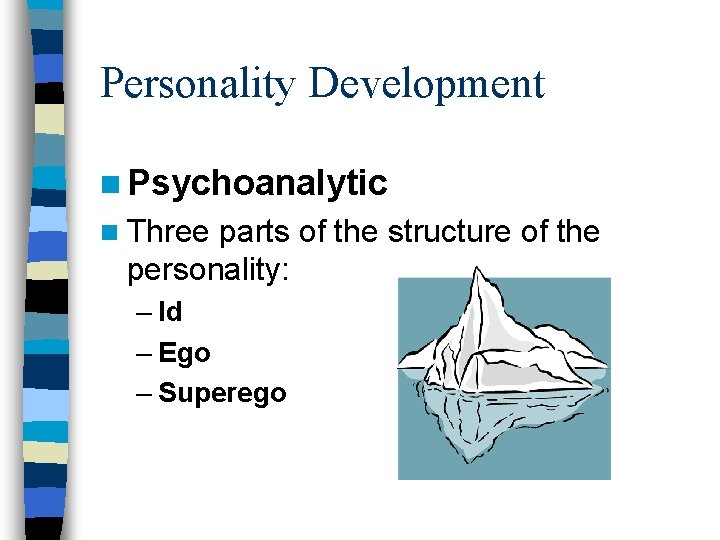
Personality Development n Psychoanalytic n Three parts of the structure of the personality: – Id – Ego – Superego
Personality Development n Defense Mechanisms – – – – Repression Projection Displacement Reaction Formation Regression Denial Rationalization Sublimation
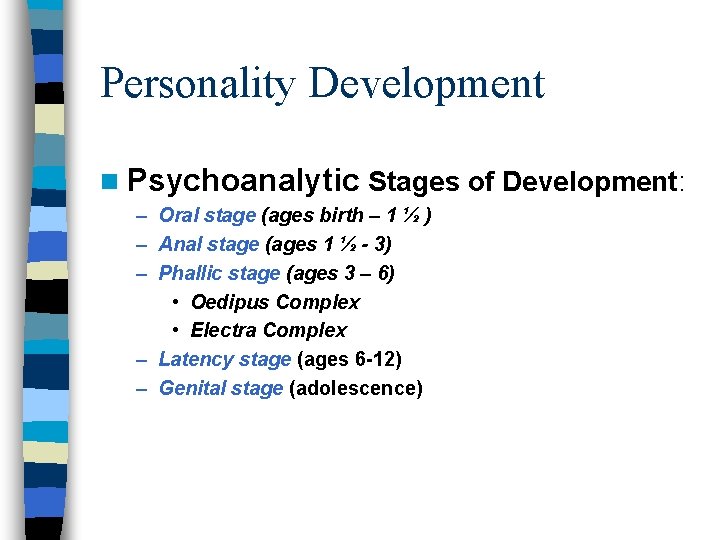
Personality Development n Psychoanalytic Stages of Development: – Oral stage (ages birth – 1 ½ ) – Anal stage (ages 1 ½ - 3) – Phallic stage (ages 3 – 6) • Oedipus Complex • Electra Complex – Latency stage (ages 6 -12) – Genital stage (adolescence)
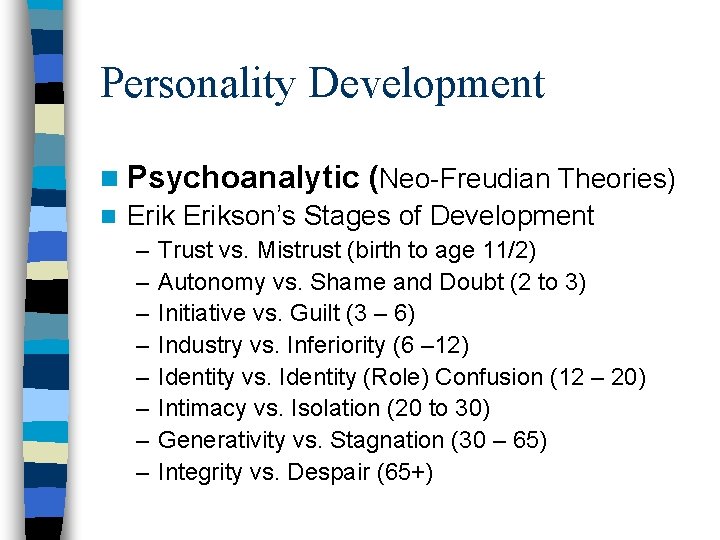
Personality Development n Psychoanalytic (Neo-Freudian Theories) n Erikson’s Stages of Development – – – – Trust vs. Mistrust (birth to age 11/2) Autonomy vs. Shame and Doubt (2 to 3) Initiative vs. Guilt (3 – 6) Industry vs. Inferiority (6 – 12) Identity vs. Identity (Role) Confusion (12 – 20) Intimacy vs. Isolation (20 to 30) Generativity vs. Stagnation (30 – 65) Integrity vs. Despair (65+)
Personality Development n Humanistic Emphasizes internal experiences (feelings and thoughts) and the individual’s own feelings of basic worth. n People are basically good and possess a positive drive toward self-fulfillment. (self actualization) n Each individual’s personality is created out of his or her unique way of perceiving and interpreting the world. n
Personality Development n Humanistic: Carl Rogers – Self • the most important part of personality. – Self-concept • refers to all information and beliefs about oneself regarding ones nature, unique qualities and typical behaviors
Personality Development n Humanistic: Carl Rogers – Self-esteem • Part of one’s self concept involving our perception of our worth and value as an individual – Unconditional positive regard • acceptance of a person as they are, with no contingencies attached – Self Actualization
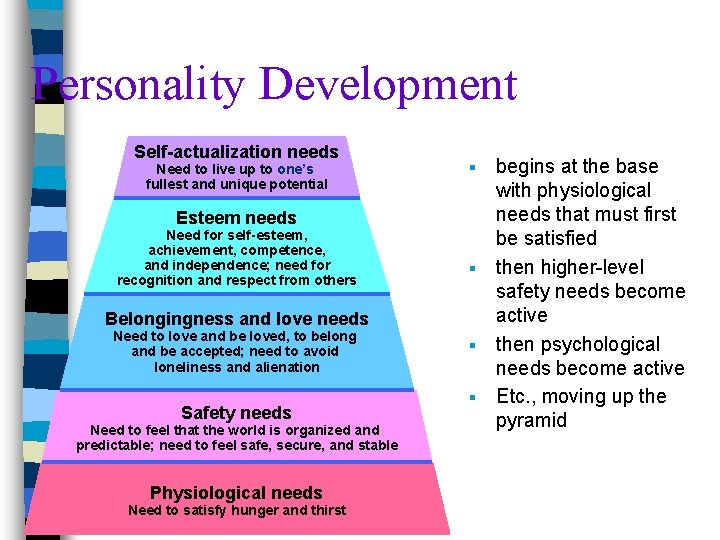
Personality Development n Humanistic: Abraham Maslow – Self-Actualization: • the innate tendency toward growth that motivates all human behavior and results in the full realization of a person’s highest potential
Personality Development Self-actualization needs Need to live up to one’s fullest and unique potential Esteem needs Need for self-esteem, achievement, competence, and independence; need for recognition and respect from others Belongingness and love needs Need to love and be loved, to belong and be accepted; need to avoid loneliness and alienation Safety needs Need to feel that the world is organized and predictable; need to feel safe, secure, and stable Physiological needs Need to satisfy hunger and thirst begins at the base with physiological needs that must first be satisfied § then higher-level safety needs become active § then psychological needs become active § Etc. , moving up the pyramid §
Personality Development n Trait – A relatively stable and consistent characteristic that can be used to describe someone – Gordon Allport • Cardinal Traits • Central Traits • Secondary Traits
Personality Development n Trait – The Big Five: (O. C. E. A. N. ) • • • Openness Conscientiousness Extroversion Agreeableness Neuroticism
Personality Development n Social Cognitive n Each of us has a unique personality based on: – our individual history of interactions with the environment and the impact it has on us – how we think about our world and interpret what happens to us.
Personality Development n Social Cognitive: Albert Bandura – Reciprocal determinism: behaviors, internal personal factors, and environmental events interact to produce personality – Self-Efficacy: learned beliefs of one’s own capabilities to accomplish things – Observational Learning
Personality Development n Social Cognitive: Julian Rotter – External Locus of Control – Internal Locus of Control