
Personality Characterological Psychopathology Cengage Learning 2016 Introduction to

- Slides: 37
Personality Characterological Psychopathology © Cengage Learning 2016
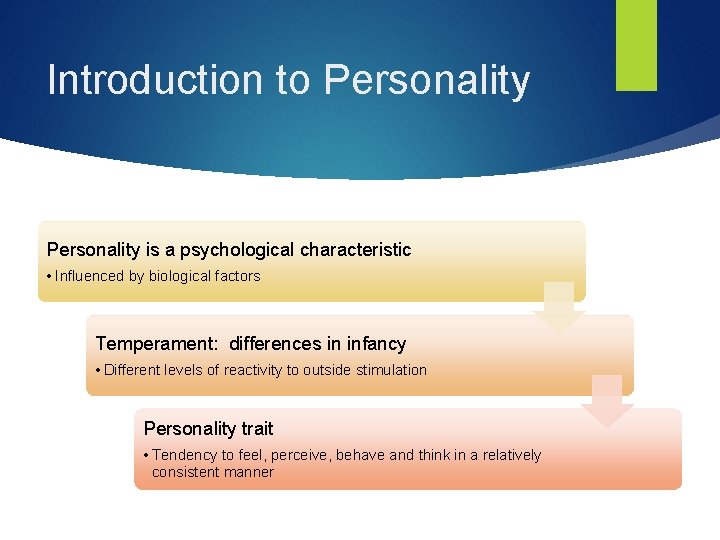
Introduction to Personality is a psychological characteristic • Influenced by biological factors Temperament: differences in infancy • Different levels of reactivity to outside stimulation Personality trait • Tendency to feel, perceive, behave and think in a relatively consistent manner © Cengage Learning 2016
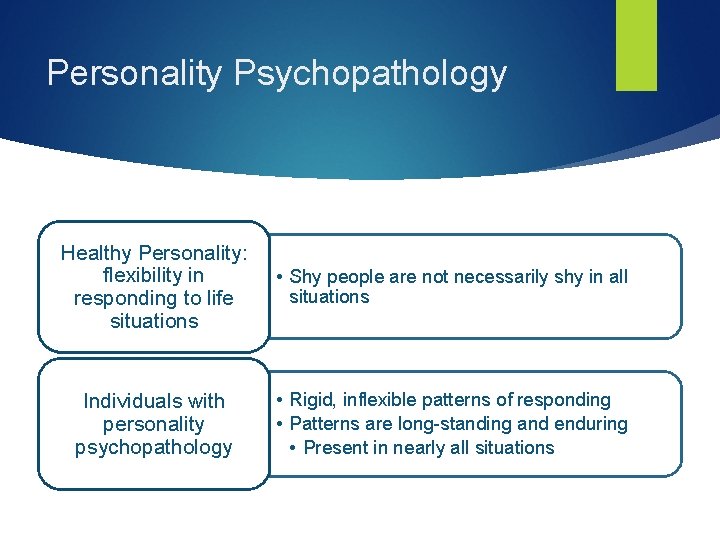
Personality Psychopathology Healthy Personality: flexibility in responding to life situations • Shy people are not necessarily shy in all situations Individuals with personality psychopathology • Rigid, inflexible patterns of responding • Patterns are long-standing and enduring • Present in nearly all situations © Cengage Learning 2016
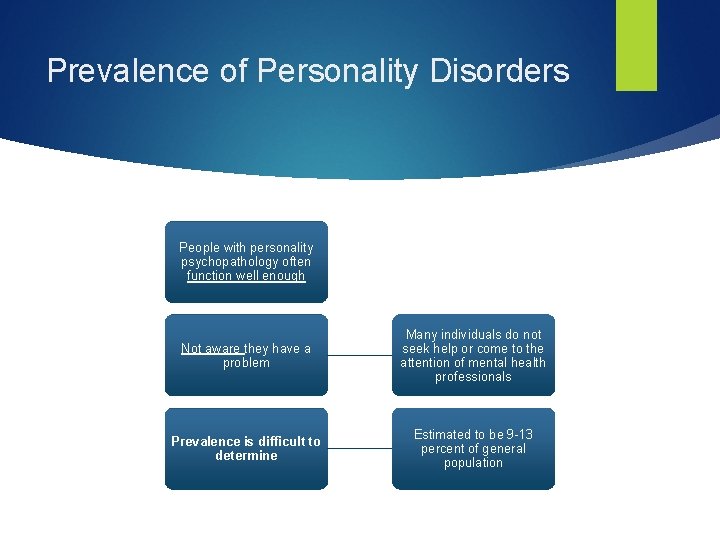
Prevalence of Personality Disorders People with personality psychopathology often function well enough © Cengage Learning 2016 Not aware they have a problem Many individuals do not seek help or come to the attention of mental health professionals Prevalence is difficult to determine Estimated to be 9 -13 percent of general population
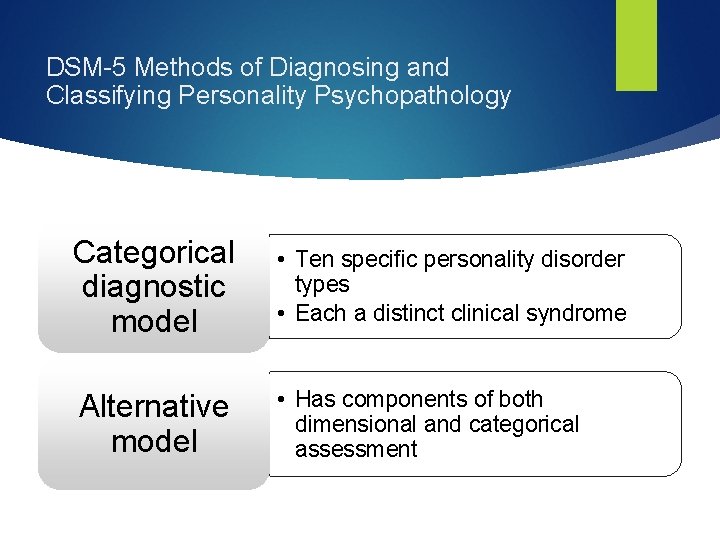
DSM-5 Methods of Diagnosing and Classifying Personality Psychopathology Categorical diagnostic model • Ten specific personality disorder types • Each a distinct clinical syndrome Alternative model • Has components of both dimensional and categorical assessment © Cengage Learning 2016
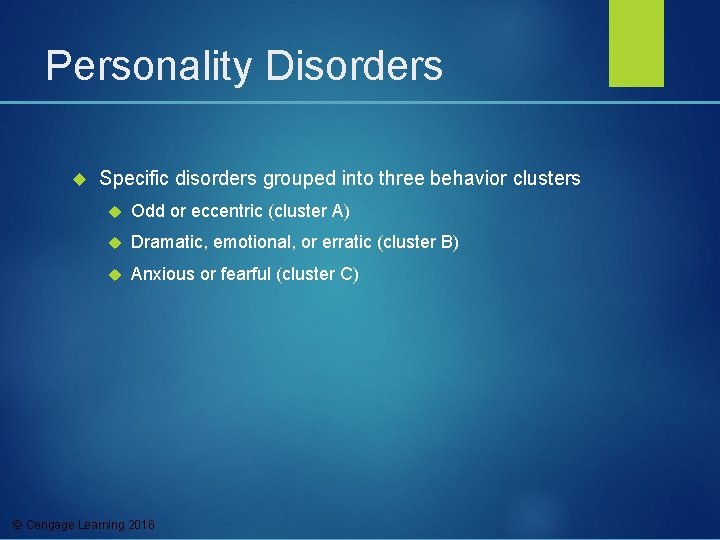
Personality Disorders Specific disorders grouped into three behavior clusters Odd or eccentric (cluster A) Dramatic, emotional, or erratic (cluster B) Anxious or fearful (cluster C) © Cengage Learning 2016
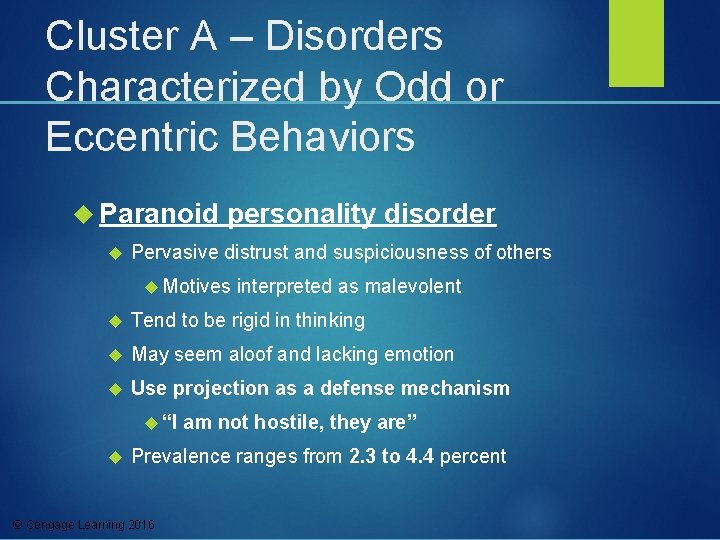
Cluster A – Disorders Characterized by Odd or Eccentric Behaviors Paranoid personality disorder Pervasive distrust and suspiciousness of others Motives interpreted as malevolent Tend to be rigid in thinking May seem aloof and lacking emotion Use projection as a defense mechanism “I am not hostile, they are” Prevalence ranges from 2. 3 to 4. 4 percent © Cengage Learning 2016
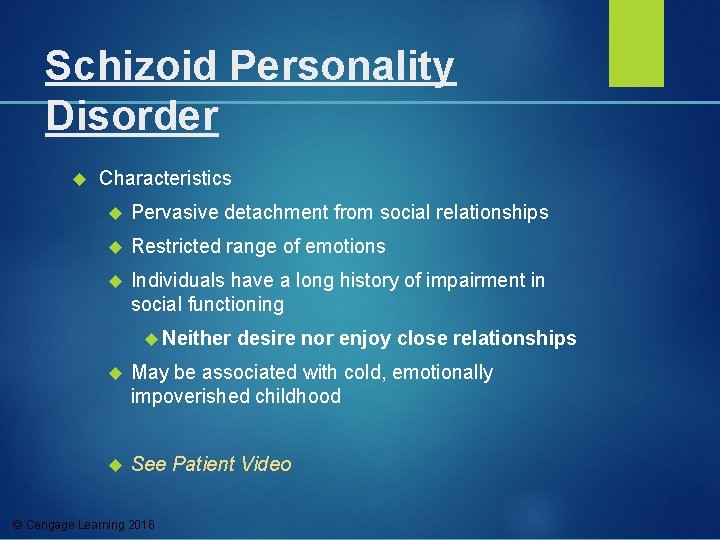
Schizoid Personality Disorder Characteristics Pervasive detachment from social relationships Restricted range of emotions Individuals have a long history of impairment in social functioning Neither desire nor enjoy close relationships May be associated with cold, emotionally impoverished childhood See Patient Video © Cengage Learning 2016
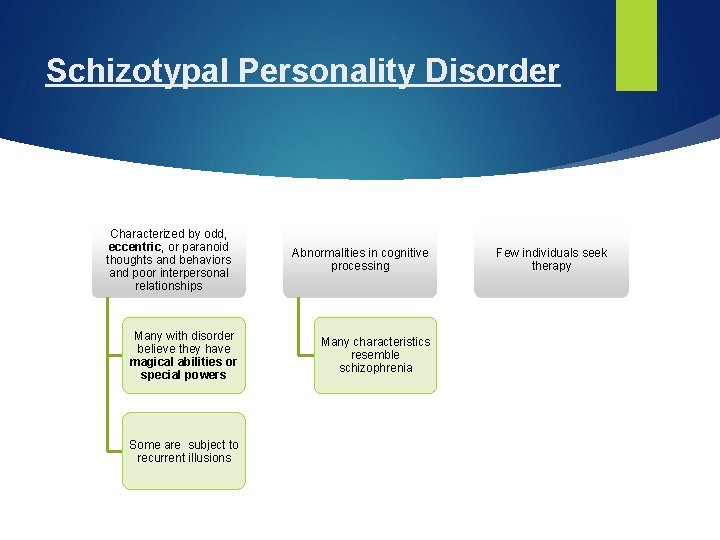
Schizotypal Personality Disorder Characterized by odd, eccentric, or paranoid thoughts and behaviors and poor interpersonal relationships Many with disorder believe they have magical abilities or special powers Some are subject to recurrent illusions © Cengage Learning 2016 Abnormalities in cognitive processing Many characteristics resemble schizophrenia Few individuals seek therapy
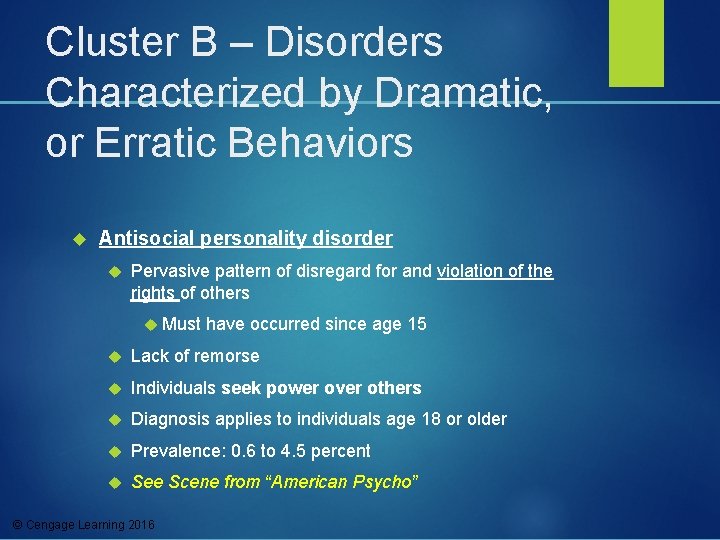
Cluster B – Disorders Characterized by Dramatic, or Erratic Behaviors Antisocial personality disorder Pervasive pattern of disregard for and violation of the rights of others Must have occurred since age 15 Lack of remorse Individuals seek power over others Diagnosis applies to individuals age 18 or older Prevalence: 0. 6 to 4. 5 percent See Scene from “American Psycho” © Cengage Learning 2016
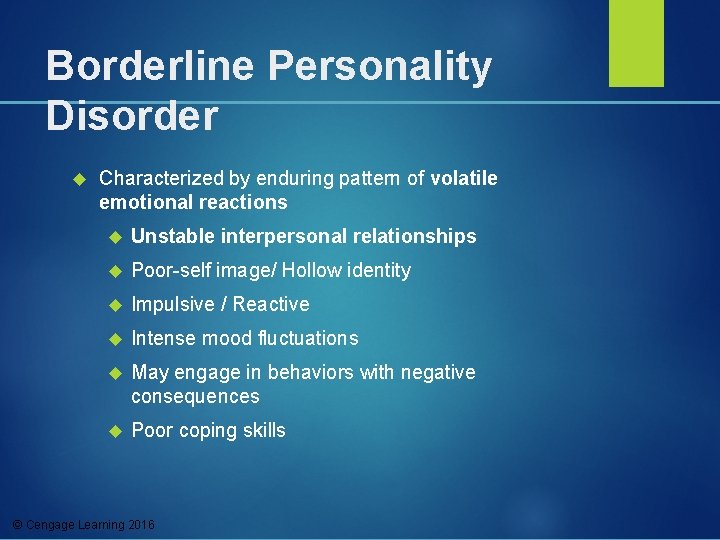
Borderline Personality Disorder Characterized by enduring pattern of volatile emotional reactions Unstable interpersonal relationships Poor-self image/ Hollow identity Impulsive / Reactive Intense mood fluctuations May engage in behaviors with negative consequences Poor coping skills © Cengage Learning 2016
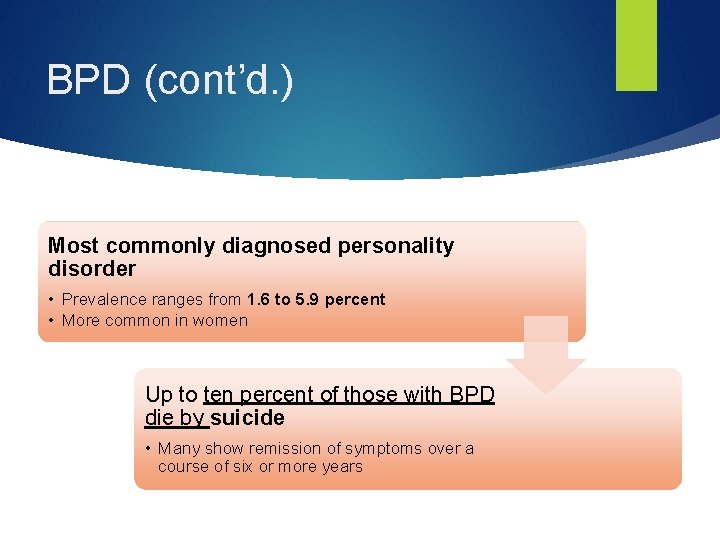
BPD (cont’d. ) Most commonly diagnosed personality disorder • Prevalence ranges from 1. 6 to 5. 9 percent • More common in women Up to ten percent of those with BPD die by suicide • Many show remission of symptoms over a course of six or more years © Cengage Learning 2016
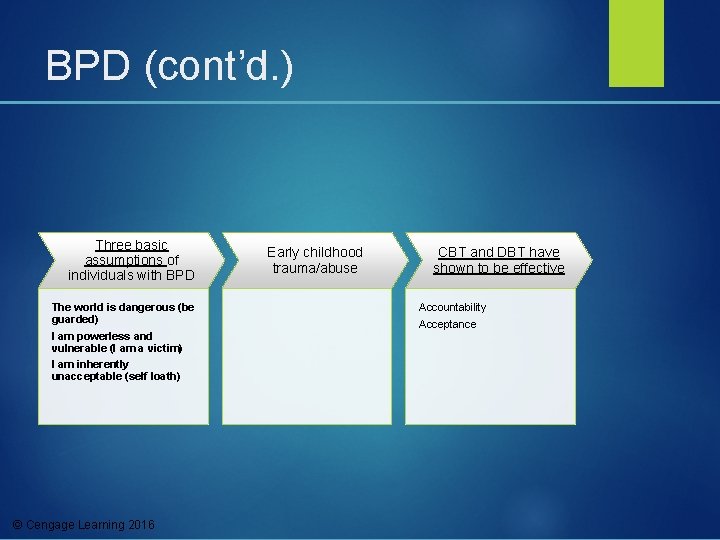
BPD (cont’d. ) Three basic assumptions of individuals with BPD The world is dangerous (be guarded) I am powerless and vulnerable (I am a victim) I am inherently unacceptable (self loath) © Cengage Learning 2016 Early childhood trauma/abuse CBT and DBT have shown to be effective Accountability Acceptance
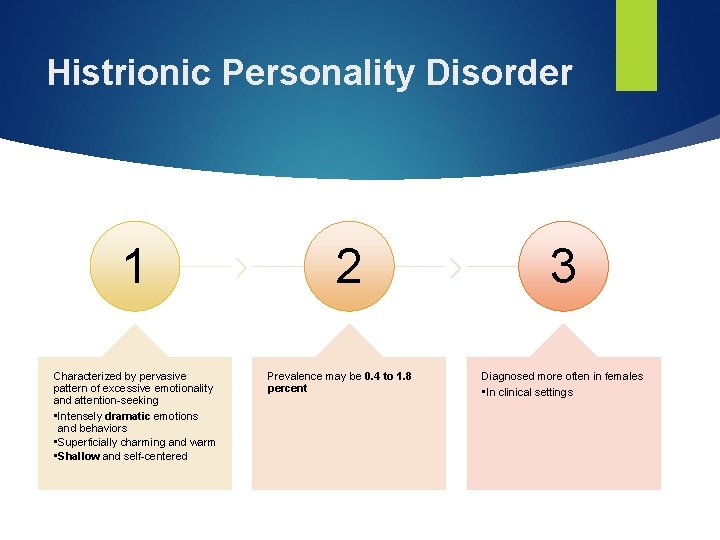
Histrionic Personality Disorder 1 Characterized by pervasive pattern of excessive emotionality and attention-seeking • Intensely dramatic emotions and behaviors • Superficially charming and warm • Shallow and self-centered © Cengage Learning 2016 2 Prevalence may be 0. 4 to 1. 8 percent 3 Diagnosed more often in females • In clinical settings
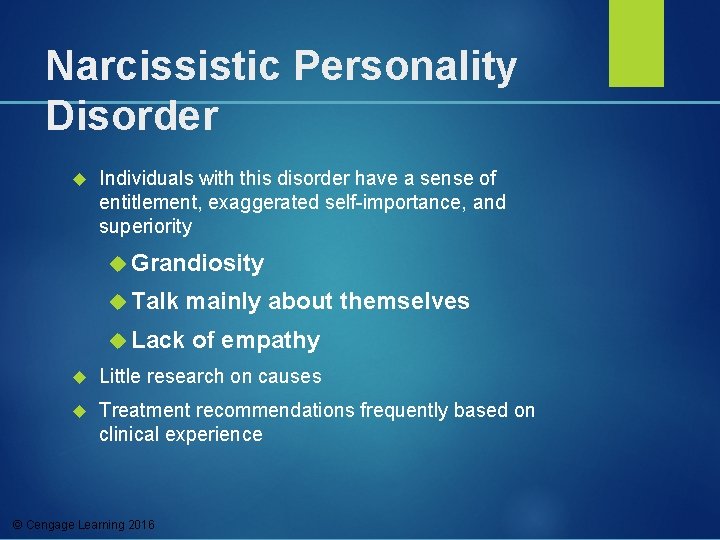
Narcissistic Personality Disorder Individuals with this disorder have a sense of entitlement, exaggerated self-importance, and superiority Grandiosity Talk mainly about themselves Lack of empathy Little research on causes Treatment recommendations frequently based on clinical experience © Cengage Learning 2016
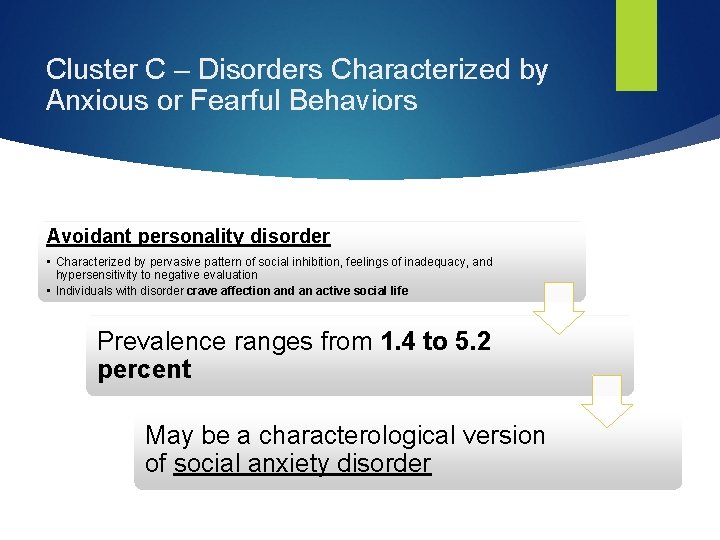
Cluster C – Disorders Characterized by Anxious or Fearful Behaviors Avoidant personality disorder • Characterized by pervasive pattern of social inhibition, feelings of inadequacy, and hypersensitivity to negative evaluation • Individuals with disorder crave affection and an active social life Prevalence ranges from 1. 4 to 5. 2 percent May be a characterological version of social anxiety disorder © Cengage Learning 2016
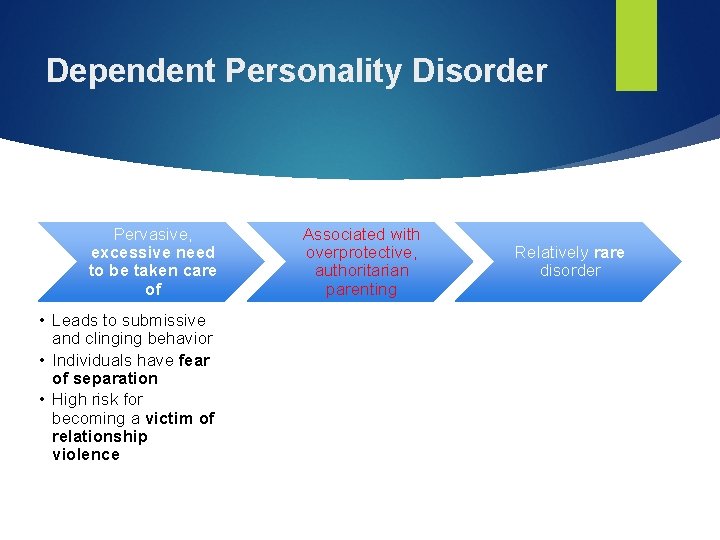
Dependent Personality Disorder Pervasive, excessive need to be taken care of • Leads to submissive and clinging behavior • Individuals have fear of separation • High risk for becoming a victim of relationship violence © Cengage Learning 2016 Associated with overprotective, authoritarian parenting Relatively rare disorder
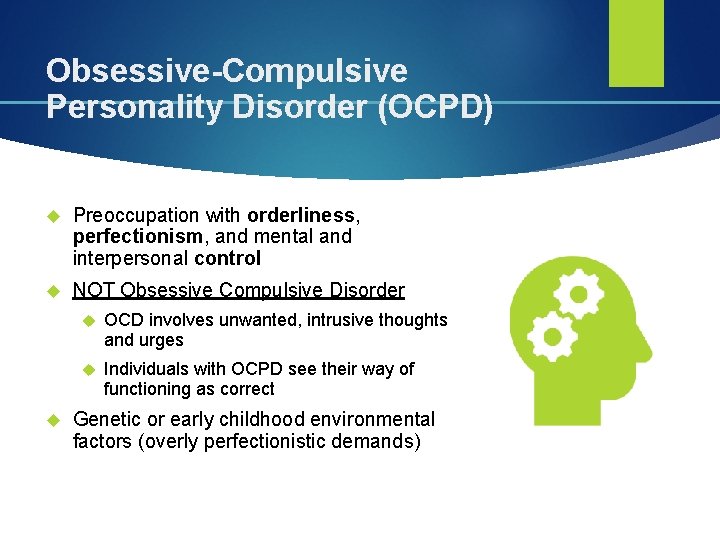
Obsessive-Compulsive Personality Disorder (OCPD) Preoccupation with orderliness, perfectionism, and mental and interpersonal control NOT Obsessive Compulsive Disorder OCD involves unwanted, intrusive thoughts and urges Individuals with OCPD see their way of functioning as correct Genetic or early childhood environmental factors (overly perfectionistic demands) © Cengage Learning 2016
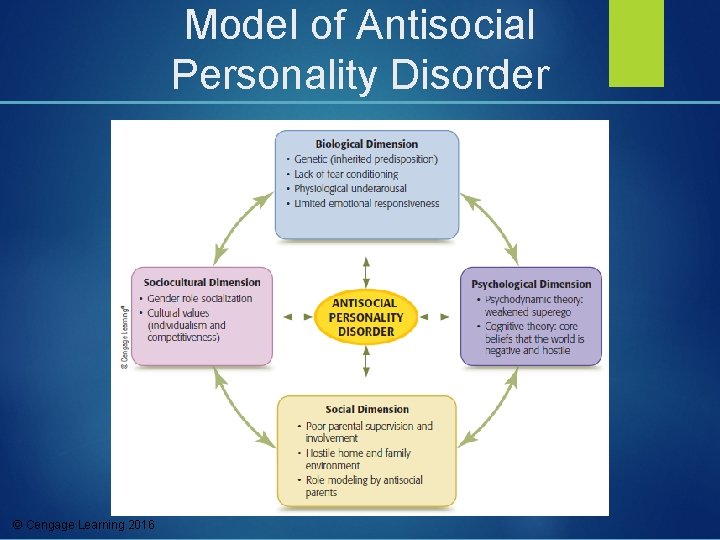
Analysis of A Personality Disorder: Antisocial Personality Individuals with APD often involved with criminal justice system Results in relatively more information on this disorder The Biopsychosocial model explains the factors leading to the development of APD © Cengage Learning 2016
Model of Antisocial Personality Disorder © Cengage Learning 2016
Biological Dimension of APD Genetic influences Genetic factors are Strong Includes behavioral characteristics observed during childhood and adolescence Risk taking, impulsivity Supported by twin studies and adoptive child studies © Cengage Learning 2016
Lack of Fear Conditioning and Emotional Responsiveness Biological abnormalities make people with APD less susceptible to fear and anxiety • Less likely to learn from experiences involving punishment Youth exhibiting antisocial behaviors showed diminished reactivity in the amygdala when shown pictures depicting fearful facial expressions © Cengage Learning 2016
Arousal and Sensation Seeking Another hypothesis: Stimulation Seeking People with APD have lower levels of physiological reactivity Generally underaroused May require more stimulation to reach optimal level of arousal Thrill seeking behavior without concern for conventional behavior standards © Cengage Learning 2016
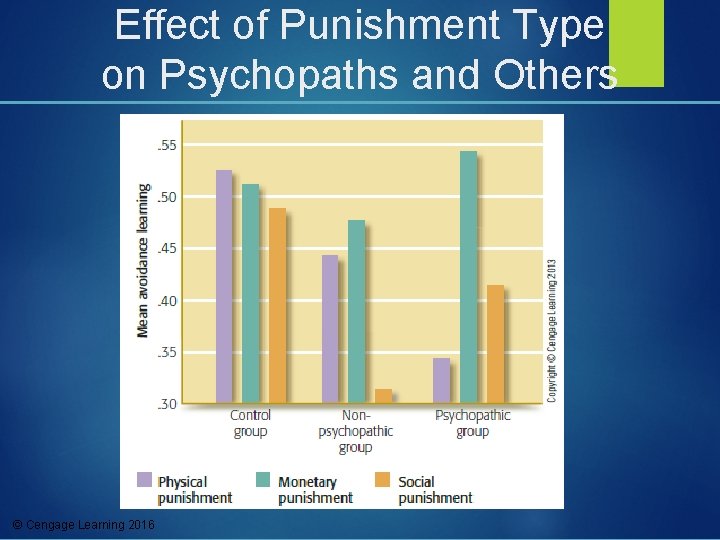
Psychoanalytic perspective • Faulty superego development Psychological Dimension of APD © Cengage Learning 2016 Learning perspective • Lack of positive role models • Type of punishment may influence learning • See next chart – responsive to monetary loss
Effect of Punishment Type on Psychopaths and Others © Cengage Learning 2016
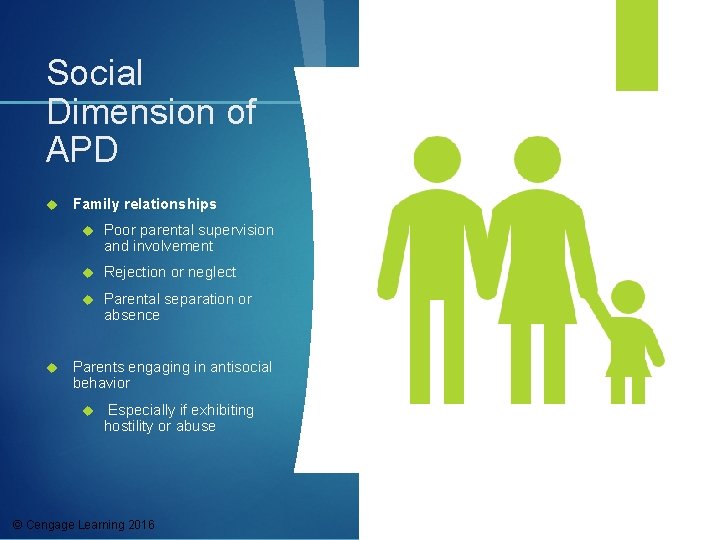
Social Dimension of APD Family relationships Poor parental supervision and involvement Rejection or neglect Parental separation or absence Parents engaging in antisocial behavior Especially if exhibiting hostility or abuse © Cengage Learning 2016
Sociocultural Dimension of APD Gender • Men more likely to exhibit characteristics of APD • Traditional gender-role training accepts or encourages aggression in boys but not girls Cultural Values in the U. S. • Individualism and independence viewed as aspects of healthy function • Idea that people can and should control their own lives • Q: Does that lead to underdx of Antisocial pd? © Cengage Learning 2016
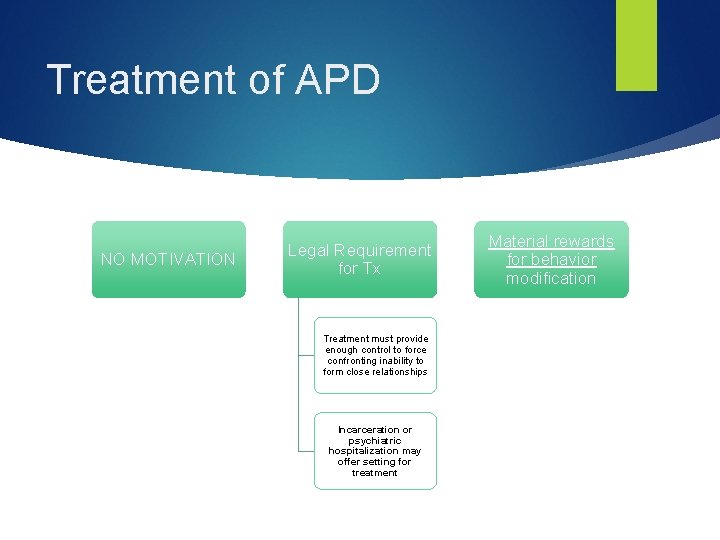
Treatment of APD NO MOTIVATION Legal Requirement for Tx Treatment must provide enough control to force confronting inability to form close relationships Incarceration or psychiatric hospitalization may offer setting for treatment © Cengage Learning 2016 Material rewards for behavior modification
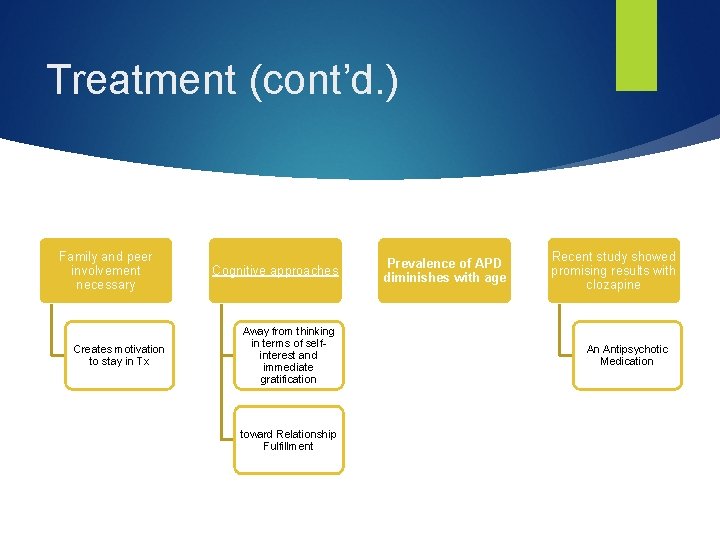
Treatment (cont’d. ) Family and peer involvement necessary Creates motivation to stay in Tx Cognitive approaches Away from thinking in terms of selfinterest and immediate gratification toward Relationship Fulfillment © Cengage Learning 2016 Prevalence of APD diminishes with age Recent study showed promising results with clozapine An Antipsychotic Medication
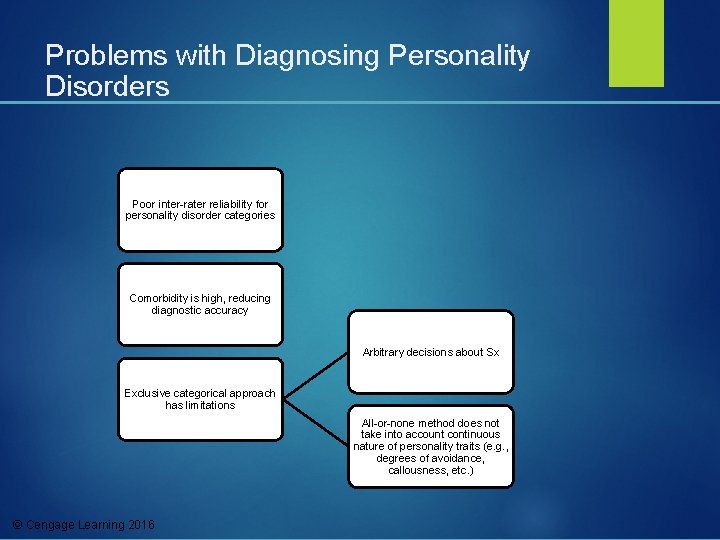
Problems with Diagnosing Personality Disorders Poor inter-rater reliability for personality disorder categories Comorbidity is high, reducing diagnostic accuracy Arbitrary decisions about Sx Exclusive categorical approach has limitations All-or-none method does not take into account continuous nature of personality traits (e. g. , degrees of avoidance, callousness, etc. ) © Cengage Learning 2016
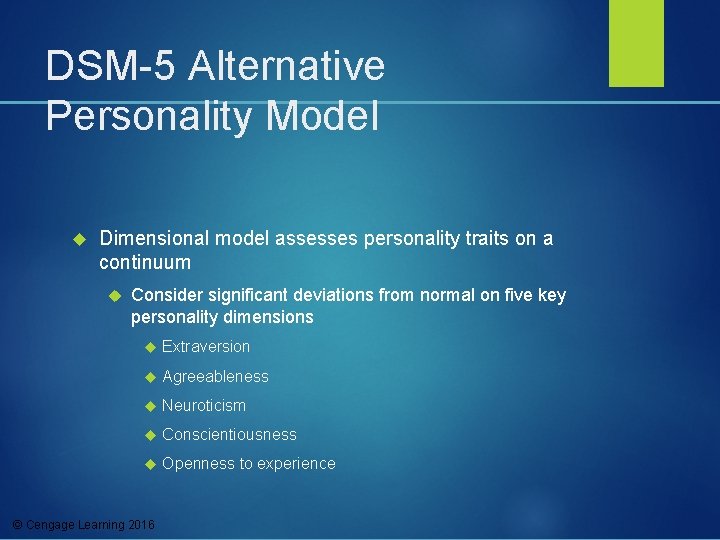
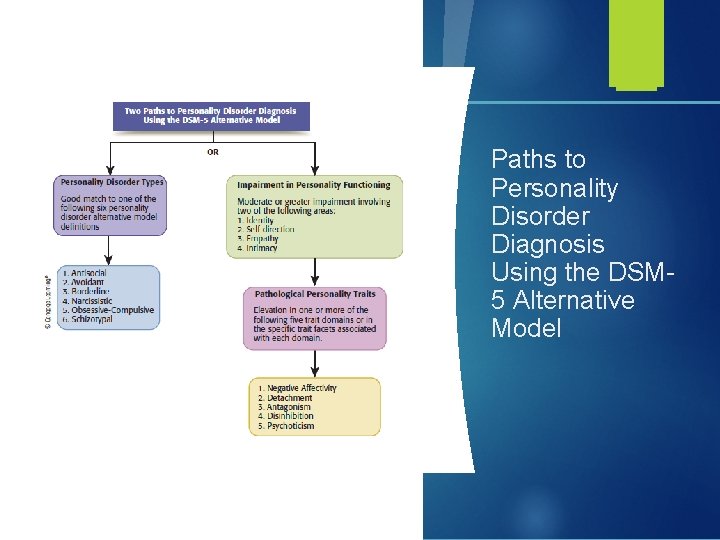
DSM-5 Alternative Personality Model Dimensional model assesses personality traits on a continuum Consider significant deviations from normal on five key personality dimensions Extraversion Agreeableness Neuroticism Conscientiousness Openness to experience © Cengage Learning 2016
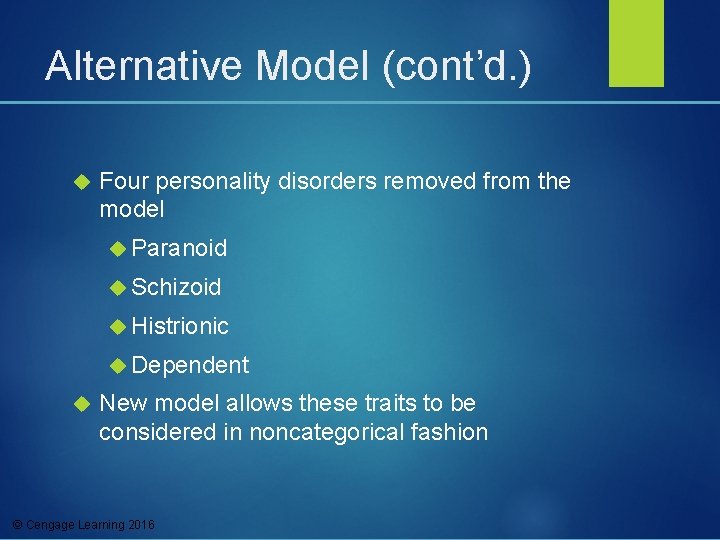
Alternative Model (cont’d. ) Four personality disorders removed from the model Paranoid Schizoid Histrionic Dependent New model allows these traits to be considered in noncategorical fashion © Cengage Learning 2016
Paths to Personality Disorder Diagnosis Using the DSM 5 Alternative Model © Cengage Learning 2016
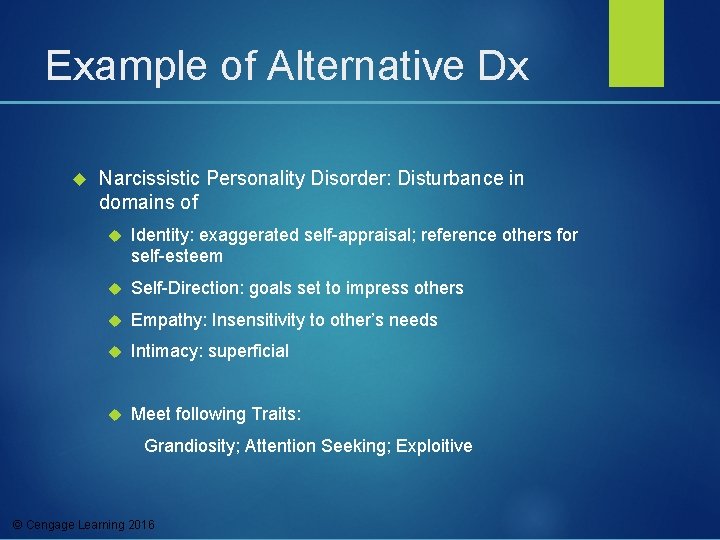
Example of Alternative Dx Narcissistic Personality Disorder: Disturbance in domains of Identity: exaggerated self-appraisal; reference others for self-esteem Self-Direction: goals set to impress others Empathy: Insensitivity to other’s needs Intimacy: superficial Meet following Traits: Grandiosity; Attention Seeking; Exploitive © Cengage Learning 2016
Traditional Categorical Dx Narcissistic Personality Disorder; Pervasive Pattern of Grandiosity (5 or more) Exaggerates achievements Fantasies of success Believe is superiority/special Requires excessive admiration Sense of Entitlement Exploitive Lacks Empathy Envy Arrogant © Cengage Learning 2016
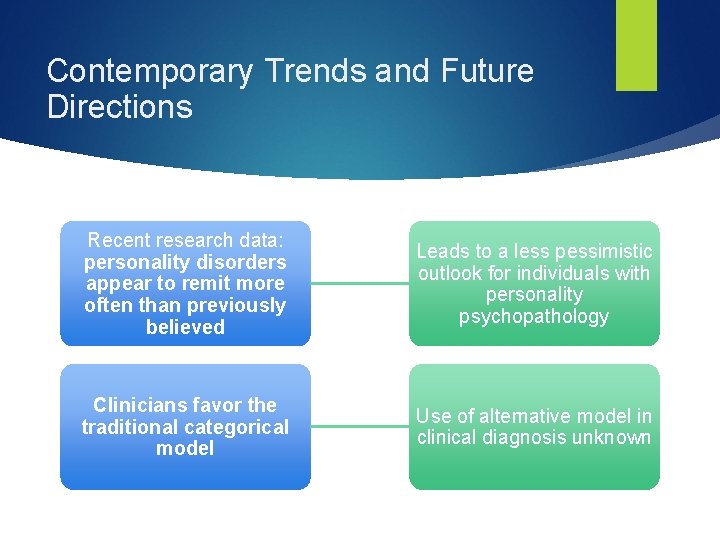
Contemporary Trends and Future Directions Recent research data: personality disorders appear to remit more often than previously believed Leads to a less pessimistic outlook for individuals with personality psychopathology Clinicians favor the traditional categorical model Use of alternative model in clinical diagnosis unknown © Cengage Learning 2016
Can one’s personality be pathological? What traits are associated with personality disorders? Review How does an antisocial personality develop and can it be changed? What problems occur with personality assessment? Are there alternative methods of personality assessment? © Cengage Learning 2016